Holding Dignity


I have to tell you this story about “Ray,” who thought he didn’t deserve help.

I used to work at a nonprofit charity for the homeless and I met Ray when he finally got housing and landed a new job. But he needed a new tool belt.

My friend heard about his situation and bought a tool belt for Ray. A fifteen-pocket leather carpenter pouch, one of the nicest ones you could buy. Ray was beside himself.

A few weeks later, somebody asked Ray how he liked the tool belt.
“I haven’t used it,” he said. “I’m not sure that I can. I don’t deserve a thing like that.”

He thought he would ruin it with himself. “The things I’ve done,” he said, “pretty much disqualify me. I feel guilty.”

Ray had told us his story before: addictions, abuse, abandonment. He never had a chance, a lap behind from the start, stuck in systemic structures beyond him. He felt he deserved his fate. But Ray learned to believe a better story about himself. He didn’t need to be good enough for the gift; the gift was good enough for him. The things he had done and the things that happened to him didn’t disqualify him from what was good. Maybe Ray really was the kind of guy who didn’t deserve it. But that was the point. It was a gift. We need that sort of grace, a grace that invites us into a better story than the one we were given.

It’s true one act of kindness doesn’t dismantle a whole system. It doesn’t automatically mean we succeed. But a reminder of our dignity is the very least we need. Even as systems around us shrink us down, it never means we are small: only that we were always too big for all we were given.

I think of all the ways
our past selves
were never shown a chance
still hold us back
our bodies brutalized in headlines
our minds made hatred internalized
we believed tall tales about us
that told the whole story without us.

But all that does not see you
says nothing about you
only that they lack vision
and you are already made in an irrevocable Image.

To become someone new
often means returning to ourselves—
souls dignified, made divine,
forged in inherent worth.

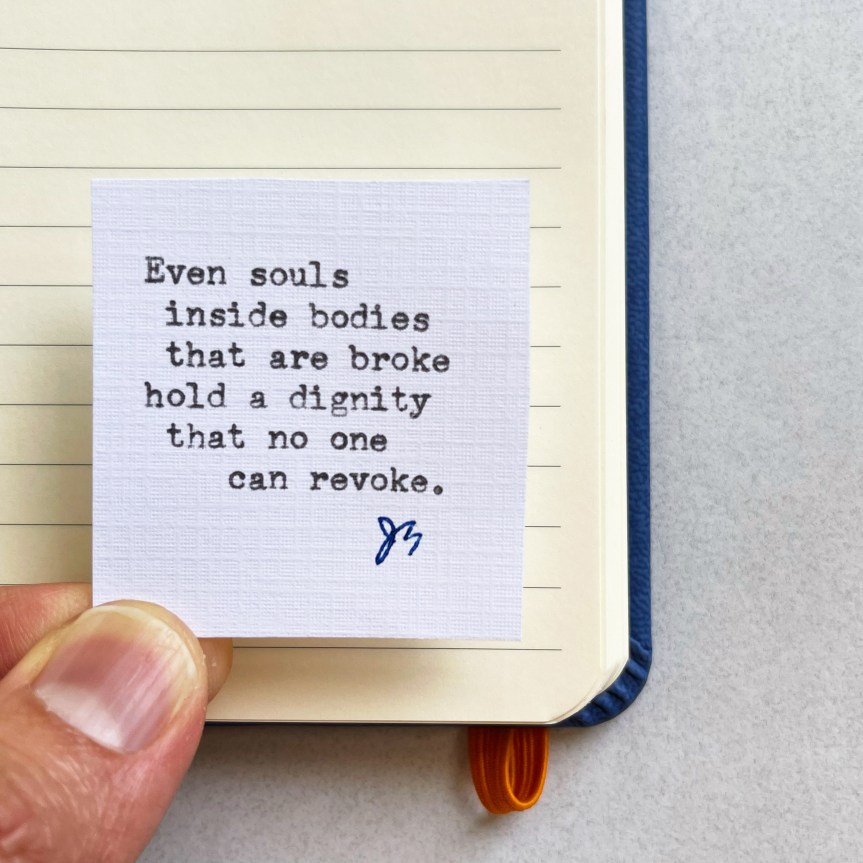
And even souls inside bodies that are broke
hold a dignity that no one can revoke.
In you, I see the face of God.

— J.S.


– Partially adapted from my book The Voices We Carry

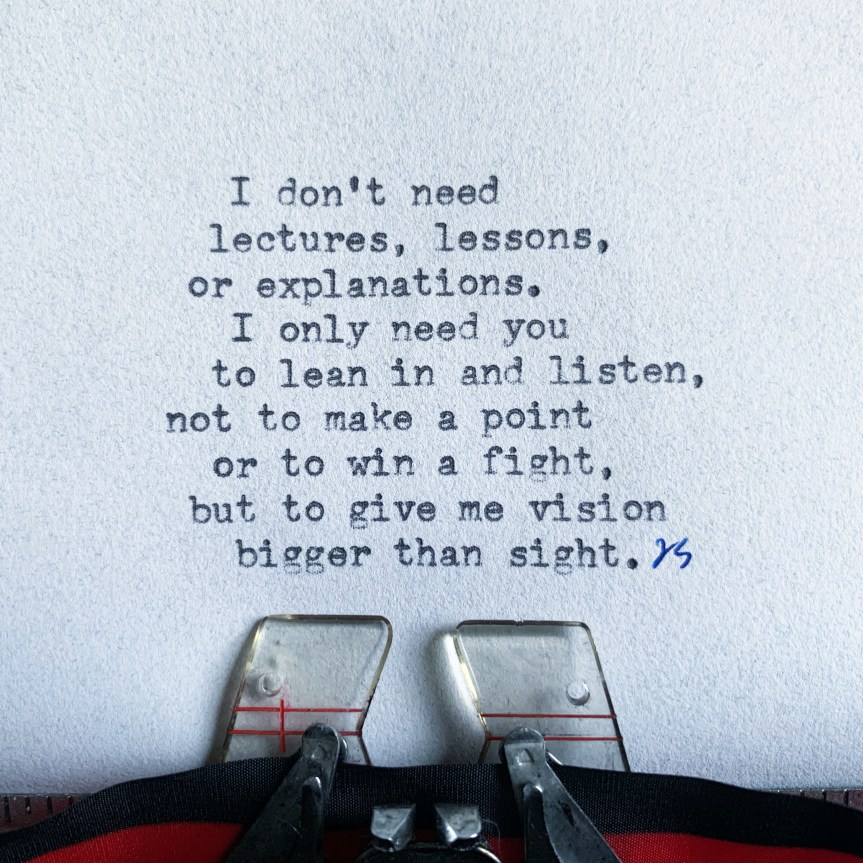
Not Lectures or Lessons, but Leaning in to Listen


If someone tells you their experience with depression, doubt, racism, sexism, abuse, classicism, trauma, grief—it’s because they trusted you. Maybe they told someone else and got laughed off, shut down, invalidated. Their voice was cut off. So they came to you with hope, at a risk, heart open.

Sometimes when I am weakened, grieving, or depressed, the response I get is complete disgust. There is something vile in the human heart that feels revulsion at “weakness.” There is some terrible urge to look at a wounded person and say, “Stop that, don’t cry, be strong.” I think part of the reason we do this is that we’re so afraid of our own vulnerability, we despise seeing it in others.

The same too when we see anger. Anger can be abusive, yes. But underneath rage is often pain. To lecture an angry person to “calm down” will only injure the injured. When we’re most angry in our wounds, the most healing response is to be angry for and with, not at. To shame a person for their emotion is to shame them for being human.

I think there’s an urge to preach advice at hurting people because it feels powerless not to say anything. But tossing advice on an already hurting person is to give them a burden on top of their burden. Out of good intentions, we tend to impart information or theology or logical points to ”fix” them—but when you were wounded, what did you need? More words? A sound argument? I-told-you-so? No. The best gifts I received in these moments were presence and silence. To bear the load together.

When someone opens up with their painful story, it’s important what you do right then. You’ll be one more person who turns them away, or you’ll be the one who opens a door. Your ears can save a life. You can be the miracle they were praying for.

— J.S.

If You Hurt, I Hurt Too


I never want to politicize, moralize, or spiritualize someone’s pain.

I am always on the side of the wounded. Where there is loss, I am for the bereaved. Where you are hurting, I want to bring healing. Anything less is making us less human and not more.

It would take only a few seconds to consider the other person’s pain and perspective and point of view. That has the power to heal. The only cost to empathy is losing bigotry, self-righteousness, and pride. Empathy is that good.

It should never be on the wounded to explain their pain, defend their injury, or to forgive over and over the injustices that never should’ve happened but keep happening. Even if your hurt is not my hurt: because you’re hurting, I hurt too.

I want to empathize first, to listen first, to grieve first, and to be angry and to weep alongside. Not lecture, lessonize, or minimize. I don’t want to add burdens, nor demand explanations, nor kick you while you’re down. I want to crawl down there with you.

I cannot understand the hasty, vicious speed by which real hurting people are turned into talking points. I don’t mean the platforms for justice. I mean the ones that degrade and deny. I cannot understand the evil scorn and jeering and mockery: there is no honor in desecration, but only violence to the soul. And while I do not believe we must be forced to give our opinion all the time—so often the silence is chilling, and apathy can be the most destructive force of all.

May I never lose sight of the wound and the wounded. May God forgive me for when I wasn’t listening, for not getting it right. Above all, I must grieve. Through tears, prayer, and action, I grieve with you.
— J.S.

#AhmaudArbery

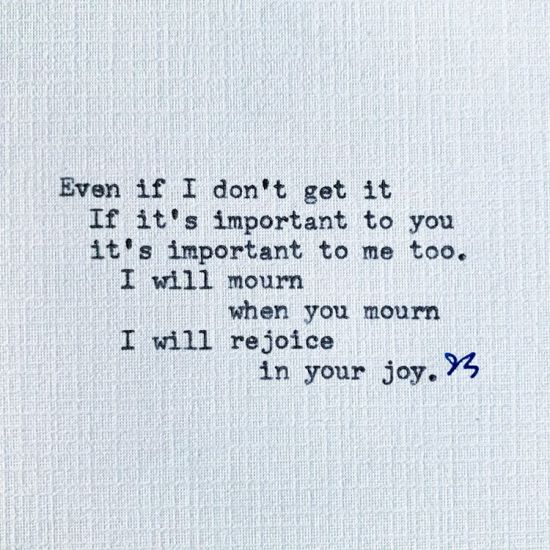
Even If I Don’t Get It


Once I had this friend who was embarrassed by my laughter. At the movies, he would literally shove my shoulder to tell me to quiet down. At first I just stopped laughing around him. But eventually I stifled my laughter around everybody.

That same friend couldn’t believe it when I was sad about something, or hurt, or not enjoying myself. I was being a downer, I guess. I was interrupting his life.

We went hiking once and he kept telling me to smile. “Why don’t you laugh?” he said. He knew I had lung issues and breathing problems. But he wouldn’t slow down for me, not for a second.

We’re not friends anymore, but here’s the thing: I don’t think we were ever friends. He wanted a customizable, checklisted, wishlisted type of robot that met his every whim. That was all. He couldn’t imagine another person with needs beyond his own. And I was happy to cater to him. There was something about his bully-like authority that I was attracted to, as if I got strength from his domineering. But no, we were never friends. I was his rug, his lapdog.

I could be mad at him, but I’m guilty of the same thing. Sometimes I don’t understand a person’s fears, dreams, and goals, and I judge them for it. I don’t get their hobbies or the movies or music they like or the fact they love quinoa and kale. Mentally I belittle them for being them.

We do this with mental health, gender, race, culture, their stories: it’s as if we withhold permission for people to feel hurt about the things that don’t hurt us. “It’s never happened to me, therefore it never happens” is the most destructive lie that destroys connection.

But I want to get it. I want to get your fear, anxiety, pain, your worries and heartaches and shame. Your whole story. To really listen means that another person’s story is more important than my own right then. But that’s how we grow. That’s how we heal. That’s how we find laughter, loud and free.

I’m sorry I didn’t listen earlier. I’m sorry I didn’t hear you. I want to. I want to hear you, and by hearing, fully see.

— J.S.

Up Again


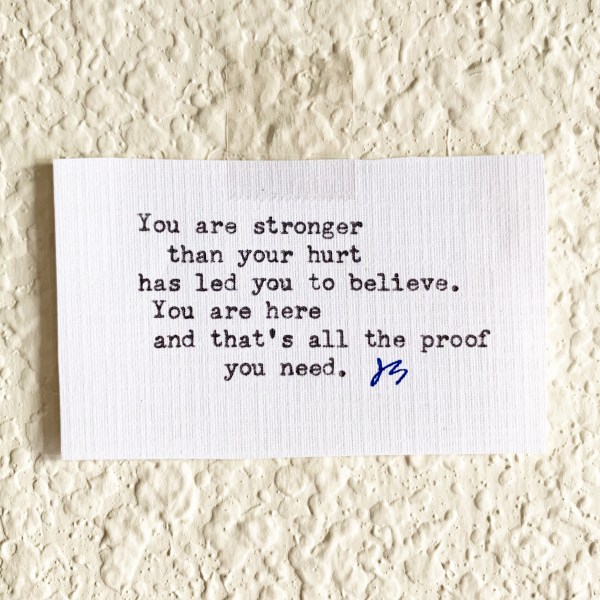
Trauma does crazy things to your brain: cognitive gaps, inexplicable phobias, silence and shut down. But the soul is so resilient and capable. It has a way of healing around good people, safe communities, and the chance to be heard. Given the opportunity, we get up again.
— J.S.

Believe It


You are loved.

You might have heard that a million times, but it’s no less true.

You do have a Creator. He is with you. He is bigger than your situation and closer than your deepest hurt. He’s not mad. He is cheering for you and rooting for you this very second. He’s okay about all the things before. He sent His Son for that very reason.

You can put down the blade. You can throw away the pills. You can quit replaying those regrets in your head. You can quit the inner-loop of self-condemnation. You can forget your ex. You can walk away from the things and people that destroy you. You can resolve your conflicts right now. You can sign up to volunteer at that shelter. You can have the courage to stand up for justice in the street, in your office, in your home. You can forgive your parents. You can forgive your children. You can draw boundaries and say no. You can go back to church. You don’t have to sit in the back. You don’t have to prove your worth to the people you’ve let down. You don’t have to live up to everyone else’s vision for your life. You’re finally, finally free.
You are loved. I am loved.

As much as I love you, dear friend, He loves you infinitely more.

Believe it. Walk in it. Walk with Him.

God is in the business of breathing life into hurting places.

This is what He does, even for the least likely like you and me.

— J.S.

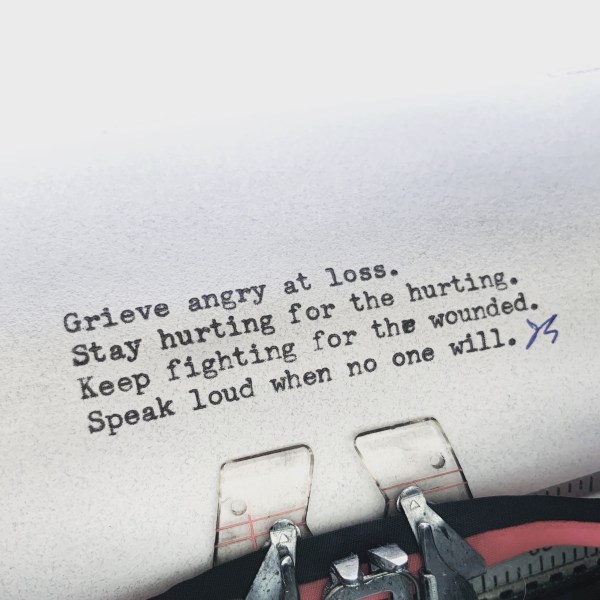
Grieve Angry


The other week, a shooting took six lives and I thought, “That’s not too bad.” I immediately felt sick. Because this isn’t normal. It isn’t okay. And I don’t want to get numb, desensitized, detached, withdrawn. I don’t ever want to get over the anger and grief of how “normal” this has become—whether it’s thirty, six, or one.

It’s a national habit to look at the death toll, but shootings really destroy lives twice. At the hospital, we regularly receive GSW (gunshot wound) patients through the ER. Many survive. Sometimes, surviving is worse. The trauma of it. The nightmares. To witness such a thing is a lifelong wound. The death tolls are horrific, but the mental and emotional toll is just as destructive. I’ve been up close with GSW victims and families—and I can’t watch the news with neutral disinterest. I can’t watch movie violence the same way. I will never get the smell out of my nostrils. When you sit among people with bullet wounds, you see most political “dialogue” for what it really is: fear, cowardice, pomp, rationalizations, and self-aggrandizing, all which speak past the victims instead of for them. I hope I’m not doing the same thing. Please tell me if I am. Please tell me what I can do.

I don’t know if anything will change. Again. It seems hopeless. But I want to grieve angry. I don’t want to calm down. I want courage. And compassion. And champions who will make waves so that something will change. God, keep us loud. God, give us strength.

J.S.

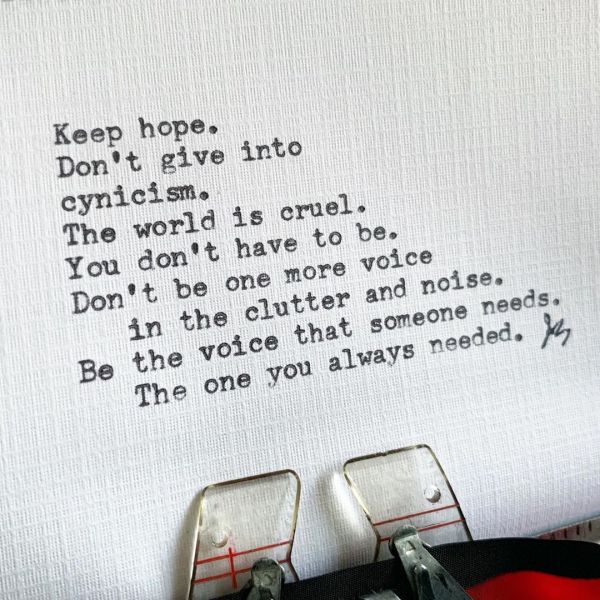
Don’t Get Cynical; Keep Hope


One look at the news and it’s easy to get cynical. It’s easy to give in to pessimism. It’s understandable, given our daily trauma, the terrible headlines, and our disappointing leaders. It’s tiring. But often the world is the way it is because too many of us have accepted the way it is. Pessimism has always been a sport for sidelines. I’m afraid that the detachment of pessimism, as fun as it is, is often just laziness.

No, simply “thinking positive” doesn’t make things better. And it takes momentous effort, decades of sweat and tears and rallies and voices, to move the needle towards real change. That has to start with you. With me. With believing that change is possible. With our little corners and small platforms and unseen podiums. With believing that even ancient institutions like politics and the church and social attitudes can be completely transformed.

Optimism doesn’t only see how we are, but who we could be. I want eyes that see that far. The way ahead was lit by others who dared to hope. Change happened by those who first believed it was possible. So we must carry the light for those coming next. We are the next. We can’t go down without a fight.
— J.S.

I Hope You Will Hear Me


Eventually I’ll say something that you’ll disagree with. I will disappoint you. I’ll come off brash, inconsiderate, ignorant, and misinformed. Your favorite writer or pastor or celebrity will miss an angle or fumble a point or miss the whole thing. You’ll think, “How could I have ever liked this guy?” We then dismiss and demonize based off one sentence, one phrasing, one particular choice of word. I’ve done it, too. You know, farewell forever.

Maybe it’s for a legitimate reason, and they really did go too far. Then farewell, sure. But I wish we could give a little space for a conversation. Even over coffee. It’s possible this person misspoke because they’re just a person and they don’t always get it right. It could be that they need the patience of dialogue to re-examine what they said, instead of the hasty hate-train that offers no fair exchange. It could be they really didn’t know better, or they just needed a nap.

I want your help. I want to know when I’m wrong – but it’s hard to hear what’s right when everyone is yelling. I want the freedom to make mistakes so that I’m not afraid to learn from you. I don’t want to be afraid that you’ll throw things when I don’t phrase things exactly the perfect way. And really, I’m not sure if you would listen to yelling, either. I’d want the same chance you’d want for you, too.

I know there are some non-negotiables that can never be compromised. I cannot say every “side” is equal or that every platform is good. None of us will ever agree on everything. Sometimes we must part ways. And that’s okay. I just don’t want to judge an entire life over a few degrees of difference. We can disagree and still be friends. Even if we must part, I want to become better from our disagreements, to see what I had not seen before, and mostly, to see you. I will hear you.

— J.S.


What I’m About


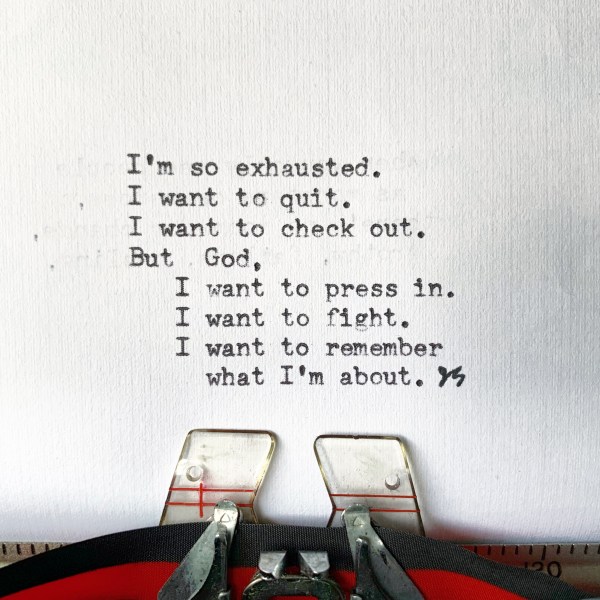
Discouraged, exhausted, beat down, beat up, clawing and falling, it’s so far, but my God, by God, another inch I crawl.
J.S.

I Am With You.


I am with you.
I am for you.
I am sorry.
I love you.
How can I help?
J.S.


Forgiveness Is Not Friendship


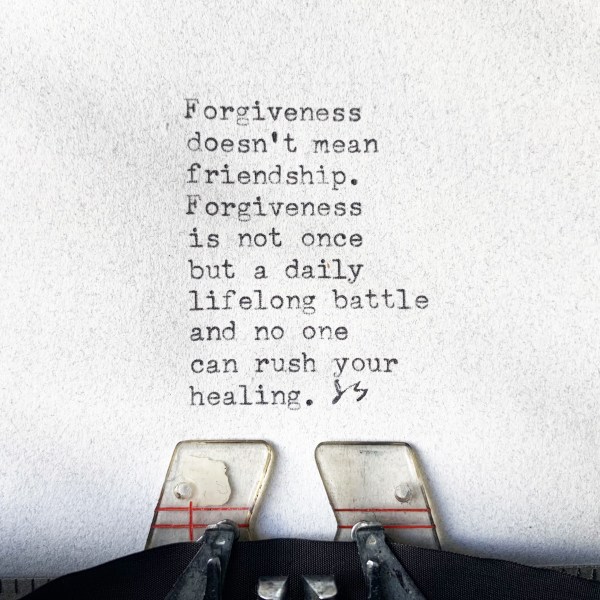
It’s unfair to rush someone into forgiveness. It’s powerful and necessary, but forgiveness is not a one-time moment that magically seals up the wound. It takes a deliberate, daily battle over a lifetime. That occasional angry twitch doesn’t mean you’ve failed at finding peace; it’s only part of the process. Let it happen. It hurts because it meant something. It has to pass through your body, like flushing out poison. No one is allowed to rush your healing, including you. No one can just “get over it.” It’s your pain, your pacing, your tempo. But I do hope to see you on the other side, where there’s freedom. You can take all the time you need, and I’m with you.
J.S.

Turning Point.


Most testimonies have a turning point: “And then I met ___” or “Someone reached out” or “I got this text at the perfect time.” It seems random, but those people and encounters and messages of encouragement happened on purpose. Someone made a choice to reach out, get involved, get near another person’s heartache, and help them for one more step. It was enough to get them moving again. Maybe it was no big deal for the person who reached out. But to the person they helped, it meant everything. It was the turning point. It was the beginning of seeing new light, of finding a new dream, the start of healing. A little bit of your time and wisdom might turn someone’s life around. I’m thankful to those who pressed in and breathed life.
J.S.

Everyone Has a Vision for Your Life


Everyone has a vision for your life. Everyone knows who you ought to be. Everyone has advice, the right answer, the easy fix.

But no one can bear the burden of those expectations. You can’t be enough all the time, not even for yourself.

You will disappoint people. You will disappoint you. It happens. It hurts. And that’s how it goes. The eventualities of life have a way of creeping in, regardless of best efforts and right motives.

You will get crushed by the weight of others’ plans. But you’re not obligated to respond to everyone’s criticism all the time. There’s no pleasing everyone. Some will have already made up their mind about you, no matter how much you sing and dance. Your side of the story won’t always be heard. Your intentions will be negatively filtered and your words shot down at first glance. That’s okay. Criticism is important, but you can’t speak on what you didn’t say. You can only mean what you did say, and mean it well.

Be encouraged, friends. You are doing a good thing. A new thing. By the grace of God we do our best and get up again.
— J.S.

Faith That Burns Slow.


I imagine that when Moses split the Red Sea, there were two groups of people.
The first group was composed of victorious triumphant warriors saying, “In your face, Egyptians! This is our God!” They were pumping their fists and thrusting their spears.

The second group was composed of doubtful, panicking screamers running full speed through whales and plankton.

I’m a Screamer. I’m a cynic. I’m a critic.

I’m a Peter, who can make a good start off the boat, but falls in the water when my eyes wander.

I’m not endorsing a halfway lukewarm faith. I believe God wants us to have a robust, vibrant, thriving relationship with Him. But as for me, I’ll be limping to the finish-line.

I’m more of a Thomas than a Paul. I’m more Martha than Mary. I’m more David than Daniel.

Yet the Warriors and Screamers all made it through.

It’s not easy to have faith the size of a mustard seed. But Jesus promised that this would be enough to move mountains, and I’m learning to be okay with that.

— J.S.

We Wear Casts.


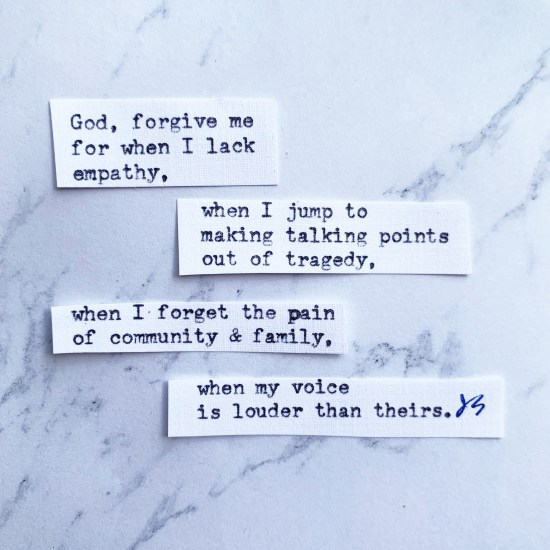
God, forgive me for when I lack empathy,
when I jump to making talking points out of tragedy,
when I forget the pain of community and family,
when my voice is louder than theirs.
— J.S.

Strength to Fight.


“May God bless you with discomfort at easy answers, half truths, and superficial relationships, so that you may live deep within your heart.

“May God bless you with anger at injustice, oppression and exploitation of people, so that you may work for justice, freedom and peace.

“May God bless you with tears to shed for those who suffer from pain, rejection, starvation, and war, so that you may reach out your hand to comfort them and turn their pain to joy.

“And may God bless you with enough foolishness to believe that you can make a difference in this world, so that you can do what others claim cannot be done.

“Amen.”

— A Franciscan blessing