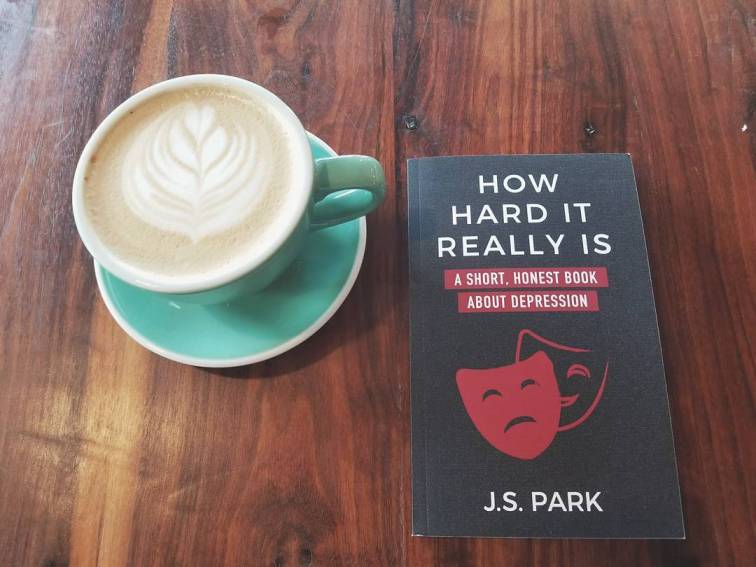
Up Again


Trauma does crazy things to your brain: cognitive gaps, inexplicable phobias, silence and shut down. But the soul is so resilient and capable. It has a way of healing around good people, safe communities, and the chance to be heard. Given the opportunity, we get up again.
— J.S.

I Am Not My Depression

Anonymous asked a question:

Hi J.S., as someone who has been diagnosed with depression, GAD, and PTSD, your writing has been a huge comfort. I wanted to ask this – have you come to accept your battle with depression? I still struggle to accept that my mood is out of my control. My faith has been rocked after the past few years of intense battling. I still get discouraged when I think that I have to work so hard to feel “normal” and even then, normalcy isn’t guaranteed. How do you continue to trust God and fight through?

Hey dear friend, first I want to encourage you: You are loved, you are incredible, you’re doing great.

My answer to your question, “Have you come to accept your battle with depression?” is both Yes and No.

Yes, I recognize that my brain is broken. Something essential to my well-being will always be missing. I will, out of nowhere, seemingly at random, fall into the abyss for long seasons. One day, my depression might win. I have accepted it as much as any person can accept they are mortally wounded. I have accepted the hand I’ve been dealt.

But no, I do not accept my depression. I am angry. I am livid. I am insulted by it. I hate what it does to my friends and family. And I have to fight. It’s exhausting. But I have to scream no. And I think part of my non-acceptance is what keeps me alive. I do not accept that God wanted this for me. I am open to therapy, to medicine, to every treatment available. I have to fight.

Continue reading “I Am Not My Depression”

I Called the Suicide Lifeline

A couple weeks ago, I called the National Suicide Lifeline.

I was in a really bad place. I was ready to go, permanently. After two rings, I hung up the phone. I was too scared to talk with someone. I had heard sometimes they call the police on you, and really, I was afraid of what my neighbors would think if I was carted away by red and blue lights. But the very act of calling got me off the floor. It was enough to get my feet moving.

I know I’m not supposed to talk about this. I’m the guy who helps people. How can anyone trust me again? Will I be fired? What will they really say about me? What sort of hate mail will I get?

I worked at a church once where I told the lead pastor that I was suicidal; I was laughed off. Maybe everyone is tired of hearing the word “stigma,” but it still exists. Everyone says they care, but anyone can act like they care online. Up close, mental illness is an ugly thing that is hard for everyone involved.

Here’s how it happened: Someone had said something to me in anger, and of course, the person apologized. I felt in some ways I had deserved it. I was fine for a few days. And maybe for somebody who is “normal,” or maybe on any other day, it should’ve all been fine. But the words caught fire in my brain, got louder, loomed over me, and dug hooks in my stomach. I took ten Advil. I wanted to take the rest of the bottle. So I called the lifeline.

I have to make clear that none of this is the other person’s fault. I would never put that on someone. That’s too much responsibility for words said in a heated moment. I am, in the end, responsible for how I choose to react. I cannot rely on good or bad words to determine my health. And I realize my mental health has been a lifelong issue and will continue to plague me. No one should feel obligated to walk on thin ice around me. I have learned, not always willingly, to be resilient in a cruel world.

At the same time, words are powerful. They have the power to heal and destroy. Words are meaningful to me. They should not be used lightly. And I’m not impervious. I’m not some tough guy who gets tougher with every punch. There’s always that one exhausted, fragile morning when I can fall apart fast. I can’t be alone in that.

Whenever I think my battle with depression is getting easier, I’m reminded that progress doesn’t go on an upward track. It’s a real one-step-forward and two-steps-back situation. More like a thousand steps down. My progress on a graph would look like a fiscal nightmare. I’m not sure it’s healthy to look at progress on a graph this way. I can only see the one step in front of me. That’s about all I can stand to take right now.

I kindly and graciously ask that you pray for me. I know the world around us is blowing up. There is a lot to pray about. My problems are small. I am lucky to be alive. I am lucky to laugh and cry and eat today. May you still send a two second prayer? And I hope you may be kind to someone today. The only words that are worse than the harsh ones are the kind ones left unspoken.
— J.S.

Everyone’s Got Advice About Your Depression


You’re going to find very quickly that when you’re depressed, nearly everyone’s got advice for you. Everyone thinks they know what’s best and what you ought to do.

It’s well-intentioned, and it’s not all bad—but in that very moment, when you’re in the colorless fog, those motivational one-liners are often tacky, tone-deaf, and untenable.

If depression robs you of your ability to logically comprehend and make sense of life, then any advice or solution is not going to reach into the heart of depression.

Both the church culture and pop culture endorse a sort of “powering through” because it really translates to, “I don’t have time to get involved with your struggle.” What’s really being said is: “Pray more and be positive so I don’t have to deal with you.”

Theology and wisdom have their place, but I suspect that we spout them to rush the hurting past their hurt, because it hurts too much to sit in their furnace. It’s a kind of reverse projecting: I can’t bear to look into my own uncertainty when I see yours.

My urge to offer advice has good intentions, but it’s also a way to offload the hard work of navigating the wound with the wounded. I offer a reason of certainty because it’s easier than traveling with the hurting in the uncertainty. It’s a way to protect myself from answering the unanswerable. I don’t like the silence because it makes me uncomfortable. I have to offer something or else it makes me feel helpless.

It’s the same reflex that happens when some of us see someone cry. “Don’t cry,” we might say, even though very often, crying is the only way to heal through the river of all we have held inside. I’ve found that when I say, “Don’t cry,” that’s about protecting me from discomfort rather than leaning into your hurt and healing.

So all my advice makes your pain, your tragedy, and your depression, about insulating me, instead of moving towards you.

You can do one from the rooftops, but the other means diving into the smells and groans of their misery.

It’s dirty. It’s work. And no one naturally wants to pay the high cost of navigating someone’s pain.

— J.S. Park How Hard It Really Is


Photo by Chris Wright