Book Launch: The Voices We Carry


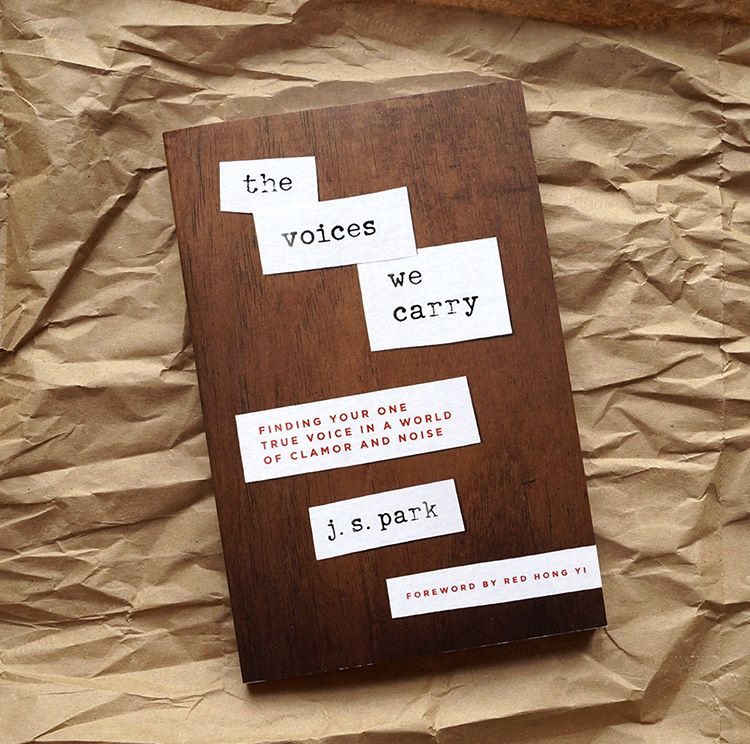
Happy day, friends! My book The Voices We Carry is officially released.

The Voices We Carry is about wrestling with our voices, such as self-doubt, people-pleasing, trauma, grief, and family dynamics, and finding our own voice in world of mixed messages. I talk about my hospital chaplaincy, what I learned from patients at the edge of life and death, and giving a voice to those who have been silenced—those like you and me.

The month of May is also Mental Health Awareness Month and Asian Pacific American Heritage Month. My book talks about the challenges of both. I believe that the more we can share our stories and make room for our many voices, the better we become.

God bless and much love to you, friends. Thank you for allowing me to speak into your life, faith, and journey.
— J.S.


The Voices We Carry is published by Northfield of Moody Publishers.

#MentalHealthAwarenessMonth
#AsianPacificAmericanHeritageMonth


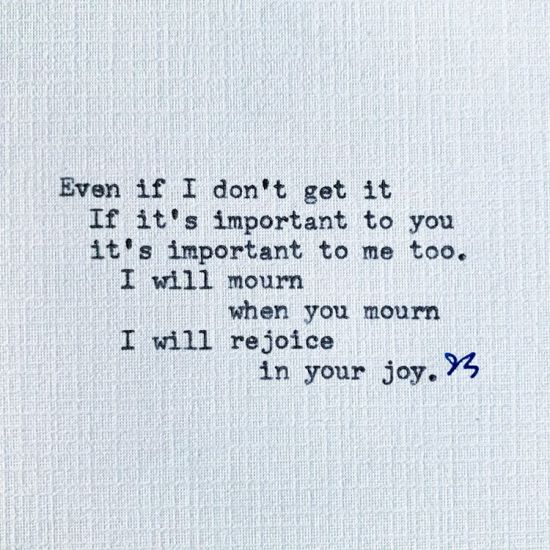
Even If I Don’t Get It


Once I had this friend who was embarrassed by my laughter. At the movies, he would literally shove my shoulder to tell me to quiet down. At first I just stopped laughing around him. But eventually I stifled my laughter around everybody.

That same friend couldn’t believe it when I was sad about something, or hurt, or not enjoying myself. I was being a downer, I guess. I was interrupting his life.

We went hiking once and he kept telling me to smile. “Why don’t you laugh?” he said. He knew I had lung issues and breathing problems. But he wouldn’t slow down for me, not for a second.

We’re not friends anymore, but here’s the thing: I don’t think we were ever friends. He wanted a customizable, checklisted, wishlisted type of robot that met his every whim. That was all. He couldn’t imagine another person with needs beyond his own. And I was happy to cater to him. There was something about his bully-like authority that I was attracted to, as if I got strength from his domineering. But no, we were never friends. I was his rug, his lapdog.

I could be mad at him, but I’m guilty of the same thing. Sometimes I don’t understand a person’s fears, dreams, and goals, and I judge them for it. I don’t get their hobbies or the movies or music they like or the fact they love quinoa and kale. Mentally I belittle them for being them.

We do this with mental health, gender, race, culture, their stories: it’s as if we withhold permission for people to feel hurt about the things that don’t hurt us. “It’s never happened to me, therefore it never happens” is the most destructive lie that destroys connection.

But I want to get it. I want to get your fear, anxiety, pain, your worries and heartaches and shame. Your whole story. To really listen means that another person’s story is more important than my own right then. But that’s how we grow. That’s how we heal. That’s how we find laughter, loud and free.

I’m sorry I didn’t listen earlier. I’m sorry I didn’t hear you. I want to. I want to hear you, and by hearing, fully see.

— J.S.
3 True Hospital Stories and What They Taught Me About Grief, Hope, and Unseen Work


I share three true hospital stories which are “deleted scenes” from my upcoming book, The Voices We Carry.

— J.S.


[Stories have details changed to maintain privacy.]

Is Anxiety a “Sin”? Does It Mean That I “Lack Faith”?

Anonymous asked a question:

Is anxiety a sin? God says to be anxious for nothing. I googled it and apparently lots of Christians say anxiety is a sin. Means you don’t fully trust God

Hey dear friend: No, I don’t believe that anxiety is a sin.

Anxiety results from a broken brain, originating from a world that is flawed, fractured, and has fallen short. At most, anxiety is the result of a sin-torn world. But no, it is not a sin that you’re premeditating, as if you’re somehow planning on having an anxiety attack.

When Scripture says “Be anxious for nothing,” well—that word anxious also means distracted or divided or pulled in every direction. Later Paul says he is content with being hungry or well fed, living in plenty or in want. In other words, he does not have a consuming preoccupation with a perfect situation. He is not basing his happiness on a full stomach or material pleasures. He is writing from prison, after all, and has chosen not to to base his value on his surroundings.

I think there’s a kind of anxiety not related to mental health, which is more of a restlessness for “better,” and it can never be content. This is not about mental health, but rather a moral choice of internal character. Paul says that by praying we’ll have “the peace of God that transcends all understanding,” which in context appears to mean that we’re not always consumed with upgrading our circumstances. It means trusting God even when we don’t have everything that we want. That sort of peace is not easy to find, but it’s possible.

But let’s assume Paul was talking about anxiety the way we understand it.

Continue reading “Is Anxiety a “Sin”? Does It Mean That I “Lack Faith”?”

I Messed Up. I Hugged Someone.


I messed up. I hugged someone. We’re supposed to practice social distancing, but my friend badly needed a hug. I know I shouldn’t have. I couldn’t help it.
— J.S.

The Storm Doesn’t Always Pass


Not everyone can stay home to wait it out.
Some have to keep working.
Some have lost their jobs.
Some have never had a home.
Some will never go back.

Maybe things are “not that bad” for you. Maybe “this too shall pass”—in your world. But someone you know doesn’t have that luxury. Someone you know is permanently affected. They’re grieving a loss, whether it’s loss of their autonomy or a whole person. Our advice doesn’t apply to them, because it can’t.

Stats and facts gloss over real loss. Two in one-hundred doesn’t sound like a lot, but if any two people I knew had died this week, it would be absolutely devastating.

To downplay any grief and loss doesn’t help, and if you keep quoting statistics to show “it’s not that bad,” you’d be the last person I would go to for help.

No, we shouldn’t panic.
But please don’t tell people it’s fine
when they’re not.

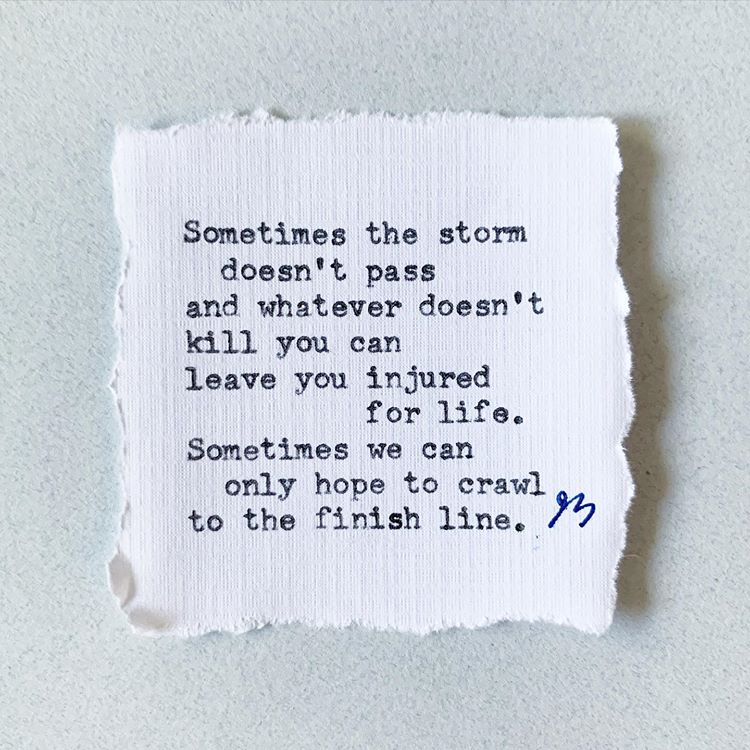
The storm doesn’t always pass. Not for everyone. Pain can last for a lifetime. We can only hope to adjust to the new normal. By the grace of God, I will crawl down there with you.
— J.S.

If My Father Abused Me, How Could I Ever Say “Heavenly Father”?

Anonymous asked a question:

My father is an abuser and maybe it’s stupid, but how can people can not be afraid of the words “our father in heaven”?

Hey my friend, thank you for sharing so honestly and I’m sorry you experienced such abuse. I hope and pray you are at a safe distance today and that you are recovering.

Your concern is not “stupid” at all. It’s absolutely valid. I work as a chaplain at two places, the hospital and a homeless shelter, and when I address God, at both places I am very careful when I say “God our father.” Especially at the homeless shelter. Many of the low income families I encounter have not had good experiences with any sort of male figure. To say “father” is okay for some, but also devastating for others.

Continue reading “If My Father Abused Me, How Could I Ever Say “Heavenly Father”?”

Top 19 Posts of 2019

Here are my Top Ten Posts of 2019, from leaving church to codependency to suicide awareness to my favorite female influences.


Runner-Up: I Signed a Book Deal

19) Grace Is Something Different

18) “God Is in Control,” but What This Really Means

17) The Only Time a Christian Goes First

16) Healing from a Breakdown Over a Break-Up

15) Are You Secretly a Liberal Who Hates Conservatives?

14) What Am I About: On Codependency

13) How Do We Show Love for Hate Groups Like Westboro?

12) Why Do You Love Your Wife?

11) My Favorite Female Influences

10) About to Get a Therapist: How Do I Do This?

9) My Greatest Fear Is Death

8) Lessons I Learned from Leaving My Evangelical Church

7) How Do I Confront a Friend Who Is “Sinning”?

6) When You Have to Save Everyone: The Warning Signs of Hero-Savior-Martyr Syndrome

5) Is Suicide the One Unforgivable Sin?

4) The Dangers & Myths of Personality Tests

3) How Do I Open Myself Up to Friends Again?

2) Compassion Fatigue: The Heartache of a Job That Requires All Heart

1) I Am Not My Depression

Loneliness: The Unnamed Pain


Let’s talk about loneliness.

I’m not a therapist or doctor, but as a hospital chaplain, I’ve seen the terrible and awful effects of loneliness on mental health. The problem is that it’s tough to admit, almost embarrassing to say, “I’m hurting from loneliness.”

Loneliness is a double-bind in that in order to find comfort, it requires reaching out to people or for people to be near. But some of us have been alone so long, it’s unthinkable that we can connect with another human without risking rejection—which fuels more loneliness.

The unhelpful reply I hear to “I’m lonely” is “Why don’t you just make friends?” But that’s like saying, “Why don’t you just get rich?” or “Why can’t you just go to the gym?” We’re already in deficit, a lap behind, because we fear connection in proportion to how alone we feel.

It’s difficult to make friends and keep them. It’s hard to have real friendships that are not just functional transactions. Even when someone is surrounded by crowds or well connected, they may be the loneliest people on earth, because all their “friends” are transactional.

I don’t know the answer to loneliness. But I know what the answer is not: We can’t just snap out of it. We can’t just cure it with a party, a bar, a church, a dating app. It requires intentional investment and yes, the risk of rejection. The opposite of loneliness is courage. It takes courage to reach out, to enter each other’s orbit, to risk trust, and to be alone in our thoughts and fears.

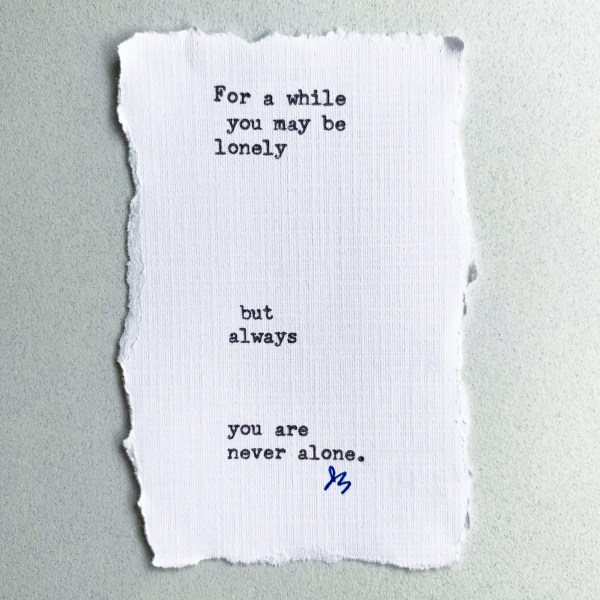
Friends, this week may be lonely. This season can be brutal. They can remind you of all that’s missing. As trite as it sounds: You may feel lonely, but you are not alone. May you find the courage to reach out, to enter the possibilities of love in all its heaven and heartache.
— J.S.

Up Again


Trauma does crazy things to your brain: cognitive gaps, inexplicable phobias, silence and shut down. But the soul is so resilient and capable. It has a way of healing around good people, safe communities, and the chance to be heard. Given the opportunity, we get up again.
— J.S.

More Than All That’s Happened


If you’ve grown up in the same town long enough, most people assume you’re the same person you always were. They can’t see past the past version of you.

I wonder a lot: Are we doomed to our former selves, time-stamped to who we used to be? Will the things we’ve done and used to do always drag at at our heels, a permanent anchor?

There are days I keep imagining what other people are saying about me. I imagine a room full of them shaking their heads. “A chaplain? Who’s he kidding? I know who he really is. He’s not the guy he pretends to be. Nobody like him could change.” It keeps me up at night. I mentally argue with them until I’ve finally proven I’m not that same guy. I’ll spend hours inside my own head explaining my side of the story and why you need to know I’m not a bad person and that I’m sorry for the person I was before.

But you know, no one may get to hear your side of the story. No one might believe you’ve changed. Even when you do the right thing, you’ll be accused of wrong motives. And you are still accountable to the wrong you’ve done, as much as others are accountable for how they’ve wronged you.

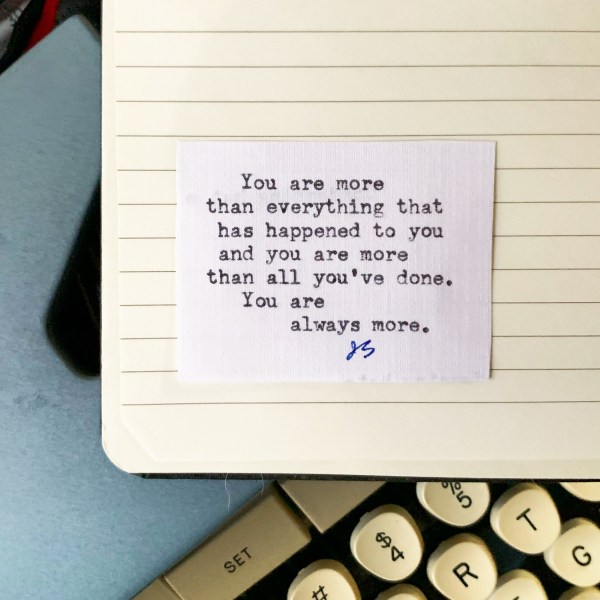
But there is a grace that says you are different now, and the old you is dead. Buried. No longer you. Maybe no one will know you’ve encountered the kind of grace that has not just changed you, but made you completely new. Your trauma, your guilt, your past, your labels: they’re taken in by grace, by a love that sees in whole and stays. Imagine that. The world may call you something, but you are more. You are new. You are always more.
— J.S.

Still You Are


I cannot promise that life gets better. Life can be cruel, unfair, intolerable. People can be downright mean. Failure and rejection will happen. Risks don’t always pay off. You will miss chances and opportunities. Injuries and disease are a real danger. Our brains are often broken by depression and other lifelong illnesses. People will leave.

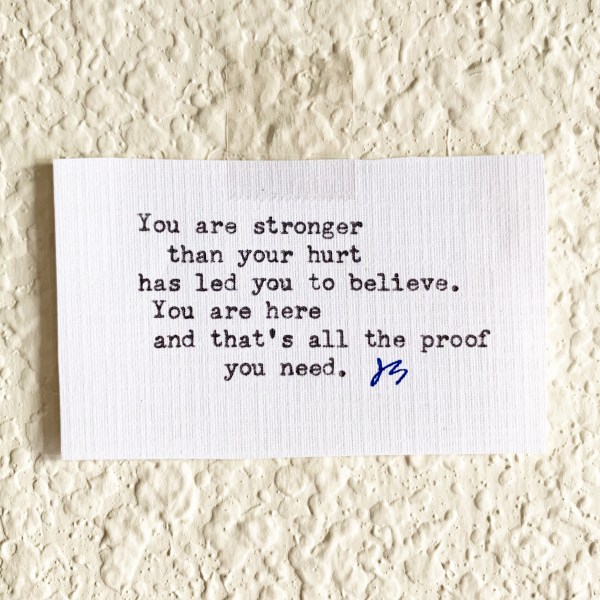
But none of these things—absolutely none of them—determine your worth as a person. Nothing that has happened to you gets the say on who you are. Of course, life hurts. We’re allowed to hurt. We’re allowed to be mad. We can vent and yell and shake a fist at God. All of that is being human. But all the ways in which life can be unfair do not have a single thing to say about you as a person. You are loved, regardless. You are loved simply because you were born. For me, that’s often enough for the next breath. Looking back, I’m glad I breathed again.

As it were, your life has launched into being, and it is the one song you get to sing. It is a song full of beauty and terror. It is a tree full of colors and crevices. There are wonderful and terrible things that life has to offer. But all of it is yours. I hope you lean into it as much as you can. It’s a crazy and ridiculous thing to be alive. I remember the philosopher saying when we look at “how things are” then we will go mad, but if we see “that things are,” that things even exist at all, we might find joy in the madness.

No, I do not feel loved all the time. It comes and goes, often based on my performance or my mood or from some bad pizza the night before. We are weird temperamental creatures. We are capable of having complete blissful giddy euphoria in one second, then chest-crushing deflated saddening numbness the next. Again, none of these things determine your worth. You are loved through and through. You were loved before you got here. You are loved, outside of your age or achievements or acclaim or applause. You are loved. I mean it.

— J.S.

How Do I Open Myself Up to Friends Again?

Anonymous asked a question:

I read a text post from you about wanting friendship just for appreciation of the person, not opportunism. I used to be like that. But somehow through the hurt I’ve accumulated from people, real relationships feel too fragile. To cope, I found myself using people for clear defined reasons, than sentimentality. It has kept me safe, but I feel like I’ve lost a part of my humanity too. How can I love people for who they are despite the total possibility of being letdown?

Hey dear friend, thank you for your very honest message.

I went through a very similar phase where for years, I couldn’t trust anyone. I had been brutally hurt by a church and I never thought I would recover. I did. It took a ton of therapy and self-examination and safe people to get there.

Continue reading “How Do I Open Myself Up to Friends Again?”

The Dangers & Myths of Personality Tests

Anonymous asked a question:

I’ve followed you for a while. I find solace in your blog. I recently did a Spiritual Gift Test in my leadership group at church. I scored a 23 in Mercy and Administration (out of 25), but I scored an 8 in Faith. The test is a tool to show your best qualities to serve your church. It really struck me hard, as I struggle with what God’s intentions are for me, and what my path is. A lot of the time I feel like I’m just going through the motions. I just don’t know what to do anymore. 

Hey my friend, thank you for sharing your struggle here.

Please know: there are a lot of “spiritual tests” out there, and I wouldn’t trust them all very much. In fact, there are thousands, if not millions, of personality tests and horoscopes and “strengths finders” and “which Marvel character are you,” and while they’re fun, they should never become permanent labels that determine your growth and journey.

I have to ask, who is developing these tests? Is it like every other westernized test with a western bias? Are they evidence-based? And if so, how? How many people have been misled by these things? And in a hundred years when they develop better tests, are we all just doomed today?

The most famous test of all time, the Myers-Briggs, is absolutely not based on any evidence or science at all. It’s also highly binary without any sort of continuum or grey area. And since major companies have been hiring and firing people based on tests rather than interaction, it’s a really big deal that we take a step back from them without condemning ourselves to one singular fate.

In fact, if we take a step back from a lot of books and blogs, many of them can be helpful, but they should all be filtered through skepticism. Authors, pastors, celebrities, and “experts” can offer good-sounding advice that does nothing but sound good. Always, always discern.

Continue reading “The Dangers & Myths of Personality Tests”

Only Heroes and Monsters


No one is the one-dimensional, evil caricature that they’re painted to be.
No one is the shiny version of a person that’s worshiped on a pedestal.
It’s easier to hate a cartoon-parody idea; to denigrate a hologram; to blast the artificial; to praise the effigy. It’s easier to demonize a faceless, disembodied, phantom enemy.
If you and I could sit down for coffee, we would discover hidden layers, messy dimensions, buried motives, unspeakable trauma, two fractured people hanging on.
We are wildly struggling, conflicted, complex.
We are not wholly evil nor holy good.
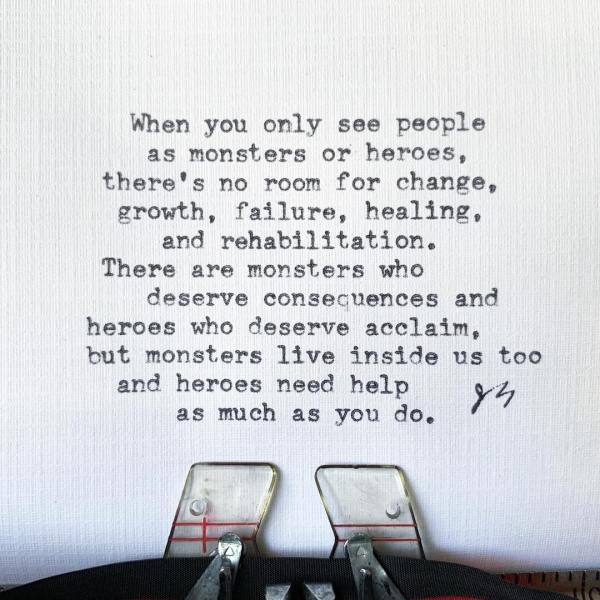
Yes, monsters deserve justice for their crimes. Heroes deserve more applause. But I will pause to consider that we are often both. We can be our own worst enemy, and we are just as capable of being our own heroes, overcoming the worst of us with the best in us.
Across a table, chair to chair, eye to eye, we might disagree—but I hope we will learn how we came to be. To hear the whole story.
— J.S.