My Family Broke Me: Breaking Family Patterns and Why Therapy Works

https://www.instagram.com/tv/B_ynqigBJMp/


Generational patterns can be passed down through family, even from great-great-grandparents we never met. This is called multigenerational transmission. If you draw a genogram—a detailed family tree that shows relationships and medical history—you’ll notice a surprising amount of repeated loops down the line.

One of the ways of breaking patterns is to seek therapy, to talk it out, to explore our own stories. There’s something powerful about telling our story that brings closure, revelation, and healing to us—especially when someone really listens.
My book has a whole chapter on family dynamics and focuses on one hospital patient who learned to make peace with her complicated family.

Grab my book here: The Voices We Carry: Finding Your One True Voice in a World of Clamor and Noise


[Patient details altered to maintain privacy.]

About to Get a Therapist: How Do I Do This?

Anonymous asked a question:

Hey there. so I’m going to be starting counseling soon and I’m kind of anxious about it. Do you have any advice on opening up to a new medical professional?

Hey dear friend, that’s great news you’re getting counseling. If it were up to me, I wish we could all have a mental health scholarship to get a counselor.

In my experience here’s what I’ve found to be helpful in a therapeutic alliance. It’s a lot, but of course, you don’t have to memorize these or anything. Maybe even one thing here will give you some peace. And friends, if I missed anything, please comment below.

Continue reading “About to Get a Therapist: How Do I Do This?”

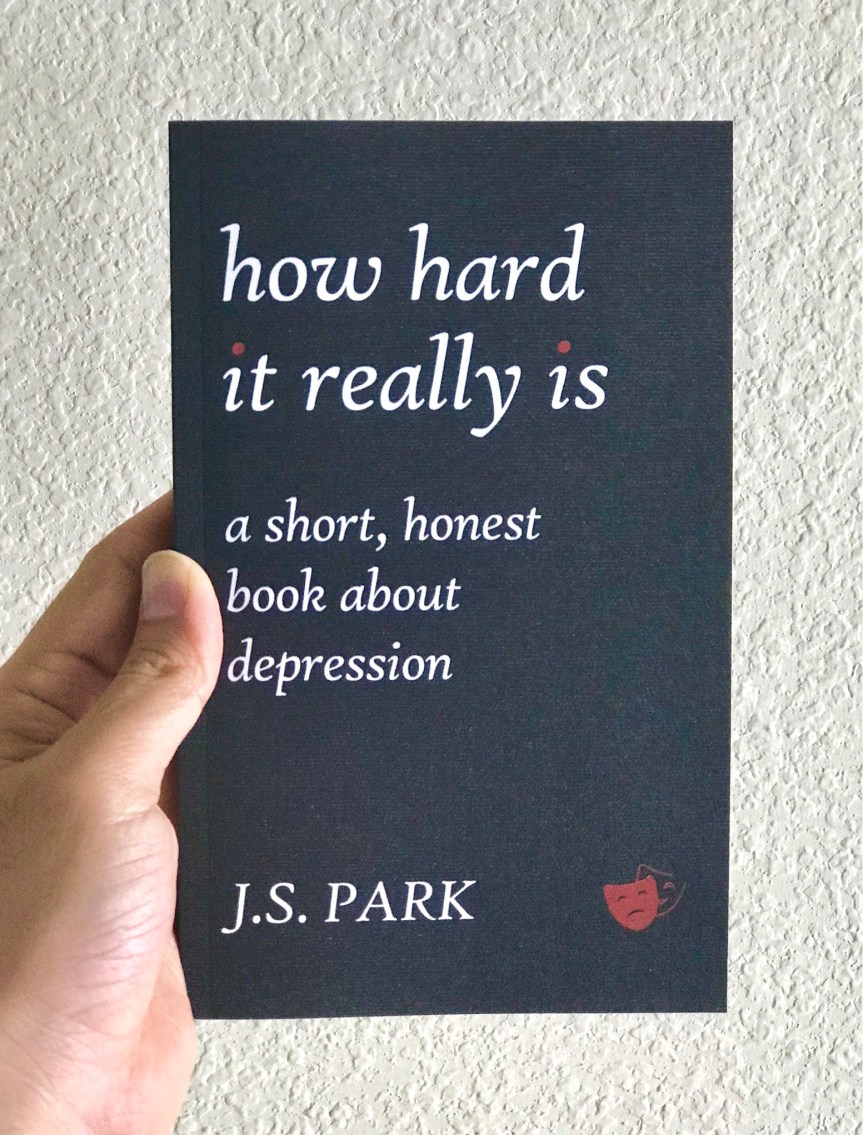
How Hard It Really Is: A Short, Honest Book About Depression


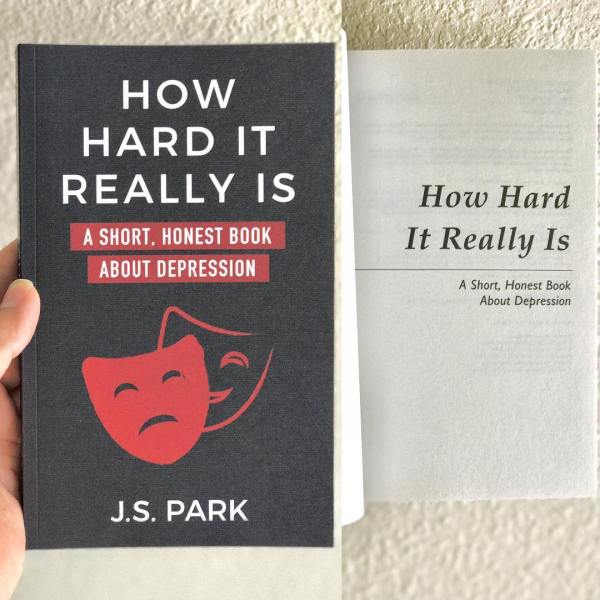
**Edit January 2018** My book on fighting depression has been revised with a new a cover and about a 10% change in content. If you’ve already purchased the book, please email me at pastorjspark@gmail.com and I’ll send a digital copy of the updated version.


Hello lovely friends! After a year and a half of painstaking work, my book on fighting depression is here. It’s called: How How Hard It Really Is: A Short, Honest Book About Depression.

The book covers:
• The science behind depression
• The helpful (and unhelpful) dialogue around mental illness
• The debate between seeing it as a choice or disease
• Stories of survivors
• A secret culture of suicide worship
• An interview with a depressed doctor
• The problem with finding a “cure”
• My own attempt at suicide
• A myriad of voices from nearly two-hundred surveys conducted over a year

The paperback is here. The ebook is here.

For my video on depression, check here: https://www.youtube.com/watch?v=xggg6xFObIE

Be blessed and love y’all, friends. A reminder that if you’re in a dark place, I hope you’ll reach out. You are truly more loved than you know. 
— J.S.


An Interview About Depression, Its Myths and Misunderstandings, When Faith Fails, and Talking It Out

– Suzanne of biblesteps recently interviewed me about my book on depression. Her post is here. The entire interview is below. You can find my book on fighting depression here. –

Given that depression can be a fragile and, at times, controversial topic, what made you decide to write a book about it?

Depression can feel like a solo sport. There’s no team backing you up. It’s like swimming or gymnastics; once you get going, it’s up to you to make it to the other end of the pool or the mat. (I was told this is why writers get depressed, because writing isn’t really a team effort).

Most of the resources I found on depression began with the “solo” premise: It’s up to you, go get help, here’s this method, try this and this. But that sort of individualized isolation was very vacuum-ish to me. Life doesn’t work in such a frictionless shrinkwrap; we affect others in a causational web and we need their help, too.

So I started with the premise: How do we collectively get through depression? How do we manage the stress and cause-and-effect and even the global consequences of depression? I wrote the book for both those who struggle with depression and those who don’t. I wanted to bring in every person involved, because depression affects families, cultures, marriages, churches, all of it.

I always knew that the topic of depression itself was a game of telephone — “I’m depressed” sounds like “I’m antisocial” to most people — but when I got to the research and surveys, it was even worse than I had thought. There was this nearly impermeable membrane around the discussion of depression. And then this phrase kept popping up in my head: If you could just know how hard it really is …

And as cheesy as that might be, it became the title of the book. My whole goal was to peel back that weird membrane around depression so, if anything, there would be more empathy on every side of the discussion.

Continue reading “An Interview About Depression, Its Myths and Misunderstandings, When Faith Fails, and Talking It Out”

The Scary Horrible Thing About Depression


Clinical depression will often do whatever it wants with you. It has no rules or code or fairness or dignity.

I have every reason to be fine, but depression is a dirty sneak attack that leaves me completely naked and debilitated. It’s a liar that sells truth: a false reality that says how-I-feel is who-I-really-am. And when a grafted lie overruns the truth, it doesn’t matter that I have “every reason” to be fine: the lie has switched every goalpost and sunk the baseline.

Depression is the worst kind of lie, in that it not only attacks your self-worth and value, but steals the meaning out of words like “self-worth” and “value.” It is cold inertia, slowing down worlds in orbit. It leaves you carved open, constantly bleeding out, unable to retain the vital stuff that makes life. There is spiritual discombobulation; every emotion is a phantom limb, and no amount of affirmation about “life-gets-better” can reach me there.

The thing is, when I’m hit with depression, I already know what to do. I know I have to fight for air. I know I have to crawl for every inch of territory that’s stolen. I know I cannot make decisions unless I talk with someone first. I must reach for my phone. I must reach for every scrap of surface to escape this tunnel.  I must remind myself that there’s so much worse in the world, and that the war inside cannot compare.

I know. None of this makes the fog any easier.

By the tiniest shred of sight, I must crawl.

— J.S. Park | How Hard It Really Is


Photo by Brandon Woller

Journeying Together Through Depression


Thank you to Nissi, Andy, Sandra, Crupa, and Amber for picking up my book on fighting depression, How Hard It Really Is. Grateful to Sandra for picking up five copies to give away. Praying the book blesses each of you.
J.S.

Paperback: https://www.amazon.com/How-Hard-It-Really-Is/dp/0692910360

Ebook: https://www.amazon.com/How-Hard-It-Really-Is-ebook/dp/B073TX15LB

Depression: The Sneak Attack Phantom


This is the Preface to my book How Hard It Really Is: A Short, Honest Book About Depression.


Depression is a rumor, until it is reality, and then it’s as if nothing else was ever real. Still, no one will believe you. I find it hard to believe it myself. I wrote this book for those who believe, and for those who want to.

Depression is, when you’re in it, absolutely ridiculous, because it seems to be the most important thing in the world when it’s happening. At the same time, it robs the world of any importance, as if nothing could ever happen again. It is a nightmare of infinity wrapped in cellophane.

Whenever I describe it happening, it sounds absurd. And it is.

At the grocery store I’m thinking about how to grill this salmon, and my chest folds inward, a curled up canvas of wax paper in a cruel, gnarled fist. It’s the familiar feeling of drowning, of disappearing in frothing acid. I fight back both tears and laughter, and I tell myself, Everything’s fine, everything’s fine, a cognitive trick to pull myself out of the falling, but nothing is fine, nothing is fine. There’s nothing I can do. My basket full of trinkets is weightless and a wrecking ball. I see people rushing to somewhere, but the illusion of significance slips away in a long, defeated sigh. I hate this part. My shoulders crumple because I’ve stopped holding them up. I can barely look at the cashier and I don’t remember paying when he hands me the receipt. I can’t turn on music in the car; it’s unbearable to turn the wheel. I’m someone else’s ghost in someone else’s body.

I wish I could say it gets easier each time, but I never know how long it’s going to be.

I never know when the colors will come back.

I never know if this will be the one that wins.

The bad news is that I don’t have a magic formula, a six-step cure, or a silver bullet. I wish I did. But I don’t believe there’s a right combination of words that will unlock depression.

The best thing we can offer each other is each other, our set of experiences, our voices, our ears, so that the tunnel is less intimidating and the light is not as distant as it was.

I wish I had more than this. I wish I could cover every angle. Maybe, though, I can cover a few.

At the very least, I can tell you what I’ve been through, and what’s worked for me. And maybe some of that will work for you, too.

— J.S. Park | How Hard It Really Is
Dealing with Depression: What to Say (and What Not to Say)


There’s a lot of unhelpful dialogue when it comes to depression and the way we talk about it matters. As a lifelong fighter of depression, here are some things I’ve learned to say (and not to say), and how presence matters more than advice.

My book on depression is here: https://www.amazon.com/How-Hard-It-Really-Is/dp/B073TX15LB/

This is the first in a series of videos called “Where Faith Meets Life,” covering topics like politics, abuse, marriage, and mental illness.

Subscribe to my YouTube channel here: https://www.youtube.com/user/jsparkblog

Be blessed and love y’all, friends!
J.S.

9 Tricky, Self-Deceptive Defense Mechanisms That Completely Undermine Dialogue

If you’ve ever been in an escalating argument, you’ll always notice how it becomes a “meta-argument” about unrelated things that are not really the point. The dialogue gets further and further away from the main thing, until you’re both screaming out your lungs and throwing appliances at the ceiling. Arguments, in hindsight, often look embarrassing, full of cringe and regret and wreckage like an irreversible radioactive wasteland.

When conflict comes around, everything feels like it’s at stake: your value, your truth, your work, your very life. So understandably, we resort to self-preserving mechanisms to scratch and claw for our very lives. Here are a few defense mechanisms that get us stuck, and how we can get un-stuck.

Continue reading “9 Tricky, Self-Deceptive Defense Mechanisms That Completely Undermine Dialogue”