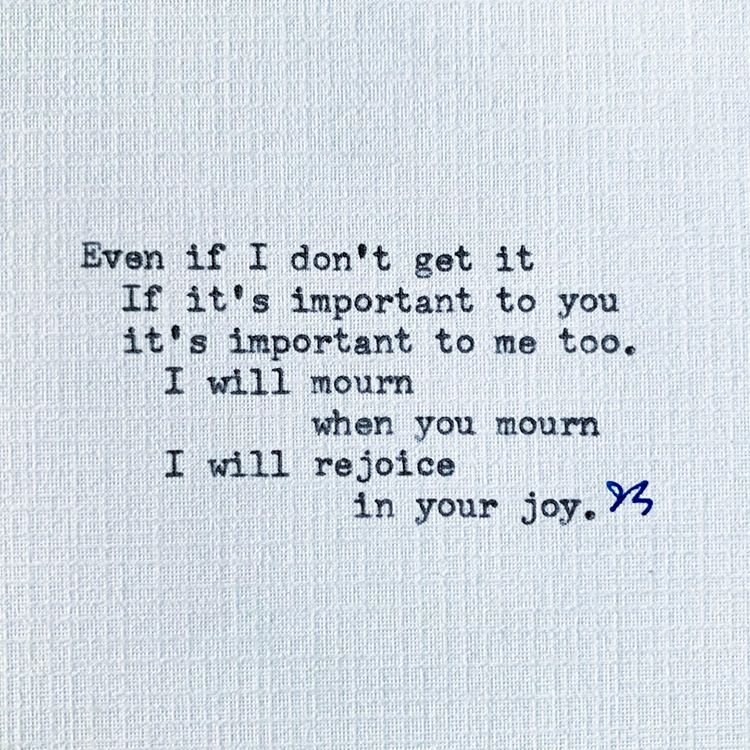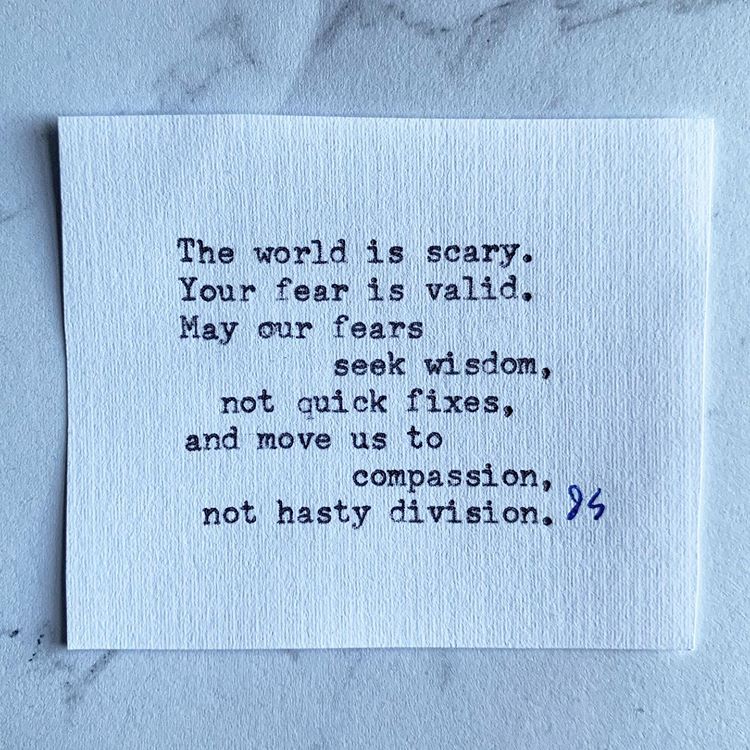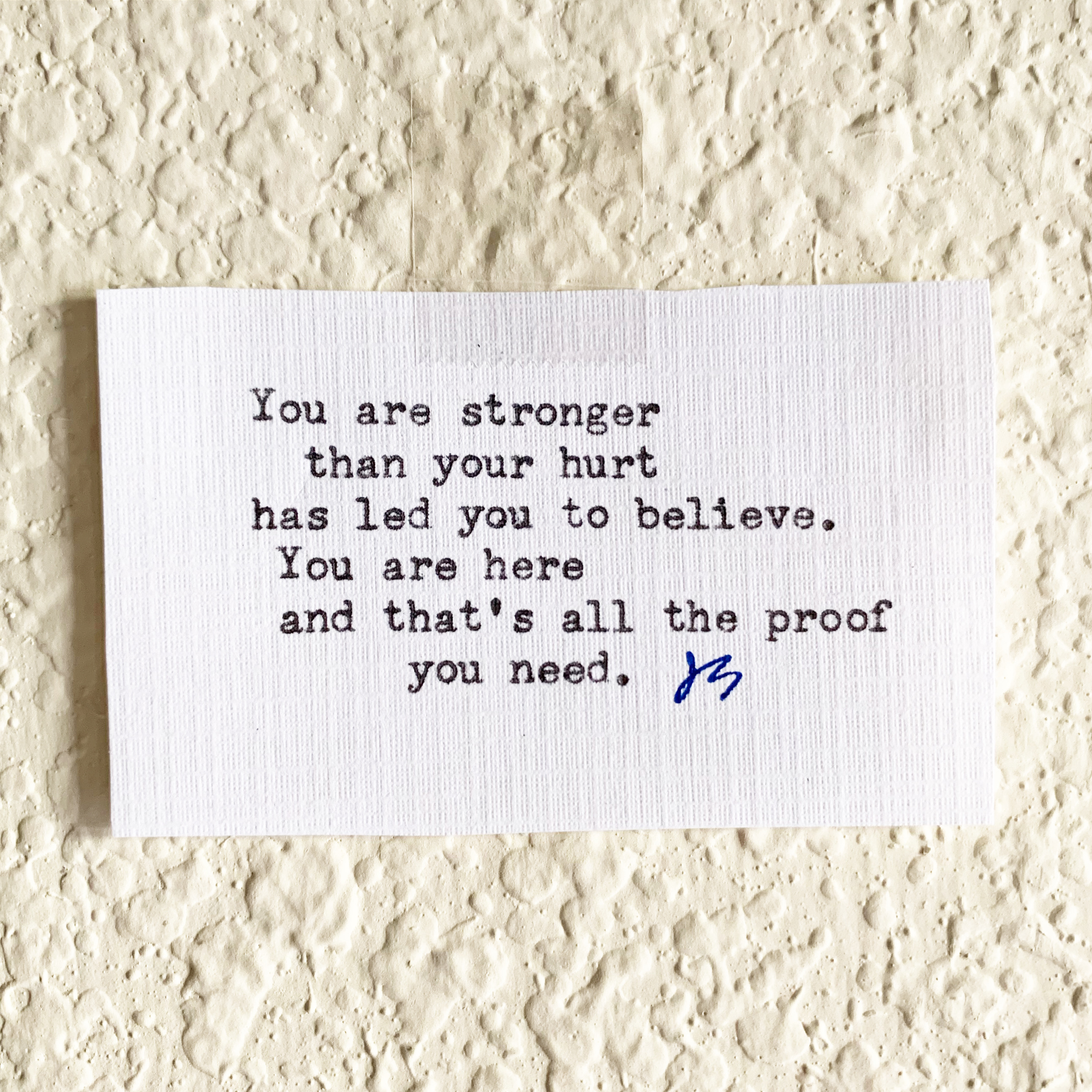
Preorder My New Book, As Long As You Need: Permission to Grieve

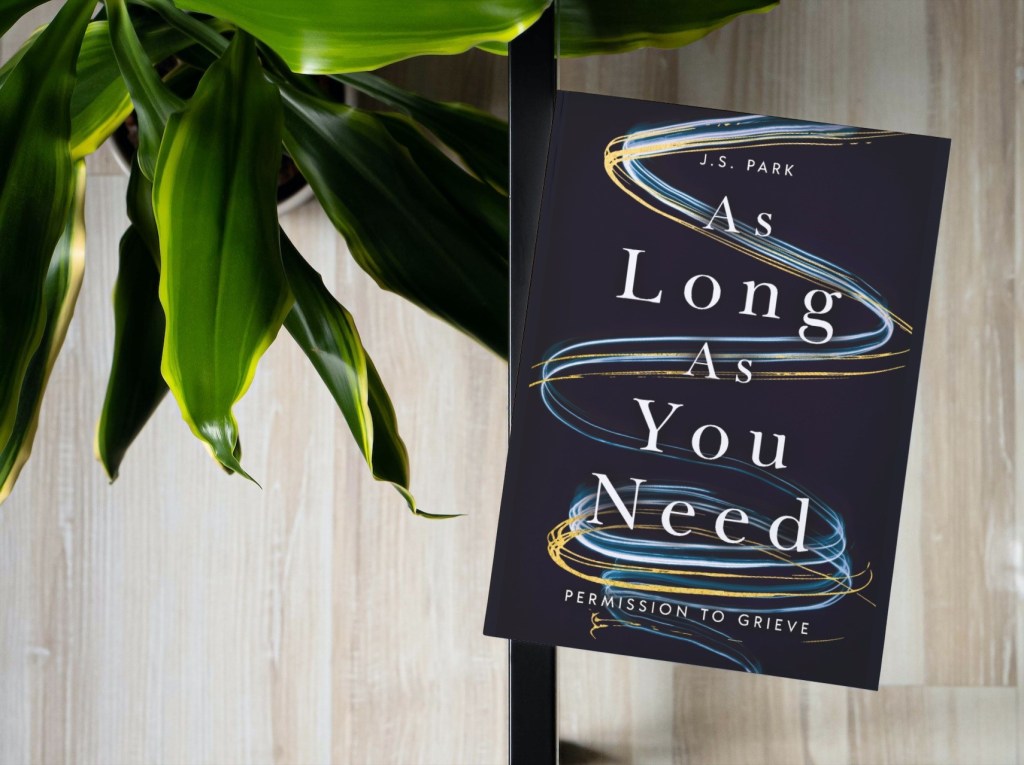
Book title and cover reveal:

• As Long As You Need: Permission to Grieve •

You can now preorder 🙌

AsLongAsYouNeedBook.com

My book releases on April 16th, 2024.

It’s about grief.

I talk about my hospital chaplain work and multiple dimensions of grief, such as loss of:

/ dreams / mental health / autonomy / community / self-worth after abuse /

I dismantle myths about grief,

share stories from the hospital,

and share what I learned and unlearned from sitting with hundreds of patients.

And it is partially a memoir of my own grief: the death of my friend John, witnessing my wife survive PPD, witnessing the hardest losses on the frontlines, the loss of my faith (and coming back to it, sort of), and confronting my own history of trauma through EMDR. ❤️‍🩹

Second to last photo is my co-author. I always had an open door policy when I was writing. Any time she dropped in, I paused and spent time with her. She’d watch me write or ask me to read it to her or just vibe to the lo-fi. She now calls lo-fi “daddy’s writing music.”

Last photo is me after recording some of the audiobook. I didn’t get to narrate my last one (I was told I failed the audition). My new publisher assured me from the start that I’d get to record for this one. Very glad and grateful and honored to be reading my book for you. 🎙️

This book could not have been written without you. Online family. Your kindness, comments, messages, stories, and feedback were my strength as I took on this emotionally challenging work.

I’ll be doing a few readings randomly in April and May. Would love to meet you. 🫶

A special thank you to Faith M Karimi, CNN digital senior writer, for writing the article about me and my work. I got a lot of interest in a book after the article. From phone calls at the hospital to hundreds of messages, I heard from so many sharing their grief stories. I’m reminded that even when it seems like grief is a scary topic, many of us really do want to talk about loss, death, and dying. In this very tough space, I hope to meet you there.

— J.S.
I’m Still Alive


CW/TW

A year ago I began taking antidepressants.

Almost twenty years ago I tried to take my life. I spent three days hospitalized after ingesting half a bottle of pills.

Over ten years ago I fell into one of the worst depressions of my life. I was laughed at by the pastor of the church where I worked.

There was a time I would’ve been deeply ashamed to tell you all this. We’ve made a lot of progress on the stigma around mental health, but so many myths are still ingrained.

This year is the first time I’ve had entire weeks without thinking about suicide. I never knew it was possible. I used to think about it every single day. That was my norm. It still happens sometimes, but I don’t dread when it will. I also don’t dread happiness either. Antidepressants don’t suddenly make you “happy,” but they open the possibility that happiness is not attached to a trap door, small print, a karmic pay-off. It turns impossible into imaginable. For even a moment, joy becomes guilt-free.

A few months ago I managed to stopped taking medication for five weeks. But on week five, I spiraled out and went back on. I thought somehow I had failed. I knew that was objectively false, but that’s how deep the stigma goes. I’m finding it okay to be on medication for life, if I need it. And today, I need it. I’m thankful.

I don’t know if the next one will win. But I’m here. I’m still here. Thank God, I am here.

Thank you friends for your prayers, messages, stories.
You keep me alive too.

— J.S.

Holding Dignity


I have to tell you this story about “Ray,” who thought he didn’t deserve help.

I used to work at a nonprofit charity for the homeless and I met Ray when he finally got housing and landed a new job. But he needed a new tool belt.

My friend heard about his situation and bought a tool belt for Ray. A fifteen-pocket leather carpenter pouch, one of the nicest ones you could buy. Ray was beside himself.

A few weeks later, somebody asked Ray how he liked the tool belt.
“I haven’t used it,” he said. “I’m not sure that I can. I don’t deserve a thing like that.”

He thought he would ruin it with himself. “The things I’ve done,” he said, “pretty much disqualify me. I feel guilty.”

Ray had told us his story before: addictions, abuse, abandonment. He never had a chance, a lap behind from the start, stuck in systemic structures beyond him. He felt he deserved his fate. But Ray learned to believe a better story about himself. He didn’t need to be good enough for the gift; the gift was good enough for him. The things he had done and the things that happened to him didn’t disqualify him from what was good. Maybe Ray really was the kind of guy who didn’t deserve it. But that was the point. It was a gift. We need that sort of grace, a grace that invites us into a better story than the one we were given.

It’s true one act of kindness doesn’t dismantle a whole system. It doesn’t automatically mean we succeed. But a reminder of our dignity is the very least we need. Even as systems around us shrink us down, it never means we are small: only that we were always too big for all we were given.

I think of all the ways
our past selves
were never shown a chance
still hold us back
our bodies brutalized in headlines
our minds made hatred internalized
we believed tall tales about us
that told the whole story without us.

But all that does not see you
says nothing about you
only that they lack vision
and you are already made in an irrevocable Image.

To become someone new
often means returning to ourselves—
souls dignified, made divine,
forged in inherent worth.

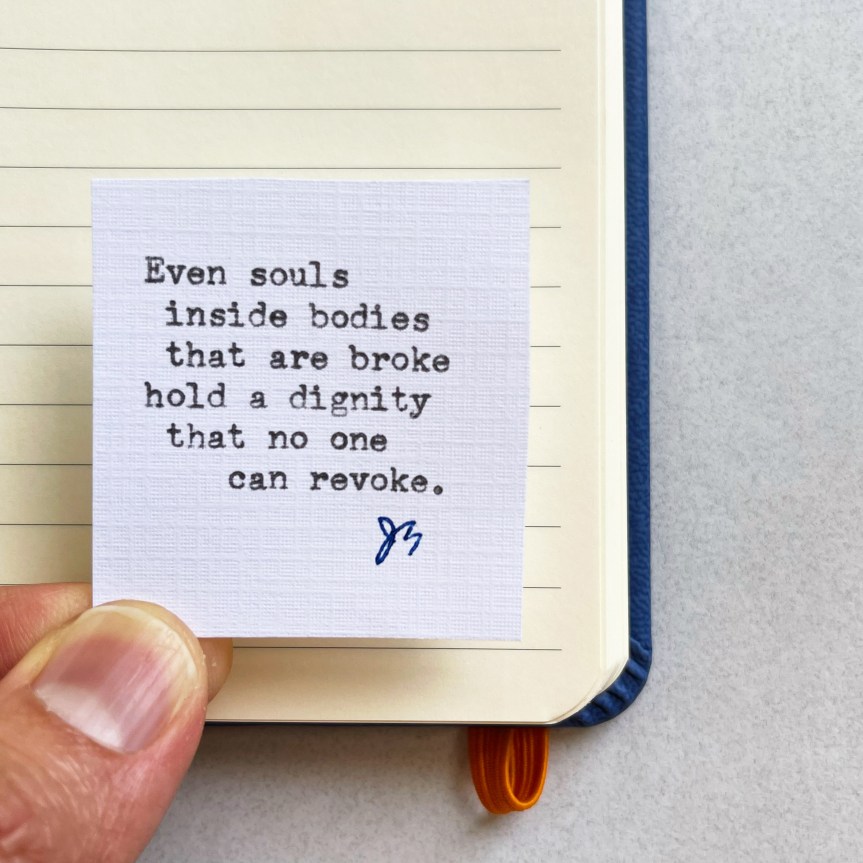
And even souls inside bodies that are broke
hold a dignity that no one can revoke.
In you, I see the face of God.

— J.S.


– Partially adapted from my book The Voices We Carry

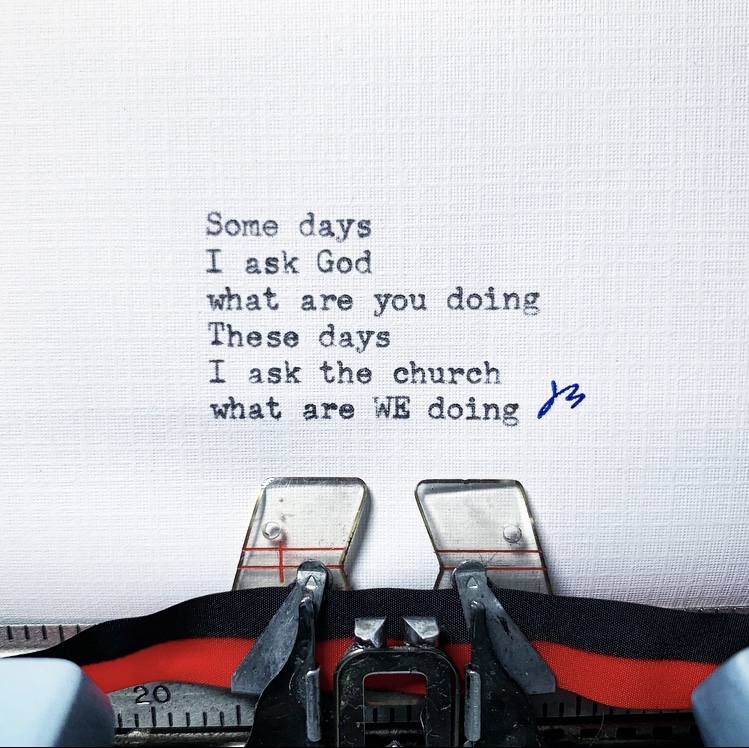
Church: What Are We Doing?


Disclaimer: Angry and disagreeable post to follow.

I’m still not over the American church of 2020 withholding comfort for pandemic anxiety, compassionate wisdom for masks and vaccines, and solidarity with POC—
but instead yelling election fraud and “my freedom.”
The church could’ve ended the pandemic in a summer and cut hate crimes by half.

Every Sunday of 2020, I was overwhelmed and hoped for a word of strength and wisdom. Instead the pulpit told me Black lives didn’t matter, masks were for cowards, and only far right Republicans could be Christians. Then had the gall to say “Don’t get political.”

I would’ve preferred the American evangelical church had said nothing, or at the least, “Let’s respect all sides.” Literally anything else. As someone who works in a hospital and is also a POC, mostly I felt embarrassment. Pastors in 2020 lived outside of reality.

I was told, “Not all pastors, not all churches, leaders, bosses, men”—
But we already know that. I’m grateful for good churches, especially now. But consider even one wounded person is 100% harmed and it matters to them. To say “not all” is to say “not me” which does nothing for those already harmed.
I was told,
“Just trust God.”
But God is all I trusted, especially in this lonely season.
I was told,
“Don’t look to people, look to God.”
But this was a complete cop-out, and I saw where God was looking: to the people.
I was told,
“Stop badmouthing the church.”
But not keeping leaders accountable was literally badmouthing the victims, the church.

I am grateful to the remnant who cared for these wounded. For the healthcare workers, therapists, and clergy over the last twenty-one months who have put compassion over conspiracy. For me, the wound is still too deep. I grieve the vision of what I knew the church could be and hardly was. I grieve knowing maybe this was who many churches really were. I grieve the many leaders I admired who were fooled. I grieve my optimism and complicity.

I’ll say it again. If your faith is making you a jerk, throw it out and start over. If Scripture is your guide, it must move us to justice, to be more kind. Otherwise it’s not what Jesus had in mind.

Over and over I heard stories of people wounded in church by abusers, predators, and political opportunists who worshiped a party over people. Pastors fired for not lifting up Trump. Victims who came forward to their pastors and were shut down or further abused. POC who needed hope and were told, “Calm down, God is in control, don’t worry about it, here’s a guest speaker who’s Black.”

I will never understand how Christian leaders are quicker to defend their denominations over the abused. The church isn’t some institutional concept that needs defending. The church is the people who needed our defense, the ones abused by leaders lording the institution.

When far right evangelicals throw insults because I talk about justice, masks, mental health, and fighting misogyny and racism, it is assumed I am “not in God’s Word.” I can assure you: the work of justice is straight outta the Word of God. Not a brag, but I’ve read the thing a lot. Six times now going on seven (not that the number matters; the words are there for anyone to read). Each time spoke differently. But on justice? That has always been the heart of God. Scripture, if anything, is the fuel for talking about these things. About the wounded.

My faith has changed a lot over the years, especially after becoming a chaplain. I am a witness to suffering around the clock. One of the truths that remain: the Bible is precious to me, which is why people are precious to me. Scripture calls me to see fully. And I hate when it’s used to abuse. It is *for* the abused. Even in the worst of my doubt and disappointment, Scripture calls me to compassion. Never less.

— J.S.

Who I Speak For


I need to tell you this story.

When I was a pastor over ten years ago, I preached at a tiny conference and afterwards a young woman approached me. She had tears in her eyes, said she was single and anxious all the time and nearing forty years old and had “accomplished nothing.” I hurt for her.

Then suddenly—
I drew a blank on what to say. My seminary hadn’t prepared me for this. And I was scared for her. How would her church reply? Her pastor? Was this place safe? All I could do was process with her, validate her feelings, remind her of her inherent value, pray with her. Was that enough?

After I had met this young anxious woman, I changed two things.
1) I rewrote the rest of my sermons for the week.
2) I vowed to always think of this woman and others like her every time I spoke or wrote.

I knew up to then, to my own shame, I had never preached for the ones in the back row.

How could I have forgotten? I was once in the back row too. But my eagerness to keep “sound” and sound pretty and to please my professors overshadowed grace.

To this day, if anything I say does not speak to the person in the back row, to someone like me or her, it’s not worth saying. I have to remember where people really live. Hope cannot smother or bypass, but must only gently enter.

If our words only work for the well-off, able-bodied, and undisturbed, then maybe we’re
1) only speaking to popular powerful folks,
2) expecting profit from big pockets, or
3) comfortable outside reality.

I have a litmus test when new theological movements pop up. Will it matter to one of my dying patients and their families? Maybe that’s basic and unfair. But that litmus test has simplified and clarified my faith.

I still make this mistake, but always a reminder to myself: If it doesn’t work in the end, it won’t work at the start. If it doesn’t work for the wounded, it won’t make you whole. If it means a lot of arguing and posturing instead of compassion and action, I’m too tired to care. I don’t. Leave it out of the patient’s room and keep it on your platform.

Jesus is with the wounded and that’s where I want to be. Bottom line, dotted line, and end of the line.

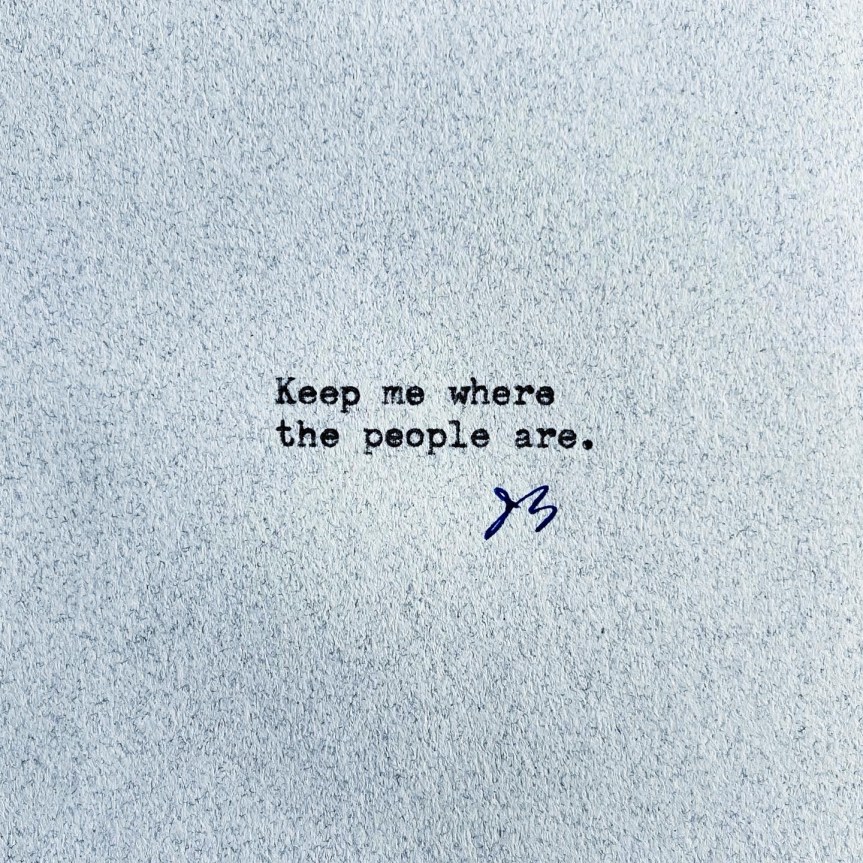
Keep me where the people are.

— J.S.

Theology Is Complete with Our Hands and Feet


There’s a classic dispute among psychologists that’s best shown by the hair dryer story. It goes like this:

A woman believes her hair dryer is going to burn down her house. It gets to be a real problem; she’s driving back home twenty times a day. Her work life and love life and social life all take a hit.

Finally a therapist asks her, “Have you thought about just bringing the hair dryer with you?”

It works. When the fear creeps in, the woman opens her office drawer and sees the hair dryer and she’s fine.

Some psychologists see a major problem here: “Nothing was solved! She still has issues! She needs to get to the root of it!” But others say she found a solution that worked for her.

I lean toward the second camp. The problem was real to her and so was the solution. Maybe later she would get to the bottom of things. But until then, she had found a way to make it okay.

The big idea is her story was taken seriously. That was the start of her wholeness. Only when a story is fully heard is there the possibility of connection or challenge or growth.

The thing is: Too many of our injuries are real. It is not merely “in their head” or “their side of the story.” And it is not enough just to believe it happened.

Abuse, racialized trauma, mass violence, systemic failures, misogyny, manipulated power dynamics, and all the mental health issues not seemingly visible—all of these need empathy, but it doesn’t stop there. They also need presence, action, compassion, and a complete reframing of all the ways that things are done. Justice would make things so right that we would never need accountability or to convince others to “believe me.”

It is already hard enough proving my injury is real.
I have the scars to prove it.
But what I need is more than belief,
more than moved hearts, more than speech.

Theology is only complete with our hands and feet.
Psychology can diagnose and make valuable notes, but only heels in the field, in the dirt, bring us hope.
Even with all our treatment and remedies, I still need you to sit with me.
In grief, your advice is probably good, but not as good as being on the floor with me.
May your pain be mine,
and your hopes mine too.

— J.S.


Part of this post is an excerpt from my book The Voices We Carry

Hear Us, See Us, Know Us


Last summer during the protests, my friend told me:

“It feels like they won’t stop killing us until we start killing them.”

He was trying to express his feelings of helplessness and rage. The sheer insanity of all he was seeing and experiencing. The fatigue of wanting to do more, but already working twice as hard to be half as far. And even if I didn’t completely understand it then, I hurt so badly for my friend. When I protested, I walked for him. For so many—too many—I walked for those who felt what he felt.

I understand that feeling a little more these days. The stomach-sick, catch-your-throat, feverish, fist-clenching disbelief. The urge to shout and throw things, but somehow it is wrong to fight for our lives, so we must only be polite to survive.

To see a body like yours, like mine, brutalized over and over again, then told it was your fault, what were they even doing there, a million more where you came from—but let me eat your food, watch your movies, wear your robes, I’ll tell you about my Asian sister-in-law, let me say hello in your language to impress you, let me tell you about the Vietnam War and the Korean War and my time stationed in Japan, let me tell you how much I love kimchi and bulgogi, I love the K-Pop on Jimmy Fallon or was it Kimmel, make me fried rice some day, your English is so good by the way, and your baby daughter has the most interesting eyes, but tell me about your pain and I will tell you it’s not real, it happens to everyone anyway, tell us at this panel and Q&A, but we only have half an hour today, you have no history or future or feelings of your own, you are my decoration and my proof of diversity, you are the authority on all eastern culture so tell me your story and pronounce your name but leave out all your hopes and pain.

All I feel is rage.
This grief is only the surface.
I am enraged.
For the love of God,
see us,
hear us.

— J.S.

My Voice Was Taken


These last few week I’ve been reading about the many assaults against Asian-Americans, and I was hit with a lightning bolt of a memory I had nearly forgotten.

It is my very first memory. I was four on my first day of preschool. The only Asian in class. I didn’t speak English. When the teacher found out, she forced me to sit in the corner all day. She told me not to talk or turn around. I wept the entire day.

My mother, when she picked me up, cussed out the teacher and switched me to another school. But it was too late. A year or two later, as I learned English, I lost much of my Korean. The trauma destroyed my native language. My tongue had been burned of its millennia of heritage in my still-forming mouth.

To this day I can still understand Korean just enough, but when I try to speak I get tongue-tied. A block. It is apparent why. My voice was strangled. A teacher failed her “non-compliant” student. A system allowed racist violence against a child. A teacher did not understand she had a non-English-speaking American in her class, and instead of including him with even the smallest gesture, simply cut him off in a corner. The teacher was a cog in a system not funded with resources to equip their educators. That child never had a chance.

Our voices are still strangled. When I am yelled at violently in traffic because “Asian driver.” Spoken very slowly to by a cashier. Spoken over constantly in meetings. When people I supervise don’t take me seriously because they are not used to an Asian in the lead. When Asian jokes are told with zero hesitation. When people who look like my father go on a walk and are killed.

I realize I am lucky. My experiences are not as bad as others. My pain though, like any pain, is still pain. And I am not tougher for what I have gone through. I was made less. I was stripped of my home tongue. But no: I will not be stripped of my voice. It will not be taken. We each have a voice, gifted by God, just the one we are given. You have a song and it must break free. You have a microphone to pass to a young uncertain child, that they may sing too. Your voice. Speak. Your voice will carry you.
— J.S.

The Green Room Interview: About My Hospital Chaplain Work, Childhood, Faith, Author Journey, and the Pandemic

I was interviewed by my publisher Moody for their author series Green Room.
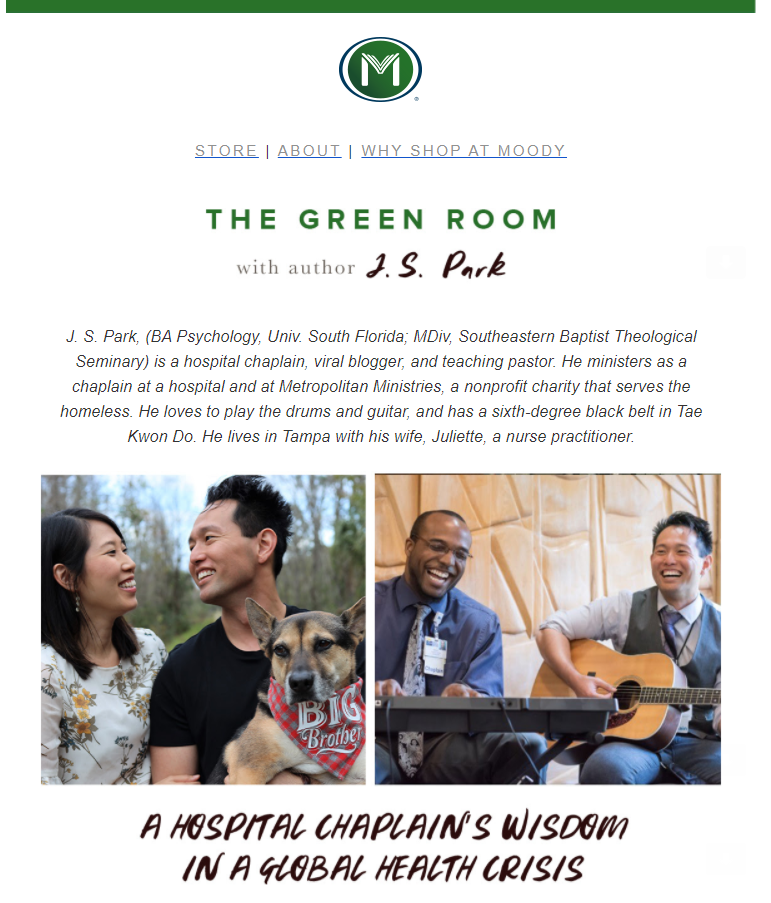
They asked me about my chaplain work, childhood, faith, my writing process, and my book The Voices We Carry, which is available in paperback, ebook, and audiobook.

With my publisher’s permission, here is the entire interview below.

Continue reading “The Green Room Interview: About My Hospital Chaplain Work, Childhood, Faith, Author Journey, and the Pandemic”

It’s Bad News and Good News: It’s Not All Up to You


Culture breakdown.

There’s a philosophical principle in South Korea called Hongik-Ingan (홍익인간), the devotion to benefit all of humanity. It’s a good thing, but it also has some very dark implications.

Basically, many Koreans are told that if their life doesn’t measure up to a surplus benefit, they might as well take their own lives. In other words, always contribute and never consume—or die.

The upside is that Koreans (and easterners in general) have a remarkable work ethic. We work crazy hard. But the downside is that if any of us encounter failure, disaster, or even imperfection, we immediately fall into an abyss of worthlessness.

I’m convinced this is one of the reasons why South Korea has the tenth highest suicide rate in the world.

The westernized philosophy of American Exceptionalism is not a lot different than 홍익인간. You see it in hustle-porn podcasts and bootstraps literature: “Believe it, dream it, achieve it, ”—but with the hidden clause, “And if you can’t, it’s all your fault. Why can’t you just …?” The eastern judgment is based on how others see you, but the western judgment is based on how you see you. It’s the same problem wrapped in different coats.


The overarching message: If you fail, you’re somehow no good. If you can’t beat this, it’s your problem. If you haven’t succeeded, it’s on you. Bigger, faster, more, or you are literally smaller, slower, less.

So when it comes to mental health, racial trauma, chronic illness, problems in the larger system—all of these are considered “excuses.”

Both the east and west are brutally unforgiving to those in uncontrollable circumstances. “Maybe you’re depressed because you’re not trying hard enough. You’re homeless because you didn’t do your homework in high school. You got abused because you were asking for it. You’re always sick because you don’t have faith. That wasn’t racism, you just weren’t acting right.”

These shaming statements revolve on the same terrible axis: that when life is bad, you are bad, and that you attracted the terror to yourself. We believe this because it fits a logical worldview. But it is not a rational one.


Here’s what I know. Your goodness absolutely does not hinge on what happens to you. There is no 1:1 ratio of your value and your life, of your effort versus outcome, no matter how someone got here. And no one ever became successful by themselves; no one is a self-made person. So it is also true that no one has ever totally failed themselves.

If it were all on you: every rainstorm would be your fault, every disaster would be your doing, winning the lottery makes you a saint, and being Jeff Bezos makes you god. Which, of course, is straight up lunacy.

Sometimes the environment or system or leaders or our own bodies were hostile, and so we never stood a chance. Unfortunately our world is not always kind to those “lesser” because we see it as their fault, therefore they’re not given an opportunity, which only reinforces a vicious cycle. You and I simply do not get better by being told, “Hey it’s entirely your fault, so good luck.”

Yes, I believe in both personal responsibility and interdependent community. We must make wise choices. I’m proud of much of my culture and how strong we are. But our choices can be limited by the mechanisms that surround us. We can always choose, but the world often determines how far we move.


All our philosophies may have many strengths, but they are built on a lie: that somehow it’s all up to you. The truth? It never was. At times the world around you has failed you. And sometimes you need help, and you won’t be able to contribute for a time because you need others to support you. And it’s okay to ask for that.

It must not be shameful to ask for charity. Any culture that makes this shameful is in itself a shameful culture that must be dismantled. You and I need help. We need each other. We need the gift of grace, a God-given help outside ourselves. We need to be okay to fail. And that does not make you less. The best of us emerges when we find where we need help.

My hope is that my daughter knows: your worth never hinges on your work. Sometimes life is just hard. It is unfair. It is ruthless. You will need help. That does not make you less. In fact, to ask for help makes you more. It makes you yourself.

Or as esteemed theologian Captain Jean Luc Picard says, “It is possible to commit no mistakes and still lose. That is not a weakness. That is life.”

— J.S.

Not Lectures or Lessons, but Leaning in to Listen


If someone tells you their experience with depression, doubt, racism, sexism, abuse, classicism, trauma, grief—it’s because they trusted you. Maybe they told someone else and got laughed off, shut down, invalidated. Their voice was cut off. So they came to you with hope, at a risk, heart open.

Sometimes when I am weakened, grieving, or depressed, the response I get is complete disgust. There is something vile in the human heart that feels revulsion at “weakness.” There is some terrible urge to look at a wounded person and say, “Stop that, don’t cry, be strong.” I think part of the reason we do this is that we’re so afraid of our own vulnerability, we despise seeing it in others.

The same too when we see anger. Anger can be abusive, yes. But underneath rage is often pain. To lecture an angry person to “calm down” will only injure the injured. When we’re most angry in our wounds, the most healing response is to be angry for and with, not at. To shame a person for their emotion is to shame them for being human.

I think there’s an urge to preach advice at hurting people because it feels powerless not to say anything. But tossing advice on an already hurting person is to give them a burden on top of their burden. Out of good intentions, we tend to impart information or theology or logical points to ”fix” them—but when you were wounded, what did you need? More words? A sound argument? I-told-you-so? No. The best gifts I received in these moments were presence and silence. To bear the load together.

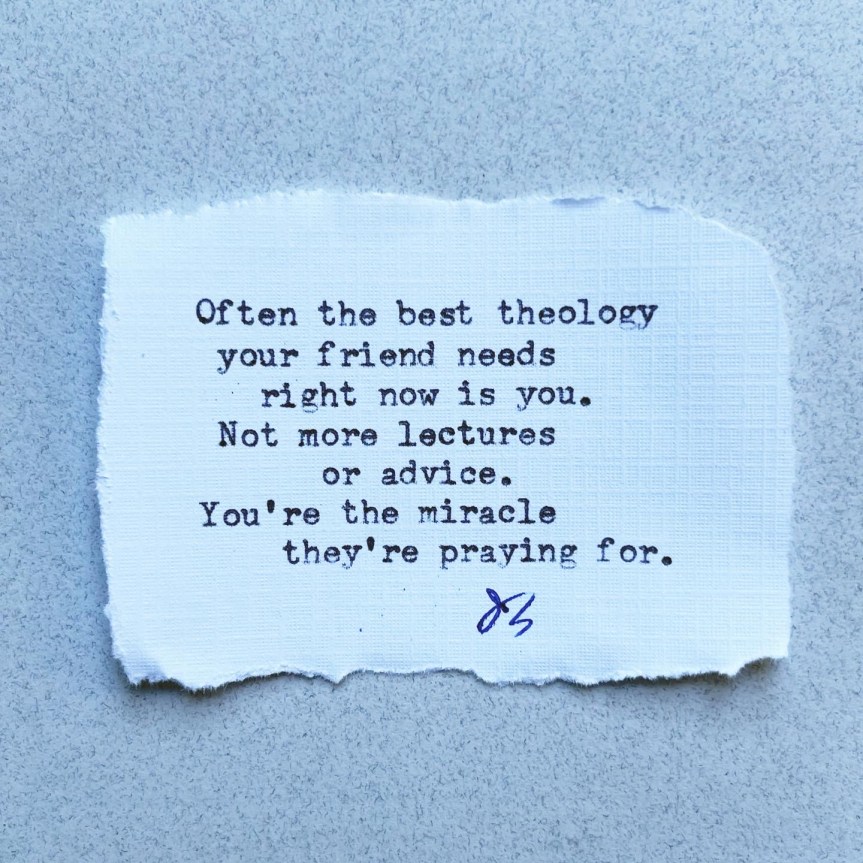
When someone opens up with their painful story, it’s important what you do right then. You’ll be one more person who turns them away, or you’ll be the one who opens a door. Your ears can save a life. You can be the miracle they were praying for.

— J.S.

Black Lives Must Matter


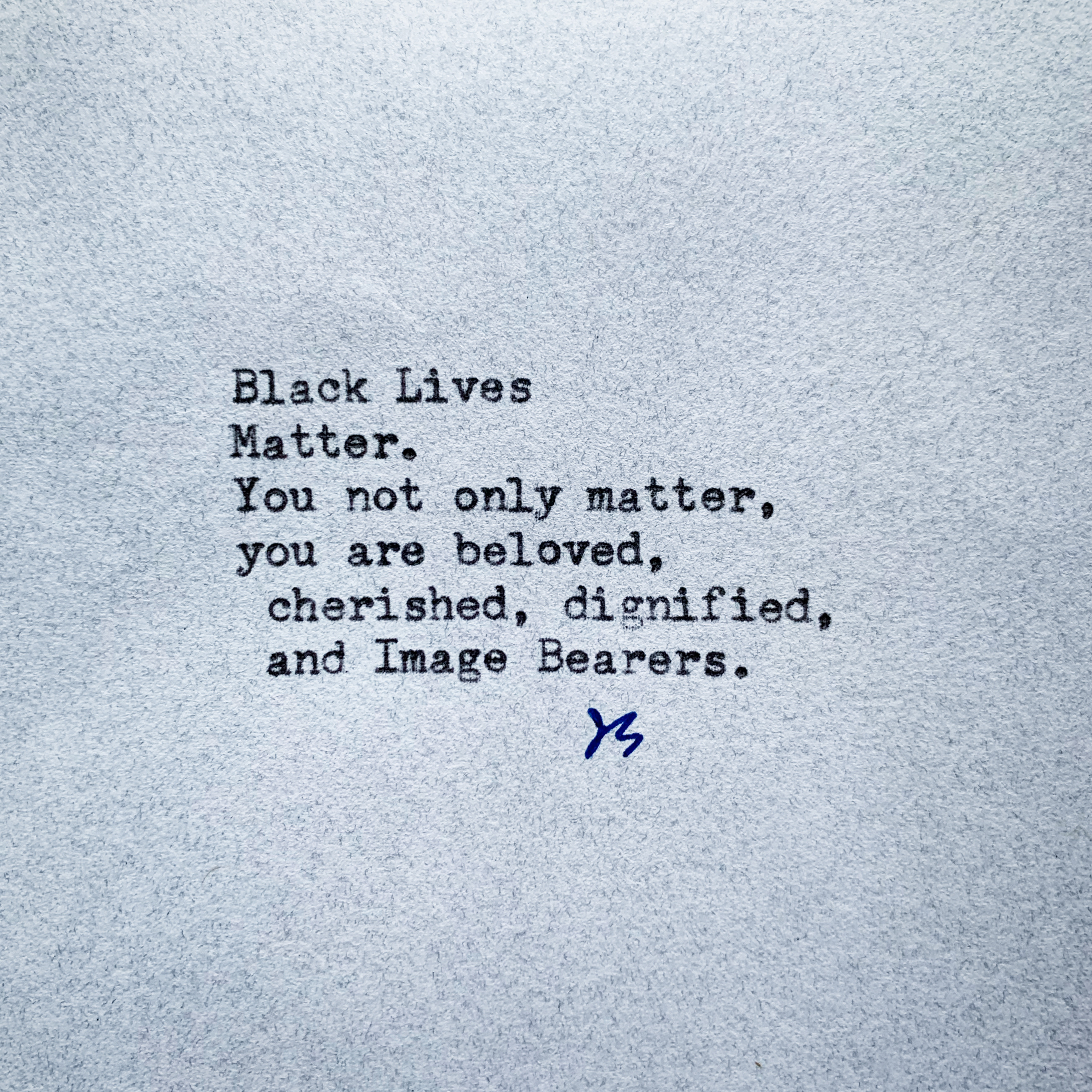
You more than matter. Black lives are beloved, cherished, dignified, and bearers of the Image of God. It is a truth denied but it is no less true.

My friend “Shayla” (who gave me permission to share her story) was telling me that after the hundredth video of a Black person beaten in the streets, after one more citation of false facts and stats, after one more demand to “just work harder and get off welfare and quit drugs,” she had the terrible thought, “Maybe they’re right. I’m not human.”

After so many racist messages and images, it can become impossible not to believe, “I’m not human.” Or, “They’re right.”

The internalized trauma of racism is crushing. Day after day, the Black community is denied their lives, art, beauty, voices, stories, truth. Even when we know these racist messages are not true, they have a way of creeping in, suffocating, infiltrating our beliefs.

It cannot be overstated how much the trauma of racism deteriorates a soul. Trauma has a way of saying, “I am what has happened to me.”

I say as a chaplain but also as a human being: I have seen so many kinds of grief, but to believe your skin makes you deficient is one of the saddest, most haunting pains of all. It sticks so hard. It kills. It takes a thousand times more work to restore wholeness than to tear it down.

I will always be on the side of the wounded. I will do all I can to be part of that thousand steps towards wholeness.

For me, to say Black Lives Matter is a starting point to recognize the full worth of Black Lives. In Korean, the phrase Black Lives Matter is “huhg-in-eh seng-myung-un so-joong-hapnida,” which means Black Life Is Precious. I will continue to say Black Lives Matter, but even more, precious and worthy—not just worthy of protecting, but also having inherent worth.

If you are burned out, traumatized, overwhelmed by racist messages and images, please know the truth: you bear the Image of God. Your worth is not in what you’ve done or how you’ve been treated. It may be hard to believe today, but you are loved. I am with you and for you. As much as I love you, the Creator loves you infinitely more.

— J.S.

Trauma Has Ruined My Life: How to Recover? Here Are Six Ways to Post-Traumatic Growth

Anonymous asked a question:

I went through a traumatic life experience about 3 years ago. As it played out over the last 2 years, I feel like I’ve lost my inner drive to do anything. What do I do?

Hey dear friend, I’m sorry to hear this and thank you for sharing about it with me.

While I’m not a doctor or therapist, I can speak just in my capacity as a trained hospital chaplain. Trauma is a serious issue that’s gotten a lot more attention in the last decade, which I’m really grateful for. I highly recommend reading The Body Keeps the Score. (Warning that it does contain some hard descriptions.)


– Therapy.
 I can’t recommend this enough. Self-disclosure is one of the absolutely best ways to get through trauma. Whether that’s with a therapist, friend, mentor, pastor: we need to talk it out. Jamie Pennebaker’s studies about self-disclosure reveal that it’s not just about venting, but sense-making. Even simply writing about your trauma (if you don’t like writing, then recording it by audio) for fifteen minutes a day for several days can have noticeable health benefits. Pennebaker suggests answering these two questions: Why did this happen? What good might I derive from it? (Quoted from The Happiness Hypothesis by Jonathan Haidt.)


– Interoception.
 When trauma occurs, it not only leads to a loss of personal and spiritual control, but also physical control of our own bodies. We can experience fatigue, chronic pain, numbness, depersonalization, or dissociation. In other words, we can become detached from ourselves. So often this happens because our internal narrative says, “This bad thing happened to me, therefore I am bad.”

One of the ways to fight this is to “master” our own bodies again. That can be done through exercise, yoga, dance, martial arts, bike-riding, or any sensory experience that requires rehearsed and specific moves. To get to know your own body again is to own your body again. (Concept of interoception from The Body Keeps the Score by Dr. Bessel van der Kolk.)

Continue reading “Trauma Has Ruined My Life: How to Recover? Here Are Six Ways to Post-Traumatic Growth”

I Am Invisible: No One Ever Believes I’ve Experienced Racism

View this post on Instagram

It’s hard and uncomfortable to talk about race—but I have to tell you this story. I’m always saddened and surprised at how much people roll their eyes at it. At how much we’re unwilling to hear each other. It’s why I’m always scared to bring it up. When I share I’ve experienced racism, I’ve been called crazy, oversensitive, dramatic, or a liar. “You’re reading into it too much” or “It’s all in your head” or “That doesn’t happen anymore.” Is it always racism? Maybe not. But without confronting ourselves, there’s no hope of healing and accountability. Then our stuff stays hidden and continues to destroy. In this video, I discuss the two most dangerous lies we tell that prevent us from hearing each other. Whether it’s race, gender, mental health, culture, class, or faith: we all get dismissed in some ways. We need to hear each other more, not less. Real compassion is not comfortable, but confronts the injustice that has been ignored. Compassion challenges us to be better. In particular, it seems no one cares about the Asian-American experience at all. When I talk about it, it’s always ghost town. I am invisible. I know my story is not as hard as many others; I’m generally lucky. But it’s still a lonely thing when nobody hears you—especially when no one believes you. My hope is that even if your story isn’t like mine, you would still hear me, and that I would hear you too. #compassion #justice #empathy #prejudice #race #racism #dialogue #injustice #privilege #poc #accountability #hope #asianamerican #asian #asianpacificamericanheritagemonth #koreanamerican #solidarity #iamwithyou

A post shared by J.S. Park (@jspark3000) on


It’s hard and uncomfortable to talk about race—but I have to tell you this story.

I’m always saddened and surprised at how much people roll their eyes at it. At how much we’re unwilling to hear each other. It’s why I’m always scared to bring it up.

When I share I’ve experienced racism, I’ve been called crazy, oversensitive, dramatic, or a liar. “You’re reading into it too much” or “It’s all in your head” or “That doesn’t happen anymore.” Is it always racism? Maybe not. But without confronting ourselves, there’s no hope of healing and accountability. Then our stuff stays hidden and continues to destroy.

In this video, I discuss the two most dangerous lies we tell that prevent us from hearing each other. Whether it’s race, gender, mental health, culture, class, or faith: we all get dismissed in some ways. We need to hear each other more, not less. Real compassion is not comfortable, but confronts the injustice that has been ignored. Compassion challenges us to be better.

In particular, it seems no one cares about the Asian-American experience at all. When I talk about it, it’s always ghost town. I am invisible. I know my story is not as hard as many others; I’m generally lucky. But it’s still a lonely thing when nobody hears you—especially when no one believes you. My hope is that even if your story isn’t like mine, you would still hear me, and that I would hear you too.

[Thank you to Moody Publishers for sharing this video on Instagram.]

I Have to Fake My Emotions: The Cost of Emotional Labor and Hospitality


If you’re always serving, it’s easy to lose your own voice and identity. Those in mental health work, hospitality, church ministry, or those who simply just listen all the time don’t always get to process their own thoughts and feelings. This can be exhausting and infuriating.

Emotional labor is the cost you pay when you feel one way and act another. Many of us who serve have to smile, nod, never flinch, never judge, and always get along. How do we keep our own voice while serving others?

I go over Ring Theory and how we can process our emotions safely. We need room to be ourselves as we take care of others.

— J.S.

Interviewed by Ben Amoah of The Auricle Podcast


I was interviewed by Ben Amoah of The Auricle Podcast. We talked about having a healthy skepticism for our beliefs, what brought me from atheism into faith, and my work as a hospital chaplain.

On Apple Podcast / iTunes here: https://podcasts.apple.com/us/podcast/the-necessity-of-being-a-skeptic-ft-j-s-park/id1434506901?i=1000474189654

Interviewed by Oleg Lougheed of Overcoming Odds


I was interviewed by Oleg Lougheed of Overcoming Odds. We talked about grief in the pandemic, confronting failure and the consequences of always trying to improve, plus why we shame and shun those who are ill.

On Apple Podcasts / iTunes here: https://podcasts.apple.com/us/podcast/how-do-we-thoughtfully-approach-mental-health-loved/id1292465138?i=1000471867963

Interviewed by Sean Bloch of Soul Tears


I was interviewed by Sean Bloch of Soul Tears. We talked about navigating grief through the pandemic and how I helped to plan a funeral, plus my book The Voices We Carry and what it means to own your voice.

On Apple Podcasts / iTunes here: https://podcasts.apple.com/us/podcast/how-to-own-your-voice-serve-others-hospital-chaplin/id1474418082?i=1000473378494

On Libsyn here: https://projectsoultears.libsyn.com/website/-how-to-own-your-voice-and-serve-others-with-hospital-chaplin-js-park

My Family Broke Me: Breaking Family Patterns and Why Therapy Works

https://www.instagram.com/tv/B_ynqigBJMp/


Generational patterns can be passed down through family, even from great-great-grandparents we never met. This is called multigenerational transmission. If you draw a genogram—a detailed family tree that shows relationships and medical history—you’ll notice a surprising amount of repeated loops down the line.

One of the ways of breaking patterns is to seek therapy, to talk it out, to explore our own stories. There’s something powerful about telling our story that brings closure, revelation, and healing to us—especially when someone really listens.
My book has a whole chapter on family dynamics and focuses on one hospital patient who learned to make peace with her complicated family.

Grab my book here: The Voices We Carry: Finding Your One True Voice in a World of Clamor and Noise


[Patient details altered to maintain privacy.]

I’m a People-Pleaser: On Ennegrams, Romanticized Outcomes, and Codependency


In a recent live video, I answered the question, “What’s your enneagram?” I talk about being a giver and how it overlaps with people-pleasing. I share a hospital story about all these ideas at play: how people-pleasing can end in disappointment, especially with those who reject our giving.

My book The Voices We Carry also discusses people-pleasing, why we do it, and how to navigate it.

Grab my book here: The Voices We Carry: Finding Your One True Voice in a World of Clamor and Noise


[Patient details altered to maintain privacy.]