May Our Fears Seek Wisdom


I’d like to think I’m not a fearful person. But I am. I never look like I worry, but I do. A lot.

This week I made the mistake of very publicly bringing up my fears about coronavirus in the workplace. I don’t mind catching the flu, but my wife is pregnant and the flu can adversely affect our baby in utero. I said some uncomfortable things in front of coworkers, when I’m supposed to be the calm voice of a chaplain.

I was not helpful. I probably incited panic and anxiety. I apologized for my behavior. Maybe the fear of being a dad in our current world really got to me. It was still not a good look.

I’m trying to balance the fear we‘re experiencing versus being calm, safe, and rational. I want to validate our anxiety without letting it consume us. I want to be vigilant, but not so on edge that I’m scaring everyone else. I want to say “God is in control,” but also run screaming and lock every window. It’s a tough, strange balance.

We’ve seen where the fear can take us: there’s been multiple racist assaults against Asians, blaming them for the pandemic. We’ve seen misinformation about drinking water and eating garlic and avoiding packages from China. We’ve seen the ugly finger-pointing of political leaders using the panic for vote-bait, promoting xenophobia and catering to the worst leanings of their base. And everyone—including me here—has some take about what to do, how to be, what to say.

I’m trying to stay cool. To be both cautious and optimistic. It’s hard. It’s scary right now. I keep thinking of raising a daughter in this world and how I’m so incapable, unsure, uncertain, lacking the wisdom to say the right thing, to be a pillar when she needs me. I hope I can be strength for her even when I have so little of it in myself.

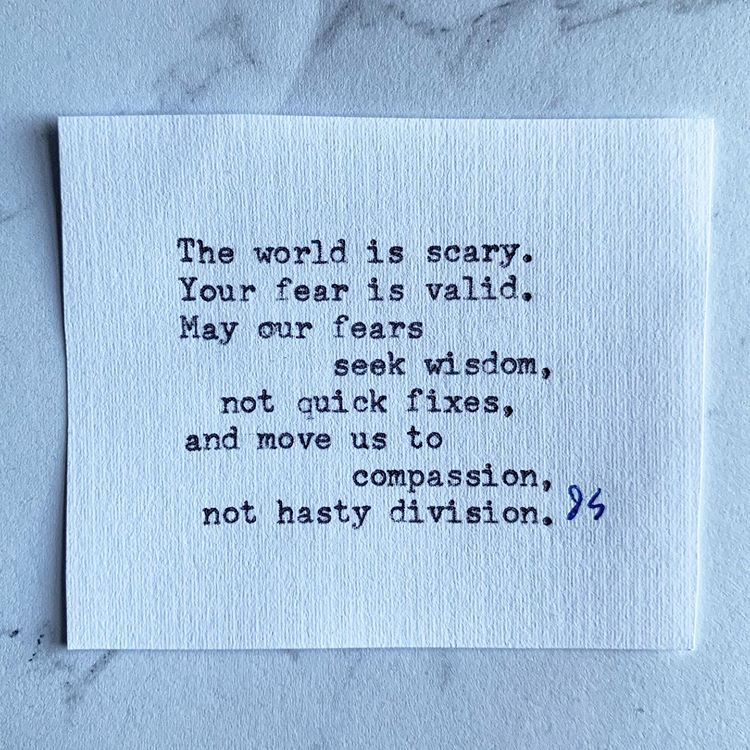
I’m trying to validate fear without giving into it, to let fear ask questions and seek wisdom and move towards compassionate curiosity, rather than hate or rash decisions. God be with us, who navigates our fears, who hears our worries, who gives us wisdom amidst division, who offers us a peace like no other.
— J.S.

An Interview About Depression, Its Myths and Misunderstandings, When Faith Fails, and Talking It Out

– Suzanne of biblesteps recently interviewed me about my book on depression. Her post is here. The entire interview is below. You can find my book on fighting depression here. –

Given that depression can be a fragile and, at times, controversial topic, what made you decide to write a book about it?

Depression can feel like a solo sport. There’s no team backing you up. It’s like swimming or gymnastics; once you get going, it’s up to you to make it to the other end of the pool or the mat. (I was told this is why writers get depressed, because writing isn’t really a team effort).

Most of the resources I found on depression began with the “solo” premise: It’s up to you, go get help, here’s this method, try this and this. But that sort of individualized isolation was very vacuum-ish to me. Life doesn’t work in such a frictionless shrinkwrap; we affect others in a causational web and we need their help, too.

So I started with the premise: How do we collectively get through depression? How do we manage the stress and cause-and-effect and even the global consequences of depression? I wrote the book for both those who struggle with depression and those who don’t. I wanted to bring in every person involved, because depression affects families, cultures, marriages, churches, all of it.

I always knew that the topic of depression itself was a game of telephone — “I’m depressed” sounds like “I’m antisocial” to most people — but when I got to the research and surveys, it was even worse than I had thought. There was this nearly impermeable membrane around the discussion of depression. And then this phrase kept popping up in my head: If you could just know how hard it really is …

And as cheesy as that might be, it became the title of the book. My whole goal was to peel back that weird membrane around depression so, if anything, there would be more empathy on every side of the discussion.

Continue reading “An Interview About Depression, Its Myths and Misunderstandings, When Faith Fails, and Talking It Out”

The Scary Horrible Thing About Depression


Clinical depression will often do whatever it wants with you. It has no rules or code or fairness or dignity.

I have every reason to be fine, but depression is a dirty sneak attack that leaves me completely naked and debilitated. It’s a liar that sells truth: a false reality that says how-I-feel is who-I-really-am. And when a grafted lie overruns the truth, it doesn’t matter that I have “every reason” to be fine: the lie has switched every goalpost and sunk the baseline.

Depression is the worst kind of lie, in that it not only attacks your self-worth and value, but steals the meaning out of words like “self-worth” and “value.” It is cold inertia, slowing down worlds in orbit. It leaves you carved open, constantly bleeding out, unable to retain the vital stuff that makes life. There is spiritual discombobulation; every emotion is a phantom limb, and no amount of affirmation about “life-gets-better” can reach me there.

The thing is, when I’m hit with depression, I already know what to do. I know I have to fight for air. I know I have to crawl for every inch of territory that’s stolen. I know I cannot make decisions unless I talk with someone first. I must reach for my phone. I must reach for every scrap of surface to escape this tunnel.  I must remind myself that there’s so much worse in the world, and that the war inside cannot compare.

I know. None of this makes the fog any easier.

By the tiniest shred of sight, I must crawl.

— J.S. Park | How Hard It Really Is


Photo by Brandon Woller

Blame, Accountability, and Addiction


Here’s an article I wrote that’s been published on X3Church, called:

“3 Ways to Stop Blaming Others and Finally Own Your Porn Problem.”

It’s about letting go of blame and receiving accountability for destructive habits, including porn and other addictions. It’s also centered around a talk by author and researcher Brené Brown.

Here’s an excerpt:

Our instant defense mechanism when something goes wrong is to say, “Tag, you’re it.” Our egos are constantly trying to protect us from feeling wrong, because we associate this with being unloved or unaccepted. All this makes a logical sort of sense, but it’s dangerous, because our initial instinct is to drag others down with us. This in turn only justifies and reinforces our cycle of destruction.

We feed our bad habits with blame. This loop can go on forever. Yet if we struck down this Hydra of Blame like a whack-a-mole before it got to others or ourselves, the inner monologue might change.

Thinking this way, as Brené Brown implies, suddenly lets go of control and creates a scary uncertainty. But it also exposes our blame-game for what it is: an excuse to use, stay mad, or stay withdrawn. When blame is named, it shrivels up and loses power.


Read the full post here. My book on quitting porn is here.
J.S.