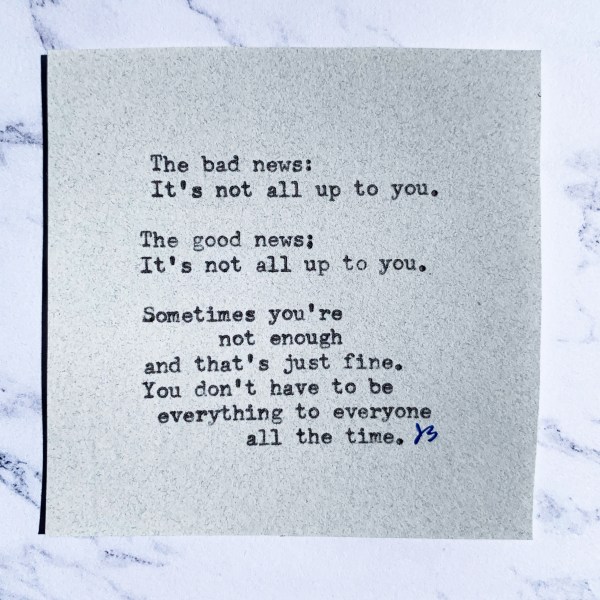
It’s Bad News and Good News: It’s Not All Up to You


Culture breakdown.

There’s a philosophical principle in South Korea called Hongik-Ingan (홍익인간), the devotion to benefit all of humanity. It’s a good thing, but it also has some very dark implications.

Basically, many Koreans are told that if their life doesn’t measure up to a surplus benefit, they might as well take their own lives. In other words, always contribute and never consume—or die.

The upside is that Koreans (and easterners in general) have a remarkable work ethic. We work crazy hard. But the downside is that if any of us encounter failure, disaster, or even imperfection, we immediately fall into an abyss of worthlessness.

I’m convinced this is one of the reasons why South Korea has the tenth highest suicide rate in the world.

The westernized philosophy of American Exceptionalism is not a lot different than 홍익인간. You see it in hustle-porn podcasts and bootstraps literature: “Believe it, dream it, achieve it, ”—but with the hidden clause, “And if you can’t, it’s all your fault. Why can’t you just …?” The eastern judgment is based on how others see you, but the western judgment is based on how you see you. It’s the same problem wrapped in different coats.


The overarching message: If you fail, you’re somehow no good. If you can’t beat this, it’s your problem. If you haven’t succeeded, it’s on you. Bigger, faster, more, or you are literally smaller, slower, less.

So when it comes to mental health, racial trauma, chronic illness, problems in the larger system—all of these are considered “excuses.”

Both the east and west are brutally unforgiving to those in uncontrollable circumstances. “Maybe you’re depressed because you’re not trying hard enough. You’re homeless because you didn’t do your homework in high school. You got abused because you were asking for it. You’re always sick because you don’t have faith. That wasn’t racism, you just weren’t acting right.”

These shaming statements revolve on the same terrible axis: that when life is bad, you are bad, and that you attracted the terror to yourself. We believe this because it fits a logical worldview. But it is not a rational one.


Here’s what I know. Your goodness absolutely does not hinge on what happens to you. There is no 1:1 ratio of your value and your life, of your effort versus outcome, no matter how someone got here. And no one ever became successful by themselves; no one is a self-made person. So it is also true that no one has ever totally failed themselves.

If it were all on you: every rainstorm would be your fault, every disaster would be your doing, winning the lottery makes you a saint, and being Jeff Bezos makes you god. Which, of course, is straight up lunacy.

Sometimes the environment or system or leaders or our own bodies were hostile, and so we never stood a chance. Unfortunately our world is not always kind to those “lesser” because we see it as their fault, therefore they’re not given an opportunity, which only reinforces a vicious cycle. You and I simply do not get better by being told, “Hey it’s entirely your fault, so good luck.”

Yes, I believe in both personal responsibility and interdependent community. We must make wise choices. I’m proud of much of my culture and how strong we are. But our choices can be limited by the mechanisms that surround us. We can always choose, but the world often determines how far we move.


All our philosophies may have many strengths, but they are built on a lie: that somehow it’s all up to you. The truth? It never was. At times the world around you has failed you. And sometimes you need help, and you won’t be able to contribute for a time because you need others to support you. And it’s okay to ask for that.

It must not be shameful to ask for charity. Any culture that makes this shameful is in itself a shameful culture that must be dismantled. You and I need help. We need each other. We need the gift of grace, a God-given help outside ourselves. We need to be okay to fail. And that does not make you less. The best of us emerges when we find where we need help.

My hope is that my daughter knows: your worth never hinges on your work. Sometimes life is just hard. It is unfair. It is ruthless. You will need help. That does not make you less. In fact, to ask for help makes you more. It makes you yourself.

Or as esteemed theologian Captain Jean Luc Picard says, “It is possible to commit no mistakes and still lose. That is not a weakness. That is life.”
— J.S.

Knowing Ourselves Requires Knowing One Another


Last summer I wrote a piece on my own experience with race and racism. A blogger then publicly blasted some harmful views I was expressing.

As I read her words, I felt she was right—but I had a hard time seeing where I fell short. So I asked my friend, with her permission, to help me. How did I get this wrong? She first pointed out what was good. Then she kindly and firmly pointed out the various ways I missed the mark. Slowly and painfully, I saw how much I had messed up.

In particular: I was invalidating others’ experiences to boost my own; I was subtly drawing disproportionate comparisons, hijacking language and images that did not belong to me; I was mostly absorbed in self-pity and blame instead of sharing a vulnerable experience. When I saw it, it clicked: I was way, way, way off.

The easy thing to say here could be, “I’m still learning, I had no idea, show me grace, I’m sorry.” And that’s true. But my words were harmful. There’s no way out of that. I have to sit down, take the L, and simply be wrong. There’s no defense, excuse, rationalization, “but”—I was wrong, plain and simple.

This can’t be about my realization or epiphany, but about tending to the injury I caused.

Even though I’m a POC, that doesn’t make me free of criticism in matters of race and racism. Even though I wrestle with depression and anxiety, I still get it wrong about mental health. And as a chaplain dealing with grief: I’ve gotten that wrong too.

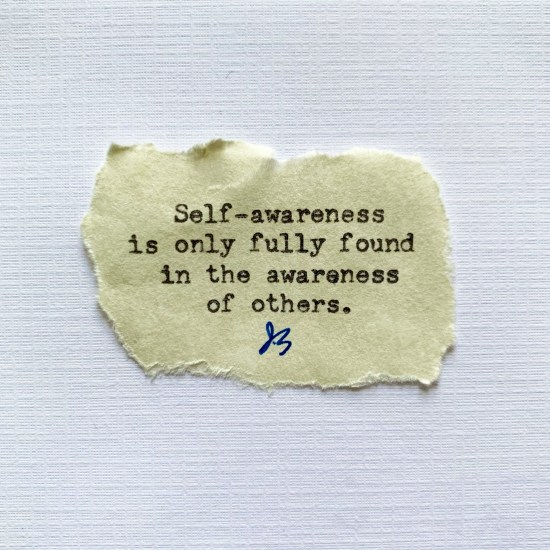
We can only become self-aware through the awareness of others. Or like C.S. Lewis says, “My own eyes are not enough for me; I will see through those of others.” To see is painful but necessary. We need others to see where we have fallen for deception, conspiracies, biases, agendas. It can truly happen to any of us. And even though I’d like to think I’m a friend to the wounded and weary, I still miss the mark. A lot. What I can do is not only examine how I went wrong, but act based on those new convictions. To rethink how I enter for the wounded, not just for my own catharsis. It shouldn’t be anyone’s burden to educate someone on the basics of humanity, but thank God for sending friends who took time to school me.

J.S.

A Response to “Stop Looking at People, Look to God”

Anonymous said:

i just want to say i think it’s ok to be skeptical and have questions and doubts but it’s bad when you start making the christian faith about people rather than Jesus. stop looking toward to people for faith and focus on Jesus and encourage that more as well


Hey there, thank you for your concern and for bringing this up. I hear what you are saying and I can agree, and I’m also not sure it’s the whole picture.

I heard those types of statements last year dozens of times: “Stop looking at people, look at God. Stop focusing on the church, focus on Jesus. Stop putting your hope in people” etc.

I understand this to be a meaningful truth. In fact, I can say this: People let me down so much last year that the only one I could really trust was God. It was only my tiny bit of faith that kept me alive, kept me from completely unraveling in my depression and anxiety. I doubted and questioned people. Did I doubt God? Sometimes. But absolutely not as much as I did the church. When nothing else was good, I trusted that God was the only one who is.

Most people of faith know that they ought to focus on the center of their faith rather than what people are doing. It is such a basic and obvious truth, that again, it was basically my only option.

Back to your statement. I want us to consider a few things.

Continue reading “A Response to “Stop Looking at People, Look to God””

Successfully Vaccinated: Covid Vaccine Journey, Dose 1 and 2

I was incredibly lucky and privileged to receive the covid vaccine from the hospital where I work. I’ve posted my journey through the vaccines, including the side effects and how it went.

The first dose had one sudden side effect which passed quickly.
The second dose had an unexpected side effect which also passed quickly.
It has now been nearly two weeks since my second dose, and there are no side effects at all.
Please feel free to ask me anything.


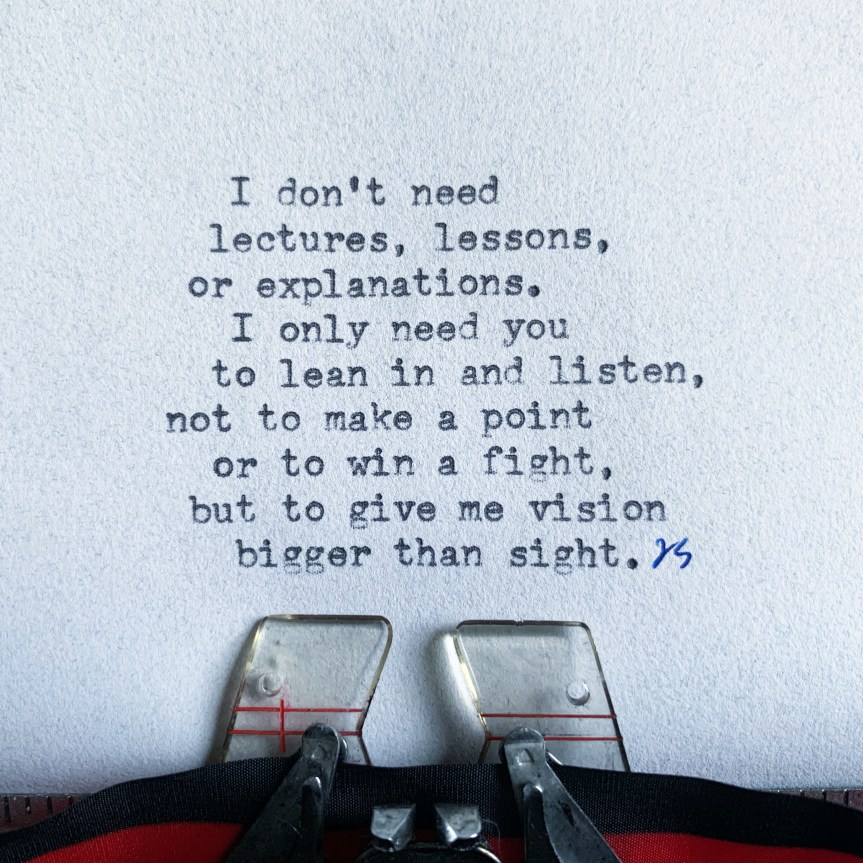
Not Lectures or Lessons, but Leaning in to Listen


If someone tells you their experience with depression, doubt, racism, sexism, abuse, classicism, trauma, grief—it’s because they trusted you. Maybe they told someone else and got laughed off, shut down, invalidated. Their voice was cut off. So they came to you with hope, at a risk, heart open.

Sometimes when I am weakened, grieving, or depressed, the response I get is complete disgust. There is something vile in the human heart that feels revulsion at “weakness.” There is some terrible urge to look at a wounded person and say, “Stop that, don’t cry, be strong.” I think part of the reason we do this is that we’re so afraid of our own vulnerability, we despise seeing it in others.

The same too when we see anger. Anger can be abusive, yes. But underneath rage is often pain. To lecture an angry person to “calm down” will only injure the injured. When we’re most angry in our wounds, the most healing response is to be angry for and with, not at. To shame a person for their emotion is to shame them for being human.

I think there’s an urge to preach advice at hurting people because it feels powerless not to say anything. But tossing advice on an already hurting person is to give them a burden on top of their burden. Out of good intentions, we tend to impart information or theology or logical points to ”fix” them—but when you were wounded, what did you need? More words? A sound argument? I-told-you-so? No. The best gifts I received in these moments were presence and silence. To bear the load together.

When someone opens up with their painful story, it’s important what you do right then. You’ll be one more person who turns them away, or you’ll be the one who opens a door. Your ears can save a life. You can be the miracle they were praying for.

— J.S.

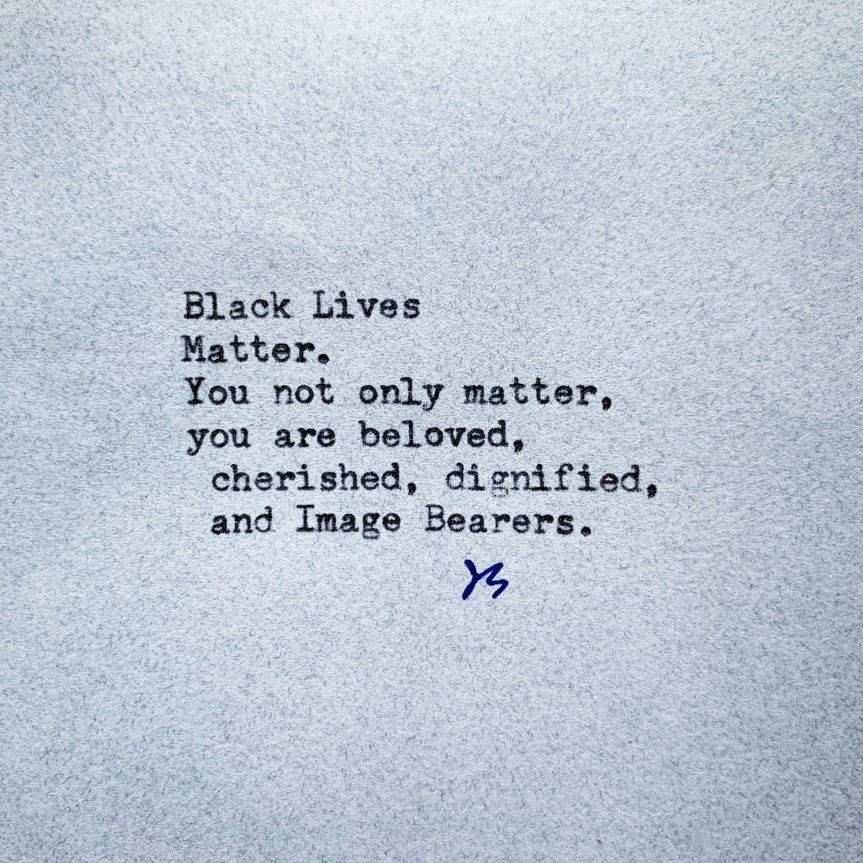
Black Lives Must Matter


You more than matter. Black lives are beloved, cherished, dignified, and bearers of the Image of God. It is a truth denied but it is no less true.

My friend “Shayla” (who gave me permission to share her story) was telling me that after the hundredth video of a Black person beaten in the streets, after one more citation of false facts and stats, after one more demand to “just work harder and get off welfare and quit drugs,” she had the terrible thought, “Maybe they’re right. I’m not human.”

After so many racist messages and images, it can become impossible not to believe, “I’m not human.” Or, “They’re right.”

The internalized trauma of racism is crushing. Day after day, the Black community is denied their lives, art, beauty, voices, stories, truth. Even when we know these racist messages are not true, they have a way of creeping in, suffocating, infiltrating our beliefs.

It cannot be overstated how much the trauma of racism deteriorates a soul. Trauma has a way of saying, “I am what has happened to me.”

I say as a chaplain but also as a human being: I have seen so many kinds of grief, but to believe your skin makes you deficient is one of the saddest, most haunting pains of all. It sticks so hard. It kills. It takes a thousand times more work to restore wholeness than to tear it down.

I will always be on the side of the wounded. I will do all I can to be part of that thousand steps towards wholeness.

For me, to say Black Lives Matter is a starting point to recognize the full worth of Black Lives. In Korean, the phrase Black Lives Matter is “huhg-in-eh seng-myung-un so-joong-hapnida,” which means Black Life Is Precious. I will continue to say Black Lives Matter, but even more, precious and worthy—not just worthy of protecting, but also having inherent worth.

If you are burned out, traumatized, overwhelmed by racist messages and images, please know the truth: you bear the Image of God. Your worth is not in what you’ve done or how you’ve been treated. It may be hard to believe today, but you are loved. I am with you and for you. As much as I love you, the Creator loves you infinitely more.

— J.S.

Trauma Has Ruined My Life: How to Recover? Here Are Six Ways to Post-Traumatic Growth

Anonymous asked a question:

I went through a traumatic life experience about 3 years ago. As it played out over the last 2 years, I feel like I’ve lost my inner drive to do anything. What do I do?

Hey dear friend, I’m sorry to hear this and thank you for sharing about it with me.

While I’m not a doctor or therapist, I can speak just in my capacity as a trained hospital chaplain. Trauma is a serious issue that’s gotten a lot more attention in the last decade, which I’m really grateful for. I highly recommend reading The Body Keeps the Score. (Warning that it does contain some hard descriptions.)


– Therapy.
 I can’t recommend this enough. Self-disclosure is one of the absolutely best ways to get through trauma. Whether that’s with a therapist, friend, mentor, pastor: we need to talk it out. Jamie Pennebaker’s studies about self-disclosure reveal that it’s not just about venting, but sense-making. Even simply writing about your trauma (if you don’t like writing, then recording it by audio) for fifteen minutes a day for several days can have noticeable health benefits. Pennebaker suggests answering these two questions: Why did this happen? What good might I derive from it? (Quoted from The Happiness Hypothesis by Jonathan Haidt.)


– Interoception.
 When trauma occurs, it not only leads to a loss of personal and spiritual control, but also physical control of our own bodies. We can experience fatigue, chronic pain, numbness, depersonalization, or dissociation. In other words, we can become detached from ourselves. So often this happens because our internal narrative says, “This bad thing happened to me, therefore I am bad.”

One of the ways to fight this is to “master” our own bodies again. That can be done through exercise, yoga, dance, martial arts, bike-riding, or any sensory experience that requires rehearsed and specific moves. To get to know your own body again is to own your body again. (Concept of interoception from The Body Keeps the Score by Dr. Bessel van der Kolk.)

Continue reading “Trauma Has Ruined My Life: How to Recover? Here Are Six Ways to Post-Traumatic Growth”

The Burden of Perfectionism: Handling Mistakes and Always Coming Up Short

Anonymous asked a question:

Do you get angry with yourself when you seem to miss obvious things? Like I’m trying for years to be good at work and I feel that I can’t obtain what I’m trying to work towards. I look to make sure things are quality and somehow it seems missed. At least sometimes when I work for certain people. I feel conflicted on compliments and then comments for revisions. Maybe it’s the way it’s said. Maybe I want to be more. I don’t know what to think of myself, how to better myself. I try to do a good job.

Hey dear friend, yes. I think you’ve described the human experience.

We each live with a “phantom pain” of regret, of choices not taken, of missed opportunities, of always seeing what could’ve been. It’s hard to hear criticism not always because they’re wrong about us, but by the possibility that they’re right and that we could’ve done better.

A recent study of almost 42,000 college students shows that our sense of perfectionism has increased drastically. There are three measured types: self-oriented, other-oriented, and socially prescribed. The last one increased the most, by 32% in a span of almost the last three decades. Why? Because more than ever, we are constantly witnessing social prescriptions of “who you should be” through social media, phones, and modern narratives.

It’s impossible to avoid the narratives, “Better than yesterday” or “I am enough” or “You can do what you set your mind to.” When the truth is, sometimes we’re not better today, we are not enough, and our brains can trick us into impossible goals.

Continue reading “The Burden of Perfectionism: Handling Mistakes and Always Coming Up Short”

I Accidentally Joined a Cult: How a Cult Got Me and the Warning Signs


I was part of a cult once. There was one warning sign that I missed—and I don’t want you to miss it. It’s not as easy to spot as you think.

I never thought I’d fall for something like that. When we think of cults, it seems obvious: they take your money, they isolate you, they talk about aliens or conspiracies, they make you wear pajamas. But this one was way different. It took me a long time to recognize I was being tricked and brainwashed. Because I was a people-pleaser, it was even harder to speak up.

If you’re at a church or workplace or student body or nonprofit or group that doesn’t allow for questions: you have to question if that’s a healthy place. The places I’m most worried about are not the weird ones, but the charming ones that get along too well.

In my book, I talk about how we can easily fall for hidden narratives, groupthink, and persuasive speech, and ways to proof ourselves.

Grab my book here: The Voices We Carry: Finding Your One True Voice in a World of Clamor and Noise

I Am Invisible: No One Ever Believes I’ve Experienced Racism

View this post on Instagram

It’s hard and uncomfortable to talk about race—but I have to tell you this story. I’m always saddened and surprised at how much people roll their eyes at it. At how much we’re unwilling to hear each other. It’s why I’m always scared to bring it up. When I share I’ve experienced racism, I’ve been called crazy, oversensitive, dramatic, or a liar. “You’re reading into it too much” or “It’s all in your head” or “That doesn’t happen anymore.” Is it always racism? Maybe not. But without confronting ourselves, there’s no hope of healing and accountability. Then our stuff stays hidden and continues to destroy. In this video, I discuss the two most dangerous lies we tell that prevent us from hearing each other. Whether it’s race, gender, mental health, culture, class, or faith: we all get dismissed in some ways. We need to hear each other more, not less. Real compassion is not comfortable, but confronts the injustice that has been ignored. Compassion challenges us to be better. In particular, it seems no one cares about the Asian-American experience at all. When I talk about it, it’s always ghost town. I am invisible. I know my story is not as hard as many others; I’m generally lucky. But it’s still a lonely thing when nobody hears you—especially when no one believes you. My hope is that even if your story isn’t like mine, you would still hear me, and that I would hear you too. #compassion #justice #empathy #prejudice #race #racism #dialogue #injustice #privilege #poc #accountability #hope #asianamerican #asian #asianpacificamericanheritagemonth #koreanamerican #solidarity #iamwithyou

A post shared by J.S. Park (@jspark3000) on


It’s hard and uncomfortable to talk about race—but I have to tell you this story.

I’m always saddened and surprised at how much people roll their eyes at it. At how much we’re unwilling to hear each other. It’s why I’m always scared to bring it up.

When I share I’ve experienced racism, I’ve been called crazy, oversensitive, dramatic, or a liar. “You’re reading into it too much” or “It’s all in your head” or “That doesn’t happen anymore.” Is it always racism? Maybe not. But without confronting ourselves, there’s no hope of healing and accountability. Then our stuff stays hidden and continues to destroy.

In this video, I discuss the two most dangerous lies we tell that prevent us from hearing each other. Whether it’s race, gender, mental health, culture, class, or faith: we all get dismissed in some ways. We need to hear each other more, not less. Real compassion is not comfortable, but confronts the injustice that has been ignored. Compassion challenges us to be better.

In particular, it seems no one cares about the Asian-American experience at all. When I talk about it, it’s always ghost town. I am invisible. I know my story is not as hard as many others; I’m generally lucky. But it’s still a lonely thing when nobody hears you—especially when no one believes you. My hope is that even if your story isn’t like mine, you would still hear me, and that I would hear you too.

[Thank you to Moody Publishers for sharing this video on Instagram.]

I Have to Fake My Emotions: The Cost of Emotional Labor and Hospitality


If you’re always serving, it’s easy to lose your own voice and identity. Those in mental health work, hospitality, church ministry, or those who simply just listen all the time don’t always get to process their own thoughts and feelings. This can be exhausting and infuriating.

Emotional labor is the cost you pay when you feel one way and act another. Many of us who serve have to smile, nod, never flinch, never judge, and always get along. How do we keep our own voice while serving others?

I go over Ring Theory and how we can process our emotions safely. We need room to be ourselves as we take care of others.

— J.S.

The Language of the Infidel: Saying “Enemy” & How It Almost Ended My Marriage


I meet many Christians who claim “persecution” any time someone disagrees with them. The words “enemy” and “worldly” are tossed around with glee.

There’s a troubling obsession with The Language of the Infidel: it’s intoxicating to think “God is on my side” and that anyone who disagrees is working for satan. Everyone is a “false teacher” including the church across the street, the pastors in a different denomination, and politicians across the aisle.

This sort of self-affirming theology can never admit it’s wrong and is always blaming the devil, demons, and warfare instead of examining itself. It fantasizes a phantom caricature of “haters” so that there never has to be accountability.

This sort of thinking can be expanded to Main Character Syndrome, in which I believe I am the hero of my own story and everyone else must be conquered or conform. This mentality almost destroyed my marriage. In my book, I talk about how my marriage was saved when I broke out of the idea that I was the hero.


Grab my book here: The Voices We Carry: Finding Your One True Voice in a World of Clamor and Noise

Interviewed by Ben Amoah of The Auricle Podcast


I was interviewed by Ben Amoah of The Auricle Podcast. We talked about having a healthy skepticism for our beliefs, what brought me from atheism into faith, and my work as a hospital chaplain.

On Apple Podcast / iTunes here: https://podcasts.apple.com/us/podcast/the-necessity-of-being-a-skeptic-ft-j-s-park/id1434506901?i=1000474189654

Interviewed by Oleg Lougheed of Overcoming Odds


I was interviewed by Oleg Lougheed of Overcoming Odds. We talked about grief in the pandemic, confronting failure and the consequences of always trying to improve, plus why we shame and shun those who are ill.

On Apple Podcasts / iTunes here: https://podcasts.apple.com/us/podcast/how-do-we-thoughtfully-approach-mental-health-loved/id1292465138?i=1000471867963

Interviewed by Sean Bloch of Soul Tears


I was interviewed by Sean Bloch of Soul Tears. We talked about navigating grief through the pandemic and how I helped to plan a funeral, plus my book The Voices We Carry and what it means to own your voice.

On Apple Podcasts / iTunes here: https://podcasts.apple.com/us/podcast/how-to-own-your-voice-serve-others-hospital-chaplin/id1474418082?i=1000473378494

On Libsyn here: https://projectsoultears.libsyn.com/website/-how-to-own-your-voice-and-serve-others-with-hospital-chaplin-js-park

My Family Broke Me: Breaking Family Patterns and Why Therapy Works

https://www.instagram.com/tv/B_ynqigBJMp/


Generational patterns can be passed down through family, even from great-great-grandparents we never met. This is called multigenerational transmission. If you draw a genogram—a detailed family tree that shows relationships and medical history—you’ll notice a surprising amount of repeated loops down the line.

One of the ways of breaking patterns is to seek therapy, to talk it out, to explore our own stories. There’s something powerful about telling our story that brings closure, revelation, and healing to us—especially when someone really listens.
My book has a whole chapter on family dynamics and focuses on one hospital patient who learned to make peace with her complicated family.

Grab my book here: The Voices We Carry: Finding Your One True Voice in a World of Clamor and Noise


[Patient details altered to maintain privacy.]

My Friend Called Me a Racial Slur: Are They a Racist?

Anonymous asked a question:

If a friend of yours who showed no signs of racism ever just happened to get mad at you about something and called you a racial slur, what would you do?

Hey my friend. That’s terrible that this happened to you, and I’m sorry.

That’s also a very, very big yikes for me.

The short answer here is that your friend is most likely a racist, and it’s a good idea to drop them.

Some words are so charged, violent, and historically poisonous that they should never be spoken, certainly never from a friend you trusted, whether they were angry or not. For me, that would be a red flag, dealbreaker, and burned bridge all in one. I would have an extremely difficult time forgiving, much less trusting, this person again.

Before that sounds too harsh, here’s a story that my friend told me.

Continue reading “My Friend Called Me a Racial Slur: Are They a Racist?”

I’m a People-Pleaser: On Ennegrams, Romanticized Outcomes, and Codependency


In a recent live video, I answered the question, “What’s your enneagram?” I talk about being a giver and how it overlaps with people-pleasing. I share a hospital story about all these ideas at play: how people-pleasing can end in disappointment, especially with those who reject our giving.

My book The Voices We Carry also discusses people-pleasing, why we do it, and how to navigate it.

Grab my book here: The Voices We Carry: Finding Your One True Voice in a World of Clamor and Noise


[Patient details altered to maintain privacy.]

Struggling with Mother’s Day


For those struggling with Mother’s Day because of a broken relationship, here’s a one minute answer that I gave on Moody Radio for those specifically struggling with today.
— J.S.

If You Hurt, I Hurt Too


I never want to politicize, moralize, or spiritualize someone’s pain.

I am always on the side of the wounded. Where there is loss, I am for the bereaved. Where you are hurting, I want to bring healing. Anything less is making us less human and not more.

It would take only a few seconds to consider the other person’s pain and perspective and point of view. That has the power to heal. The only cost to empathy is losing bigotry, self-righteousness, and pride. Empathy is that good.

It should never be on the wounded to explain their pain, defend their injury, or to forgive over and over the injustices that never should’ve happened but keep happening. Even if your hurt is not my hurt: because you’re hurting, I hurt too.

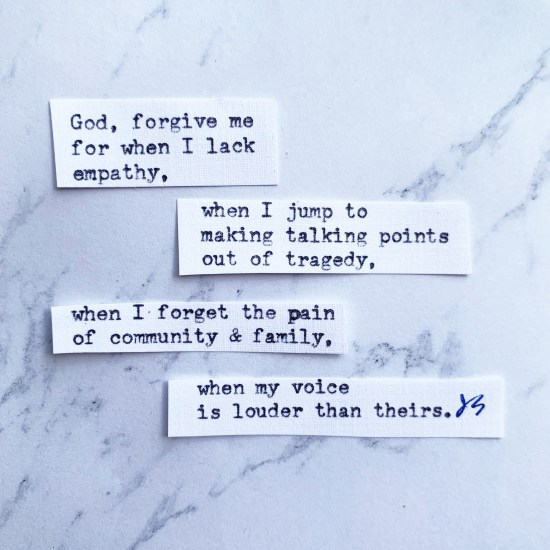
I want to empathize first, to listen first, to grieve first, and to be angry and to weep alongside. Not lecture, lessonize, or minimize. I don’t want to add burdens, nor demand explanations, nor kick you while you’re down. I want to crawl down there with you.

I cannot understand the hasty, vicious speed by which real hurting people are turned into talking points. I don’t mean the platforms for justice. I mean the ones that degrade and deny. I cannot understand the evil scorn and jeering and mockery: there is no honor in desecration, but only violence to the soul. And while I do not believe we must be forced to give our opinion all the time—so often the silence is chilling, and apathy can be the most destructive force of all.

May I never lose sight of the wound and the wounded. May God forgive me for when I wasn’t listening, for not getting it right. Above all, I must grieve. Through tears, prayer, and action, I grieve with you.
— J.S.

#AhmaudArbery