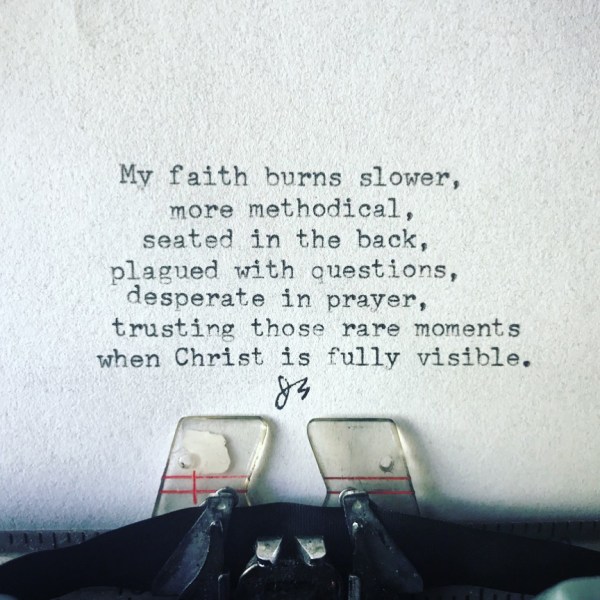
Faith That Burns Slow.


I imagine that when Moses split the Red Sea, there were two groups of people.
The first group was composed of victorious triumphant warriors saying, “In your face, Egyptians! This is our God!” They were pumping their fists and thrusting their spears.

The second group was composed of doubtful, panicking screamers running full speed through whales and plankton.

I’m a Screamer. I’m a cynic. I’m a critic.

I’m a Peter, who can make a good start off the boat, but falls in the water when my eyes wander.

I’m not endorsing a halfway lukewarm faith. I believe God wants us to have a robust, vibrant, thriving relationship with Him. But as for me, I’ll be limping to the finish-line.

I’m more of a Thomas than a Paul. I’m more Martha than Mary. I’m more David than Daniel.

Yet the Warriors and Screamers all made it through.

It’s not easy to have faith the size of a mustard seed. But Jesus promised that this would be enough to move mountains, and I’m learning to be okay with that.

— J.S.

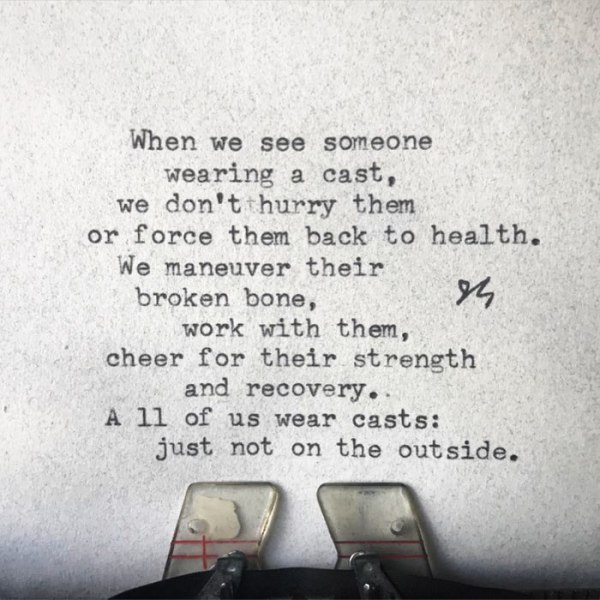
We Wear Casts.


God, forgive me for when I lack empathy,
when I jump to making talking points out of tragedy,
when I forget the pain of community and family,
when my voice is louder than theirs.
— J.S.

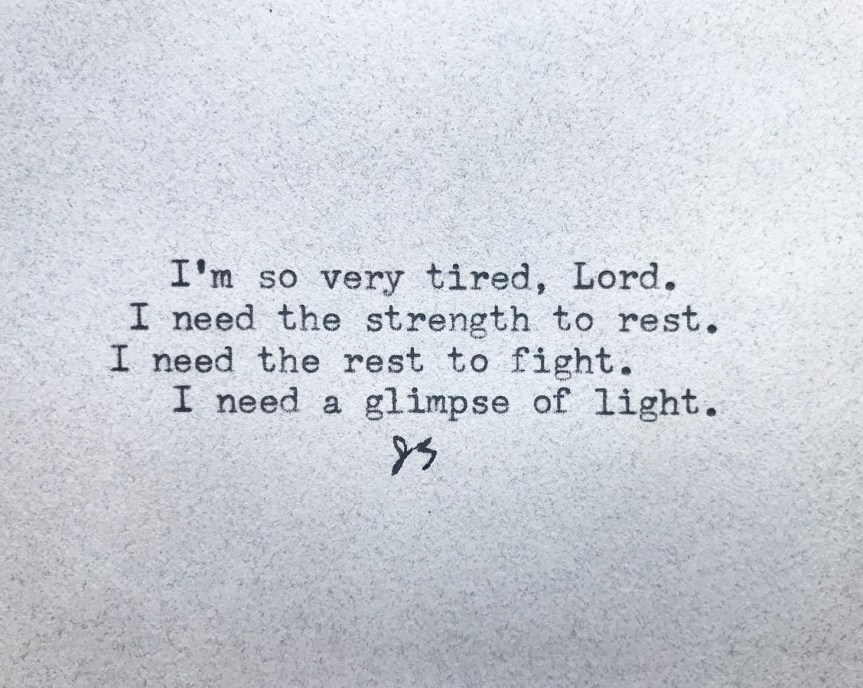
Strength to Fight.


“May God bless you with discomfort at easy answers, half truths, and superficial relationships, so that you may live deep within your heart.

“May God bless you with anger at injustice, oppression and exploitation of people, so that you may work for justice, freedom and peace.

“May God bless you with tears to shed for those who suffer from pain, rejection, starvation, and war, so that you may reach out your hand to comfort them and turn their pain to joy.

“And may God bless you with enough foolishness to believe that you can make a difference in this world, so that you can do what others claim cannot be done.

“Amen.”

— A Franciscan blessing

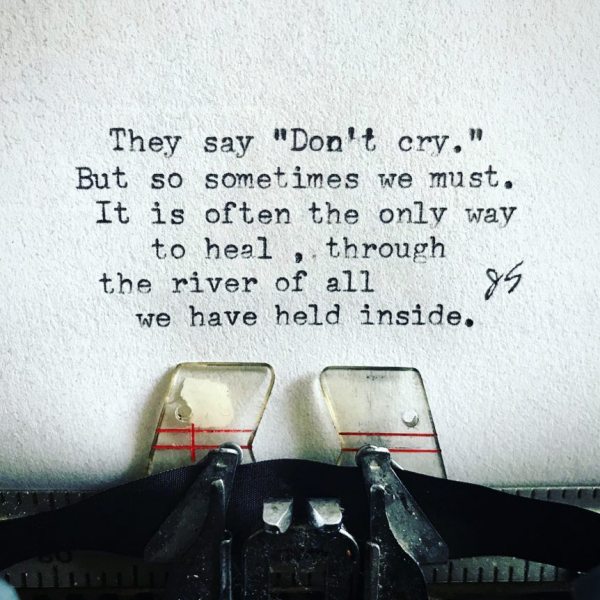
They Say “Don’t Cry” — But So We Must.


It’s a crazy incredible thing to be in a place where people slow down and listen, where they hear your whole story and let you paint your full heart in the air.

I was telling one of my fellow hospital chaplains about life lately, about my health problems and secret panics and suddenly about a billion other things, every humiliating and painful and neurotic moment that had been twitching over for the longest time, and I didn’t realize how much I had bottled up in my neatly wrapped fortress. My chaplain friend never judged, only nodded, never flinched, stayed engaged. She then prayed for me, a really beautiful prayer, like cool water for bruised purple hands. And I wept. A lot. Quietly, but inside, loudly. It was a little embarrassing. But something shifted and settled and became still for a moment, like the leaves of a tree coming together after a strong wind, a momentary painting. I left lighter.

Later I visited a patient who had nearly died from a brain bleed, and when I offered prayer, the nurse grabbed me and said, “Me, too.” I took her to the side, and she whispered, “Cancer. I might have breast cancer, and I’m afraid, chaplain. I’m so damn afraid.” She clenched her teeth and tried not to weep, but I put a quick hand on her shoulder and she wept anyway. She talked. I listened. There was nothing for me to say but to be there. And maybe nothing had changed—except we were made light somehow, and together drew something bigger than us. We drew colors into the gray.

There are still places, I believe, even in a busy and unhearing time, where we can draw free. I hope to meet you there, where we are not okay, but less gray than yesterday. I hope to pray for you, that we become bigger.

— J.S.


I Never Knew I Was at a Toxic Workplace—Until I Went to a Healthy One.

I love my current workplace. I mean, the work itself is incredibly difficult: grief counseling at a hospital, notifying family members of an accident, bringing up end-of-life decisions. But it makes a difference to have co-workers who are more than faceless employees. We are fellow sojourners on a mission together.

One of my previous workplaces was not like this. There was bullying, nepotism, high suspicion, and hateful gossip. The people were just mean. No one cared about seeing the best in each other. Every call or email from the higher-ups would throw me into a panic. Of course, I had my issues too. But I walked through them alone, alienated, with constant dread.

I recognize now that I’m lucky. At my current job, we’re all on the same page, we pause and listen, we clarify our communication without fear of retaliation. We deeply care about each other and the work we do.

The thing is, I didn’t know how awful my previous job was until I landed where I am.

My guess is that most of us will tolerate an abusive, toxic, punishing work environment because “I’m paying my dues” or “This is all I can get right now.” And that’s true. We often have to do things we don’t like to get where we want to be. We can still thrive in those places. Sometimes it’s the best we can do, and we can still be our best there.

Continue reading “I Never Knew I Was at a Toxic Workplace—Until I Went to a Healthy One.”

How Do You Know You’re Persecuted or Just a Terrible Person?

illuminirk asked a question:

how do you differentiate when you’re being persecuted for christ and being slammed for… for lack of a better word, for being a shitty person? for instance, i see a lot of american christians claiming persecution when really people are mad that they’re racist or homophobic or etc. how do you navigate that? how do you know?

Perhaps the simplest way is this:

Look around. Do you live in the West? You’re probably free to express your faith. So most likely you’re not being persecuted, but you’ve picked the wrong battle.

Look around. Do you live in the East? You’re probably not free to express your faith. So most likely you’re being persecuted, because you’re in the battle at all.

The thing is, early first century Christians were being persecuted simply for existing. Their faith was not primarily about self-improvement (though that’s in there), but about enduring the suffering of a cruel world. They didn’t have much room for political rallies or fighting for moral issues. They were in survival mode. They saw Christianity as the good news of a God who walked with them, rather than some kind of behavioral improvement tool. So while they did care about self-improvement, their first priority was merely survival.

Many Christians in the West today don’t experience the same kind of cultural suffering. They’re not in survival mode, so they’re focused more on self-improvement. I include me in this. It’s not a bad thing. I actually have space to think about how to better my own life and live like Christ. So sometimes Christians have too much idle time and pick the wrong fights in a free society. 

And really, when you have the chance to self-improve, it’s easier instead to stand up for some policy outside yourself. It’s a way to offload responsibility for your own actions: by trying to change laws or take the “moral high ground,” you then don’t have to look at changing yourself. Christians find it hard to follow Scripture, so they pick a path of lesser resistance (I include me here, too). It’s easier for Christians to shout really loudly in a free society than actually change their own self-destructive habits and live a useful, meaningful life.

I don’t mean that a person who experiences physical pain for their faith is necessarily a “real Christian.” Sometimes that’s just self-imposed martyrdom, and that’s selfish too. I mean that real persecution is about a cultural baseline of restricted freedom. If you’re free to express yourself, you’re not persecuted. If you express yourself and some people complain, you’re not persecuted. If you express yourself and some people call you mean names and avoid you at work, sorry, but you’re not persecuted.

Continue reading “How Do You Know You’re Persecuted or Just a Terrible Person?”

Everyone’s Got Advice About Your Depression


You’re going to find very quickly that when you’re depressed, nearly everyone’s got advice for you. Everyone thinks they know what’s best and what you ought to do.

It’s well-intentioned, and it’s not all bad—but in that very moment, when you’re in the colorless fog, those motivational one-liners are often tacky, tone-deaf, and untenable.

If depression robs you of your ability to logically comprehend and make sense of life, then any advice or solution is not going to reach into the heart of depression.

Both the church culture and pop culture endorse a sort of “powering through” because it really translates to, “I don’t have time to get involved with your struggle.” What’s really being said is: “Pray more and be positive so I don’t have to deal with you.”

Theology and wisdom have their place, but I suspect that we spout them to rush the hurting past their hurt, because it hurts too much to sit in their furnace. It’s a kind of reverse projecting: I can’t bear to look into my own uncertainty when I see yours.

My urge to offer advice has good intentions, but it’s also a way to offload the hard work of navigating the wound with the wounded. I offer a reason of certainty because it’s easier than traveling with the hurting in the uncertainty. It’s a way to protect myself from answering the unanswerable. I don’t like the silence because it makes me uncomfortable. I have to offer something or else it makes me feel helpless.

It’s the same reflex that happens when some of us see someone cry. “Don’t cry,” we might say, even though very often, crying is the only way to heal through the river of all we have held inside. I’ve found that when I say, “Don’t cry,” that’s about protecting me from discomfort rather than leaning into your hurt and healing.

So all my advice makes your pain, your tragedy, and your depression, about insulating me, instead of moving towards you.

You can do one from the rooftops, but the other means diving into the smells and groans of their misery.

It’s dirty. It’s work. And no one naturally wants to pay the high cost of navigating someone’s pain.

— J.S. Park How Hard It Really Is


Photo by Chris Wright

Was Religion Made Up Just to Sugar-Coat the Fear of Death?

gollywholly asked a question:

Have you ever read “The Worm at the Core” by Sheldon Solomon et al? It’s about death, and basically the theory is that everything we do and believe in is to mitigate our fear of death. It follows from that that religion, and our belief in Jesus, is just a way to mitigate our fear of death. And this is messing with my head big time. What do you think?

Hey dear friend, I’m sorry for my late reply. I’ve been on a break (due to a breakdown) but still checking my inbox, and I really love this question.

I actually studied this very phenomenon for my undergrad in Psychology, also known as “Terror management theory” or “Mortality Salience.” The basic idea is that death is inevitable, so we must give meaning to life. Therefore, religion and culture and identity are responses to death. We could call this “whistling past the graveyard.”

While the premise is intriguing and persuasive, it’s also a bit Swiss cheese, which sociologists have addressed and countered just as persuasively. Many of the counter-arguments can be found online, but I’ll offer some of my own thoughts.

Here are a few things to consider about “Christianity as a way to mitigate the fear of death.” Please feel free to skip around.

Continue reading “Was Religion Made Up Just to Sugar-Coat the Fear of Death?”

How C.S. Lewis Felt About Everything


A rare picture of C.S. Lewis.

It has been fifty-years since the passing of C.S. Lewis, as well as JFK and Aldous Huxley. It’s also been one-hundred twenty years since Lewis was born.

C.S. Lewis has been the most influential Christian writer in my spiritual journey. He has shaped my spirituality more than any other writer I know. I do not agree with all he says (when do we ever find such a person anyway?) — but he is absolutely a kindred soul. I also love his tales of pulling pranks on his dear hapless friends.

To commemorate, here are some of my favorite Lewis quotes.

Continue reading “How C.S. Lewis Felt About Everything”