From Atheism to Faith: Discovering the Hidden Story of Humanity


About my journey from atheism to faith, and how our historical impulse for religion points to the hidden story of humanity. I also engage with Yuval Noah Harari’s Sapiens and his take on religious metafictions.

For my seminar and Q&A “Jesus for Atheists,” click here.

Subscribe to my YouTube channel here: https://www.youtube.com/user/jsparkblog

Love y’all, friends!
— J.S.

A Reminder, Dear Friend.


You are loved.

You might have heard that a million times, but it’s no less true.

You do have a Creator. He is with you. He is bigger than your situation and closer than your deepest hurt. He’s not mad. He is cheering for you and rooting for you this very second. He’s okay about all the things before. He sent His Son for that very reason.

You can put down the blade. You can throw away the pills. You can quit replaying those regrets in your head. You can quit the inner-loop of self-condemnation. You can forget your ex. You can walk away from the porn. You can resolve your conflicts right now. You can sign up to volunteer at that shelter. You can thank your parents for everything. You can hug the person next to you. You can tell the waiter, “Jesus loves you.” You can go back to church. You don’t have to sit in the back. You don’t have to prove your worth to the people you’ve let down. You don’t have to live up to everyone else’s vision for your life. You’re finally, finally free.

You are loved.  I am loved.

As much as I love you, dear friend, He loves you infinitely more.

Believe it. Walk in it. Walk with Him.

God is in the business of breathing life into hurting places.

This is what He does, even for the least likely like you and me.

— J.S.


Happy Easter, Jimmy

Dear cousin Jimmy,

You died about fifteen years ago. When I met you, you were screaming in pain but you didn’t know why. You were born almost completely brain-dead; you could only eat, drink, breathe, scream, laugh, smile, and cry. I had the privilege of making you laugh once by making a funny face. Or maybe you just laughed at my face.

Continue reading “Happy Easter, Jimmy”

Spoken Word: Friday / Saturday / Sunday – Death, Doubt, and Deliverance


Hey friends, this is a Spoken Word performance that I gave with Yale University Students in CT. About the three fateful days from Jesus’s crucifixion to resurrection, told from the viewpoint of a modern day disciple.


To download directly: http://traffic.libsyn.com/thewayeverlasting/JS_Park_-_Fri_Sat_Sun_Spoken_Word_1-21-18.mp3

I’m also on iTunes here: https://itunes.apple.com/us/podcast/j-s-park-the-way-everlasting-podcast/id395594485?mt=2

Be blessed and much love to you, friends! — J.S.

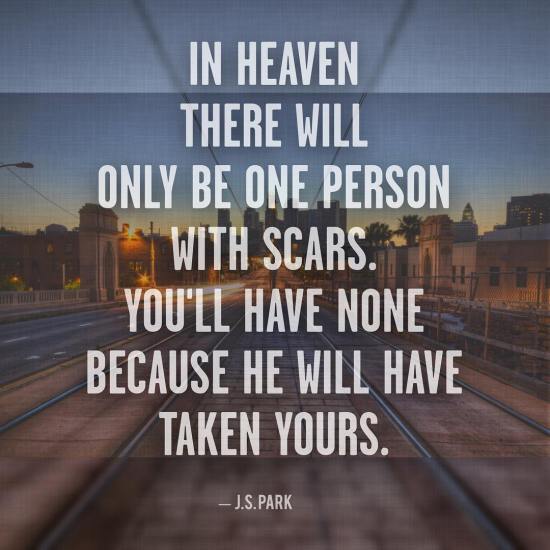
Scars and Heaven.


In Heaven, there will only be one person with scars. You’ll have none because he will have taken yours.
J.S.


Angry About Anger


An honest confession:

I struggle a lot with anger.

I’ve also been told that anger is wrong, so I tend to stuff it down. Eventually there’s a breaking point where it flies out like twice a year. I look pretty laidback and congenial until I have my semi-annual blow-up. It’s ugly. Embarrassing. Enough to make people leave forever.

Anger, of course, can be scary. I have thrown things. I have punched a wall. I have yelled uncontrollably. There’s no excuse for that sort of behavior and I deserve every consequence. People have a right to leave.

But I never knew there was a healthy kind of anger. That anger is pointing to something true, real, and valid. That it means something is very wrong around us or inside us, and it needs healing. At the very least, it needs to be heard.

No, we should never use anger as an excuse to hurt someone. It’s never okay to say, “I only did that because I was angry.” Nothing justifies abuse. Ever. We must be held accountable regardless of how we felt at the time.

I just wonder how we can talk about this in an honest way without totally writing off the angry person.

I’ve found that underneath rage is usually pain. Grief. A kind of hurt that has left us powerless.

The hard part is venting our anger in a way that’s constructive instead of explosive. The even harder part is to talk about it without people judging.

The common response is always condemning: “I knew he was terrible. His life is so good, he has no reason to be mad.” And maybe that’s true. But how can we correct this unless we talk about it? Aren’t there sometimes real reasons a person is mad? There must be a safe venue for an angry person to say, “I’m bitter, I’m resentful, I can’t forgive, and I don’t know what to do with this.”

My fear is that no one will make room for it. You can usually tell someone you’re insecure, sad, or lonely, and they’ll hear you. Tell someone you’re angry and they assume you’re a “bad person.” Sometimes angry people are also “bad people,” sure. But I wish we could find help for our rage without immediately being crushed and cast out. I wish we could talk through the stigma.

I think, in the end, that anger must have a place. You can be angry for instead of against. It can be motivated by justice. There are legitimate reasons to be righteously mad. A call for reparations. A proper outrage when someone is oppressed, exploited, abused. I wish I had known this sooner. I want to be angry for you, not at you. I hope there’s grace enough to learn how.

— J.S.

Another Year.


Another year older. I’ve stopped tweezing all the white hairs above my ears; it’s a losing battle. I have some new hairs inside my ears. I wear knee braces all the time now because without them I feel naked and confused. I now use words like “heartburn” and “retirement fund” and “grocery list” and “youngsters.” I like nature shows and full-on jazz and classical. I look forward to sitting down in every situation. I now empathize with the parents in the background of every TV show. My lower back knows when it’ll rain. I take fish oil every day. New technology makes me go “Bah.” It takes me some time (and a lot of noise) to get out of a chair. My thirties are flashing by. Loving it. Love y’all very much.
— J.S.

A Relationship Is Not a Wishlist


Look, a romantic wishlist is a nice thought, but it’s also creepy and unfair. It’s setting up an impossible monstrosity of expectations and you’ll be disappointed for no other reason than you played yourself.

I don’t mean lowering your standards. I mean setting real ones, for actual people who exist. For people who are just people and not a customized Frankenstein creature.

The person you’ll end up with is going to be their own personwith their own hopes, dreams, goals, anxieties, and weird little habits. They’re not a checklist trophy that will meet your every size or quota.

They’re going to be way different and in fact way more interesting than the stitched up hologram made from half-baked movie cliches and choir-preaching memes.

Relationships are about compromise. Not compromising yourself, no. But about two weird people making it work. It’s a wild mix of chemistry, compatibility, non-negotiables, history and trauma, highs and lows, disagreements and pushback and feedback, augmenting goals, and lifelong change.

“Get you a guy/girl who” only works if you see yourself as a main character-savior-hero and you see others as a secondary prop to fulfill your romantic comedy narrative. In that case, you have other issues and you can wait.

And waiting in the meantime is a really good time for growth, for self-discovery, and for becoming the kind of person you never knew you were looking for. Singleness, really, isn’t waiting. It’s being.

J.S.


Photo from Unsplash

The Truths and Myths of Christian Dating and Relationships

julettejoonengaged-073


Hello wonderful friends! Here’s a seminar that I gave in San Jose, CA about the truths and myths of dating & relationships within both the church-culture & pop-culture. Stream below or download directly here.

Some things I talk about are: “The time I overheard a couple have their final knock-down drag-out fight, my absolutely favorite type of scene in the movies, what everyone really wants in the hospital, dating theology from Taylor Swift, when God looks at you through the ceiling, and Christianity according to a cologne sample.”


I also did a follow-up Q&A which you can stream below or download here.


Be immensely blessed! — J.S.


Photo from my engagement shoot, by Angel He Photography

I Never Knew I Was at a Toxic Workplace—Until I Went to a Healthy One.

I love my current workplace. I mean, the work itself is incredibly difficult: grief counseling at a hospital, notifying family members of an accident, bringing up end-of-life decisions. But it makes a difference to have co-workers who are more than faceless employees. We are fellow sojourners on a mission together.

One of my previous workplaces was not like this. There was bullying, nepotism, high suspicion, and hateful gossip. The people were just mean. No one cared about seeing the best in each other. Every call or email from the higher-ups would throw me into a panic. Of course, I had my issues too. But I walked through them alone, alienated, with constant dread.

I recognize now that I’m lucky. At my current job, we’re all on the same page, we pause and listen, we clarify our communication without fear of retaliation. We deeply care about each other and the work we do.

The thing is, I didn’t know how awful my previous job was until I landed where I am.

My guess is that most of us will tolerate an abusive, toxic, punishing work environment because “I’m paying my dues” or “This is all I can get right now.” And that’s true. We often have to do things we don’t like to get where we want to be. We can still thrive in those places. Sometimes it’s the best we can do, and we can still be our best there.

Continue reading “I Never Knew I Was at a Toxic Workplace—Until I Went to a Healthy One.”

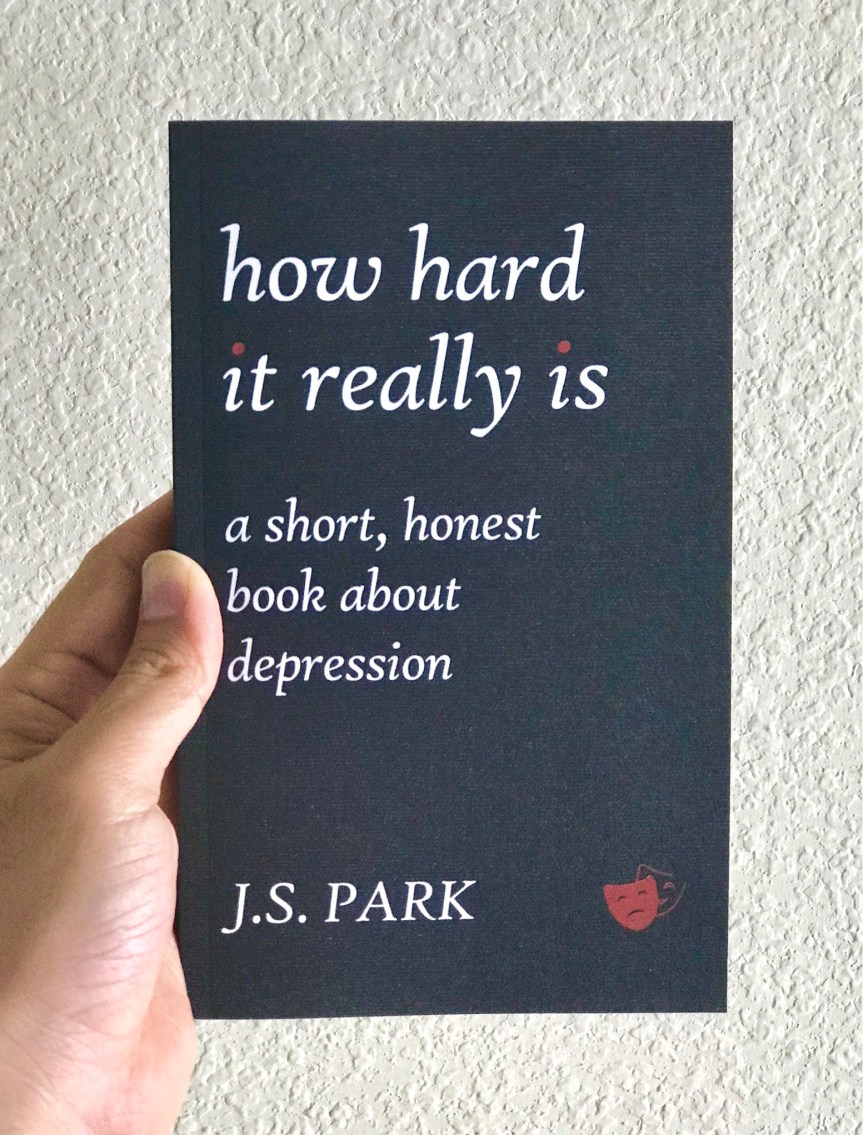
How Hard It Really Is: A Short, Honest Book About Depression


**Edit January 2018** My book on fighting depression has been revised with a new a cover and about a 10% change in content. If you’ve already purchased the book, please email me at pastorjspark@gmail.com and I’ll send a digital copy of the updated version.


Hello lovely friends! After a year and a half of painstaking work, my book on fighting depression is here. It’s called: How How Hard It Really Is: A Short, Honest Book About Depression.

The book covers:
• The science behind depression
• The helpful (and unhelpful) dialogue around mental illness
• The debate between seeing it as a choice or disease
• Stories of survivors
• A secret culture of suicide worship
• An interview with a depressed doctor
• The problem with finding a “cure”
• My own attempt at suicide
• A myriad of voices from nearly two-hundred surveys conducted over a year

The paperback is here. The ebook is here.

For my video on depression, check here: https://www.youtube.com/watch?v=xggg6xFObIE

Be blessed and love y’all, friends. A reminder that if you’re in a dark place, I hope you’ll reach out. You are truly more loved than you know. 
— J.S.


A Friendly Reminder: I Am Not Your Counselor and I Am Not a Journalist


I keep forgetting that most people on social media who act like authorities are young 20-somethings who haven’t seen much of the world and don’t know how it works. They want to change the world from their basement, or they’re just hungry to go viral. It doesn’t mean they can’t have an opinion. It means I need to double check theirs.

Bloggers are not your counselors or journalists. Most are just making up stuff with flowery words and “what I would do” sentiment. It’s not that we’re bad or wrong. But please keep in mind that most social media users care about your clicks, not your life.

I’m always asking, “Says who? By what authority? What makes it credible? Why do you believe it to be true? Why should I believe you? And how is it working out for you?”

Don’t trust me. Don’t believe me. Just because I have “followers” doesn’t mean a thing. Check the facts. For the love of God, triple check. Discern. Think for yourself. I can speak with authority on some things, but I won’t get it right every time. Trust with a closed grip.

J.S.


Photo from Unsplash

How Do You Know You’re Persecuted or Just a Terrible Person?

illuminirk asked a question:

how do you differentiate when you’re being persecuted for christ and being slammed for… for lack of a better word, for being a shitty person? for instance, i see a lot of american christians claiming persecution when really people are mad that they’re racist or homophobic or etc. how do you navigate that? how do you know?

Perhaps the simplest way is this:

Look around. Do you live in the West? You’re probably free to express your faith. So most likely you’re not being persecuted, but you’ve picked the wrong battle.

Look around. Do you live in the East? You’re probably not free to express your faith. So most likely you’re being persecuted, because you’re in the battle at all.

The thing is, early first century Christians were being persecuted simply for existing. Their faith was not primarily about self-improvement (though that’s in there), but about enduring the suffering of a cruel world. They didn’t have much room for political rallies or fighting for moral issues. They were in survival mode. They saw Christianity as the good news of a God who walked with them, rather than some kind of behavioral improvement tool. So while they did care about self-improvement, their first priority was merely survival.

Many Christians in the West today don’t experience the same kind of cultural suffering. They’re not in survival mode, so they’re focused more on self-improvement. I include me in this. It’s not a bad thing. I actually have space to think about how to better my own life and live like Christ. So sometimes Christians have too much idle time and pick the wrong fights in a free society. 

And really, when you have the chance to self-improve, it’s easier instead to stand up for some policy outside yourself. It’s a way to offload responsibility for your own actions: by trying to change laws or take the “moral high ground,” you then don’t have to look at changing yourself. Christians find it hard to follow Scripture, so they pick a path of lesser resistance (I include me here, too). It’s easier for Christians to shout really loudly in a free society than actually change their own self-destructive habits and live a useful, meaningful life.

I don’t mean that a person who experiences physical pain for their faith is necessarily a “real Christian.” Sometimes that’s just self-imposed martyrdom, and that’s selfish too. I mean that real persecution is about a cultural baseline of restricted freedom. If you’re free to express yourself, you’re not persecuted. If you express yourself and some people complain, you’re not persecuted. If you express yourself and some people call you mean names and avoid you at work, sorry, but you’re not persecuted.

Continue reading “How Do You Know You’re Persecuted or Just a Terrible Person?”

An Interview About Mental Health, Minority Stigma, and the Church Vs. Depression

I recently did an interview about mental health with a student filmmaker. My book on depression can be found here.

Disclaimer: I’m a hospital chaplain who does grief counseling and helps with end-of-life decisions, but I’m not qualified to offer medical advice. I’d recommend following @wayfaringmd, who is.

Continue reading “An Interview About Mental Health, Minority Stigma, and the Church Vs. Depression”

Real Dark Jesus


So my church showed this video of Jesus doing a bunch of miracles. Great production values. All non-whites, mostly authentic languages, culturally and ethnically reproduced to how it would look in the first century eastern world.

But — I was amazed and amused by the reaction of the church attendees (most of whom are classically westernized i.e. white). They were squirming like crazy the entire video. Like very, very bothered. It wasn’t hard to read.

I was smiling ear to ear that this video mostly got the “look and feel” of the actual first century east. But soon I became angry and sad that the church was so squirmy because they didn’t see western interpretations of white Jesus on the screen.

I’m sure this sounds silly and petty, but our preconceived ideas of Jesus, the east, and the grit of the first century plays a lot into how we view culture, faith, and “the foreigner.” Whitewashing is a big trigger word that’s overplayed, but it’s real.

And for evangelical Christians who are used to seeing a tall, handsome, blonde Jesus, this ain’t how it was. Not even close. By all biblical reports, he was ordinary, unattractive, unremarkable, and dark. Christianity is built on a guy that most of the west is scared of by default.

I’m super-glad my church risked an authentic interpretation of Jesus, and super-sad it bothered the church so much. I also had to wonder how many normative images I have in my head of beauty, truth, heroism, and villainy—and how these images have harmed how I see others.

J.S.


Photo from Image Catalog, CC0 1.0

I Care Too Much What Other People Think About Me


undefeatedx asked a question:

how do i stop caring about what people think about me?? 😦

Hey dear friend, I really wrestle with this, too. I’ve discovered in therapy that I’m a people-pleaser, even codependent, and I often have this crazy conspiracy in my head of small-town backroom rumors, where everyone I know secretly dislikes me and laughs about me in some seedy, poorly lit poker room.

A few things about how to deal with what others think about you:

Continue reading “I Care Too Much What Other People Think About Me”

My Top Ten Posts of 2017

Here are the Top Ten Posts of 2017 from my blog, ranging from topics such as North Korea, the 2016 election, crazy hospital stories, when people can’t admit they’re wrong, dealing with a friend’s depression, and surviving the world as an ugly Asian male.

Continue reading “My Top Ten Posts of 2017”

Grinches, Scrooges, and Grieving Souls: Christmas Is For You, Too


I know that for many of us, the Christmas season is a painful time. The festive celebration is in stark contrast to your own history.

It could be a dysfunctional family. Grief from loss. A lonely time. The heartache of a hard year. Or it could just be you dislike the whole affair. You can’t stand the egg nog, mistletoes, and holiday radio.

But that’s okay. Please know: You are not obligated to pretend happiness just because a certain calendar date has fallen on you. You have permission to be a Scrooge, a Grinch, a “downer.” No one else has to live through what you’re going through, and they will be long gone after telling you how to feel.

I believe that God can handle that. He receives you. He validates your grief. No one else can, not fully. He does.

And more, God’s invitation to rejoice still stands. Always. He won’t stop inviting you to joy. Through tears, even for brief moments, laughter can still bubble up and surprise you. Jesus broke in the same way: through dirt, grief, a lonely manger, he was light pushing through the dark. A surprise.

Merry Christmas, to Scrooges and celebrators. However you spend this time and through all you’re going through, I hope you know: you are loved.
J.S.


Photo from Images Catalog, CC0 1.0

How Do I “Let Go and Let God”? Does Working Hard Mean I’m Not Trusting God?

sunmoonandmyrtle asked a question:

Hi JS, I was wondering about the balance between trusting God and making your plans/taking action. I am a bit OCD about planning. My journey at the moment seems to be learning to let go of trying so hard and have faith in God to provide. On the other hand, I don’t want to be the kind of person who says God will bless them yet doesn’t work hard or look for ways to work smart. I’m not looking for a quick solution, but would be glad to just hear what you think. (I hope you’re having a nice day.)

Hey dear friend, I really wrestle with this too: When do I let go and “let God”? If I hustle and pursue, does that mean I’m not trusting Him?

Here are a few things I’ve learned about trusting God:

Continue reading “How Do I “Let Go and Let God”? Does Working Hard Mean I’m Not Trusting God?”

How Do I “Bring People to God” Without “Shoving My Religion Down Their Throat”?

caito8o asked a question:

How do you bring people to God without telling them that they are going to hell? Or “shoving my religion down their throat?” And how do you deal with people that tried Jesus and still don’t believe? I have issues with the way my church discuss these topics so I was wondering if you could bring some clarity. Thank you so much for your help!

Hey dear friend, I speak all this with absolute grace and love for you, and I’d like to go one further.

Hell is not a motivation for faith—but neither is heaven. If a punishment or a prize are the motivations for someone’s journey, then my assumption is that person hasn’t thought very far about why they’re on this journey at all. I’m reminded of that quote from True Detective:  “If the only thing keeping a person decent is the expectation of divine reward, then brother, that person is a piece of s__.”

If my goal is to “bring people to God,” that actually won’t work either, because we shouldn’t be trying to make it work. I don’t mean to assume your motives, but evangelism isn’t a score-card where we win people by attendance. No one is a project or a charity case.

Christians might not think we do this, but it happens in all kinds of unseen ways: we attract people until they’re baptized, and then the pastor stops talking to them. I’ve seen it hundreds of times. God can only naturally flow out of who we are and how we interact with others. God flows from my art, my expression, my patience, my generosity, and what I do with my free time. It’s not primarily a conscious goal to say, “See, this is God!” It was C.S. Lewis who said we can’t try to make good art, but that we make art and it might turn out good. It’s the same way with expressing God to others: it happens or it doesn’t.

Continue reading “How Do I “Bring People to God” Without “Shoving My Religion Down Their Throat”?”