
Compassion Fatigue: The Heartache of a Job That Requires All Heart

Anonymous asked a question:

I’m a medical social worker and quite new to the profession. For a long while I had thought that it was what I wanted to do in life. Now… I’m not quite sure. It’s exhausting and I’m not quite sure if it’s beneficial for my mental health in the long run… so many patients to see who need a lot of help but hospitals just want to hurry and discharge them. Part of me wonders if it’s worth it or is it better to just work an unemotional administrative job. Any advice? Prayer please

Hey dear friend, I’m sorry that you’re going through this. I also applaud you for choosing your profession. I work alongside many social workers (I’m a hospital chaplain) and y’all are seriously the best of the best.

A few things. If you haven’t done so already, I would consider seeking therapy. It helps. Anyone in the field of service and healing takes on so much, and it’s too much for any one person to hold. It requires processing.

I would find experienced people in your field and be in conversation with them. Process with them. Ask them how they did it and how they continue to do so.

Some hospitals are not like others. I’m fortunate to work at a really good one where the nurses and doctors really care. Your issue might be the place you’re working at.

You had also mentioned it might be better to work an “unemotional administrative job.” I can tell you right now, almost any job is emotional, including admin. It really depends on how your workplace helps you to deal with those things.

Which brings us to “compassion fatigue.” This is a very real issue. Some of us (like me) over-identify with our patients and tend to feel everything all the time. It’s not entirely a bad thing, but it can also be draining. Some of us (also me) have a bit of a savior-martyr-hero syndrome and really need to check our motives. We need safer boundaries and more spaces of rest. We’re likely to pour out so much as if this is “sacrifice,” when really it’s self-harm and it ends up harming everyone.

It’s helpful to know what your rhythms look like. It’s worth asking: When do you get most tired? Most hurt? What do you do for rest? What is your body telling you today? What are your heart and mind saying? How can it be changed for better today?

Two other important things.

Continue reading “Compassion Fatigue: The Heartache of a Job That Requires All Heart”
If You Say You Love God


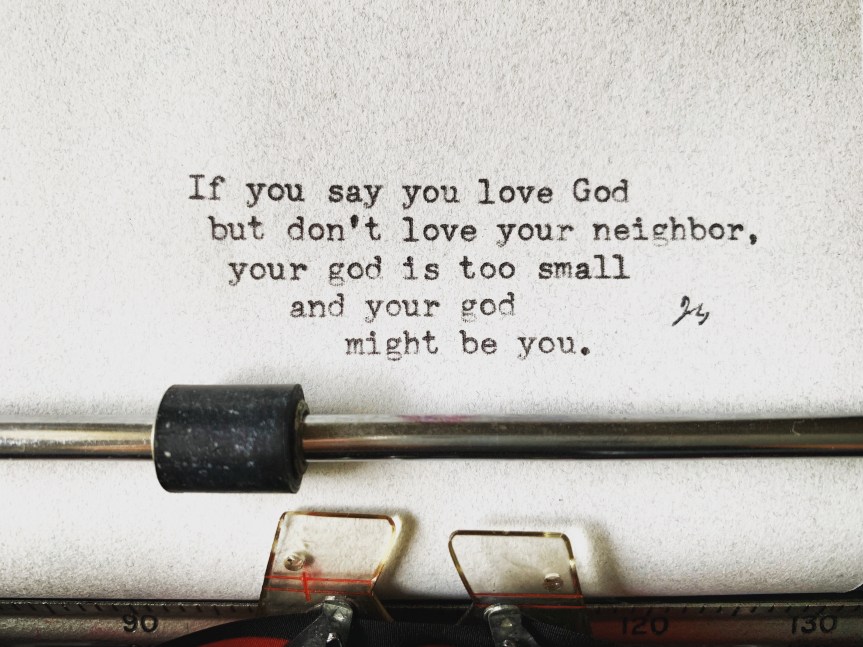
It’s super easy to preach “love your neighbor,” but the loving part is crazy hard. I think most people really believe they’re loving and kind when they have to be, but the second someone disagrees or causes inconvenience or looks at you funny, the love thing can go out the window real quick.

What I usually see online or in church or in politics or in marriages is that unless a person fits an exact specification of beliefs and behaviors and likes and dislikes, that person is cast out of the inner-ring. I’ve spent a lot of terrible energy trying to carve others into my own image, overriding their point of view, always waiting for others to “come around.” That‘s no better than hate.

It seems Jesus said that “hate is murder” because when we only accept the people who match our values, we are disappearing them. We’re essentially saying, “Be like me or you don’t exist. I’d rather you be someone you’re not.” This is hate, and it’s crushing somebody out of existence.

This is especially obvious in social media, when one wrong word gets you canceled. But it’s worse when it comes to religion. That’s attributing a supernatural superiority to hatred. It gives an awful permission to say, “God said it, not me.” Which is cowardly. And if your god always agrees with what you believe and only likes the people you like—that god is the one you made up to justify your bitterness and to boost your ego. It’s a push-button keychain god that does your bidding. It isn’t the God who will challenge you, stretch you, surprise you, and who loves the people you can’t stand.

No, we cannot love all the things that people do. Yes, I believe in accountability and justice and boundaries. But over all, I want to love my neighbor for who they are and not for my version of them. I believe not in who someone should be, but could be. It’s the same way that I believe God loves a guy like me.

J.S.

I Am Not My Depression

Anonymous asked a question:

Hi J.S., as someone who has been diagnosed with depression, GAD, and PTSD, your writing has been a huge comfort. I wanted to ask this – have you come to accept your battle with depression? I still struggle to accept that my mood is out of my control. My faith has been rocked after the past few years of intense battling. I still get discouraged when I think that I have to work so hard to feel “normal” and even then, normalcy isn’t guaranteed. How do you continue to trust God and fight through?

Hey dear friend, first I want to encourage you: You are loved, you are incredible, you’re doing great.

My answer to your question, “Have you come to accept your battle with depression?” is both Yes and No.

Yes, I recognize that my brain is broken. Something essential to my well-being will always be missing. I will, out of nowhere, seemingly at random, fall into the abyss for long seasons. One day, my depression might win. I have accepted it as much as any person can accept they are mortally wounded. I have accepted the hand I’ve been dealt.

But no, I do not accept my depression. I am angry. I am livid. I am insulted by it. I hate what it does to my friends and family. And I have to fight. It’s exhausting. But I have to scream no. And I think part of my non-acceptance is what keeps me alive. I do not accept that God wanted this for me. I am open to therapy, to medicine, to every treatment available. I have to fight.

Continue reading “I Am Not My Depression”

I Am With You.


I am with you.
I am for you.
I am sorry.
I love you.
How can I help?
J.S.


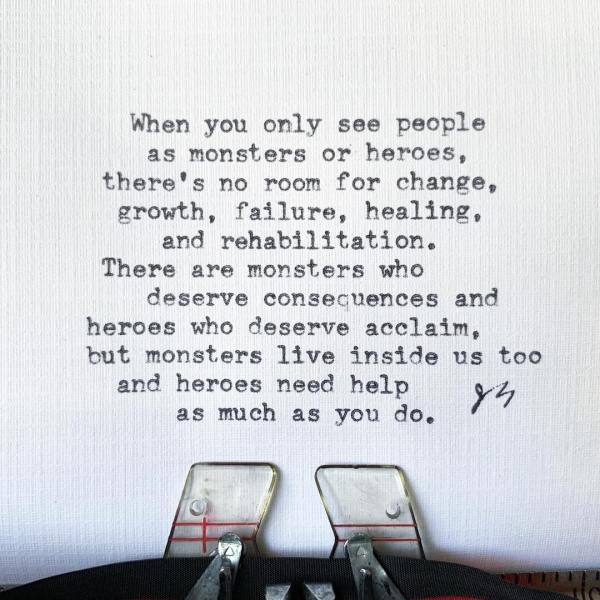
Only Heroes and Monsters


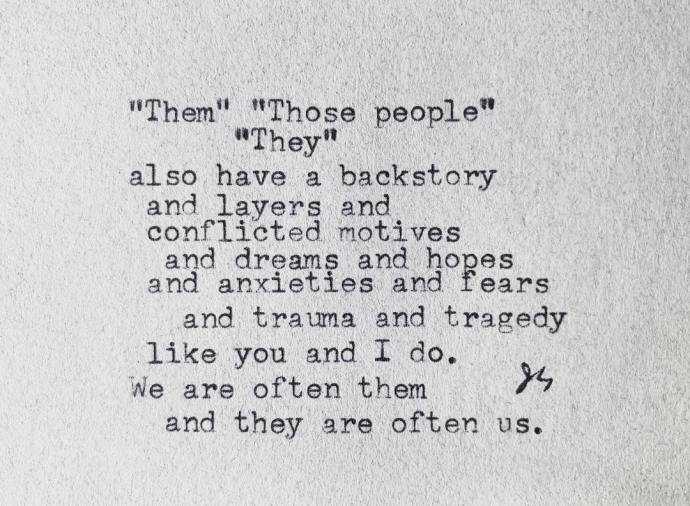
No one is the one-dimensional, evil caricature that they’re painted to be.
No one is the shiny version of a person that’s worshiped on a pedestal.
It’s easier to hate a cartoon-parody idea; to denigrate a hologram; to blast the artificial; to praise the effigy. It’s easier to demonize a faceless, disembodied, phantom enemy.
If you and I could sit down for coffee, we would discover hidden layers, messy dimensions, buried motives, unspeakable trauma, two fractured people hanging on.
We are wildly struggling, conflicted, complex.
We are not wholly evil nor holy good.
Yes, monsters deserve justice for their crimes. Heroes deserve more applause. But I will pause to consider that we are often both. We can be our own worst enemy, and we are just as capable of being our own heroes, overcoming the worst of us with the best in us.
Across a table, chair to chair, eye to eye, we might disagree—but I hope we will learn how we came to be. To hear the whole story.
— J.S.

A Time to Speak, a Time to Pause


I’ve seen bloodthirsty demands that “public voices” must speak on every social issue.

There’s a harsh condemnation on the silence of celebrities, clergy, artists, authors, and your average blogger—as if that silence was the same as the injustice itself.

I absolutely agree we must speak up. Silence perpetuates the status quo. I believe in the the gritty necessity of protest and picket signs. We cannot sit idly by in the isolated concerns of our own four walls. Silence is the accomplice to injustice, and I expect better from those who have the golden reach of influence. Our platforms have a responsibility.

I also wonder about the hasty speed we comment on issues which are still unfolding. I wonder how many half-informed people are writing too quickly to get clicks and views and attention and to catch the viral heat of the moment. I wonder if we can both raise our voices while listening across the widening divide. I wonder how we can slow down in crisis to engage with the hurting rather than brew up a think-piece for yet another grand, eloquent, self-promoting manifesto. (I know, I’m guilty of doing the same thing here.)

And I wonder why we demand so much from public voices, as if we are waiting to be told what to think. Or worse, to validate a preprogrammed opinion. Maybe those voices indeed have the power to change things—but we do too, starting with ourselves and the people in the room. We don’t need to know everything first. We can start with the stories across from us.

It‘s physically impossible to care about everything all the time. We can choose to be passionate for just a few crucial things in our very short time on earth. It can’t be done with a flashy, trashy headline that’ll be forgotten in a week, but by the accumulative power of listening to other voices as we find our own. I cannot speak for you, but with you. And if you and I are to be a voice for the voiceless, maybe that means stepping off the stage and passing the microphone to the unheard. I want to hear you.
— J.S.


https://instagram.com/jspark3000

Forgiveness Is Not Friendship


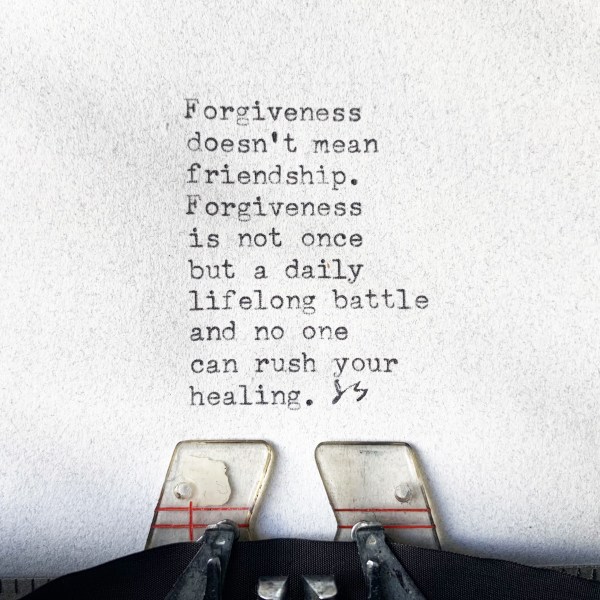
It’s unfair to rush someone into forgiveness. It’s powerful and necessary, but forgiveness is not a one-time moment that magically seals up the wound. It takes a deliberate, daily battle over a lifetime. That occasional angry twitch doesn’t mean you’ve failed at finding peace; it’s only part of the process. Let it happen. It hurts because it meant something. It has to pass through your body, like flushing out poison. No one is allowed to rush your healing, including you. No one can just “get over it.” It’s your pain, your pacing, your tempo. But I do hope to see you on the other side, where there’s freedom. You can take all the time you need, and I’m with you.
J.S.

Are You Secretly a Liberal Who Hates Conservatives?

Anonymous asked a question:

You always seem to rebuke “conservative” types who remake Christ in their political image. What about the liberals who do the same? I remember you shared this great post about how ~Christians~ will end up not falling into neat, political distinctions, and then all I see on your blog is this not-so-subtle finger wagging at conservatives? Where’s that energy when people want to turn Jesus into an anarchist revolutionary? A communist?

Isn’t God multi-faceted? Can’t God be operating on many different levels, not just the one where He’s taking care of us ~poor minorities~, with all of our ~Immigrant Virtue~? I’m not for conservative, pro-life, MAGA Jesus but I’m also not for socialist, bleeding heart, liberal Jesus either. They’re both idols. They’re for people who wear ideological garments instead of garments of righteousness. Neither make it into the Kingdom of God.

I agree with much of what you said. I may be blind to my own bias, as many of us are, and maybe I have given disproportionate weight to one side or the other. I’d like to think I have held myself and all groups accountable, but maybe not. For that, I very much appreciate that you’re pointing this out in me. I get many things wrong, and this might be one more. I have more to learn. Having said that, I’d gently like to offer a little pushback, too.

Continue reading “Are You Secretly a Liberal Who Hates Conservatives?”

Loving “Them.”

The nurse told me that the patient Willard had taken a bite out of another nurse. He had swung at one of the doctors and thrown urine at a surgeon. Willard couldn’t walk; he kept demanding to go home. “Get me a wheelchair, I’ll flop in and ride over you people.” The staff kept trying to get him to stay, to get treated, despite his violent non-compliance, because nurses and doctors have the guts to look past that stuff.

The staff called for a chaplain, and I was the lucky one. I walked in and saw the patient had a tattoo of a swastika on his hand enclosed in a heart.

My eyes locked on the swastika first. The symbol held a terrible place in my memory: when I was a kid, someone had spray-painted a red swastika next to the front door of my dad’s business. Though my dad had tried to paint over it, I could still see it on hot summer days, a scar on the wall and a scar in my head, a mad throbbing declaration of all the world’s ugliness dripping in crimson. I still dream about it sometimes, and in the dream I’ll peer down at my wrists, engraved with the same red marks down to the veins.

The patient, Willard, saw me and said, “Thank God, a chaplain, finally someone who can hear me.”

But I didn’t want to hear him. And a part of me also thought, “You deserve this. I hope you never leave. Then you can’t hurt anyone out there.”

He said, “Look, I see your face, I’m not trying to hurt anybody. You get it? I just want to go home. Fetch me a f__ing wheelchair, would you?.”

Willard got louder. He clenched his fists and waved them around. He went into an f-bomb monologue about the staff, “you people,” about the whole dang world.

I had half a mind to leave. I didn’t have to stay. I didn’t want to stay. I kept looking at that swastika. I kept thinking he deserved to be here, to be sick and sorry and helpless.

When Willard stopped talking for a moment, I said the only thing I could think of.

Continue reading “Loving “Them.””

My Top 12 Posts of 2018


Here are my Top Twelve Posts of 2018, including topics like the benefit of grief, dealing with depression in marriage, misogyny in the Bible, people-pleasing, and my brush with suicide this year.

For all my typewriter posts, click here or my Instagram here.

My top two selling books this year were the one on fighting depression and the one on King David.


12) Grief Over the Death of a Loved One: To Move On or Hold On?

11) I Called the Suicide Lifeline

10) An Interview About Mental Health, Minority Stigma, and the Church Vs. Depression

9) Angry About Anger

8) I Want My Life to End—What Do I Do?

7) I Have Doubts: Am I Allowed to Say That?

6) How Do You Know You’re Persecuted or Just a Terrible Person?

5) Working Through Depression As a Team: What to Do and Not to Do with Your Friend’s Mental Health

4) I Think I Hurt Someone: How Do I Clear the Air?

3) I Care Too Much What Other People Think About Me

2) What’s Up with the Bible Saying “Wives Submit to Husbands”?

1) “Suicide Is a Ticket to Hell” (and Other Bad Theology)

To Love Is to Fight.


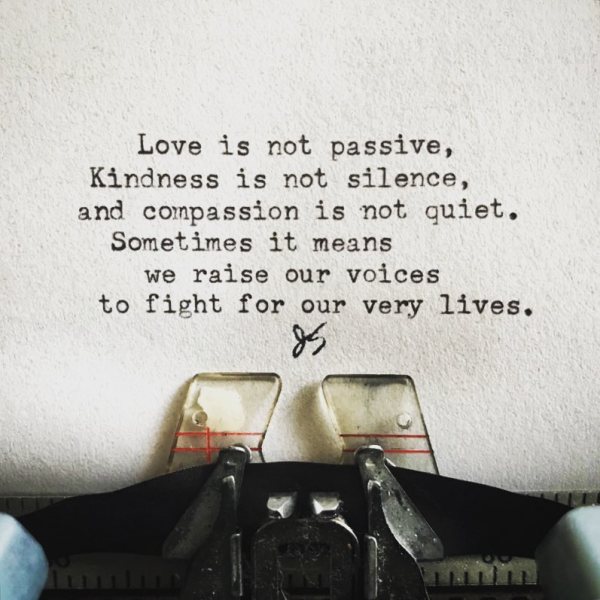
I’m all for love and patience and understanding and compassion —

But there’s also a time to say enough is enough. There’s a time to vent, weep, scream, shake a fist, and to simply be mad. There’s a space when things aren’t okay and the injustice is still a fresh wound and no one is supposed to tell you how to feel. We need to grieve before jumping to commentary and those extra little points of debate and platforms and policy. We need to grasp the magnitude of what happened without rushing to a better place, so we can do the hard work of healing deeply, and to ensure that justice is not forfeited for the sake of politeness. Sometimes love has to be outraged, because it won’t sit down and take anymore of this. Sometimes love has to get up and fight.

— J.S.

I Think I Hurt Someone: How Do I Clear the Air?

purposedinthecosmos asked a question:

Sometimes we do good things that people may perceive as bad especially if they don’t know the heart behind our actions. Is it necessary to clear that up? Also how can you not be hurt by the way people (think) you treated them or who they (think) you are?

Hey dear friend. I would validate what the other person says with as much reverence as you can.

If someone thinks you have harmed them, even if you have tried to help them, I would consider taking them seriously and being open to hearing them out.

If a person says, “You hurt me,” they are saying it for a reason. It might not always be the best reason, but that’s why a discussion needs to be had.

It’ll be messy and sloppy and full of embarrassing cringe, especially if this is between friends, but that’s how friendship goes. Friendship isn’t all fun and games, but requires the weird work of meeting in the middle between two different wills.

On one hand, what someone feels might not be the best reflection of what is truly happening. On the other hand, I would never want to outright dismiss a person’s pain, regardless of what I might think about it.

Continue reading “I Think I Hurt Someone: How Do I Clear the Air?”

Grief Over the Death of a Loved One: To Move On or Hold On?

Anonymous asked:

How do I deal with the death of a loved one?

Dear friend: I’m so sorry. A close death is one of the most difficult things you will ever experience. There’s almost no getting over it. Grief is less like a cold and more like a shadow, always lingering even in the brightest light. It gets easier, but it stays with you in all kinds of ways.

As a hospital chaplain, I have seen hundreds of people die now, and there’s no formula or plan or mantra to get you through. All the hard things you’re feeling, whether it’s numbness or waves of pain or a deep soul itchiness or a tight chest or an empty stomach or rivers of tears, are all a part of grief. You’re not crazy. You might see a random thing that will remind you of your loved one, and it will hit you in the gut. You might visit a street or see someone’s smile or hear a movie quote that reminds you of everything, and it will hit you all over again. That happens. You’re not crazy. 

Continue reading “Grief Over the Death of a Loved One: To Move On or Hold On?”

Everyone Has a Vision for Your Life


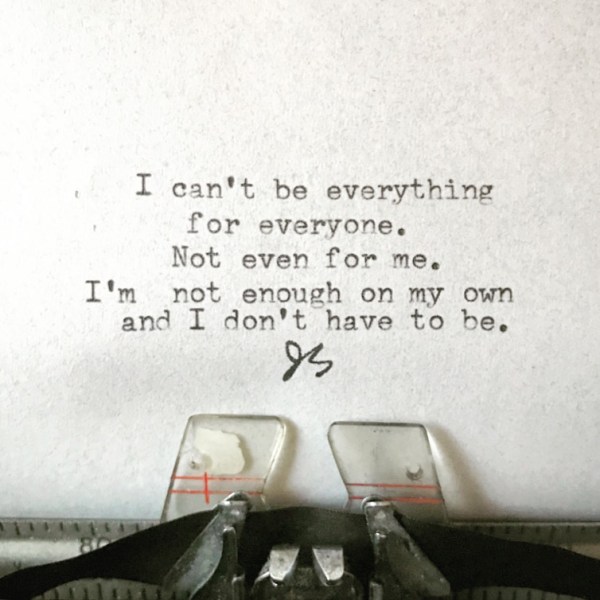
Everyone has a vision for your life. Everyone knows who you ought to be. Everyone has advice, the right answer, the easy fix.

But no one can bear the burden of those expectations. You can’t be enough all the time, not even for yourself.

You will disappoint people. You will disappoint you. It happens. It hurts. And that’s how it goes. The eventualities of life have a way of creeping in, regardless of best efforts and right motives.

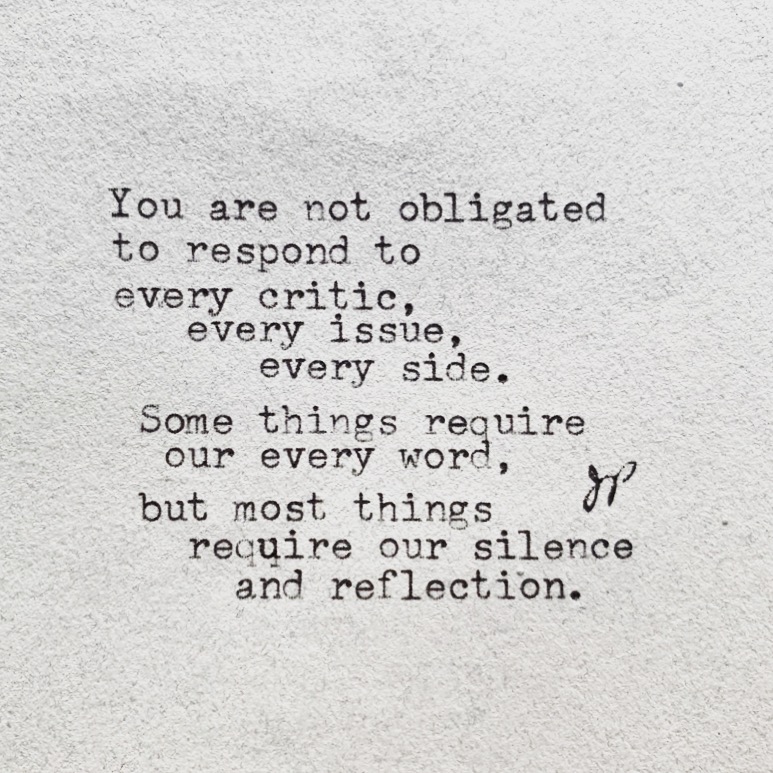
You will get crushed by the weight of others’ plans. But you’re not obligated to respond to everyone’s criticism all the time. There’s no pleasing everyone. Some will have already made up their mind about you, no matter how much you sing and dance. Your side of the story won’t always be heard. Your intentions will be negatively filtered and your words shot down at first glance. That’s okay. Criticism is important, but you can’t speak on what you didn’t say. You can only mean what you did say, and mean it well.

Be encouraged, friends. You are doing a good thing. A new thing. By the grace of God we do our best and get up again.
— J.S.

I’m Sorry, My Misogyny.


One of the sad things I recognize more and more is that my view of women has been poisoned from my own traditions and from culture at large. It took me a while to see how distorted my ideas of women were. I’ve had to unlearn so much gross misogyny.

For example: I was rewatching a romantic comedy from a decade ago, and the male lead stops the woman from leaving, grabbing her arm and totally blocking her. The male lead “wins the girl” who has no life or mind of her own, and all he has to do is be mopey and constantly pine after her. He also violently terrorizes his ex-girlfriend and her new boyfriend. The movie should have been called “I Swear I’m a Nice Guy: Black Mirror Edition.”

It’s all supposed to be cute and heroic. It’s nauseating. And I wonder how much I’ve taken my cue from these “romantic” gestures that are only aggressive, territorial, and bullying.

The Christian world hasn’t been kind to women, either. The church is called to be the most loving place on the face of the earth. It isn’t. Not even close.

I can’t blame all these external things. I know it’s on us. It’s on me. I don’t have an adequate apology. I’m not attempting false humility. I can only say I’m sorry a million times for how I’ve viewed women. I’m thankful for my wife who is gracious. I’m thankful for people who speak up at a cost. I ask for forgiveness.

J.S.


Image from Unsplash

We Wear Casts.


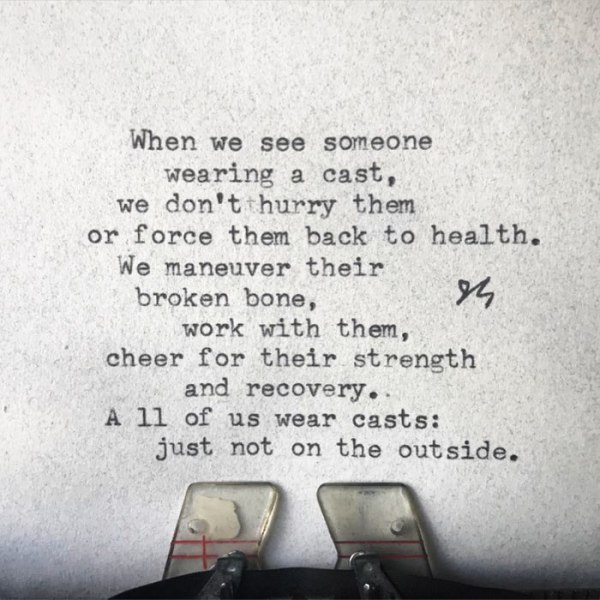
God, forgive me for when I lack empathy,
when I jump to making talking points out of tragedy,
when I forget the pain of community and family,
when my voice is louder than theirs.
— J.S.

Strength to Fight.


“May God bless you with discomfort at easy answers, half truths, and superficial relationships, so that you may live deep within your heart.

“May God bless you with anger at injustice, oppression and exploitation of people, so that you may work for justice, freedom and peace.

“May God bless you with tears to shed for those who suffer from pain, rejection, starvation, and war, so that you may reach out your hand to comfort them and turn their pain to joy.

“And may God bless you with enough foolishness to believe that you can make a difference in this world, so that you can do what others claim cannot be done.

“Amen.”

— A Franciscan blessing

Love Doesn’t Enable, But Empowers.


I fell for the romanticized, destructive idea in both church culture and pop culture that we must constantly “love and forgive and give away,” a sort of martyr-hero syndrome that guilts us into perpetual generosity.

I spent too many years consumed by the “sacrificial radical love” model of Christianity, which required that I pour out more than I had—but it only scooped out my guts and left me bitter and resentful and exhausted.

To love must include truth, wisdom, and boundaries. Sometimes it means distance. It means knowing when to rest and recharge and to embrace our limits. It always means to have grace for yourself, too.

And to love is not enabling, pampering, coddling, or letting someone off the hook—or it wouldn’t really be love at all. There’s a way to help others that really hurts them because it only feeds into their harmful patterns.

For those who have been abused or traumatized: Forgiveness doesn’t mean friendship. No one should ever be rushed into forgiveness, not for the sake of “getting right with God.” Not for trying to look like the “bigger person” or “because it’s the right thing to do.” We need to recognize patterns of unrepentant abuse and gaslighting and manipulative language that will only guilt-trip back into a vicious cycle. We can never mindlessly open the door again on an abusive relationship. You have the right to say “no.”

God does redeem the evil, yes, but God is for the victims, for the abused, for the survivors, too. God is for the exile, the foreigner, the despised, the despondent who crossed the Red Sea. God is for you.

— J.S.

Squishy Small Brain.


Note to future self:
When you don’t get it right —
Apologize quickly and let go.
Don’t beat yourself up or defend yourself too long.
Humans are squishy with small brains. We don’t get it right every time. And that’s okay. Being wrong is not the end of the world.
— J.S.

No, You’re Not Persecuted.


There is a particular Christianese language that demonizes “the enemy” and “the infidel,” in which “God is on my side” and “They’re holding me back.”

This triumphalistic self-affirming theology, wrapped up in warfare terms and royalty cliches, cannot stand criticism.

It assumes all disagreement is trolling.

It attempts to say “I have the truth” as if truth must be weaponized to hold over someone’s head.

It breeds yes-men and an insider’s club.

It moralizes its own values based on “who we are not.”

It is an anti-theology that covers deep insecurity with little fleeting boosts of ego.

It attacks the most minor offenses in “secular worldly” culture in order to play victim—when sadly, Christians and truly persecuted groups are killed daily overseas.

I’m guilty of abusing the persecution complex, too. It’s incredibly easy to fall into a dichotomous division between in-groups and out-groups, between my church and your church, my dogma versus yours, to feel important, as if by lots of motion I am really moving. It’s easy for me to write a post like this and presume that I’m above all of it somehow, as if by mere awareness I have it figured out. It’s easier to look certain in our convictions rather than say, “I don’t know, I’m still figuring it out,” or, “Can you help me understand?”

In the end, Jesus told us to love our enemies. Yes, them. To them, it’s us. Every person in this discussion needs grace and a generous space. The people who “don’t get it yet” are also you and me. The people who cry “I’m persecuted” need as much grace as you and I do. I pray for me. I pray for you.

— J.S.