The Gritty, Raw Dance of Marriage


Marriage is hard. Pretty pictures and bite-sized highlights might give you a false impression that it only takes sparks and looks: but the gritty reality is work, tears, and sacrifice. It’s a dance, everyday, to compromise and serve. In the depth of this tough humility, there can be great beauty. Real joy requires a fight from our very best.
J.S.


Photo by The Ganeys

The Thinnest Thread Across a Chasm: I Survived.

001-blue


I did this photo shoot a few years ago with a ton of smiles and silly faces—but this picture was a bit closer to how I was really feeling. It was during one of the most miserable seasons of life, when depression had hit full force and I was contemplating The End every waking moment. I had gained over twenty lbs from binging and I randomly fell asleep in my office and I kept letting go of the steering wheel, daring myself to crash. No one knew what was happening; I tried to tell someone but he laughed it off: “Look at you, how could you be so stressed when you’re so blessed?” So I kept up the smiles and silliness, all while my insides were wax dipped in acid, melted to the thinnest thread, stretched between bones across a chasm. I was Zeno’s paradox, motionless in motion. I was begging God to kill me.

I wanted to give up: but no. God said no. He was stubborn, and so I was, too. I hustled. I fought the dark with everything, both fists swinging, screaming and laughing at the same time, crawling by my bare fingernails to the lip of the well I had been cast down. Slowly, painfully, somehow, I made it through, mostly because I kept waking up and I was astounded to find myself still breathing, and because I gained ground by inches. Colors returned; the fog lifted over time; I found people I could tell; I got a dog and I lost the weight and I survived. It’s not as romantic as it sounds, and I don’t know if the next one will win. But that time, at least, I did. He did. God didn’t answer my prayer then, and it was the best “no” that I’ve ever gotten. I’m here, just barely. So is He, completely.
J.S. Park

Can Shaming Really Motivate? 4 Thoughts About Shame, Guilt, and Change

waylandheat asked a question:

Hi J.S. Park! I’ve been reading your book What the Church Won’t Talk About because I am currently struggling a lot with stuff and on top of that feeling a very dry season with God. I honestly love reading through your thoughts and stories on Tumblr, and reading through this book has brought me a renewed perspective on things- so thank you J.S. Park for being a light in so many lives! I don’t know if you have written anywhere on it before- but have you ever shared your thoughts on shame?

Hey dear friend, thank you so much for your encouragement and your kind words. I really needed them today. Also the book you’re referring to is here for anyone interested.

Here are a few thoughts about shame:

1) Shame is a very poor motivation for long-term change.

Shame is that sick physical feeling of being washed through with a debilitating shiver; emotionally it can be an internal bomb of embarrassment, grief, anger, or regret; psychologically it feels like losing self-worth and value. We try to escape this feeling as much as we can—it’s an awful, nauseating, dizzying flush that your entire body recognizes on impact.

Shame is socially weaponized to coerce others into “doing the right thing.” Other times, it’s just to make someone feel like a terrible person, like they could never do any good. In the best case scenario, “shaming” would create the desire to reflect and change your ways for the better. It provokes a sort of social conformity in which you must fall in line for the common benefit of everyone else.

You can see shame tactics being weaponized everywhere. Think of every “public shaming” blog, made famous first by Tumblr, that calls out your fave celebrities for being problematic or mocks the guy who uses the entire four-chair table at Starbucks. Think of books like Battle Hymn of the Tiger Mother or movies like Whiplash. Think of the model who was recently charged for “fat-shaming” (the actual charge was invasion of privacy, and rightly so). Think of this recent method to help quit smoking, in which if you relapse, you donate the amount of money you’ve saved off cigarettes to a campaign that you hate (this combines shame with aversion). Think of a typical evangelical preacher, who uses fear, shame, and fire-and-brimstone to manipulate you into “getting right with God.” Think of terms like “slut-shaming, virgin-shaming, gay-shaming”—and the list goes on.

In the short term, some studies show that shame can make change. However, other studies show that shame is destructive and does permanent long-term damage.

I believe that shame doesn’t really work as a motivation for long-term change. All it does is modify behavior to look like it’s conforming, without actually getting to the root of the issue.

For a great talk about shame and vulnerability, watch Brene Brown’s TED Talk, the most watched TED Talk of all time. Her research is the absolute seminal work on this topic.

2) Shame and guilt are two entirely different things.

You’ve probably heard this by now, but guilt is saying, “I did something bad,” while shame is saying, “I am bad.”

It sounds like splitting hairs, but our approach to both can have entirely different outcomes.

If we can adapt to guilt—”I did something bad”—then we can focus on the how and why of the behavior and even internally change our motivations.

If we adapt to shame—”I am bad”—then there’s no room to look at how and why we do things, and instead can only use punishment and external deprivation to make change. This in turn only makes us craftier and more likely to suppress our true motivations without changing them.

We’ve all seen this before. You can have two people who attend church sit side-by-side who look exactly the same: they show up on time, they donate to charity, they bring coffee and donuts, they read their Bible everyday, they mow your lawn for free. But one is motivated by the anxiety of possible punishment and always compensating for a terrible gap inside them, as if they’ll always be found out. The other is motivated by doing good purely for the good in itself.

Of course, our motives are very messy and never this clear-cut. We could be a blend of both. But the next time you mess up, pay attention to your thoughts and feelings. Do you feel guilt or remorse or even anger about the thing you did? That’s more or less normal. Or do you disproportionately beat yourself up and wish you could disappear for a week? There’s probably buried shame that’s been carved into you by condemning voices over a lifetime—and really that’s no fault of your own. Many of us have been indoctrinated since birth to only respond to shame, and so we’ve become maladaptive.

Continue reading “Can Shaming Really Motivate? 4 Thoughts About Shame, Guilt, and Change”

Depression: The Sneak Attack Phantom


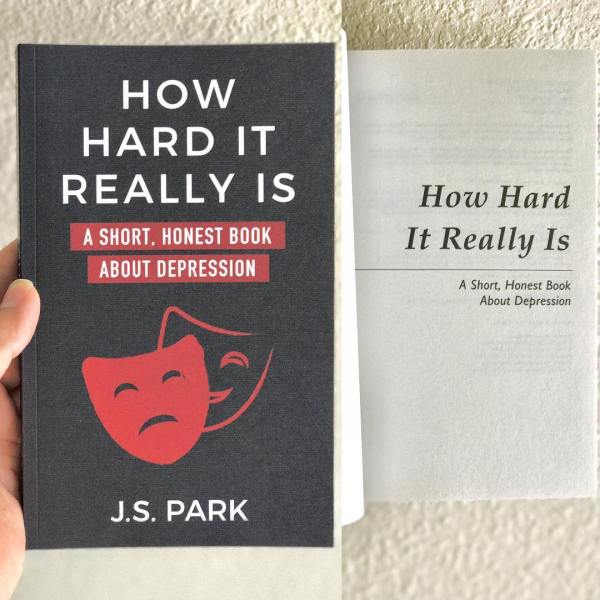
This is the Preface to my book How Hard It Really Is: A Short, Honest Book About Depression.


Depression is a rumor, until it is reality, and then it’s as if nothing else was ever real. Still, no one will believe you. I find it hard to believe it myself. I wrote this book for those who believe, and for those who want to.

Depression is, when you’re in it, absolutely ridiculous, because it seems to be the most important thing in the world when it’s happening. At the same time, it robs the world of any importance, as if nothing could ever happen again. It is a nightmare of infinity wrapped in cellophane.

Whenever I describe it happening, it sounds absurd. And it is.

At the grocery store I’m thinking about how to grill this salmon, and my chest folds inward, a curled up canvas of wax paper in a cruel, gnarled fist. It’s the familiar feeling of drowning, of disappearing in frothing acid. I fight back both tears and laughter, and I tell myself, Everything’s fine, everything’s fine, a cognitive trick to pull myself out of the falling, but nothing is fine, nothing is fine. There’s nothing I can do. My basket full of trinkets is weightless and a wrecking ball. I see people rushing to somewhere, but the illusion of significance slips away in a long, defeated sigh. I hate this part. My shoulders crumple because I’ve stopped holding them up. I can barely look at the cashier and I don’t remember paying when he hands me the receipt. I can’t turn on music in the car; it’s unbearable to turn the wheel. I’m someone else’s ghost in someone else’s body.

I wish I could say it gets easier each time, but I never know how long it’s going to be.

I never know when the colors will come back.

I never know if this will be the one that wins.

The bad news is that I don’t have a magic formula, a six-step cure, or a silver bullet. I wish I did. But I don’t believe there’s a right combination of words that will unlock depression.

The best thing we can offer each other is each other, our set of experiences, our voices, our ears, so that the tunnel is less intimidating and the light is not as distant as it was.

I wish I had more than this. I wish I could cover every angle. Maybe, though, I can cover a few.

At the very least, I can tell you what I’ve been through, and what’s worked for me. And maybe some of that will work for you, too.

— J.S. Park | How Hard It Really Is

Dealing with Depression: What to Say (and What Not to Say)


There’s a lot of unhelpful dialogue when it comes to depression and the way we talk about it matters. As a lifelong fighter of depression, here are some things I’ve learned to say (and not to say), and how presence matters more than advice.

My book on depression is here: https://www.amazon.com/How-Hard-It-Really-Is/dp/B073TX15LB/

This is the first in a series of videos called “Where Faith Meets Life,” covering topics like politics, abuse, marriage, and mental illness.

Subscribe to my YouTube channel here: https://www.youtube.com/user/jsparkblog

Be blessed and love y’all, friends!
J.S.

Real Joy Actually Hurts


It can be easy to romanticize a passion or a social cause or a marriage or raising kids with tons of posed pictures and flowery words—but all such things are gritty, raw, rough, and painstakingly sculpted from our fully invested hearts. There is a lot of standing around and sweating through our shirts and seasons of self-doubt and all the frustrated parts that no one else can see. We fall in love with highlights but these were formed in the valley. Please don’t be seduced by soundbites and filtered photos and bowtie daydreams. Real joy actually hurts, but that’s why it’s real. It was carved from the best of us.
J.S.


[Photo by The Ganeys Photography.]

The Deal with North Korea


Here’s the deal: If you share any misinformed hype about North Korea, I’m blocking you here and I’m done with you in real life, for good.

North Korean citizens are scared, exhausted, and threatened daily into falling in line. They’re in constant fear of death or worse. They’re imprisoned and tortured for the smallest infractions, and about 3500 die every month from starvation. The very few in power in NK are the monsters, not the people. The entire nation is not some one-dimensional evil entity: it’s comprised of families, and they want peace as much as you or I do.

If your only idea of North Koreans is a ridiculous caricature from action movies or ratings-driven media, then don’t speculate. Either learn or seriously shut your mouth.

Those of you hyping up North Korean panic are exactly the reason why there’s a panic. And yes, you know who “you” are. I’m especially appalled and ashamed at the evangelical American church for fear-mongering and flag-waving about North Korea. I’m shaking as I write this and absolutely disgusted at your antics.

I pray for North Korean citizens. Their liberty is one of the very few times I’ve marched in front of the White House in raising peaceful awareness of their awful conditions. Please pray with me and help however you can. Start with clamping down on misinformation.
J.S.


Photo by Stephan, CC BY-SA 2.0

A Flag Salute to Life.


At the hospital where I work, whenever a patient dies and donates their organs, a flag is raised for them. One life for another: we honor you.
J.S.

I Need Your Help: Test Readers


**Edit – June 17th**

Dear friends: The draft of my upcoming book on depression has been sent to your email. Test reading has begun! If you’d still like to join, please email me. Love y’all friends, and thank you again for making this possible. — J.S.

pastorjspark@gmail.com


Hey friends, I’m giving away a draft of my book on depression before it’s released. All I ask for in return are feedback and a review on Amazon.

If you want to be a test reader, please send me your email to
pastorjspark@gmail.com

and I’ll send it as soon as it’s ready. The final book will be out this summer. Love y’all, friends. — J.S.

My Friend Won’t Forgive Me for My Depression


Anonymous asked a question:

My roommate used to be my best friend. However, I became incredibly depressed from last year until about a month ago, and that severely strained our relationship. Even though I don’t believe I should apologize for everything that happened (because I was depressed), I have a bunch of times and asked her for forgiveness. She has yet to say to me “I forgive you” and hasn’t ever apologized for the things she did to me. I don’t understand how a “Christian” friend could treat me like this.

Hey dear friend, I’m sorry this happened, and I’m with you: I’ve wrestled with depression for a lifetime, and I know how it can take us over and make us irrational and out of our minds. The harm we do is not intentional and not our fault. And I know how awfully insensitive the general culture can be towards your depression, from ignoring it to mocking it to offering all sorts of wrong theories on how to get “cured.”

Now, I have to say the very difficult truth, and I’m saying it entirely with grace and empathy and love for your situation as well as my own. I say this attempting to balance my heart for you as well as for your friend.

Unfortunately, the bad news is that your friend is not obligated to forgive you. As much as she tried to stay, she also has every right to leave. She’s not obligated to apologize, and if you’re holding her apology to a “Christian standard,“ that’s rather gaudy and even malicious. This sounds cold and unfair, but to expect every single person to stay through our mental hardships is to ask them to be God, and is almost just as burdensome as enduring depression itself.

Both pop culture and church culture might teach you a romanticized, whimsical way to “always be there for someone,” but it’s never that easy. Dealing with a depressed person (like me) is exhausting and draining, and it requires a help far greater than many of us can give. Not everyone is built to endure these sort of things. I don’t blame them: my depression is so severe, I cannot imagine who’d be left in its wake.

I’m sure you never meant to hurt your friend while you were depressed, but she was indeed hurt, and she is not required to still be your friend, your confidant, or your companion through your journey. Your friend is not your therapist. Your depression and mine are not some “quirks” to be glossed over. Most likely, our depression will ruin many, many more friendships. I wish friends would stay, but so often they don’t, and I’ve come to make peace with when they won’t.

Consider the words of famed journalist and professor Andrew Solomon, who has written the definitive work on depression called The Noonday Demon, and who himself suffered a depression so severe that he tried to contract HIV from male prostitutes to kill himself:

“Depression is hard on friends. You make what by the standards of the world are unreasonable demands on them, and often they don’t have the resilience or the flexibility or the knowledge or the inclination to cope. If you’re lucky some people will surprise you with their adaptability. You communicate what you can and hope. Slowly, I’ve learned to take people for who they are. Some friends can process a severe depression right up front, and some can’t. Most people don’t like one another’s unhappiness very much.”

Our depression certainly takes us hostage and hijacks our brains into doing things we normally wouldn’t do, but please allow me to dispel you of the romantic notion that everyone must stick through “thick and thin.” Movies and TV shows can make mental illness look quirky and appealing, but in real life, it’s nearly impossible for my friends to endure with me when I fall into depression. It’s intolerable and insufferable. While it’s true that we are not ourselves when we’re depressed, the injuries we have caused are still very real, and it is our friends’ choice to draw boundaries when they feel unsafe around us.

Continue reading “My Friend Won’t Forgive Me for My Depression”

Ugly Asian Male: On Being the Least Attractive Guy in the Room

Statistically, I’m the least attractive person in the dating scene. Alongside black women, the Asian-American male is considered the most ugly and undesirable person in the room.

Take it from Steve Harvey, who won’t eat what he can’t pronounce:

“‘Excuse me, do you like Asian men?’ No thank you. I don’t even like Chinese food. It don’t stay with you no time. I don’t eat what I can’t pronounce.’”

Eddie Huang, creator of the groundbreaking Asian-American sitcom Fresh Off the Boat, responded to Steve Harvey in The New York Times:

“[Every] Asian-American man knows what the dominant culture has to say about us. We count good, we bow well, we are technologically proficient, we’re naturally subordinate, our male anatomy is the size of a thumb drive and we could never in a thousand millenniums be a threat to steal your girl.”

Asian-American men, like me, know the score. That is, we don’t count at all.

Hollywood won’t bank on me. Think: When was the last time you saw an Asian male kiss a non-Asian female in a movie or TV show? Or when was the last time an Asian-American male was the desired person in a romantic comedy? And more specifically, when where they not Kung Fu practitioners or computer geniuses? I can only think of two examples: Steven Yeun as Glenn from The Walking Dead and John Cho as Harold from Harold and Kumar Go to White Castle. So it takes either a zombie apocalypse or the munchies to see a fully breathing Asian male lead, or a Photoshop campaign #StarringJohnCho for an Asian protagonist with actual thoughts in his head.

It’s so rare to see a three-dimensional Asian male character, with actual hopes and dreams, that Steven Yeun remarks in GQ Magazine:

GQ Magazine: When you look back on your long tenure on The Walking Dead, what makes you proudest?

Steven Yeun: Honestly, the privilege that I had to play an Asian-American character that didn’t have to apologize at all for being Asian, or even acknowledge that he was Asian. Obviously, you’re going to address it. It’s real. It’s a thing. I am Asian, and Glenn is Asian. But I was very honored to be able to play somebody that showed multiple sides, and showed depth, and showed a way to relate to everyone. It was quite an honor, in that regard. This didn’t exist when I was a kid. I didn’t get to see Glenn. I didn’t get to see a fully formed Asian-American person on my television, where you could say, “That dude just belongs here.” Kids, growing up now, can see this show and see a face that they recognize. And go, “Oh my god. That’s my face too.”

Growing up, I never had that, either. I can’t help but think of this scene from the biopic, Dragon: The Bruce Lee Story, in which Bruce Lee watches the controversial Asian stereotype played by Mickey Rooney in Breakfast at Tiffany’s to a theater filled with derisive laughter. This moment with Bruce Lee is most likely fictional, but the weight of it is not lost on us:

This was a powerful moment for me as a kid, because I grew up with the same sort of mocking laughter, whether it was watching Short Round in Indiana Jones and the Temple of Doom with my white neighbors, or being assailed by the Bruce Lee wail in the local grocery store. I knew they were laughing at me, and not with.

Continue reading “Ugly Asian Male: On Being the Least Attractive Guy in the Room”

The Reversal of All That Is Wrong.


Here’s why I believe in Jesus.

Because at some point in human history, God became one of us and reversed the human condition. Just one place, at one time, in the dirtiest sand-swept stain of a city, He healed our entropy: and He invites us into that better story.

In the cross and resurrection: Jesus absorbed the cycle of human violence. He showed there was a better way than self-centered tyranny and retaliation. He paid the cost of sin on our behalf. He reversed the ultimate consequence of death from the first Garden by turning death backwards in a new Garden. He bestowed that same death-defeating power into those who believed his story. He identified with us by taking on all the harm of sin, though he never sinned himself. He promised us a union with Him by uniting us to the Spirit of God. He inaugurated a new kind of kingdom where the weak can win, the poor can succeed, and all our survival values are flipped into sacrifice.

Jesus redefined what it meant to be human by creating an upside-down kingdom where the humble will be elevated and the prideful would be melted by love.

He walked into the fragments and re-created the pieces. He doesn’t answer why bad things happen, but he gives us a love stronger than all that does.

J.S. Park


How They Yelled Barabbas


Image by Adam4d.com


I wonder how they could yell Barabbas instead of Jesus.
I wonder how they sang Hosanna and days later, Crucify him.
I wonder how Pontius could wash his hands of it, as though a dirty conscience could be so easily cleaned.

But — I am Barabbas, sinner set free.
I yell Crucify him as I sing praises with ease.
I am Pontius, who turned a blind eye to glory.
And yet, so Christ still died for me.
Still he died, where I should be,
a perfect love on that tree.

— J.S.


The Piercing, Paradoxical Love of Christ.


Jesus’s death and resurrection built an iconoclastic world-upheaving truth that is upheld by the counterintuitive element of grace.

Jesus is existentially satisfying because he accurately describes the human condition and provides the solution. Every other system of belief is built on performance, maintenance, reward/punishment, dichotomous banner-waving division, moralism, superiority, self-improvement, and self-isolated relativism. Jesus destroys all these categories and provides a way above all ways that I have absolutely not found in any other system of thinking.

He speaks to my desperate need for self-justification. All day long, I’m justifying myself to prove I’m worthy. I am making myself better than others and comparing my weakness to someone who is weaker than me. I am in a moral race that causes me to laugh at a celebrity’s downfall or to help the poor to look righteous. Jesus destroyed this in the cross by calling us all equally guilty and all equally loved. It was never in us to justify ourselves, but only Jesus can do this.

He speaks equally to my lack of humility and my lack of confidence. Jesus had to die for my sin so I can’t be prideful: but he was glad to die for my sin so I can’t be in despair. Both are somehow true at the same time, and it’s this paradoxical union of tensions that keeps me oriented to a self-forgetting love for others and a right estimation of myself.

He speaks to my need to serve myself and make life about me. I’m set free because my life is not about me. Life is about the story of God and we’re all bit players. Imagine this sort of freedom: when you can quit living selfishly for yourself. You’re no longer enslaved under the tyrannical dictatorship of self. Imagine this sort of Gospel-shaped person who loved you but didn’t need you, because they’re not using you as a vehicle to serve themselves. They’re not killing you as an obstacle who is in the way of their desires. They’re instead seeking to love you simply because they love you and not because of what you can or won’t do for them, and this is because they are loved the same way.

You see: Every other kind of motivation is inherently selfish. It is all seeking a means to an end, one method using another for self-gain. We’re motivated by fear, by conformity, by trophies, by pleasure, by social standing: and while they might benefit a few, they really just benefit me. The love of God is entirely intrinsic unto itself, in a single direction initiated by its own essence, with nothing to gain and no reason to exist except that it does. When we understand such a love: we’re motivated by a purely one-way love to love in the same way, motivated by the reason of no-reason, because it has inherently punctured through our souls. There is no stronger force than this in the entire universe.

J.S. Park


Spoken Word: Friday / Saturday / Sunday


Hello beloved friends!

This is a Spoken Word performance. It’s a modern re-telling of the three fateful days of Jesus’s crucifixion and resurrection, and how the chaos of the cross turned into beautiful death-defying glory.

Stream here:

Or download directly here.

I’m also on iTunes here.

Love y’all and be blessed!

J.S.

Around The Corner: A Second Wind

You’ve been in meltdown before, when the world felt unusually cruel and your insides collapsed and there weren’t enough tears to cry through your heaving convulsing sobs.  Like the wind was uppercut out of your soul.

It’s not pretty.  Not like the movies.  It’s not dramatic or cathartic or ironic or Oscar-worthy — it’s ugly, snot all over, face puckered in fifty places, bowled over with all kinds of noises spewing from your guts.

I was reading John 20, and Mary Magdalene was there too.

Now Mary stood outside the tomb crying.

I read this and grew horribly sad, imagining her hunched over and hopeless.  Her world was punched through.  I knew how she felt.

The man they called Savior, who had rebuked seven demons out of Mary and had been bathed by her family’s precious perfume, was now just a cold lifeless body in an airtight tomb.  Along with his body were the dreams of a different future.

Continue reading “Around The Corner: A Second Wind”

Prayer Request, Friends.


Hey friends, I’d like to ask for a quick prayer and encouragement. I’ve been working on a new book about fighting depression, and it’s about halfway done. It was supposed to be done three months ago. It’s been excruciating to get through each page, and it’s a crucially important work (for me, anyway) to share with fellow fighters. At times, I want to give up: it’s painstakingly difficult to finish, not least of all because of revisiting the shadows behind me.

I know this is a tiny problem amidst all that’s happening out there, but please pray I’d have the fortitude to follow through. If it helps just one reader, it’ll have been absolutely worth it. Thank you and love you, friends.
J.S.


Photo from Image Catalog, CC BY PDM

How Is God Enough Through Loneliness? 9 Truths for The Lonely

– In the book of Genesis, there’s a verse where God said that it was not good for man to be alone so He will make a helper for him. I think this extends even beyond marriage to say that we were made to have close relationships in our lives. What’s confusing is how this applies when we feel lonely? It’s not all about us & what we want but, how do we cope with loneliness when we were made to have those close friendships to walk through life together but also know that God is all we truly need?

– Hi, I have struggled with loneliness for a very long time. God has been healing me but I still have problems with it. During my lonely times, I would listen to sermons, sing praise songs, or just do activities I enjoy but sometimes, I just get wrecked and end up sinning. I belong to a church and try to catch up with friends but because relationships are like revolving doors- they come and go, it doesn’t really help. How can I trust God when I am an emotional wreck.

Hey there dear friends: thank you for trusting me with such a huge important issue.  I think it’s very rare that we get to hear about a theology on loneliness and companionship, and while I know I can’t possibly remedy all your concerns today, we can chip away a few layers of this together.

Please first know that loneliness is part of who we are and is not wrong or bad or sinful.  In other words, being lonely actually shows you’re human, and not anything else.

To quote Timothy Keller, he says:

Adam was not lonely because he was imperfect. Adam was lonely because he was perfect. Adam was lonely because he was like God, and therefore, since he was like God, he had to have someone to love, someone to work with, someone to talk to, someone to share with.

All of our other problems—our anger, our anxiety, our fear, our cowardice—arise out of sin and our imperfections. Loneliness is the one problem you have because you’re made in the image of God.

But of course, it’s not just as simple as walking into a party or a college campus or a church and suddenly finding all you’re looking for.  While I’m not sure I can hit everything you’re thinking, here are a few things to consider.

Continue reading “How Is God Enough Through Loneliness? 9 Truths for The Lonely”

A Story to Tell.


You still have a story to tell.

Nothing about you is over yet.

Tell it well.

Finish strong.

Don’t look in the rearview too long.

No matter what’s been done or done to you,

you can still be you, truly.

No one else can write your story.

Live it well.

J.S.


Photo from Image Catalog, CC BY PDM

What Breaks My Heart Is When You Don’t Hear Mine

I’ve always had trouble approaching someone with a fragile ego, because I know if I say anything disagreeable or honest, they’ll defend themselves like crazy with a million excuses or throw insults or throw things off the desk or make ugly-cry-face and cut me off for a month.

I know this because it’s me too.  It’s hard to hear the truth about yourself.  It’s hard to confront the ugliness inside.

But confronting yourself is the only way to be truly liberated from the lies we believe.  Without rebuke, we’re left sauntering in an unseen momentum of darkness that threatens to destroy us by a gradual downhill fade.  The most dangerous way to die is slowly, unaware, in descent.

A few years ago, one of my best friends was messing up with something.  No one else knew but me.  It probably wasn’t a big deal, and no one would’ve been hurt if he continued, but as a friend I had to bring it up.  I really didn’t want to, but I couldn’t just sit by.

My friend is the coolest guy in the world.  I’ve never seen him rage out or say a harsh word in his life.  He was the kind of guy who would walk away from a group the second they began to gossip, who wouldn’t hesitate to break up a street fight on his way home.

But even when I bring the truth to the coolest people: I’ve seen the worst come out of them.  There’s always a mirror-defense where they decide to bring up your grievances, or a lot of casual dismissal, or loud angry hostility.  Honestly, I was jaded to this sort of thing whenever I tried to confront someone, and I expected it to go bad just like with everyone else.

Continue reading “What Breaks My Heart Is When You Don’t Hear Mine”