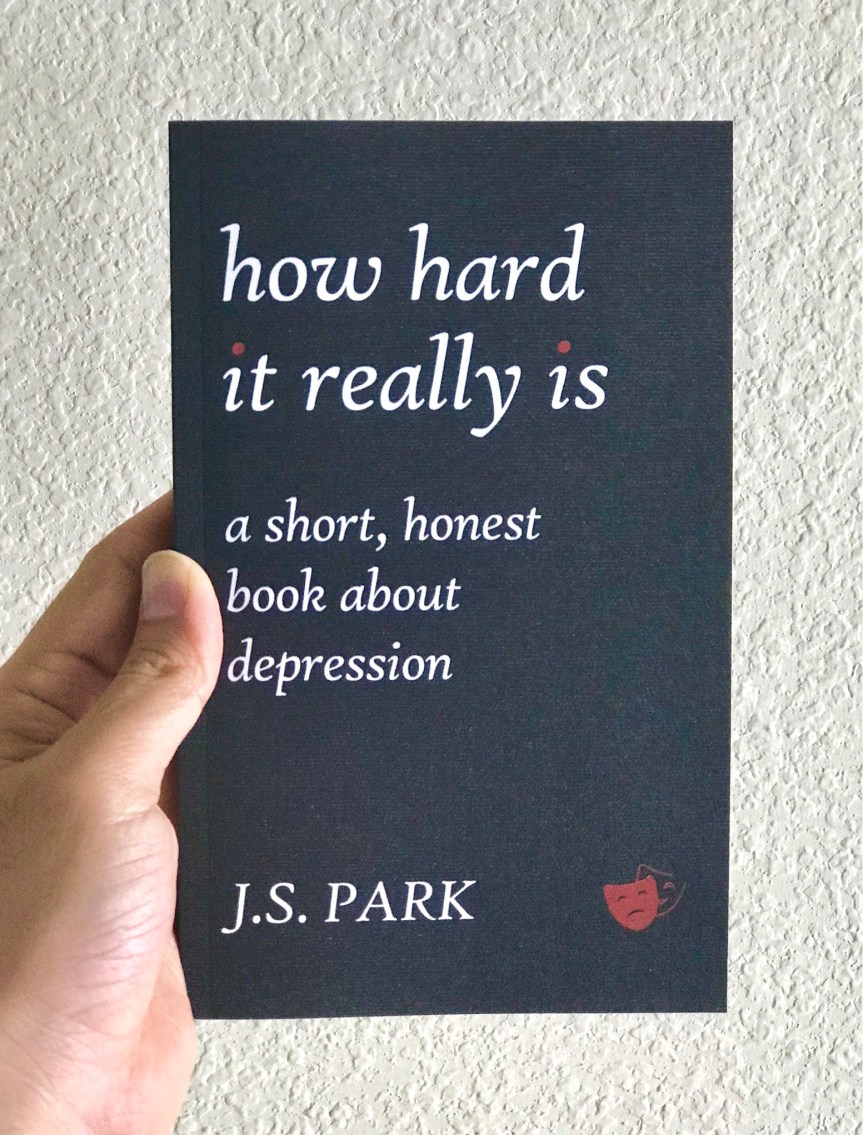
How Hard It Really Is: A Short, Honest Book About Depression


**Edit January 2018** My book on fighting depression has been revised with a new a cover and about a 10% change in content. If you’ve already purchased the book, please email me at pastorjspark@gmail.com and I’ll send a digital copy of the updated version.


Hello lovely friends! After a year and a half of painstaking work, my book on fighting depression is here. It’s called: How How Hard It Really Is: A Short, Honest Book About Depression.

The book covers:
• The science behind depression
• The helpful (and unhelpful) dialogue around mental illness
• The debate between seeing it as a choice or disease
• Stories of survivors
• A secret culture of suicide worship
• An interview with a depressed doctor
• The problem with finding a “cure”
• My own attempt at suicide
• A myriad of voices from nearly two-hundred surveys conducted over a year

The paperback is here. The ebook is here.

For my video on depression, check here: https://www.youtube.com/watch?v=xggg6xFObIE

Be blessed and love y’all, friends. A reminder that if you’re in a dark place, I hope you’ll reach out. You are truly more loved than you know. 
— J.S.


A Friendly Reminder: I Am Not Your Counselor and I Am Not a Journalist


I keep forgetting that most people on social media who act like authorities are young 20-somethings who haven’t seen much of the world and don’t know how it works. They want to change the world from their basement, or they’re just hungry to go viral. It doesn’t mean they can’t have an opinion. It means I need to double check theirs.

Bloggers are not your counselors or journalists. Most are just making up stuff with flowery words and “what I would do” sentiment. It’s not that we’re bad or wrong. But please keep in mind that most social media users care about your clicks, not your life.

I’m always asking, “Says who? By what authority? What makes it credible? Why do you believe it to be true? Why should I believe you? And how is it working out for you?”

Don’t trust me. Don’t believe me. Just because I have “followers” doesn’t mean a thing. Check the facts. For the love of God, triple check. Discern. Think for yourself. I can speak with authority on some things, but I won’t get it right every time. Trust with a closed grip.

J.S.


Photo from Unsplash

How Do You Know You’re Persecuted or Just a Terrible Person?

illuminirk asked a question:

how do you differentiate when you’re being persecuted for christ and being slammed for… for lack of a better word, for being a shitty person? for instance, i see a lot of american christians claiming persecution when really people are mad that they’re racist or homophobic or etc. how do you navigate that? how do you know?

Perhaps the simplest way is this:

Look around. Do you live in the West? You’re probably free to express your faith. So most likely you’re not being persecuted, but you’ve picked the wrong battle.

Look around. Do you live in the East? You’re probably not free to express your faith. So most likely you’re being persecuted, because you’re in the battle at all.

The thing is, early first century Christians were being persecuted simply for existing. Their faith was not primarily about self-improvement (though that’s in there), but about enduring the suffering of a cruel world. They didn’t have much room for political rallies or fighting for moral issues. They were in survival mode. They saw Christianity as the good news of a God who walked with them, rather than some kind of behavioral improvement tool. So while they did care about self-improvement, their first priority was merely survival.

Many Christians in the West today don’t experience the same kind of cultural suffering. They’re not in survival mode, so they’re focused more on self-improvement. I include me in this. It’s not a bad thing. I actually have space to think about how to better my own life and live like Christ. So sometimes Christians have too much idle time and pick the wrong fights in a free society. 

And really, when you have the chance to self-improve, it’s easier instead to stand up for some policy outside yourself. It’s a way to offload responsibility for your own actions: by trying to change laws or take the “moral high ground,” you then don’t have to look at changing yourself. Christians find it hard to follow Scripture, so they pick a path of lesser resistance (I include me here, too). It’s easier for Christians to shout really loudly in a free society than actually change their own self-destructive habits and live a useful, meaningful life.

I don’t mean that a person who experiences physical pain for their faith is necessarily a “real Christian.” Sometimes that’s just self-imposed martyrdom, and that’s selfish too. I mean that real persecution is about a cultural baseline of restricted freedom. If you’re free to express yourself, you’re not persecuted. If you express yourself and some people complain, you’re not persecuted. If you express yourself and some people call you mean names and avoid you at work, sorry, but you’re not persecuted.

Continue reading “How Do You Know You’re Persecuted or Just a Terrible Person?”

An Interview About Mental Health, Minority Stigma, and the Church Vs. Depression

I recently did an interview about mental health with a student filmmaker. My book on depression can be found here.

Disclaimer: I’m a hospital chaplain who does grief counseling and helps with end-of-life decisions, but I’m not qualified to offer medical advice. I’d recommend following @wayfaringmd, who is.

Continue reading “An Interview About Mental Health, Minority Stigma, and the Church Vs. Depression”

Real Dark Jesus


So my church showed this video of Jesus doing a bunch of miracles. Great production values. All non-whites, mostly authentic languages, culturally and ethnically reproduced to how it would look in the first century eastern world.

But — I was amazed and amused by the reaction of the church attendees (most of whom are classically westernized i.e. white). They were squirming like crazy the entire video. Like very, very bothered. It wasn’t hard to read.

I was smiling ear to ear that this video mostly got the “look and feel” of the actual first century east. But soon I became angry and sad that the church was so squirmy because they didn’t see western interpretations of white Jesus on the screen.

I’m sure this sounds silly and petty, but our preconceived ideas of Jesus, the east, and the grit of the first century plays a lot into how we view culture, faith, and “the foreigner.” Whitewashing is a big trigger word that’s overplayed, but it’s real.

And for evangelical Christians who are used to seeing a tall, handsome, blonde Jesus, this ain’t how it was. Not even close. By all biblical reports, he was ordinary, unattractive, unremarkable, and dark. Christianity is built on a guy that most of the west is scared of by default.

I’m super-glad my church risked an authentic interpretation of Jesus, and super-sad it bothered the church so much. I also had to wonder how many normative images I have in my head of beauty, truth, heroism, and villainy—and how these images have harmed how I see others.

J.S.


Photo from Image Catalog, CC0 1.0

I Care Too Much What Other People Think About Me


undefeatedx asked a question:

how do i stop caring about what people think about me?? 😦

Hey dear friend, I really wrestle with this, too. I’ve discovered in therapy that I’m a people-pleaser, even codependent, and I often have this crazy conspiracy in my head of small-town backroom rumors, where everyone I know secretly dislikes me and laughs about me in some seedy, poorly lit poker room.

A few things about how to deal with what others think about you:

Continue reading “I Care Too Much What Other People Think About Me”

My Top Ten Posts of 2017

Here are the Top Ten Posts of 2017 from my blog, ranging from topics such as North Korea, the 2016 election, crazy hospital stories, when people can’t admit they’re wrong, dealing with a friend’s depression, and surviving the world as an ugly Asian male.

Continue reading “My Top Ten Posts of 2017”

Grinches, Scrooges, and Grieving Souls: Christmas Is For You, Too


I know that for many of us, the Christmas season is a painful time. The festive celebration is in stark contrast to your own history.

It could be a dysfunctional family. Grief from loss. A lonely time. The heartache of a hard year. Or it could just be you dislike the whole affair. You can’t stand the egg nog, mistletoes, and holiday radio.

But that’s okay. Please know: You are not obligated to pretend happiness just because a certain calendar date has fallen on you. You have permission to be a Scrooge, a Grinch, a “downer.” No one else has to live through what you’re going through, and they will be long gone after telling you how to feel.

I believe that God can handle that. He receives you. He validates your grief. No one else can, not fully. He does.

And more, God’s invitation to rejoice still stands. Always. He won’t stop inviting you to joy. Through tears, even for brief moments, laughter can still bubble up and surprise you. Jesus broke in the same way: through dirt, grief, a lonely manger, he was light pushing through the dark. A surprise.

Merry Christmas, to Scrooges and celebrators. However you spend this time and through all you’re going through, I hope you know: you are loved.
J.S.


Photo from Images Catalog, CC0 1.0

How Do I “Let Go and Let God”? Does Working Hard Mean I’m Not Trusting God?

sunmoonandmyrtle asked a question:

Hi JS, I was wondering about the balance between trusting God and making your plans/taking action. I am a bit OCD about planning. My journey at the moment seems to be learning to let go of trying so hard and have faith in God to provide. On the other hand, I don’t want to be the kind of person who says God will bless them yet doesn’t work hard or look for ways to work smart. I’m not looking for a quick solution, but would be glad to just hear what you think. (I hope you’re having a nice day.)

Hey dear friend, I really wrestle with this too: When do I let go and “let God”? If I hustle and pursue, does that mean I’m not trusting Him?

Here are a few things I’ve learned about trusting God:

Continue reading “How Do I “Let Go and Let God”? Does Working Hard Mean I’m Not Trusting God?”

How Do I “Bring People to God” Without “Shoving My Religion Down Their Throat”?

caito8o asked a question:

How do you bring people to God without telling them that they are going to hell? Or “shoving my religion down their throat?” And how do you deal with people that tried Jesus and still don’t believe? I have issues with the way my church discuss these topics so I was wondering if you could bring some clarity. Thank you so much for your help!

Hey dear friend, I speak all this with absolute grace and love for you, and I’d like to go one further.

Hell is not a motivation for faith—but neither is heaven. If a punishment or a prize are the motivations for someone’s journey, then my assumption is that person hasn’t thought very far about why they’re on this journey at all. I’m reminded of that quote from True Detective:  “If the only thing keeping a person decent is the expectation of divine reward, then brother, that person is a piece of s__.”

If my goal is to “bring people to God,” that actually won’t work either, because we shouldn’t be trying to make it work. I don’t mean to assume your motives, but evangelism isn’t a score-card where we win people by attendance. No one is a project or a charity case.

Christians might not think we do this, but it happens in all kinds of unseen ways: we attract people until they’re baptized, and then the pastor stops talking to them. I’ve seen it hundreds of times. God can only naturally flow out of who we are and how we interact with others. God flows from my art, my expression, my patience, my generosity, and what I do with my free time. It’s not primarily a conscious goal to say, “See, this is God!” It was C.S. Lewis who said we can’t try to make good art, but that we make art and it might turn out good. It’s the same way with expressing God to others: it happens or it doesn’t.

Continue reading “How Do I “Bring People to God” Without “Shoving My Religion Down Their Throat”?”

How Do I Call Out Someone Who Believes in Messed Up Stuff?

iliveinayellowsub asked a question:

How can we “gently rebuke” our brothers and sisters who believe in and propogate prosperity doctrine? Because honestly, my first reaction is anger and a desperate need to shut them down 😦

Hey dear friend, this is a really, really tough one. Prosperity Theology is one of the most painful iterations of the Christian religion I’ve ever seen, and it’s always psychologically abusive in the long run.

The thing is, attempting to challenge anyone’s beliefs is a dicey, dangerous endeavor that requires an extremely fine balance of love and truth. It’s terribly difficult and will certainly go wrong. Here are a few thoughts about it:

1) Before challenging someone’s harmful belief, get to know why they believe what they do.

There is a concept called The Deep Story in which if you ask someone about their beliefs, they will tell you a deeper story about what led them there. And every single time, if you listen with an open mind, it’s easy to see that if you had the same upbringing, same trauma, same family and friends, same community, and same circumstances as this other person, you might have come to believe exactly as they do.

Because we are much quicker to speak than ever before—social media, globalization, polarization, all that stuff—we are a bit slower to listen these days. In the last ten years, especially, much of our language has revolved around lectures and imperative commands, so that we’re always (consciously or not) trying to force other people into seeing “my point of view, which is obviously the best point of view.” We are always carving other people into our image.

If you pause to listen instead of lecture, you’ll find that many, many harmful beliefs are based on the premise that I am doing good for the world. Almost no one thinks, “I’m the bad guy” or “I’m defective and trying to hurt people.”

The best thing you can do is really get to know why. Why have they fallen into this cult-like belief system? What does it do for them? How is it working out? And what is good about their beliefs that you can affirm on a common ground?

Continue reading “How Do I Call Out Someone Who Believes in Messed Up Stuff?”

An Interview About Depression, Its Myths and Misunderstandings, When Faith Fails, and Talking It Out

– Suzanne of biblesteps recently interviewed me about my book on depression. Her post is here. The entire interview is below. You can find my book on fighting depression here. –

Given that depression can be a fragile and, at times, controversial topic, what made you decide to write a book about it?

Depression can feel like a solo sport. There’s no team backing you up. It’s like swimming or gymnastics; once you get going, it’s up to you to make it to the other end of the pool or the mat. (I was told this is why writers get depressed, because writing isn’t really a team effort).

Most of the resources I found on depression began with the “solo” premise: It’s up to you, go get help, here’s this method, try this and this. But that sort of individualized isolation was very vacuum-ish to me. Life doesn’t work in such a frictionless shrinkwrap; we affect others in a causational web and we need their help, too.

So I started with the premise: How do we collectively get through depression? How do we manage the stress and cause-and-effect and even the global consequences of depression? I wrote the book for both those who struggle with depression and those who don’t. I wanted to bring in every person involved, because depression affects families, cultures, marriages, churches, all of it.

I always knew that the topic of depression itself was a game of telephone — “I’m depressed” sounds like “I’m antisocial” to most people — but when I got to the research and surveys, it was even worse than I had thought. There was this nearly impermeable membrane around the discussion of depression. And then this phrase kept popping up in my head: If you could just know how hard it really is …

And as cheesy as that might be, it became the title of the book. My whole goal was to peel back that weird membrane around depression so, if anything, there would be more empathy on every side of the discussion.

Continue reading “An Interview About Depression, Its Myths and Misunderstandings, When Faith Fails, and Talking It Out”

The Scary Horrible Thing About Depression


Clinical depression will often do whatever it wants with you. It has no rules or code or fairness or dignity.

I have every reason to be fine, but depression is a dirty sneak attack that leaves me completely naked and debilitated. It’s a liar that sells truth: a false reality that says how-I-feel is who-I-really-am. And when a grafted lie overruns the truth, it doesn’t matter that I have “every reason” to be fine: the lie has switched every goalpost and sunk the baseline.

Depression is the worst kind of lie, in that it not only attacks your self-worth and value, but steals the meaning out of words like “self-worth” and “value.” It is cold inertia, slowing down worlds in orbit. It leaves you carved open, constantly bleeding out, unable to retain the vital stuff that makes life. There is spiritual discombobulation; every emotion is a phantom limb, and no amount of affirmation about “life-gets-better” can reach me there.

The thing is, when I’m hit with depression, I already know what to do. I know I have to fight for air. I know I have to crawl for every inch of territory that’s stolen. I know I cannot make decisions unless I talk with someone first. I must reach for my phone. I must reach for every scrap of surface to escape this tunnel.  I must remind myself that there’s so much worse in the world, and that the war inside cannot compare.

I know. None of this makes the fog any easier.

By the tiniest shred of sight, I must crawl.

— J.S. Park | How Hard It Really Is


Photo by Brandon Woller

Journeying Together Through Depression


Thank you to Nissi, Andy, Sandra, Crupa, and Amber for picking up my book on fighting depression, How Hard It Really Is. Grateful to Sandra for picking up five copies to give away. Praying the book blesses each of you.
J.S.

Paperback: https://www.amazon.com/How-Hard-It-Really-Is/dp/0692910360

Ebook: https://www.amazon.com/How-Hard-It-Really-Is-ebook/dp/B073TX15LB

Do the Abused Need to Forgive Their Abuser? About Boundaries for the Traumatized


Everyone loves the idea of love and forgiveness—but do the abused need to “love and forgive” their abuser?

Here’s my quick take on boundaries and self-care for the abused and traumatized.

A romanticized culture of hyper-compassion easily leads to fatigue, disillusionment, and secondhand trauma, especially when we attempt to love those beyond our limits. I also share on trying to help those with mental illness, and the ugly reality that many of us are in over our heads and need to refer to professional help.

My post on love, abuse, and trauma is here.

My book on fighting depression and empathizing with those who have depression:

Paperback: https://www.amazon.com/How-Hard-It-Really-Is/dp/0692910360/
Ebook: https://www.amazon.com/How-Hard-It-Really-Is-ebook/dp/B073TX15LB/

Subscribe to my YouTube channel here: https://www.youtube.com/user/jsparkblog

Love y’all, friends!
— J.S.

Texas, Nepal, India, Bangladesh, Sierra Leone


Texas, India, Nepal, Bangladesh, and Sierra Leone have all been affected by disasters in the last week. Not all of them are being equally reported; thousands have died in Asia and Africa. This isn’t a rant but a request. You can still help. Please consider donating to The Salvation Army for their teams in Texas or Save the Children for their emergency fund around the world, which will provide food and water to those in need globally. Please share and pray.

– How to help: http://www.independent.co.uk/news/world/asia/south-asia-flooding-how-you-help-victims-india-bangladesh-mumbai-millions-a7920641.html

– Save the Children Emergency Fund: http://www.savethechildren.org/site/apps/nlnet/content2.aspx?c=8rKLIXMGIpI4E&b=9506655&ct=15003327&notoc=1

– Salvation Army: http://helpsalvationarmy.org

Officially Finished Chaplain Residency


Officially graduated from my year long chaplain residency. Pics of our ceremony service. Thank you and love you friends, for your prayers and encouragement. Thank you to the incredible doctors, nurses, surgeons, unit coordinators, PCTs, environmental services, and every other unsung hero of the hospital. On to more chaplaincy and the next chapter!
J.S.

Everyone’s Got Advice About Your Depression


You’re going to find very quickly that when you’re depressed, nearly everyone’s got advice for you. Everyone thinks they know what’s best and what you ought to do.

It’s well-intentioned, and it’s not all bad—but in that very moment, when you’re in the colorless fog, those motivational one-liners are often tacky, tone-deaf, and untenable.

If depression robs you of your ability to logically comprehend and make sense of life, then any advice or solution is not going to reach into the heart of depression.

Both the church culture and pop culture endorse a sort of “powering through” because it really translates to, “I don’t have time to get involved with your struggle.” What’s really being said is: “Pray more and be positive so I don’t have to deal with you.”

Theology and wisdom have their place, but I suspect that we spout them to rush the hurting past their hurt, because it hurts too much to sit in their furnace. It’s a kind of reverse projecting: I can’t bear to look into my own uncertainty when I see yours.

My urge to offer advice has good intentions, but it’s also a way to offload the hard work of navigating the wound with the wounded. I offer a reason of certainty because it’s easier than traveling with the hurting in the uncertainty. It’s a way to protect myself from answering the unanswerable. I don’t like the silence because it makes me uncomfortable. I have to offer something or else it makes me feel helpless.

It’s the same reflex that happens when some of us see someone cry. “Don’t cry,” we might say, even though very often, crying is the only way to heal through the river of all we have held inside. I’ve found that when I say, “Don’t cry,” that’s about protecting me from discomfort rather than leaning into your hurt and healing.

So all my advice makes your pain, your tragedy, and your depression, about insulating me, instead of moving towards you.

You can do one from the rooftops, but the other means diving into the smells and groans of their misery.

It’s dirty. It’s work. And no one naturally wants to pay the high cost of navigating someone’s pain.

— J.S. Park How Hard It Really Is


Photo by Chris Wright

Isn’t Everyone’s View of the Bible Just Their Own Opinion? Whose Interpretation Is Right?

iscribblesometimes asked a question:

The last post you made is really good, I think that sort of attitude is really important in Christianity. But how do I keep that attitude, and understand that the bible has been interpreted in many ways, while not becoming doubtful of the bible and it’s truth? How do I keep an open mind and still remember that God is unchanging? (I’m not sure if you take asks so don’t feel pressured to answer, just thought I would say what I’ve been thinking for a while that your post reminded me of.)

Hey dear friend, I believe you’re referring to this post.

For reference, I wrote this:

“Because the Bible says so.” Okay, but whose interpretation? Yours? Mine? From the era of the Crusades? When they were burning people at the stake? When it was used to support slavery? What if we have different conclusions? What if we’re both wrong? 

So first off: I got quite a lot of backlash on that post, and I had to take a break from my inbox and from looking at comments and reblogs. I don’t say that out of self-pity (there’s a lot more important stuff happening across the world), but rather to point out that I must’ve hit a nerve. Someone commented something like, “I thought you were one of the good guys.” I mean, I laughed, but I was also a little bummed out by all the judgmental assumptions. Like, can we not ask these questions at all?

I wrote the post originally because a few people confronted me saying things like, “I unfollowed you because I don’t agree with you theologically” (which is fine, everyone has a right to unfollow) or “Your interpretation is off” or “You’re becoming a liberal” (as if liberal is a bad word).

So I asked the questions out of sincere curiosity. How do we get out of this conundrum of your interpretation versus my interpretation? If you say my view is wrong, isn’t that just your opinion of my opinion? Aren’t we all sort of flying blind? And how exactly do we meet in a place where we can intellectually discuss our disagreements if one party already presumes the higher ground? Really, when someone says “I disagree with your theology,” what they’re saying is, I disagree with your interpretation of theology based on my interpretation of theology. So where did that interpretation come from? Trace it back and it’s always from someone else. A person. With a tiny brain like yours and mine. Augustine or Calvin or Nietzsche or Osteen. Some church leader a thousand years ago, or some book written last year, or some preacher guessing at the Bible the best he or she knows how.

Of course, I don’t mean to say the whole thing is unfathomable. Much of the Bible is very plainly spoken and can be taken prima facie, at face value. I also remember in seminary learning that the best way to interpret the Bible is by using the Bible. That sounds like self-defeating circular logic, but it does make sense: for any kind of text in history, whether a play or novel or comic book or mythology, it require an internal consistency with a baseline, on its own terms. The Bible does have these rules, called hermeneutics, and each book within it follows the rules of its own genre, whether poetry, eyewitness account, journal entry, or practical wisdom. So the Bible can be understood, as long as the authorial intent, the time period, and the genre are taken into context.

Yet—even on its own terms, even within context, even knowing all the rules, the content of the Bible can become difficult to comprehend. The Apostle Peter himself writes of Paul’s letters, [Paul’s] letters contain some things that are hard to understand, which ignorant and unstable people distort, as they do the other Scriptures, to their own destruction (2 Peter 3:16). If Peter says this of Paul, we shouldn’t be surprised at all that Scripture can get murky and muddled.

And it’s that second thing that Peter writes, about people distorting the Bible, that always gets me. I’m not always sure how to discover which interpretation is the right one, and some of that is because of my bias that is staining the lens with which I read Scripture. Each of us have so much self-interest that we can use the Bible (and other stuff) to justify any position we want, even under the guise of “the common good” or “your benefit.”

On top of that, multiple competing viewpoints appear to have sound logic backing them. There are a ton of different ways to interpret the Bible, and each interpretation can look as good as the last one. Who’s to say who’s right? Is Moby Dick really about revenge? Did F. Scott Fitzgerald really mean all the symbolism? Is The Planet of the Apes about racism, class warfare, the folly of playing God, all of them, or none of them? How can I trust my senses? Or yours?

So I have two starting points that might help.

Continue reading “Isn’t Everyone’s View of the Bible Just Their Own Opinion? Whose Interpretation Is Right?”

Condemning Hate Is Not Enough


Condemning hate isn’t enough. That’s the bare minimum. We also need solidarity. Compassion. Calling out. Standing with. Fighting for. Ground level work. Sleeves up. In the dirt. There’s the difficult brutal unpopular risk of getting on the right side of history. In the home. Out there. Over fences, across oceans. Side by side when it isn’t pretty, when no one’s looking, when everyone is, when the wounded lean heavily on our shoulders, when no one cares. That’s the stuff that changes where we’re going.
J.S.