David: Chronic Doubter, Constant Believer

P1020145


One of the most remarkable things about David was his doubt.

All through the Psalms, we see David contending with his doubts about God. Whenever there’s a stanza of praise, it follows just as quickly with despair and confusion.

There are so many Psalms where David is singing in a flowery refrain of awe, but out of nowhere, he’ll say, “Do I not hate those who hate you, O LORD, and abhor those who rise up against you? I have nothing but hatred for them; I count them my enemies.”   It’s all going so well, until you turn the page. These are like cysts that swell over the canvas, so jarring and troubling that you won’t see them on coffee cups and Twitter.

David was really all over the place in his faith.

But just as much as David interrupts his own Psalms with rage and grief, these are rolled over by a sudden clarity of God’s goodness, like a splash of cold water for bruised, bent hands. Most of the Psalms have a Turn, an about-face resolve where David recalls the truth about God’s sovereignty. These upward Turns don’t solve the situation, but they break David’s fear and paralysis, and keep a terrible season of life from making him just as terrible.

These sharp Turns in the Psalms are a frail and feeble call to remember God in the midst of so much distress. The deepest of David was calling out to deep.
In David’s prayer-life, we see both severe drops into depression and sudden bolts of euphoria, and we find a point of dizzying tension.

David managed to live with both complete joy and complete sorrow at the same time. He had a foot in the heavens and a toe in the abyss. He had a frighteningly pessimistic view of the world in the worst of his questions, but he was absolutely optimistic about a God who was working all things together.

David let the gravity of his hopelessness sink in. The Psalms are full of yelling because David and the other psalmists don’t hide under false coping mechanisms to dampen the pain. They hardly ever run to thrills and pills and religion and therapy, and if they do, they just as quickly run back. David allows the emptiness of his heart to take full course until the bottom gives out, so that he has no other choice but to find refuge in a bottomless God. The resolve of every Psalm could only come by scraping along the walls of a downward spiral, until there was a landing. It’s in our full-on grief that we find the fullness of grace.

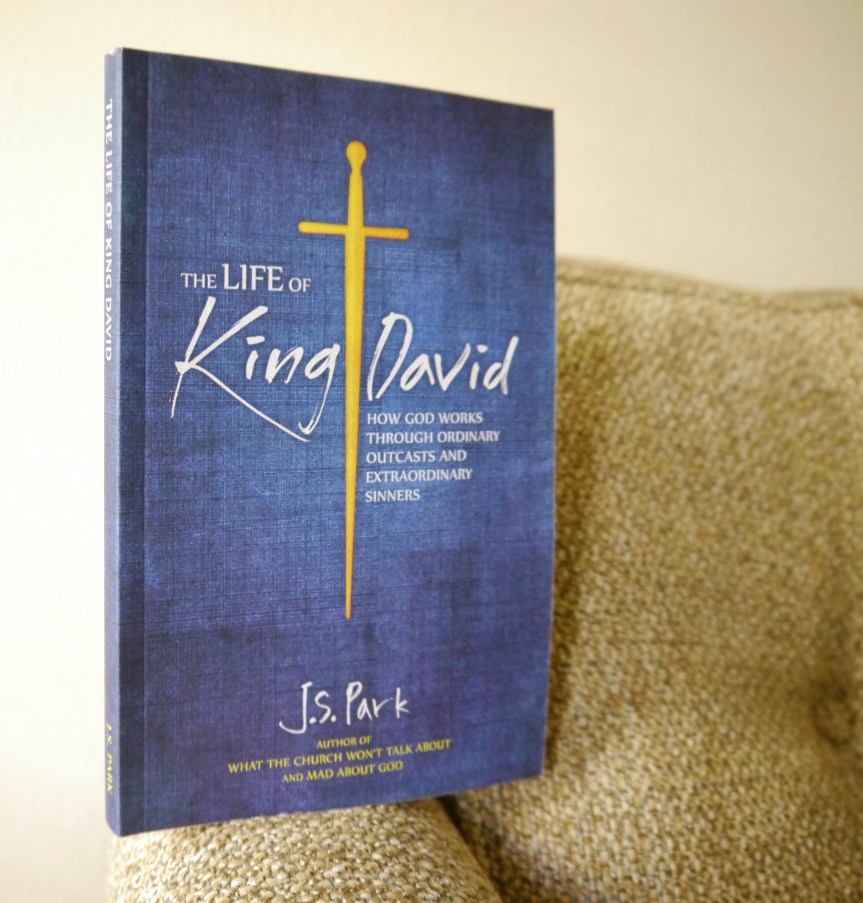
— J.S. Park | The Life of King David


Long As You Wake Up and Show Up

Photo by Lindsey Noel


I hate holding up exhaustion as a trophy. I’m uncomfortable with the romanticism around high-functioning, fast-talking over-achievement.

I’m not endorsing complacency or relaxing all the time. I love to work hard. But there’s a difference between pouring out and exhausting fatigue. One requires your best and the other is just double-booking yourself.

Waking up and showing up are just as important. Giving your all is as crucial as being all there. I can’t put productivity over being present. I’m celebrating both the work and the will to get there.

J.S.


A Few Quick Things About Forgiveness: What It Is and What It’s Not

A few quick things about forgiveness.

– Forgiveness is not a one-shot deal, but a daily lifelong process that might take a hundred times a day. This is partially what Jesus meant when he said forgive seventy times seven.

– It’s okay to be mad. It’s okay to grieve about what happened. You don’t have to stuff these feelings. In fact, it’s better to feel them down to the bottom if you want to make it back out.

– Forgiveness does not mean friendship. Boundaries are necessary and you’re not required to hang out with the people who hurt you. It’s possible to be kind, but that doesn’t require becoming best buddies.

– Forgiveness does not mean that the hurt should be forgotten or dismissed. In fact, true forgiveness actually confronts the very real hurt that was done to you and says, “This is not okay. This is something terrible that requires that someone pays.” The Christian recognizes that reparations are required, while at the same time we absorb the emotional hurt with the process of forgiveness.

– Christians are too quick to rush this process and it’s almost like they become lawyers for the perpetrator instead of healers for the wounded. The people who hurt you should still be held accountable, with all the mercy you can give and with all the justice that they’re owed.

Continue reading “A Few Quick Things About Forgiveness: What It Is and What It’s Not”

We Hold On.


I’ve been thinking about how much has changed over the last few years.

I’ve been grieving over the reactionary microcosm of social media. The fiery rhetoric. The click-baiting. The “experts.” Beirut, Paris, Syria, the two earthquakes in Nepal, the ISIL threat, the US shootings, the protests in South Korea, racial tension, the political circus, the same celebrity drama.

I’ve been expecting the same predictable cycles at every headline: the outrage, the outrage against the outrage, the ever-loving trolls, the escalating comment sections, and the sudden silence when the bandwagon has moved on. I’ve been thinking how easy it is to lose sight of the real outrage, when we truly have the right to be offended amidst the “crying wolf,” and how unfortunate it is that true pain gets drowned in the viral-seeking echo chambers that never reach across the divide, but choir-preach with buzzwords and snarky flashy lines.

I’ve been wondering if we’re really this crazy.
If we’re really this hateful.
If we’re finally in the burning wreckage of a dying age.
If we’re really this angry about the wrong things and silent about the right things.
If we’re really this lost.

I’ve been thinking about how we can get better, or if we’re beyond recovery. That maybe I should give up, and give in to the cynicism, because it’s easier.

I was with a patient in the hospital who had a blood condition. “Derrick” suffered debilitating physical pain his entire life. His knees were twisted in circles, his fingers into claws, his body turned sideways, his eyes burned with baggage. He didn’t have much longer to live. It hurt him to talk, but he wanted to talk so badly. We were face to face, and he spoke about his illness, his dreams, his hopes, his insecurities, his faith, his fears, his family. We didn’t break eye contact for over an hour.

The news was on TV and there was another awful headline. The ticker-tape was scrolling at the bottom, one thing after another. The TV caught Derrick’s eye.

He said, “I don’t understand. I don’t get how we’re still fighting. I don’t understand how we’re still so mad. I’m hurting every second, and I see the news, and people still want to hurt each other. When is it enough? I can’t even play with my kids; I can’t hold them long; I can’t work or run or laugh too loud. If I just … if I could just walk without falling into a heap, the things I would do. The things we could do, you know, and we choose this instead.”

He tried to point to the television but he barely got his arm up.

“I’ll never get better. Physically, I mean. I’m at the end of my time here. But we can get better, you know, in the way that matters. I think if we knew … if we knew we’re all hurting somehow, we might be better. We might reach for each other.”

I looked over at Derrick and he was weeping. For the world. For himself. For me. For you. For us to get better.

And I wept, too. I knew that sort of pain, that desperate burden for healing and connection. To reach across the divide.

Derrick looked at me and said, “This is what matters. Right here. You and me, this is it. Can you stay with me? Can you pray with me? Can you pray for me and the hurting people?”

Through tears, we prayed. At the end, all I could really think to say was, “God—give us hope.”

I prayed for hope against the cynicism. Hope to make the best of it. Hope to hold on in the burning wreckage. Hope that there’s still good in us. Hope that we’ll make it. Hope that we’d find each other with our tiny little time on earth.

We held hands tightly. We held onto hope.

J.S.


Top 20 Posts on my Tumblr of 2015


20) Letting Go or Holding On: The One Friend I Want to Help, But Can’t Anymore

19) We Say Goodbye, One More Time.

18) What The Bible Talks About When It Talks About Women: A Mega-Post on Those Troubling “Anti-Women” Bible Verses

17) Forgetting How To Be, Reclaiming How To Breathe

16) The Scary Horrible Thing About Depression

15) Why Is God So Homicidal In The Old Testament?

14) I Will Disappoint You

13) Wise Love.

12) You Can Do The Thing: And It Starts With This One Phrase

11) The Jesus That I Need

10) Three Lessons I Learned Instantly in My First Week of Marriage (That I’ll Need for Life)

9) A Friendly Reminder: You Are Loved

8) Surviving Suicide: A Testimony

7) To Remain Teachable

6) 11 Thoughts From A “Conservative Christian” About Marriage and Sexuality

5) I Voted “No.”

4) The Problem of Dealing With Racism Without Being Smug & Snarky: And Two Questions That I Ask Every Racist.

3) I Will, Anyway

2) I Refuse to Refuse Anyone

1) Tragedy is not a contest


Top 20 Quotes on my Tumblr of 2015


20) Being a Christian Means and Doesn’t Mean

19) Sometimes Pain Is Just Pain, Not a Lesson

18) I’ve Tried to Turn Away From God So Many Times

17) One of the Worst Things to Do to Someone

16) What Injustice Requires

15) We Don’t Hurry Someone Wearing a Cast

14) When I Doubt God and Doubt Myself

13) When You See Who Jesus Was

12) I Demanded God To Explain Himself

11) I Can’t Love You Less

10) Jesus Loves You, Right Now

9) Eyes To See What God Is Doing

8) The Only Time a Christian Should Be First

7) Two Kinds of Faith: Warriors and Worriers

6) It Might Have Been a Tough Week

5) Your Voice Is Important, Don’t Go Halfway

4) The Heartbreaking Journey of Loving Others

3) I Have Him, But More Importantly …

2) When You Return to God After a Long Time Away

1) You Don’t Owe Anyone an Explanation, But …

A Theology of Loss, Love, and Leaning In

For my chaplaincy, I had to answer the questions:

Where is God in the midst of suffering, loss, illness, tragedy?
Where is God for the patients?
Where is God for you?

Here’s my meager attempt to answer these very huge questions.

In the worst moments of our lives — the cancer, the car accident, the phone call that changes everything — I’m not always sure where God is. Even the most trusting and devout are spouting, “God’s got this” with quivering lips and a shaking voice, with the slight clench of a fist, with feverish bewilderment: because the words fall flat on the cold linoleum of the hospital.

No matter how much theology we know in our three lb. brains, it all goes out the window when the floor opens up and steals us into the abyss of loss, the irreversible before and after, and the world becomes a chaotic, unsafe place of random disaster.

I can’t say where God is.

I can only say with some certainty where God is not.

I don’t believe God is distant and detached from our pain. I don’t believe He’s gloating over us behind a glass cage. I don’t believe He uses pain to teach us a lesson. I don’t believe that trials are part of “God’s amazing plan for your life.”

I don’t believe that God is some stoic, abstract teacher who waits for us to “get it.” Pain is pain, and it hurts, and no amount of theology is going to glamorize a special reason that it happens.

Not every pain has a connect-the-dots theology. When a hurricane misses a city and everyone “praises God,” it’s only condemning the millions of people who are hit by the same storm. When a child dies of preventable diseases or drunk drivers or a genetic anomaly, there’s no curse or blame upon the child. We can’t force such a tragedy into easily quantifiable boxes. To make such a correlation, if anything, is worse than the pain itself.

The truth is that we live in loss every single second, just by the mere fact that our lives won’t turn out the way we want them to. We live within absolute suffering just by losing time on the clock in the inevitable march towards death. The hospital only puts a neon sign around the coffin that awaits us all.

But my Christian faith tells me that this is completely expected. We live on a fallen world where the thread of sin has woven its tendrils into every part of our being, and that something will always be missing. Rather than deny pain, the Christian faces it head-on and acknowledges the tension. From our grief in loss to our hunger for approval to our need for intimacy: we float in this strange limbo of discontent, where nothing is ever quite the way we want it.

At the same time: My faith holds onto the hope that total fulfillment really exists. Our pain is unbearably awful, but it actually points to our desire for a healing of everything that has ever fallen apart. The inverse irony of pain is that when we’re hurting, it conveys a contrast to a very real wholeness. It’s why pain hurts. Pain tells us that something is terribly wrong and we know it ought to be put right. Or as C.S. Lewis said, “Nothing is yet in its true form.” The very reality of suffering points to our need for an ultimate comfort and justice: for God Himself.

This means there is some perfect song on the other side of the door; a light at the end of the tunnel that fills the tunnel; a beauty that doesn’t explain our pain, but is stronger and louder and bigger than all that has happened to us. We know this because we know bad notes, we know the darkness of a tunnel, we know the scars of marred beauty. Christianity says that the only real beauty is the infinitely satisfying perfection of God, who is the only being in existence that fulfills every longing we’ve ever had for truth and beauty and wholeness.

But I believe that Christianity fulfills us not only by perfection, but also by descending. Christianity says that God became one of us, out of solidarity, to suffer with us, not as a mere deity in an abstract palace, but a flesh-dwelling person in a sand-swept desert, so that, though God is so above us, He knows what it’s like to be one of us. The Christian believes in a God who wept and bled and suffered, an infinite God who infinitely compensated for our hurt, thereby cosmically answering for our afflictions and fulfilling the deep need to be heard and known at our very worst.

This must mean that God is just as mad at suffering as we are. God must be grieving with us, too. And in fact, my Christian faith tells me that because God is mad at our pain and still perfect, we’re also allowed to be as mad as He is at the very same things.

Maybe there’s an intellectually satisfying answer why we’re suffering: but what I want is someone who relates instead of debates. This is why we get flustered when someone connects the dots on our tragedies. It’s better they get with me in the trenches.

This means my job is not to solve for the other person’s pain. It’s not to bring diagrams and flowcharts. It’s to sit inside the uncertainty and anxiety of suffering and to shout against the dark, until we have shouted ourselves out. This is when God can begin to show up at all, for at our rock-bottom, He is already there.

Continue reading “A Theology of Loss, Love, and Leaning In”

Featured on the Front Page of WordPress

Drawing by Russell Jackson,

Art by Russell Jackson of Draw the Public


Hey friends, I’m featured on the very front page of WordPress.com!

I was interviewed among several writers & bloggers, and mine is the final one about learning how to rest.

https://en.blog.wordpress.com/2015/12/16/2016-blogging-goals/


I Want a Better Church (And the Church Is Me)

Photo from worshipgifs

Anonymous asked a question:

Sometimes I get really angry at the Western-Protestant church for our consumerism in Christianity and how we base our worship services on emotional highs and raise our hands to the bridges and hooks of songs, out of emotion, and neglect the God they are being sung to.

Hey dear friend, I get mad about that, too. There’s a lot of strange fakery out there and I think people are catching on.

Here’s one thing I’d gently like to suggest, and as I have no pastoral authority with you and I’m just a stranger online, you may please feel free to dismiss what I’m saying and to disagree. I hope you will hear me with a pure heart of grace and love for you.

I absolutely believe you’re coming from a genuine place of desiring authenticity. The only thing is, I wouldn’t want that to make you run the opposite way against a certain subculture or a group of people, as if “I’m not gonna be like those Christians” is going to help. I can promise you with guaranteed certainty that it will not.

Consumerist Christianity is bad; emotionalism is bad; legalism and fundamentalism is bad; those are true sentiments. But at times these sincere convictions can filter the way we see all of church, so that by slow degrees we begin to think buildings are bad, programs are bad, techniques are bad, schedules are bad, and let’s not do it like those guys with big speakers and jumbotrons, and we’ll show them what it really looks like, and I’m so anti-institutional and counter-cultural, and I’m so over the plastic manufactured Sunday machine, and let’s be organic and “get back to our roots.” This is such a common temptation to every Christian that I’m sure it’s Satan’s favorite game-plan.

An over-desire to be “purist” is still idolatry. It’s exactly how Satan fractures the church so that Christians will bicker and grumble at each other instead of looking past the box and getting into the battlefield.

Continue reading “I Want a Better Church (And the Church Is Me)”

Tragedy is not a contest.

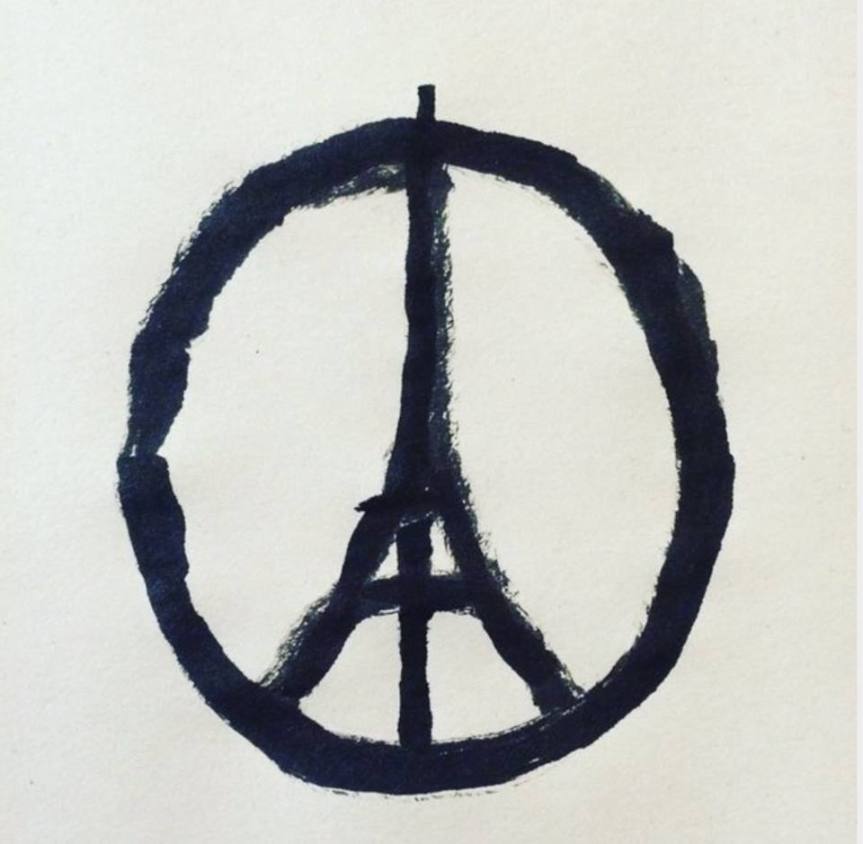
peace Paris Red Hong Yi


To those who are saying, “France is a big deal but it’s getting more coverage than other tragedies” — I would humbly and kindly ask to look up the Fallacy of Relative Privation.

It’s possible that we can care about one tragedy without pitting it against another (which is just crazy, when you think about it). Saying “Well what about __” doesn’t address the original problem and ultimately dishonors the real human lives we lost in all of them.

It’s possible to educate others and bring awareness of what’s neglected without condescending or competing by numbers.

It’s possible to both pray and donate; there’s enough time in the day for both.

It’s possible just to grieve and be angry and weep right now instead of using tragedy as a platform for politics or a spiritual lesson or a moral epiphany (and I realize I’m in danger of doing the same — yet I’m truly grieving, too).

Neglecting to say something on social media is not equivalent to apathy, and mentioning something on social media is not equivalent to empathy. It’s also unfair to be guilt-tripped by either. It’s okay if you don’t accordingly change your profile picture. It’s also unfair to accuse someone of being shallow if they change their profile picture.

It’s impossible to boycott everything and protest everything and raise awareness on everything, as much as we’d like to. By the time we figure out one problem, another comes along. It’s a fruitless exercise and only spreads us thin: and much better to use our limited resources and individual gifting and unique voices to deeply care about a few things as best as we possibly can. It’s possible to fully invest in one or two, and that’s how movements start.

There are many, many ways to care. We need all of them. There’s not enough time to care about everything, but there’s too much time wasted on nothing, and if each of us could care deeply about some things, we could find each other and cover almost everything.

J.S.


Art used with permission by Red Hong Yi

My Heart is with Paris.

Paris peace Liz Gilbert Jean Jullien


Grieving. Angry. Praying. My heart is with Paris, for Paris.


Image from Jean Jullien, found from Elizabeth Gilbert

My Father, Survivor of the Vietnam War


My father Jung Hwan Park in the Vietnam War, c. 1964.

He was a 2nd Lieutenant in the R.O.K. Army.  He taught hand-to-hand combat to both Korean and American soldiers, including the U.S. Navy Seals.

In 1968, he was captured during the Tet Offensive and forced to walk barefoot, blindfolded, and hands tied to a prison, where he was a POW.  My dad was forced to eat rats and fight other prisoners to survive, and he went blind several times due to poor nutrition.  After a failed escape attempt, he was tortured with bamboo shoots underneath his fingernails and a few of his fingers were broken.  Before execution, he escaped alone (by killing a few guards with his bare hands) and was the only known soldier who escaped his encampment.  He was then captured in Cambodia and declared a Korean spy, and for two years the Korean Embassy worked for his release.  He’s authored an autobiography in Korea, translated Through the Jungle of Death.  A few Korean history textbooks talk about his successful escape.  He’s established a martial arts franchise in America called J. Park Martial Arts, and at 70 he still teaches.

— J.S.

Before Jesus, After Jesus.


Maybe you’re way further along than you thought you were. Every blip and spurt of righteousness in your life is nothing short of a supernatural God-made miracle, because naturally in our own fleshly skin, we’re incapable of True Good. Before you met Jesus, you didn’t even care about trying to live right or to make a difference or to help people — and if you did care, it was motivated by self-promotion, image maintenance, social standards, and Darwin-esque survival.

But after Jesus, you have the reason of No-Reason, because now you’re lit up by a Person who out of his own initiated love dared to die in your place on the cross and put His Holy Spirit in you to live out your true calling: which is to love him and love others without expecting anything back. You’re re-created with a new heart to care about what God cares about, and the Father is proud even of your stumbles. Any step forward into your purpose is like the birth of a new life: it is momentous, surprising, awesome, and worth celebrating.

— J.S. Park | What The Church Won’t Talk About


Photo by athenagracee

An Artist Turned My Words Into Art.

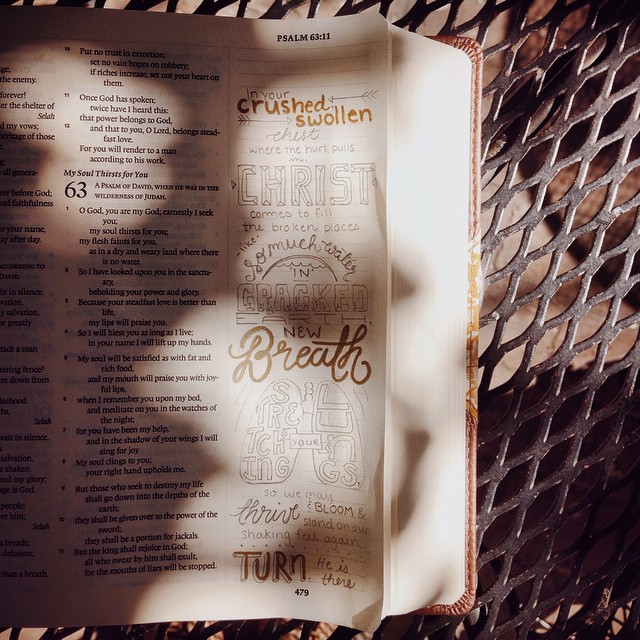
Quote Alyssa Wans


This is the first time anyone has ever made art out of my words. A quote from my book. I’m absolutely amazed by the beautiful skill and artistry, and the fact that anyone would make art out of anything I’ve said. Thank you so much, Alyssa!

Alyssa’s Tumblr blog and Instagram! Her art is incredible.


“In your crushed swollen chest where the hurt pulls in: Christ comes to fill the broken places like so much water in cracked earth, new breath stretching your lungs, so we may thrive and bloom and stand on our shaking feet again.
Turn. He is there.”


My book What The Church Won’t Talk About is here.

Everyone’s Screwed Up, Busted Up, and Catching Up: And That’s Okay

image

I don’t think I’ve ever really met anyone who is living out of a full cup.

What I mean is: Everyone lives a lot further ahead than they really are, giving advice they don’t follow and loving others without any love for themselves and running on empty all the time. We’re all on fumes.

I’m finding out this is okay for today, and no lifetime is meant to be lived in a day.

There’s this Secret Guilt going around that we’re all halfway hypocritical frauds who will maybe one day catch up to an awesome version of ourselves. It’s a desperate hope that we’ll eventually do what we’re preaching with our mouths and our blogs. And then we blow up or flip a table or punch a wall and that monster comes out, and we think “Where did that even come from?” — and the Guilt chokes the pit of our stomach again.

The finality of settling into your own skin never arrives.

We co-exist with the monster.

I remember a famous pastor who deleted his entire backlog of podcasts from his first years of preaching.  Because he “no longer agreed” with those old messages.  I thought it was pretty humble.  But I also thought, What about those people who heard those old messages?  What if they followed through on that stuff?  Are they just screwed?  And ten years from now will you delete your stuff from today?

Every artist I’ve met says their first drawing, song, poem, novel, or dance routine was unworthy. They’re hard on their first creations. You know, that whole “you are your own worst critic” paranoia. But: Don’t we all have to purge these things before moving onto greatness?  And what about those people who enjoyed the first creations?  Are they just idiots?

Everyone keeps saying, “I used to be so stupid.”  Or, “I was so empty when I taught that thing.”  Or, “I didn’t even deserve to preach that sermon on marriage, my own marriage was failing.”  Or, “I wasn’t even following my own advice.”

It’s a reoccurring pattern.  No one ever thinks they’re good enough to do what they’re doing.  Or they think now they’re okay, but everything before today was terrible.  “I finally found my voice,” they say, which is at once a victory and an admission of defeat.

It’s scary to think we’re always walking in the dark, the light dissipating just out of reach.

Continue reading “Everyone’s Screwed Up, Busted Up, and Catching Up: And That’s Okay”

Through Fire, By Faith: A Testimony.

I got an incredibly humbling email from a wonderful therapist who read my book on persevering through pain and used it for a book club with other therapists. She also shared her journey through some very hard times. I wept reading her email, both tears of sorrow and joy. With her permission, I now share her testimony with you.

Continue reading “Through Fire, By Faith: A Testimony.”

Holding On or Letting Go: The One Friend I Want to Help, But Can’t Anymore.

Anonymous asked a question:

For a while now, my best friend has been struggling with depression, self-harm and suicidal thoughts. I am the only one that knows this. She takes a lot of her issues out on me … But I can’t take the emotional abuse anymore. It’s an unhealthy relationship that has stopped being a friendship.

I have been asking God what to do. I have sat with her in her mess. In her screaming. In her crying. In her hopelessness. I have tried to give advice. I have prayed for her. I have been patient and worried and angry all at once. I have been bitter because everyone else gets to experience the side of her that I used to know, the happy, loving girl that puts on a mask to hide her pain.

I have decided to tell her that I can’t be the person she needs me to be for her. That she needs to seek professional help. This is going to be a really hard conversation … If you have any advice, I’d love to hear it.

Thank you so much for your honesty and for reaching out to me. I’m also very sorry about the heartache that you’re experiencing; I absolutely know how hard it is to decide between holding on and letting go.

I have to say this upfront, and it’s going to be a wildly unpopular opinion: You’re on to something that most people won’t admit, that “love” and “friendship” do not mean exhaustively giving ourselves out to the point of toxic self-harm. That would be unfair to you and enabling and coddling to your friend, which would end up destroying everyone involved.

Here’s something even more unpopular, and please believe me that I have a hard time writing this. I think that most of us have been bombarded with the Hollywood idea that if we help someone enough, that person will eventually get to an “epiphany” full of high fives and hugging, and that their recovery will get on some upward trajectory. You’ll also be demonized if you “leave someone behind,” especially if you’re considering to possibly “leave behind” someone who is depressed or suffering a mental illness (and I’ve suffered from depression for as long as I can remember, so I’ve been on both sides of this).

Most of us hate to admit when we don’t have the qualified “training” to help someone, and there’s a secret guilt when we simply don’t have the energy or time. So we almost force ourselves to help everyone, which can be good, because most people simply need encouragement and listening, but there’s a very small percentage that need something way beyond us. By now you’ve seen how truly difficult it is to bear with someone who might be beyond your “ability.” What you’re going through is commonly known as secondhand trauma, like secondhand smoking.

The truth is, most of us are unequipped to fully help someone who is suffering from an overwhelming mental illness. In fact, social workers and psychologists tend to get cranky about people who think they’re doing “hero work” by helping the mentally ill. It’s basically like a painter trying to perform open heart surgery. I know that even the best of my friends are limited when it comes to dealing with my own depression. I don’t hold that against them. What I see is that you’re not so much asking for permission to give up, but for permission to rest and to have a wise distance.

And I’m here to tell you, keeping a distance even from your most well-adjusted friends is not “leaving behind” your friend, but simply a necessary rhythm of friendship. Of course, I absolutely believe we’re meant to be there for someone, that no one is excluded from our love and company, and that we must move towards people who are hard to love. I’m not at all saying that it’s okay to give up, or that it’s okay to cut someone off at the earliest convenience. Yet there must be a point when we recognize that someone is abusing our trust, and that professional counseling is not only an option, but a very real next step.

I advise two things.

Continue reading “Holding On or Letting Go: The One Friend I Want to Help, But Can’t Anymore.”

Choices, Decisions, Passion, Life


I think sometimes we desperately want others to understand our life-decisions and we want to explain our side of the story and make sure others understand why we are set on these dreams: and we feel that even if they really believed in us, they are still looking down on us somehow and that maybe fate or God or the universe will catch up to our subpar choices and pay us back. 

I wish others could see we are conflicted, that certain decisions are not easy, that nothing is as ideal as we hope, that we don’t always know if this is right or wrong, that we often decide what we feel is best at the time and that we really are trying our hardest while trying to make everyone happy.  But there is no pleasing everyone, and probably not even fully ourselves, and some decisions are bound to make others angry.

We are bound to accrue enemies over a lifetime for the decisions we make — and we can’t control that.  We can only control how we respond. 

It does not help our case to be rude to our “enemies.”  But it also does not help to constantly apologize for our life-choices and act sorry about the path we chose when it’s already so hard to figure out our one life on this earth.

Continue reading “Choices, Decisions, Passion, Life”

What Is The Definition of Grace?

dearaudre asked:

What would you say the christian definition of grace is?

Hey my friend: the technical Christian definition of grace is “unmerited favor, an undeserved gift that outweighs its own need.”

But I’ve never known grace to simply be boxed inside doctrinal boundaries. The second it becomes abstract, it tends to be enabling and pampering and a sugarcoated excuse to abuse the word “struggle.”  Grace is way too costly to be thrown around like cheap lingerie, and if it does not motivate you, then it’s not real grace.

True grace is love that costs everything.  It is sacrificial.  For God to show us grace, it cost Him the life of His very son.

Let’s consider the implications of this.  You create a race of sentient human beings who you’ve given paradise, and they give you the middle finger and begin to kill each other for fame and glory and pieces of green paper, and you keep sending other little beings to tell them about True Life, but they kill all those beings too.  So you become one of your toy-creations by limiting your infinite power and taking on all their weaknesses and only asking for them to believe you’re real, and they torture you and string you up and stab you with jagged metal spikes in your most tender flesh-covered places (which you willingly took on), and there under a sunless sky you still offer forgiveness and love for everyone because this is the best and only way to love them.  And to validate your claims, you come back to life from the grave and show yourself to hundreds of people and remind them of their real purpose, and even after all that, two-thirds of the world abuses your name for the worst of atrocities and the one-third who believes in you still chase after mindless powerless images or lies or approximations of the real thing.  And you still love them.

You see, romantic love is easy.  It lasts as long as the feelings last.  Maybe we have a good temperament so we’re patient and laidback.  Maybe your friends are all pretty cool and stable and rich and they’re not needy, so you like being with them.  Maybe you were genetically predisposed to being generous and truthful and reliable, so everyone around you likes you too.

But marriages that last fifty years take sweat, blood, heart.  Friendships that encounter flaws take a supernaturally forgiving power that is not inherent to our self-preservation.  Raising children requires you to stay home when you’d rather be out clubbing and chugging.  Serving the homeless and ex-convicts and orphans and the emotionally unstable will demand all your life.  Endorsing justice in the world takes more than a blog post or pink ribbons or an X on your hand.  Love is not love unless it costs you something, and grace is the love that costs you everything.

Continue reading “What Is The Definition of Grace?”

If You Were To Love God.


“Ask yourself, ‘If I were sure that I loved God, what would I do?’ When you have found the answer, go and do it.”
— C.S. Lewis