What Forgiveness Is and Is Not: Seven Rules of Forgiveness


Too often forgiveness is a burden on the wounded. Instead the imperative of accountability must be on the abuser.

When I’m told to forgive, I think about

my math tutor when I was barely twelve years old, who shouted in my face and dug his fingers in my shoulders

a grown woman who beat me for “misbehaving” at a public pool when I was seven

students who randomly assaulted me in school calling me racial slurs

the thousands of hate crimes and murders both reported and unrecorded against POC

the dozens of stories I’ve heard from patients assaulted by their most trusted people.

But I’m told to just let go. “Forgiveness is a gift.”
Is it? How is it a gift to remove this knife from my gut that never should’ve been there? Why is abuse became the abused person’s problem to solve?

Forgiveness is powerful, yes. On the other side there’s freedom. But when forgiveness is demanded of a victim in a bad power dynamic—who benefits? Abusive people and systems often act in a remorseless repetition of violence. It’s that very violence which keeps power and profit.

I have learned it is more wrong
not to be angry at injustice.
Why demand the wounded
to be level-headed, neutral, watch their tone, to grow, be resilient, be the example, take the high road?
Sometimes the high road
goes right off a cliff.

Inside anger
I hear the voice of grief
because the abused person
had their life interrupted
and never asked for an apology
—they needed honor for their dignity.

Here are some of my rules on forgiveness.
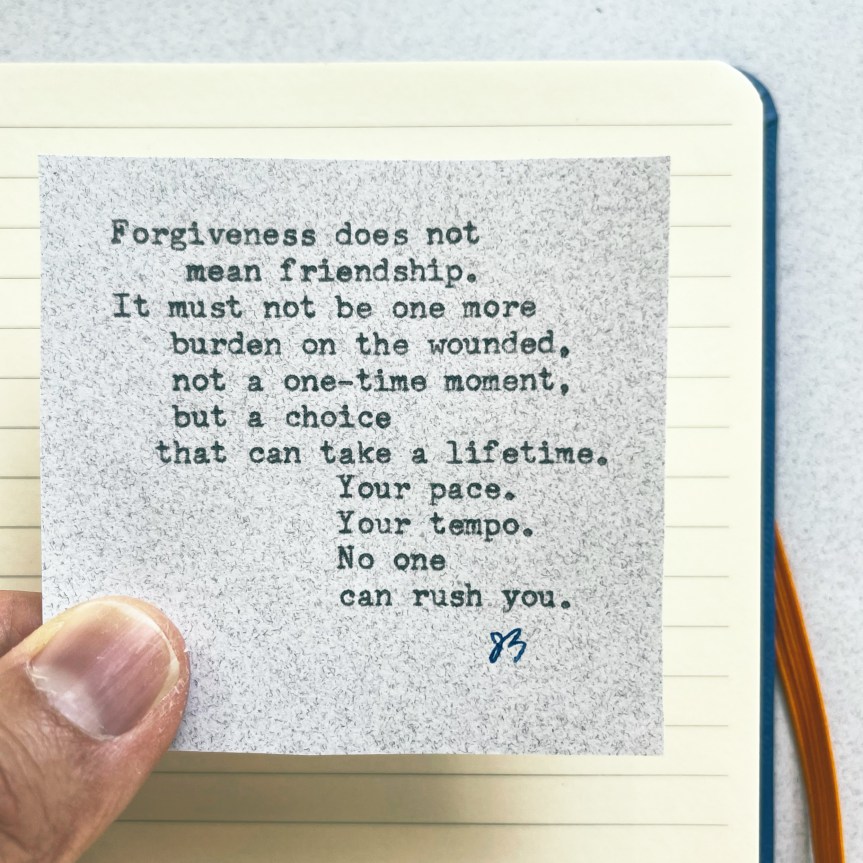
1) Forgiveness does not mean friendship.
2) Forgiveness is a daily choice that can take a lifetime.
3) No one can rush your forgiveness, ever.
4) You can be angry while forgiving.
5) Forgiveness does not negate justice.
6) If you have been abused and traumatized, then forgiveness is not a prerequisite for your recovery. To make forgiveness a burden on the abused only enables the abuser. It also mocks the abused. To skip anger is to bypass pain and therefore true recovery.
7) Do not make forgiveness an imperative burden to force a romanticized outcome of “peace,” especially on the abused and oppressed. All you’ll do is guilt trip already wounded people into a false truce.

— J.S.
I Accidentally Joined a Cult: How a Cult Got Me and the Warning Signs


I was part of a cult once. There was one warning sign that I missed—and I don’t want you to miss it. It’s not as easy to spot as you think.

I never thought I’d fall for something like that. When we think of cults, it seems obvious: they take your money, they isolate you, they talk about aliens or conspiracies, they make you wear pajamas. But this one was way different. It took me a long time to recognize I was being tricked and brainwashed. Because I was a people-pleaser, it was even harder to speak up.

If you’re at a church or workplace or student body or nonprofit or group that doesn’t allow for questions: you have to question if that’s a healthy place. The places I’m most worried about are not the weird ones, but the charming ones that get along too well.

In my book, I talk about how we can easily fall for hidden narratives, groupthink, and persuasive speech, and ways to proof ourselves.

Grab my book here: The Voices We Carry: Finding Your One True Voice in a World of Clamor and Noise

The Storm Doesn’t Always Pass


Not everyone can stay home to wait it out.
Some have to keep working.
Some have lost their jobs.
Some have never had a home.
Some will never go back.

Maybe things are “not that bad” for you. Maybe “this too shall pass”—in your world. But someone you know doesn’t have that luxury. Someone you know is permanently affected. They’re grieving a loss, whether it’s loss of their autonomy or a whole person. Our advice doesn’t apply to them, because it can’t.

Stats and facts gloss over real loss. Two in one-hundred doesn’t sound like a lot, but if any two people I knew had died this week, it would be absolutely devastating.

To downplay any grief and loss doesn’t help, and if you keep quoting statistics to show “it’s not that bad,” you’d be the last person I would go to for help.

No, we shouldn’t panic.
But please don’t tell people it’s fine
when they’re not.

The storm doesn’t always pass. Not for everyone. Pain can last for a lifetime. We can only hope to adjust to the new normal. By the grace of God, I will crawl down there with you.
— J.S.

Facing COVID19 from a Chaplain’s Perspective


Hey friends, I did a video with my publisher Moody Publishers to talk about COVID-19.

I go through five points: How to approach the pandemic from a chaplain’s perspective—dealing with our fear, with each other, and with ourselves—and I directly address those who have tested positive for COVID-19 or have lost someone to it.

I hope even a single sentence will help you through this time.
(Also, this might be the first time you’ve heard my voice or seen me in video, I apologize in advance.)

God bless and much love to each of you, friends.
— J.S.

I’m Sorry for the Bad Advice


It‘ll happen. You’ll give bad advice. I have given plenty. And it seems every season, I end up disagreeing with a lot of things I’ve said the season before. So is advice ever really any good?

I’ve met people who will say things like, “A long time ago you told me ___ and it really changed me.” And sometimes I panic. Do I even agree with what I said before? Wasn’t I a different person then? Wasn’t I just saying flowery poetic idealistic stuff that wasn’t field tested? That I wasn’t even living out myself?

Here’s where we need to be cautious. The advice we hear, whether from a friend or blogger or leader or pastor or celebrity or book or podcast, is probably good advice. But it might not be for you in your current walk of life. It might just be for that person, in that season, and they grew past it already. Or their advice was something they just made up, and it was never time tested or proven. It sounded pretty, but would never work in the dirt, in the hustle, in the hurt.

It’s amazing how a string of eloquent and witty combination of buzzwords can truly change a life. But I also worry that those same words can take us down a path not meant for us. Or it worked at the time, but can’t now. Or those words came from a version of myself that was a moron, and has learned much better. So the advice you’re hearing from somebody is just a temporal snapshot. It’s a set of clothes, and you can outgrow those.

Don’t trust me. Don’t trust this. Don’t trust an articulate, punchy, hyped up blog post or TED Talk just because of a few flashy graphics and catchphrases. Discern. Think through it. Investigate. Hear many opinions, not just one. Search yourself. Trust your own tears; they’re speaking. Seek new ideas. Seek God. Seek what is timeless. And don’t be too ashamed of your older self: that person believed some weird things, but those were growing pains. You’ll always feel weird about your old self, but that means renovation has happened.

— J.S.

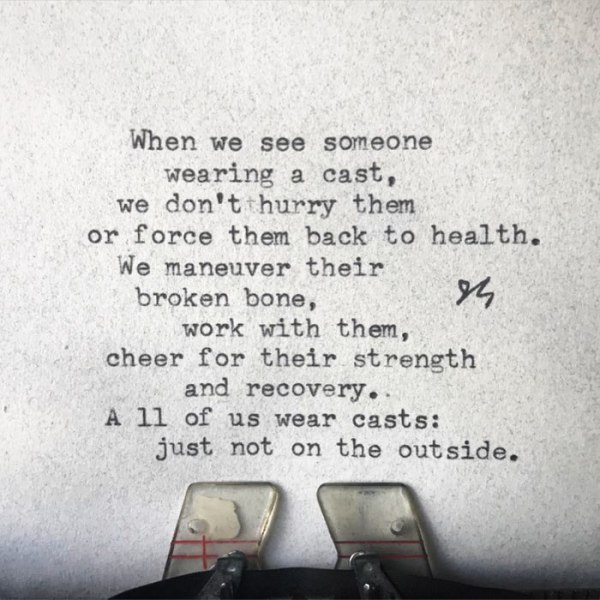
We Wear Casts.


God, forgive me for when I lack empathy,
when I jump to making talking points out of tragedy,
when I forget the pain of community and family,
when my voice is louder than theirs.
— J.S.

God’s Will, In The End


You’ve had the Late-Night Regret Twitch: to mourn over why we couldn’t have just done better. There are defining moments in the past where we think, “I should’ve went to that city. I should’ve gotten that job. I never should’ve dated her. I wish I could un-meet him.”

My dear friend: If you’ve really messed it up, I don’t believe you can “fall off” God’s Will. I don’t believe that God’s Will could be a fixed straight line. I don’t think God ever says, “Well, you fell off the track so good luck in the ditch for the rest of your life.”

Many earnest Christians assume that this relationship or this job or this house is the one that God really has for them, so they invest their entire heart into these things. But at any moment, our idea of the future can be upturned. We see it happen all the time. Did that mean God had it coming for them? Does that mean they’re now out of line with God’s Will and they need to claw for their dream again?

When I read Scripture, I see that most of the biblical characters had to change choices on the fly. They would run into a dead end, back up, and start again. They spent years in circles. Sometimes God would reveal what to do next; other times they would just pack up and start walking. Their lives were flexible. They didn’t have one specific dream. They did mess up, a lot. I’m sure they had tons of Late-Night Regret Twitching. I’m sure, like us, they often thought, “It’s too late for me.” But in hindsight, the very interruptions and unforeseen circumstances in their lives were part of God’s Plan A. Every wrinkle in their story was a new doorway.

And God’s Will, in the end, wasn’t so much about what they were doing, but the kind of person they were becoming. The destination was important, but the journey was the pulse that beat their hearts.

J.S. Park


Photo by Image Catalog, CC BY PDM

What Love Doesn’t Do


Love doesn’t keep a score. It wipes the record clean each day. It says good morning today and goodbye to yesterday.
J.S.


Art by jeannedarvin

5 Kinds of Romanticized Crushes That Will Mess You Up

I think “crushing” on someone is a natural thing, and in the right place and the right time, it can lead to something great. Most of the time it’ll pass, as it’s meant to, and we can look back and laugh at the ridiculous amount of time spent mentally replaying the one failed conversation that we still twitch about in the shower. Crushes happen, and they almost never equate to a magical romance materializing out of thin air.

But the darker problem with “crushing” is that it occasionally turns a real live person into a trophy, a sort of non-independent rubber statue imprisoned on a pedestal, and if you ever finally reached it, you’d either squeeze it too hard or please it too much. In both cases, both people lose.

Relationships are hard work, and absolutely require more than the initial illusion of fleeting chemicals in our easily tricked brains. That rush of first feelings is overwhelming, but it doesn’t mean a whole lot in the grander scheme: and we could save ourselves a lot of trouble if we took up Taylor Swift to “count to ten, take it in, this is life before you know who you’re gonna be.

Here are five types of romanticized crushes that require a heavy dose of self-awareness. I apologize in advance for the snark: I’m only so impassioned here because I’ve seen how badly it can get out of control.

1) Hate Crush (aka Freudian Defense Mechanism)

What it looks like: You like someone, but you hate that you like them, so there’s a lot of passive-aggressive, mean-spirited, hyper-critical gas-lighting aimed their way. This looks cute in movies, but is often awful and humiliating to an actual human being with, you know, their own thoughts and dreams.

Problems: This can be irreversibly destructive if you drag someone long enough through your daily catharsis. I understand the psychology behind this—we resent what we can’t have or we just hate it when we feel so vulnerable with someone—but displacing anger out of confusion when you can’t “have someone” is a really dark, desperate issue that might require real help, immediately.

Continue reading “5 Kinds of Romanticized Crushes That Will Mess You Up”