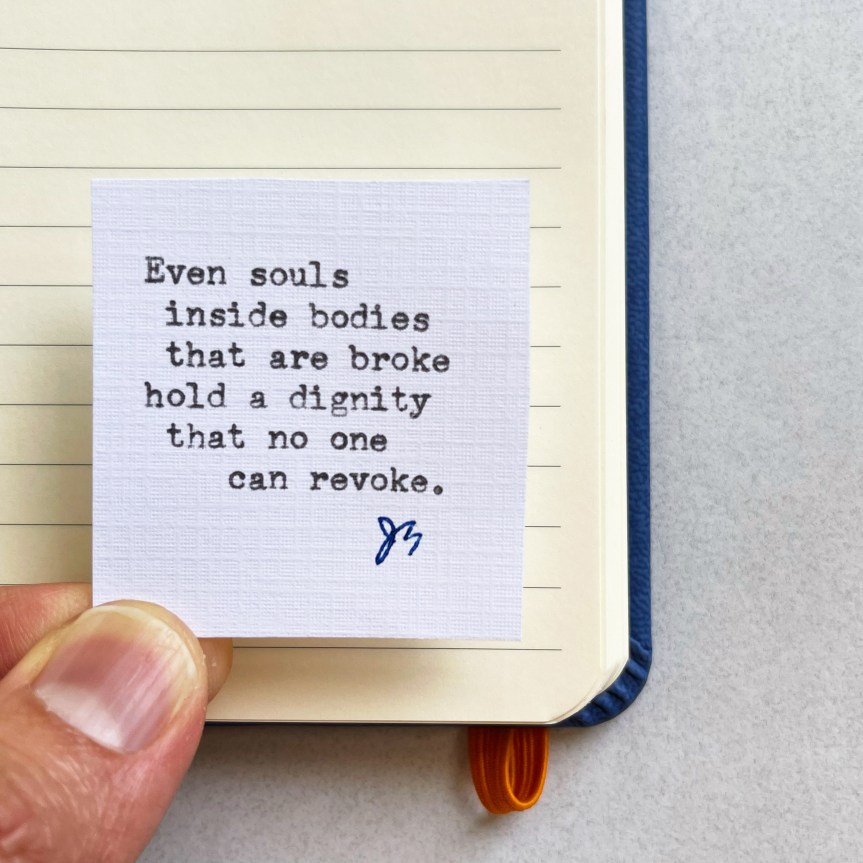
Holding Dignity


I have to tell you this story about “Ray,” who thought he didn’t deserve help.

I used to work at a nonprofit charity for the homeless and I met Ray when he finally got housing and landed a new job. But he needed a new tool belt.

My friend heard about his situation and bought a tool belt for Ray. A fifteen-pocket leather carpenter pouch, one of the nicest ones you could buy. Ray was beside himself.

A few weeks later, somebody asked Ray how he liked the tool belt.
“I haven’t used it,” he said. “I’m not sure that I can. I don’t deserve a thing like that.”

He thought he would ruin it with himself. “The things I’ve done,” he said, “pretty much disqualify me. I feel guilty.”

Ray had told us his story before: addictions, abuse, abandonment. He never had a chance, a lap behind from the start, stuck in systemic structures beyond him. He felt he deserved his fate. But Ray learned to believe a better story about himself. He didn’t need to be good enough for the gift; the gift was good enough for him. The things he had done and the things that happened to him didn’t disqualify him from what was good. Maybe Ray really was the kind of guy who didn’t deserve it. But that was the point. It was a gift. We need that sort of grace, a grace that invites us into a better story than the one we were given.

It’s true one act of kindness doesn’t dismantle a whole system. It doesn’t automatically mean we succeed. But a reminder of our dignity is the very least we need. Even as systems around us shrink us down, it never means we are small: only that we were always too big for all we were given.

I think of all the ways
our past selves
were never shown a chance
still hold us back
our bodies brutalized in headlines
our minds made hatred internalized
we believed tall tales about us
that told the whole story without us.

But all that does not see you
says nothing about you
only that they lack vision
and you are already made in an irrevocable Image.

To become someone new
often means returning to ourselves—
souls dignified, made divine,
forged in inherent worth.

And even souls inside bodies that are broke
hold a dignity that no one can revoke.
In you, I see the face of God.

— J.S.


– Partially adapted from my book The Voices We Carry

Theology Is Complete with Our Hands and Feet


There’s a classic dispute among psychologists that’s best shown by the hair dryer story. It goes like this:

A woman believes her hair dryer is going to burn down her house. It gets to be a real problem; she’s driving back home twenty times a day. Her work life and love life and social life all take a hit.

Finally a therapist asks her, “Have you thought about just bringing the hair dryer with you?”

It works. When the fear creeps in, the woman opens her office drawer and sees the hair dryer and she’s fine.

Some psychologists see a major problem here: “Nothing was solved! She still has issues! She needs to get to the root of it!” But others say she found a solution that worked for her.

I lean toward the second camp. The problem was real to her and so was the solution. Maybe later she would get to the bottom of things. But until then, she had found a way to make it okay.

The big idea is her story was taken seriously. That was the start of her wholeness. Only when a story is fully heard is there the possibility of connection or challenge or growth.

The thing is: Too many of our injuries are real. It is not merely “in their head” or “their side of the story.” And it is not enough just to believe it happened.

Abuse, racialized trauma, mass violence, systemic failures, misogyny, manipulated power dynamics, and all the mental health issues not seemingly visible—all of these need empathy, but it doesn’t stop there. They also need presence, action, compassion, and a complete reframing of all the ways that things are done. Justice would make things so right that we would never need accountability or to convince others to “believe me.”

It is already hard enough proving my injury is real.
I have the scars to prove it.
But what I need is more than belief,
more than moved hearts, more than speech.

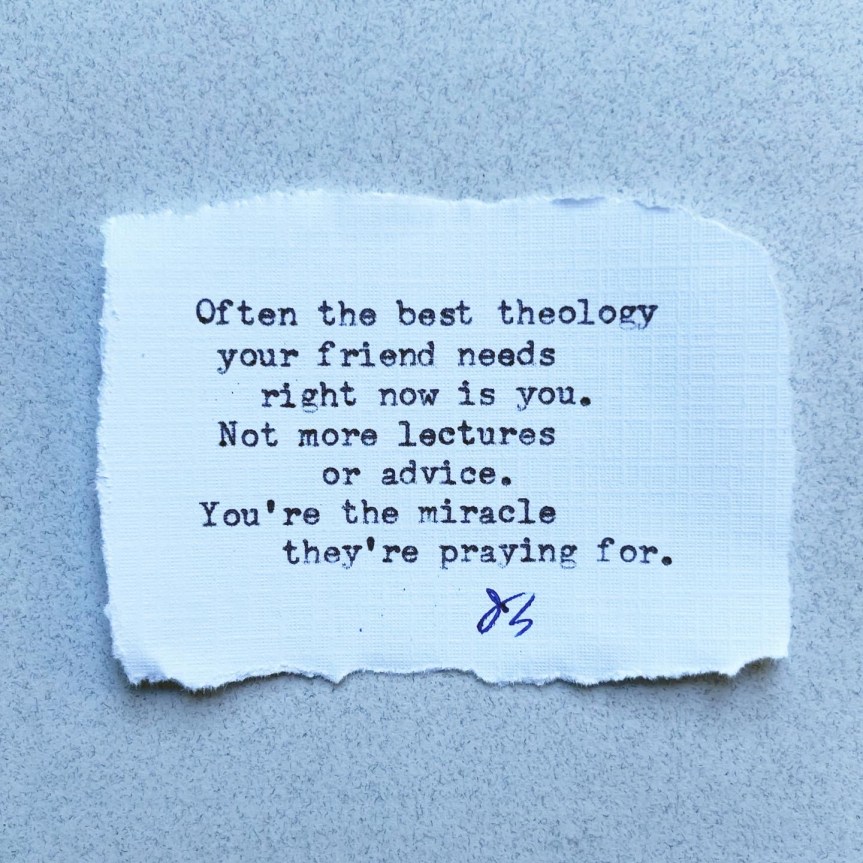
Theology is only complete with our hands and feet.
Psychology can diagnose and make valuable notes, but only heels in the field, in the dirt, bring us hope.
Even with all our treatment and remedies, I still need you to sit with me.
In grief, your advice is probably good, but not as good as being on the floor with me.
May your pain be mine,
and your hopes mine too.

— J.S.


Part of this post is an excerpt from my book The Voices We Carry

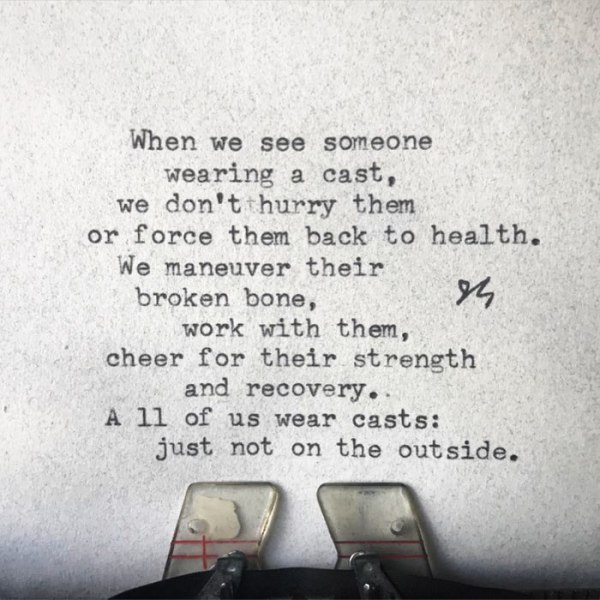
We Wear Casts.


God, forgive me for when I lack empathy,
when I jump to making talking points out of tragedy,
when I forget the pain of community and family,
when my voice is louder than theirs.
— J.S.

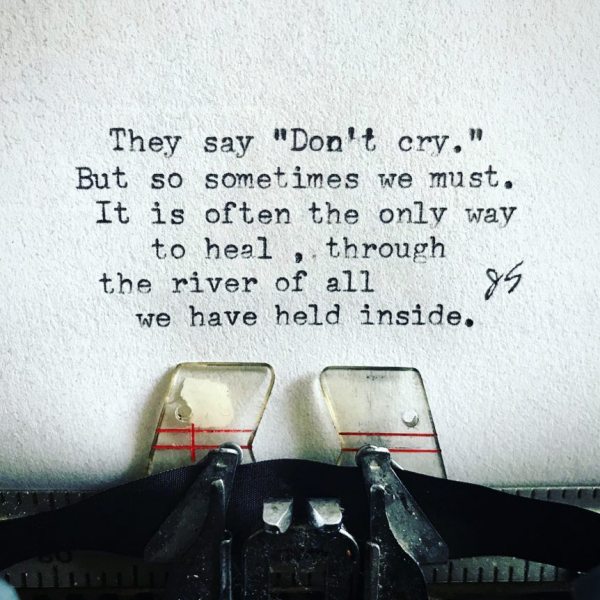
They Say “Don’t Cry” — But So We Must.


It’s a crazy incredible thing to be in a place where people slow down and listen, where they hear your whole story and let you paint your full heart in the air.

I was telling one of my fellow hospital chaplains about life lately, about my health problems and secret panics and suddenly about a billion other things, every humiliating and painful and neurotic moment that had been twitching over for the longest time, and I didn’t realize how much I had bottled up in my neatly wrapped fortress. My chaplain friend never judged, only nodded, never flinched, stayed engaged. She then prayed for me, a really beautiful prayer, like cool water for bruised purple hands. And I wept. A lot. Quietly, but inside, loudly. It was a little embarrassing. But something shifted and settled and became still for a moment, like the leaves of a tree coming together after a strong wind, a momentary painting. I left lighter.

Later I visited a patient who had nearly died from a brain bleed, and when I offered prayer, the nurse grabbed me and said, “Me, too.” I took her to the side, and she whispered, “Cancer. I might have breast cancer, and I’m afraid, chaplain. I’m so damn afraid.” She clenched her teeth and tried not to weep, but I put a quick hand on her shoulder and she wept anyway. She talked. I listened. There was nothing for me to say but to be there. And maybe nothing had changed—except we were made light somehow, and together drew something bigger than us. We drew colors into the gray.

There are still places, I believe, even in a busy and unhearing time, where we can draw free. I hope to meet you there, where we are not okay, but less gray than yesterday. I hope to pray for you, that we become bigger.

— J.S.