God, Be Here Somehow


Flashback. I’m twenty-one. I’m in the hospital. I’ve swallowed half a bottle of acetaminophen. My brother is there. He says, “That must’ve been a hell of a headache,” and we both laugh. I love that sound. In the middle of laughing, I vomit all over the place. It’s pitch black. The nurse had given me a cup of liquid charcoal to neutralize the pills. It’s blasting from my nostrils; my body is ejecting a nightmare. My brother yells for help. I try to tell him I’m okay, but I vomit some more. I think the charcoal is working though. My liver has stopped twisting into my ribs.

I go to a “mental institution,” one of those padded lock-ups with the words “Life” or “Care” or “Point” in the title. I’ve been discharged from the hospital. I lost thirteen pounds in three days. I have to be Baker Act’ed (the nurses keep saying it like that, “You’ve been Baker Act’ed”).

My bunkmate thinks roaches are crawling into his pores. The patients roll eyes at him. We go to a group meeting and the counselor asks, “What’s your goal today?” We get these giant rubber pens with round paper. One of the guys pulls the fire alarm and yells, “I don’t care, I’ll suck it for crack, this is a free country!” Two nurses sedate him. He’s dragged across the floor, sneakers scraping the linoleum, his shrieks drowned out by the alarm.

The counselor asks again, “What’s your goal today?” I write down, “To get out.”

Later that night, my bunkmate wakes me up. He’s spinning his mattress over his head, saying, “Roaches in my bed, my veins, come on, it’s true, it’s really true!” “Hey,” I say. “I know. Let’s look for them, you know? If we don’t find any, we can sleep, how’s that? Let’s look for them together.” He likes this plan so we get on our hands and knees and look for roaches. After thirty seconds he plops onto his mattress and falls asleep.

I try to pray for him. I can’t imagine how hard it must be for him, to think roaches are really in his veins. Never mind that it wasn’t true. It was true for him. “I’m sorry,” I say. “I’m sorry it hurts so bad. At least you can sleep tonight. God, be here somehow.”
— J.S.

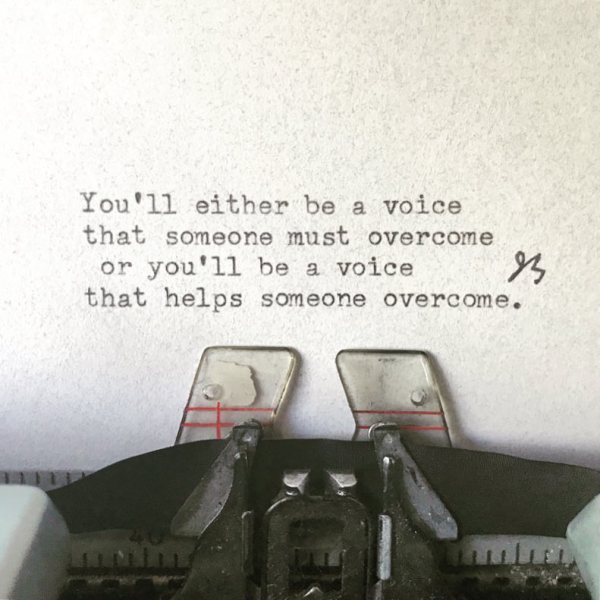
The Voice That Overcomes.


I took a speech class in college because of my stage fright. The professor, Mr. Johns, was about the most encouraging guy on the face of the earth.

There was a girl in the class who was just like me. She was the class because she wanted to overcome her fear. In her first speech, she burst into tears and couldn’t stop shaking. I thought I had it bad, but this girl came undone at the seams. I was worried that we’d have to call an ambulance for her. She wanted to stop but the professor got up right next to her, nudging her to finish. Some of the others stood with her and we cheered her on, rooting for her, clapping and fist-pumping and even saying “amen” the whole way. She finished the speech.

By her final one, she could do it up front by herself. She knew we were still with her up there.

— J.S.

Five Husbands.

Part of my hospital chaplaincy duties is to write a reflection on how it’s going. Identities are altered for privacy. All the writings are here.

The doctor tells him in one long breath, “Your wife didn’t make it, she’s dead.”

Just like that. Irrevocable, irreversible change. I’ve seen this so many times now, the air suddenly pulled out of the room, a drawstring closed shut around the stomach, doubling over, the floor opened up and the house caving in.

“Can I … can I see her?” he asks the doctor.

The doctor points at me and tells Michael that I can take him back. The doctor leaves, and Michael says, “I can’t yet. Can you wait, chaplain?” I nod, and after some silence, I ask him, “What was your wife like?” and Michael talks for forty-five minutes, starting from their first date, down to the very second that his wife’s eyes went blank and she began seizing and ended up here.

I’m in another room, with a father of two, Felipe, whose wife Melinda is dying of cancer. She’s in her thirties. She fought for three months but that was all the fight in her; she might have a few more days. Felipe is asking if his wife can travel, so she can die with her family in Guatemala. The kids are too young to fully comprehend, but they know something is wrong, and they blink slowly at their mother, who is all lines across greenish skin, clutching a rosary and begging God to see her parents one more time.

“Can I see them?” she asks the doctor.

Another room, with a man named Sam who has just lost his wife and kids in a car accident. Drunk driver, at a stop sign, in the middle of the day. Sam was at home cooking; his wife was picking up their two daughters from school; the car had flipped over twice. The drunk driver is dead; Sam doesn’t even have the option to be angry. Sam was hospitalized because when he heard the news, he instantly had a heart attack. He keeps weeping, panicked breaths, asking to hold my hand because he doesn’t know how he can live through this. He hasn’t seen the bodies of his wife and daughters yet.

“Can I see them?” he asks me.

Continue reading “Five Husbands.”

My Father, Survivor of the Vietnam War


My father Jung Hwan Park in the Vietnam War, c. 1964.

He was a 2nd Lieutenant in the R.O.K. Army.  He taught hand-to-hand combat to both Korean and American soldiers, including the U.S. Navy Seals.

In 1968, he was captured during the Tet Offensive and forced to walk barefoot, blindfolded, and hands tied to a prison, where he was a POW.  My dad was forced to eat rats and fight other prisoners to survive, and he went blind several times due to poor nutrition.  After a failed escape attempt, he was tortured with bamboo shoots underneath his fingernails and a few of his fingers were broken.  Before execution, he escaped alone (by killing a few guards with his bare hands) and was the only known soldier who escaped his encampment.  He was then captured in Cambodia and declared a Korean spy, and for two years the Korean Embassy worked for his release.  He’s authored an autobiography in Korea, translated Through the Jungle of Death.  A few Korean history textbooks talk about his successful escape.  He’s established a martial arts franchise in America called J. Park Martial Arts, and at 70 he still teaches.

— J.S.