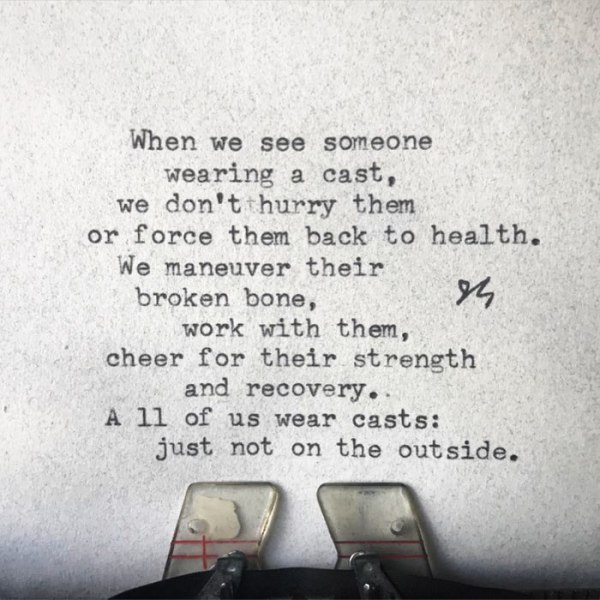
God, forgive me for when I lack empathy,
when I jump to making talking points out of tragedy,
when I forget the pain of community and family,
when my voice is louder than theirs.
— J.S.
God, forgive me for when I lack empathy,
when I jump to making talking points out of tragedy,
when I forget the pain of community and family,
when my voice is louder than theirs.
— J.S.
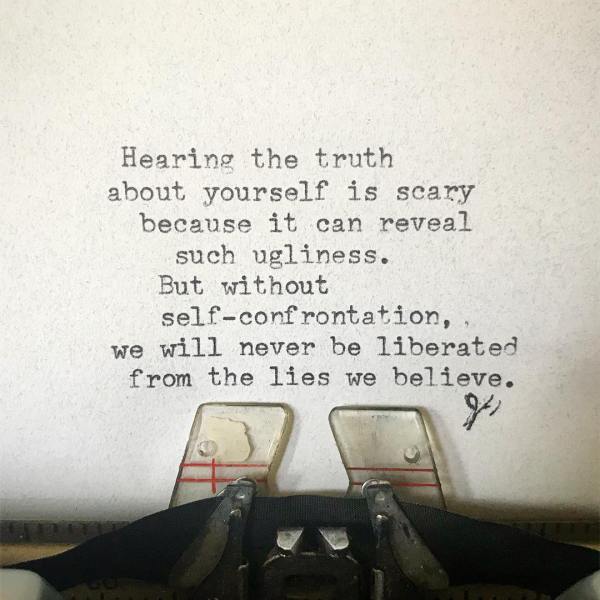
If you want any hope of change, freedom, progress, recovery, and growth: you’ll need to confront yourself, too.
The quickest way to not grow is to surround yourself with yes-men, run from rebuke, only read self-affirming bias, and unfollow all disagreement.
I don’t mean we listen to every opinion. Especially not online. I don’t mean we call each other out over the smallest infraction. I mean getting with the one friend who has tears in their eyes, voice shaking, who knows that friendship isn’t all giggles and games, who can say, “You’re better than this.” I still run from it all the time. Hearing the hard stuff is excruciating. But as hard as it is, to admit “I was wrong, I’m sorry, I’m learning, please forgive me and show me” is not the end of the world. It hurts, but not more than the pain of staying ignorant in our ego.
I hope too that we can make space for those who admit they’re wrong and apologize and ask to be further schooled. I hope we can start and finish with grace. Trust and honesty and confession only happens in spaces where we won’t be met with cringing, but embrace.

I fell for the romanticized, destructive idea in both church culture and pop culture that we must constantly “love and forgive and give away,” a sort of martyr-hero syndrome that guilts us into perpetual generosity.
I spent too many years consumed by the “sacrificial radical love” model of Christianity, which required that I pour out more than I had—but it only scooped out my guts and left me bitter and resentful and exhausted.
To love must include truth, wisdom, and boundaries. Sometimes it means distance. It means knowing when to rest and recharge and to embrace our limits. It always means to have grace for yourself, too.
And to love is not enabling, pampering, coddling, or letting someone off the hook—or it wouldn’t really be love at all. There’s a way to help others that really hurts them because it only feeds into their harmful patterns.
For those who have been abused or traumatized: Forgiveness doesn’t mean friendship. No one should ever be rushed into forgiveness, not for the sake of “getting right with God.” Not for trying to look like the “bigger person” or “because it’s the right thing to do.” We need to recognize patterns of unrepentant abuse and gaslighting and manipulative language that will only guilt-trip back into a vicious cycle. We can never mindlessly open the door again on an abusive relationship. You have the right to say “no.”
God does redeem the evil, yes, but God is for the victims, for the abused, for the survivors, too. God is for the exile, the foreigner, the despised, the despondent who crossed the Red Sea. God is for you.

Note to future self:
When you don’t get it right —
Apologize quickly and let go.
Don’t beat yourself up or defend yourself too long.
Humans are squishy with small brains. We don’t get it right every time. And that’s okay. Being wrong is not the end of the world.
— J.S.

There is a particular Christianese language that demonizes “the enemy” and “the infidel,” in which “God is on my side” and “They’re holding me back.”
This triumphalistic self-affirming theology, wrapped up in warfare terms and royalty cliches, cannot stand criticism.
It assumes all disagreement is trolling.
It attempts to say “I have the truth” as if truth must be weaponized to hold over someone’s head.
It breeds yes-men and an insider’s club.
It moralizes its own values based on “who we are not.”
It is an anti-theology that covers deep insecurity with little fleeting boosts of ego.
It attacks the most minor offenses in “secular worldly” culture in order to play victim—when sadly, Christians and truly persecuted groups are killed daily overseas.
I’m guilty of abusing the persecution complex, too. It’s incredibly easy to fall into a dichotomous division between in-groups and out-groups, between my church and your church, my dogma versus yours, to feel important, as if by lots of motion I am really moving. It’s easy for me to write a post like this and presume that I’m above all of it somehow, as if by mere awareness I have it figured out. It’s easier to look certain in our convictions rather than say, “I don’t know, I’m still figuring it out,” or, “Can you help me understand?”
In the end, Jesus told us to love our enemies. Yes, them. To them, it’s us. Every person in this discussion needs grace and a generous space. The people who “don’t get it yet” are also you and me. The people who cry “I’m persecuted” need as much grace as you and I do. I pray for me. I pray for you.

So my church showed this video of Jesus doing a bunch of miracles. Great production values. All non-whites, mostly authentic languages, culturally and ethnically reproduced to how it would look in the first century eastern world.
But — I was amazed and amused by the reaction of the church attendees (most of whom are classically westernized i.e. white). They were squirming like crazy the entire video. Like very, very bothered. It wasn’t hard to read.
I was smiling ear to ear that this video mostly got the “look and feel” of the actual first century east. But soon I became angry and sad that the church was so squirmy because they didn’t see western interpretations of white Jesus on the screen.
I’m sure this sounds silly and petty, but our preconceived ideas of Jesus, the east, and the grit of the first century plays a lot into how we view culture, faith, and “the foreigner.” Whitewashing is a big trigger word that’s overplayed, but it’s real.
And for evangelical Christians who are used to seeing a tall, handsome, blonde Jesus, this ain’t how it was. Not even close. By all biblical reports, he was ordinary, unattractive, unremarkable, and dark. Christianity is built on a guy that most of the west is scared of by default.
I’m super-glad my church risked an authentic interpretation of Jesus, and super-sad it bothered the church so much. I also had to wonder how many normative images I have in my head of beauty, truth, heroism, and villainy—and how these images have harmed how I see others.
— J.S.
Photo from Image Catalog, CC0 1.0

Here’s the deal: If you share any misinformed hype about North Korea, I’m blocking you here and I’m done with you in real life, for good.
North Korean citizens are scared, exhausted, and threatened daily into falling in line. They’re in constant fear of death or worse. They’re imprisoned and tortured for the smallest infractions, and about 3500 die every month from starvation. The very few in power in NK are the monsters, not the people. The entire nation is not some one-dimensional evil entity: it’s comprised of families, and they want peace as much as you or I do.
If your only idea of North Koreans is a ridiculous caricature from action movies or ratings-driven media, then don’t speculate. Either learn or seriously shut your mouth.
Those of you hyping up North Korean panic are exactly the reason why there’s a panic. And yes, you know who “you” are. I’m especially appalled and ashamed at the evangelical American church for fear-mongering and flag-waving about North Korea. I’m shaking as I write this and absolutely disgusted at your antics.
I pray for North Korean citizens. Their liberty is one of the very few times I’ve marched in front of the White House in raising peaceful awareness of their awful conditions. Please pray with me and help however you can. Start with clamping down on misinformation.
— J.S.
Photo by Stephan, CC BY-SA 2.0

If you’ve ever been in an escalating argument, you’ll always notice how it becomes a “meta-argument” about unrelated things that are not really the point. The dialogue gets further and further away from the main thing, until you’re both screaming out your lungs and throwing appliances at the ceiling. Arguments, in hindsight, often look embarrassing, full of cringe and regret and wreckage like an irreversible radioactive wasteland.
When conflict comes around, everything feels like it’s at stake: your value, your truth, your work, your very life. So understandably, we resort to self-preserving mechanisms to scratch and claw for our very lives. Here are a few defense mechanisms that get us stuck, and how we can get un-stuck.
Continue reading “9 Tricky, Self-Deceptive Defense Mechanisms That Completely Undermine Dialogue”

I was nearly an abortion. I was an unplanned accident, born out of wedlock, and the one before me was aborted.
I was born to immigrant parents, who naturalized and met in New York. They started with nothing, working as many as 100 hours per week, slowly and painfully saving money until they could open their own businesses. They believed this was a great country, and still do. My father served alongside the U.S. in the Vietnam War, and he is a proud veteran of this nation.
Many of us have these sorts of stories; they inform who we are, what we believe, and what we fight for, and so we are a myriad of uniquely shaped stories, each giving rise to a different voice in the world.
The really tragic thing is when we superimpose a particular idea on someone without attempting to hear their story first, and their voice is then stamped and smothered. We can too quickly assume a person is only their picket sign, their political party, their social media feed, or a cartoonish, dogmatic, one-dimensional archetype sensationalized by a grab-bag of Hollywood images. We predict what they might or might not believe without asking, without listening, without understanding.
A person’s voice is always built from their stories, their experiences, their very real pains, and it’s this blend of blisters that has brought them to stand on their particular hill. It is a hill, whether rightly or wrongly, that has been reached by a stream of forces that no two individuals can fully comprehend in each other.
So we can only try. Patiently, graciously: to hear their story on the hill.

Here are the Top 16 Most Viral Posts of 2016 from my blog, ranging from topics such as porn addiction, feminism, neo-Nazis, being at the bedside of death, and the time my wife and I broke up for six months.
16) The Christian Life Isn’t a One-Shot Deal, But a Walk Painted by Steps
The Christian walk isn’t a “one chance and it’s over,” but a life-long mosaic.

15) The Irretrievable Vacuum of Unhappily Never After.
Sometimes it doesn’t work out; the prayers go unanswered; we won’t know why.
14) I’m Not Okay. Is That Okay?
I need to know I can tell you everything.

13) How Do You Keep Believing This Jesus Bulls__t?
I’m often asked how I keep believing, and I can’t believe that I keep believing.
12) A Few Quick Things About Forgiveness: What It Is and What It’s Not
Seven truths and myths about forgiveness.

11) Movies That Christians Should Watch: The Truman Show
In my movie analysis series, I go over the spiritual and cultural themes of The Truman Show, a deeply tragic comedy about opportunism and freedom.
10) I Hate My Life and Myself and I Want to Die: What Do I Do?
The reality is, our dreams get crushed, and people will leave or cheat or abuse us, and our perseverance doesn’t always pay off. Most of us are not prepared for how harsh and brutal that life can be, because no one gives the hard talk about what it’s really like.

9) “4 Unexpected Things That Happen When You Quit Porn”
An article I wrote for X3Church about four incredible things that happen when you quit pornography.
(My book on quitting porn is here.)
8) Breaking Up and Getting Back Together: About Me and My Wife
My wife and I had a six-month break-up. We needed it.

On a whirlwind day at the hospital, I visit five husbands who have lost their spouses.
(My other chaplain stories are here.)
Contrary to pop opinion, the Bible is one of the most, if not the most, pro-women document in history.

A girl gets mad at her boyfriend and tries to cheat with me, and things only get worse from there.
4) You Won’t Like This But I Hope You Hear Me
No one likes to hear the hard truth about themselves: but without it, we will never grow, never heal, never go.

At the hospital, I visit a patient who tried to bite a nurse and threw urine at a surgeon, and happens to have a tattoo of a swastika.
2) 5 Kinds of Romanticized Crushes That Will Mess You Up
When “romantic feelings” overtake you, here’s a little guide to see where that goes.

1) 15 Things I’ve Learned Not to Say at the Hospital
My work as a hospital chaplain has helped me to know what not to say to patients and the hurting.

I believe people are worse than we think.
I believe people are better than we think.
As a Christian, I’m both a pessimist and an optimist at the same time.
I’m painfully aware that we are capable of the worst sorts of evil, and worse, that we too easily turn a blind eye to the real grief of others. Many of us are so sheltered that we deny how deep such depravity runs in our veins. We laugh it off, we whistle past the graveyard, we gloss over the wounded. I’m pessimistic because I see how awful we can be.
I’m also painfully aware that we can be manipulated into thinking people are one-dimensional cartoon caricatures, so much that we become cynical and jaded over the possibility of change. Our very real fears are often exaggerated by a binary social narrative that has us ravenous for blood. We forget that each of us do have hopes and dreams and passions that overlap and interweave. I’m optimistic because I see how harmonious we can be.
I’m hopeful that the best of us, within us and among us, can build bridges through open scars and new stories through broken hearts. That we can give a voice to our uncertainty. That we are on hand one not extremely dismissive, and on the other hand not completely nihilistic. That we validate each other’s concerns and lean into our very real wounds, while not buying into the back-and-forth backlash of answering hurt with hurt.
I am holding space for our fears.
I am holding space for our hopes.
I’m a cynic and a critic.
I’m a believer and I’m with you.
Will you be with me, too?
— J.S.
Photo by Image Catalog, CC BY PDM

Some questions to ask ourselves before voting:
How will my vote affect the story and direction of our country?
Is this candidate I’m voting for going to help defuse our current racial tensions?
Is this candidate going to hold themselves accountable as an example?
Is this candidate capable of proper foreign policy as well as bridging the divisions between American individuals?
Is this candidate a step forward in the tapestry of progress and history?
Is this candidate the kind of person who can address grief, loss, and prayers with sincerity and movement?
Who are we more or less comfortable with in directing our social and cultural narrative?
— J.S.
Photo by Saint Julian, CC BY-ND 2.0

One of the problems with circular echo chambers like Tumblr, Facebook, WordPress, or Twitter is that we mostly follow the voices that confirm our own preconceived beliefs while shutting down the evidence that runs counter to our bias. We’ve locked ourselves up in self-preaching choirs and impregnable ivory towers. Our life philosophy is then reinforced by the buzzwords and bloggers we want to hear, and we demonize a phantom enemy that isn’t anything close to a real person or idea, neglecting to engage with the real world and the very real issues at hand.
On a long enough timeline, you and I become radicalized into a new kind of fanaticism, devoted to our out-of-touch, fact-devoid, isolated cages. With so many actual injustices abounding that need solutions, our faceless debating hijacks the limelight and resources from the deficit of the people we claim to be rooting for.
This is a vicious cycle that continually perpetuates misinformation disguised in pieces of truth. Some of these truths are necessary, which is all the more reason it’s a travesty that they’re buried under a blind clicking frenzy. We buy into an aggregated “fringe platform” of like-minded ideologies that only feeds itself, like the mythical dragon ouroboros that chokes on its own tail, which only attracts people who already agree and don’t want to be challenged. This common delusion appeals to our basest urge for socialization and vicariously victimizing ourselves on behalf of someone else’s “inspirational tragedy.” Never mind that it’s the other person’s everyday life and only your two second click of a like button.
It gives us a self-righteous tingle to think, “I have the insider knowledge and you don’t.” It’s a shiny trophy of “online education” that will swell your ego and high-five the hive-mind, but it does nothing and goes nowhere and has no real chance of dialogue.
If this makes you mad, then it might be too late for you. I understand though: we hate the possibility of being on the “wrong side” and “losing face.” Being rejected by your group of yes-men or criticized by the opposite side feels like death, and we either self-destruct or destroy others. And to actually work to understand the issue? It’s too hard. We’re in love with trying to change the world by looking like we’re trying to change it, with pretty text on a screen.
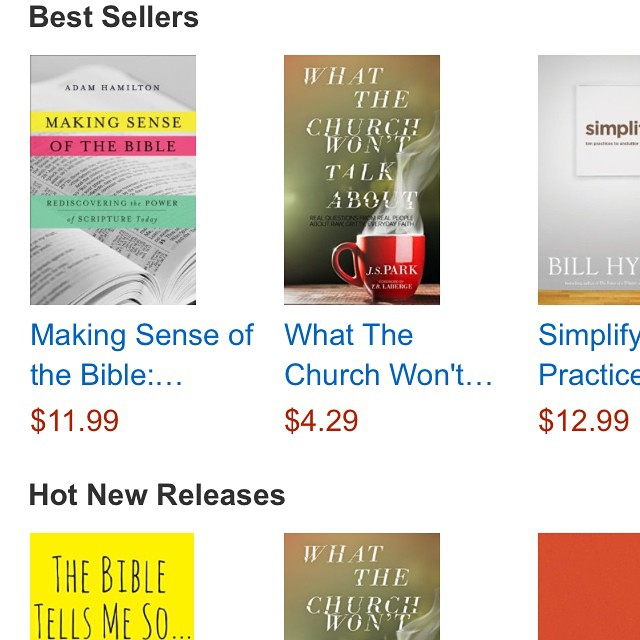
On the Amazon Christian Kindle List for Devotionals.

My friend Caleb sent this to me. Honored and humbled to be next to the great Dietrich Bonhoeffer, who I also quoted in my book.

My wonderful friend Lauren from the blog Yesdarlingido sent me this to celebrate the book release.
— J.S.
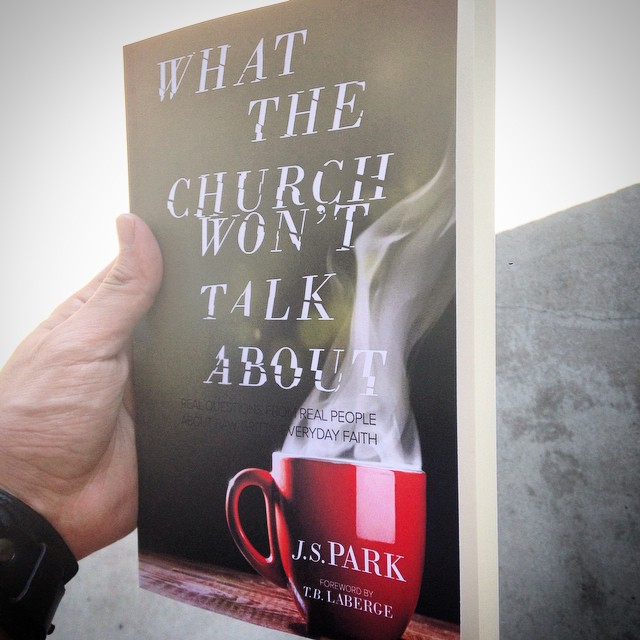
Get the e-book on Amazon here!
And now in paperback here!
 J.S. Park: Hospital Chaplain