What Forgiveness Is and Is Not: Seven Rules of Forgiveness


Too often forgiveness is a burden on the wounded. Instead the imperative of accountability must be on the abuser.

When I’m told to forgive, I think about

my math tutor when I was barely twelve years old, who shouted in my face and dug his fingers in my shoulders

a grown woman who beat me for “misbehaving” at a public pool when I was seven

students who randomly assaulted me in school calling me racial slurs

the thousands of hate crimes and murders both reported and unrecorded against POC

the dozens of stories I’ve heard from patients assaulted by their most trusted people.

But I’m told to just let go. “Forgiveness is a gift.”
Is it? How is it a gift to remove this knife from my gut that never should’ve been there? Why is abuse became the abused person’s problem to solve?

Forgiveness is powerful, yes. On the other side there’s freedom. But when forgiveness is demanded of a victim in a bad power dynamic—who benefits? Abusive people and systems often act in a remorseless repetition of violence. It’s that very violence which keeps power and profit.

I have learned it is more wrong
not to be angry at injustice.
Why demand the wounded
to be level-headed, neutral, watch their tone, to grow, be resilient, be the example, take the high road?
Sometimes the high road
goes right off a cliff.

Inside anger
I hear the voice of grief
because the abused person
had their life interrupted
and never asked for an apology
—they needed honor for their dignity.

Here are some of my rules on forgiveness.
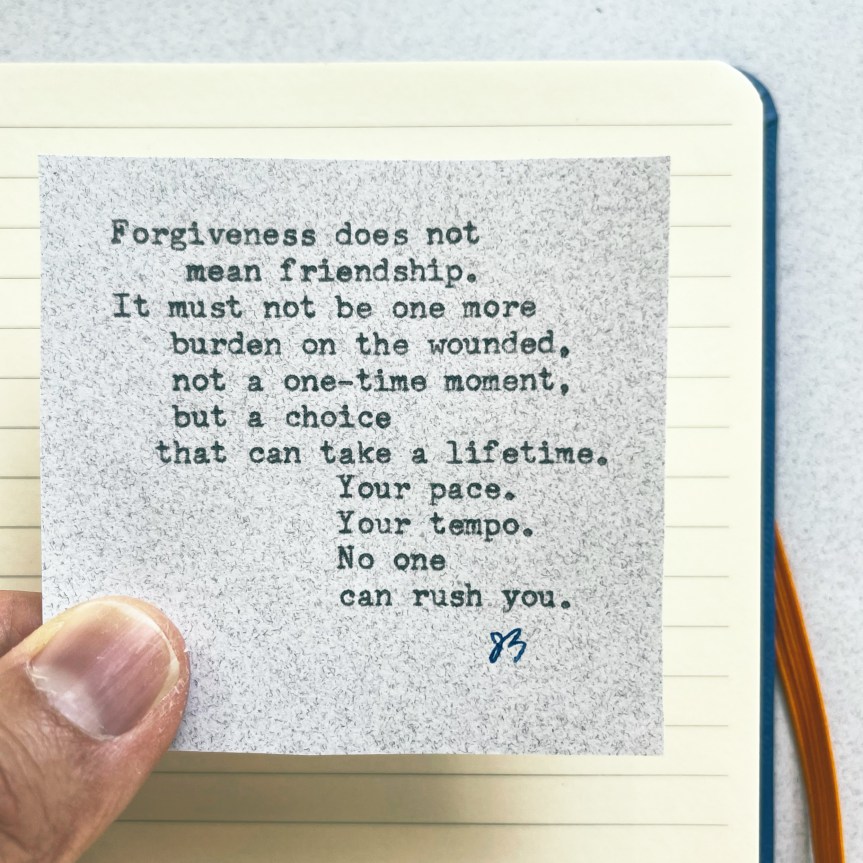
1) Forgiveness does not mean friendship.
2) Forgiveness is a daily choice that can take a lifetime.
3) No one can rush your forgiveness, ever.
4) You can be angry while forgiving.
5) Forgiveness does not negate justice.
6) If you have been abused and traumatized, then forgiveness is not a prerequisite for your recovery. To make forgiveness a burden on the abused only enables the abuser. It also mocks the abused. To skip anger is to bypass pain and therefore true recovery.
7) Do not make forgiveness an imperative burden to force a romanticized outcome of “peace,” especially on the abused and oppressed. All you’ll do is guilt trip already wounded people into a false truce.

— J.S.
How Do I Confront a Friend Who Is “Sinning”?

Anonymous asked a question:

What do you do if you’re asking a non-Christian friend what they’re up to and they respond with telling you they’re doing some activity you know is sinful? Let’s say they could tell you they’re smoking or doing something dishonest or they’re practicing wicca. What’s the proper response to something like that?

Hey dear friend, just a few thoughts on this.

– I would first determine what is “sinful.” Why is it sinful to you? What makes it sin? Is it based on your preference or discomfort? Is there real harm being done? What is the sin against?

– If you lead with, “You’re a sinning sinner and you’re sinful,” I wouldn’t expect that person to hear you out. It has to start with dialogue first.

– If you find that your friend is truly being destructive towards their neighbors and themselves, then I would ask questions. I once knew a person who eventually trusted me enough to say, “I’m going to kill someone today.” My first instinct was to slowly back away and climb out the window. But I asked, “How do you think that would work out for you?” After a few minutes, that person finally said, “Yeah, I guess it wouldn’t work out at all.”

Continue reading “How Do I Confront a Friend Who Is “Sinning”?”

Still You Are


I cannot promise that life gets better. Life can be cruel, unfair, intolerable. People can be downright mean. Failure and rejection will happen. Risks don’t always pay off. You will miss chances and opportunities. Injuries and disease are a real danger. Our brains are often broken by depression and other lifelong illnesses. People will leave.

But none of these things—absolutely none of them—determine your worth as a person. Nothing that has happened to you gets the say on who you are. Of course, life hurts. We’re allowed to hurt. We’re allowed to be mad. We can vent and yell and shake a fist at God. All of that is being human. But all the ways in which life can be unfair do not have a single thing to say about you as a person. You are loved, regardless. You are loved simply because you were born. For me, that’s often enough for the next breath. Looking back, I’m glad I breathed again.

As it were, your life has launched into being, and it is the one song you get to sing. It is a song full of beauty and terror. It is a tree full of colors and crevices. There are wonderful and terrible things that life has to offer. But all of it is yours. I hope you lean into it as much as you can. It’s a crazy and ridiculous thing to be alive. I remember the philosopher saying when we look at “how things are” then we will go mad, but if we see “that things are,” that things even exist at all, we might find joy in the madness.

No, I do not feel loved all the time. It comes and goes, often based on my performance or my mood or from some bad pizza the night before. We are weird temperamental creatures. We are capable of having complete blissful giddy euphoria in one second, then chest-crushing deflated saddening numbness the next. Again, none of these things determine your worth. You are loved through and through. You were loved before you got here. You are loved, outside of your age or achievements or acclaim or applause. You are loved. I mean it.

— J.S.

Believe It


You are loved.

You might have heard that a million times, but it’s no less true.

You do have a Creator. He is with you. He is bigger than your situation and closer than your deepest hurt. He’s not mad. He is cheering for you and rooting for you this very second. He’s okay about all the things before. He sent His Son for that very reason.

You can put down the blade. You can throw away the pills. You can quit replaying those regrets in your head. You can quit the inner-loop of self-condemnation. You can forget your ex. You can walk away from the things and people that destroy you. You can resolve your conflicts right now. You can sign up to volunteer at that shelter. You can have the courage to stand up for justice in the street, in your office, in your home. You can forgive your parents. You can forgive your children. You can draw boundaries and say no. You can go back to church. You don’t have to sit in the back. You don’t have to prove your worth to the people you’ve let down. You don’t have to live up to everyone else’s vision for your life. You’re finally, finally free.
You are loved. I am loved.

As much as I love you, dear friend, He loves you infinitely more.

Believe it. Walk in it. Walk with Him.

God is in the business of breathing life into hurting places.

This is what He does, even for the least likely like you and me.

— J.S.

Grace Is Something Different


Grace is thoughtful. It considers a back-story, an upbringing, their trauma and trials, the whole person, and not just a tiny single slice of their life.

Grace brings wholeness to a hasty judgement; it regards my own flaws first, in light of the grace I’ve also been given.

Grace brings what could be instead of what should’ve been. Grace covers my past and empowers my future. Grace does not shame. It does not enable. It does not condemn nor condone, but convicts and re-creates.

Grace confronts the worst of a person and does not shy away from surgical rebuke. At our worst, we realize how much we must confront the ugliness inside. But grace restores there, in the wreckage. It sees what is both our doing and the undoing of others; it sees both our affliction and the pain that was inflicted. It is always healing the fractured fallen weary sinner.

Grace is what we least want to give but most need to receive. Jesus saw what we deserved, but gave us what we needed instead. That’s grace. Not merely unconditional love, but counter-conditional, unfazed, unrelenting.

— J.S.

In Darkness He Rolls the Stone


When I ask if God is good
I see a cross, an empty tomb.
What He writ large in the stars
is writ small for our wounds.
From the sky to my sin
He is re-making us again.
When nothing else is good,
He is the only one who is.
— J.S.

Jesus, Barabbas, You and Me


I wonder how they could yell Barabbas instead of Jesus.
I wonder how they sang “Hosanna” and days later, “Crucify him.”
I wonder how Pontius could wash his hands of it, as though a dirty conscience could be so easily cleaned.

But – I am Barabbas, sinner set free.
I yell “Crucify him” as I sing praises with ease.
I am Pontius, who turned a blind eye to glory.
And yet, so Christ still died for me.
Still he died, where I should be,
a perfect love on that tree.
J.S.


If You Say You Love God


It’s super easy to preach “love your neighbor,” but the loving part is crazy hard. I think most people really believe they’re loving and kind when they have to be, but the second someone disagrees or causes inconvenience or looks at you funny, the love thing can go out the window real quick.

What I usually see online or in church or in politics or in marriages is that unless a person fits an exact specification of beliefs and behaviors and likes and dislikes, that person is cast out of the inner-ring. I’ve spent a lot of terrible energy trying to carve others into my own image, overriding their point of view, always waiting for others to “come around.” That‘s no better than hate.

It seems Jesus said that “hate is murder” because when we only accept the people who match our values, we are disappearing them. We’re essentially saying, “Be like me or you don’t exist. I’d rather you be someone you’re not.” This is hate, and it’s crushing somebody out of existence.

This is especially obvious in social media, when one wrong word gets you canceled. But it’s worse when it comes to religion. That’s attributing a supernatural superiority to hatred. It gives an awful permission to say, “God said it, not me.” Which is cowardly. And if your god always agrees with what you believe and only likes the people you like—that god is the one you made up to justify your bitterness and to boost your ego. It’s a push-button keychain god that does your bidding. It isn’t the God who will challenge you, stretch you, surprise you, and who loves the people you can’t stand.

No, we cannot love all the things that people do. Yes, I believe in accountability and justice and boundaries. But over all, I want to love my neighbor for who they are and not for my version of them. I believe not in who someone should be, but could be. It’s the same way that I believe God loves a guy like me.

J.S.

Loving “Them.”

The nurse told me that the patient Willard had taken a bite out of another nurse. He had swung at one of the doctors and thrown urine at a surgeon. Willard couldn’t walk; he kept demanding to go home. “Get me a wheelchair, I’ll flop in and ride over you people.” The staff kept trying to get him to stay, to get treated, despite his violent non-compliance, because nurses and doctors have the guts to look past that stuff.

The staff called for a chaplain, and I was the lucky one. I walked in and saw the patient had a tattoo of a swastika on his hand enclosed in a heart.

My eyes locked on the swastika first. The symbol held a terrible place in my memory: when I was a kid, someone had spray-painted a red swastika next to the front door of my dad’s business. Though my dad had tried to paint over it, I could still see it on hot summer days, a scar on the wall and a scar in my head, a mad throbbing declaration of all the world’s ugliness dripping in crimson. I still dream about it sometimes, and in the dream I’ll peer down at my wrists, engraved with the same red marks down to the veins.

The patient, Willard, saw me and said, “Thank God, a chaplain, finally someone who can hear me.”

But I didn’t want to hear him. And a part of me also thought, “You deserve this. I hope you never leave. Then you can’t hurt anyone out there.”

He said, “Look, I see your face, I’m not trying to hurt anybody. You get it? I just want to go home. Fetch me a f__ing wheelchair, would you?.”

Willard got louder. He clenched his fists and waved them around. He went into an f-bomb monologue about the staff, “you people,” about the whole dang world.

I had half a mind to leave. I didn’t have to stay. I didn’t want to stay. I kept looking at that swastika. I kept thinking he deserved to be here, to be sick and sorry and helpless.

When Willard stopped talking for a moment, I said the only thing I could think of.

Continue reading “Loving “Them.””

Turning Point.


Most testimonies have a turning point: “And then I met ___” or “Someone reached out” or “I got this text at the perfect time.” It seems random, but those people and encounters and messages of encouragement happened on purpose. Someone made a choice to reach out, get involved, get near another person’s heartache, and help them for one more step. It was enough to get them moving again. Maybe it was no big deal for the person who reached out. But to the person they helped, it meant everything. It was the turning point. It was the beginning of seeing new light, of finding a new dream, the start of healing. A little bit of your time and wisdom might turn someone’s life around. I’m thankful to those who pressed in and breathed life.
J.S.

Rolls The Stone Away.


In darkness, He rolls the stone away.
At your worst, He loves you anyway.
— J.S.