What Forgiveness Is and Is Not: Seven Rules of Forgiveness


Too often forgiveness is a burden on the wounded. Instead the imperative of accountability must be on the abuser.

When I’m told to forgive, I think about

my math tutor when I was barely twelve years old, who shouted in my face and dug his fingers in my shoulders

a grown woman who beat me for “misbehaving” at a public pool when I was seven

students who randomly assaulted me in school calling me racial slurs

the thousands of hate crimes and murders both reported and unrecorded against POC

the dozens of stories I’ve heard from patients assaulted by their most trusted people.

But I’m told to just let go. “Forgiveness is a gift.”
Is it? How is it a gift to remove this knife from my gut that never should’ve been there? Why is abuse became the abused person’s problem to solve?

Forgiveness is powerful, yes. On the other side there’s freedom. But when forgiveness is demanded of a victim in a bad power dynamic—who benefits? Abusive people and systems often act in a remorseless repetition of violence. It’s that very violence which keeps power and profit.

I have learned it is more wrong
not to be angry at injustice.
Why demand the wounded
to be level-headed, neutral, watch their tone, to grow, be resilient, be the example, take the high road?
Sometimes the high road
goes right off a cliff.

Inside anger
I hear the voice of grief
because the abused person
had their life interrupted
and never asked for an apology
—they needed honor for their dignity.

Here are some of my rules on forgiveness.
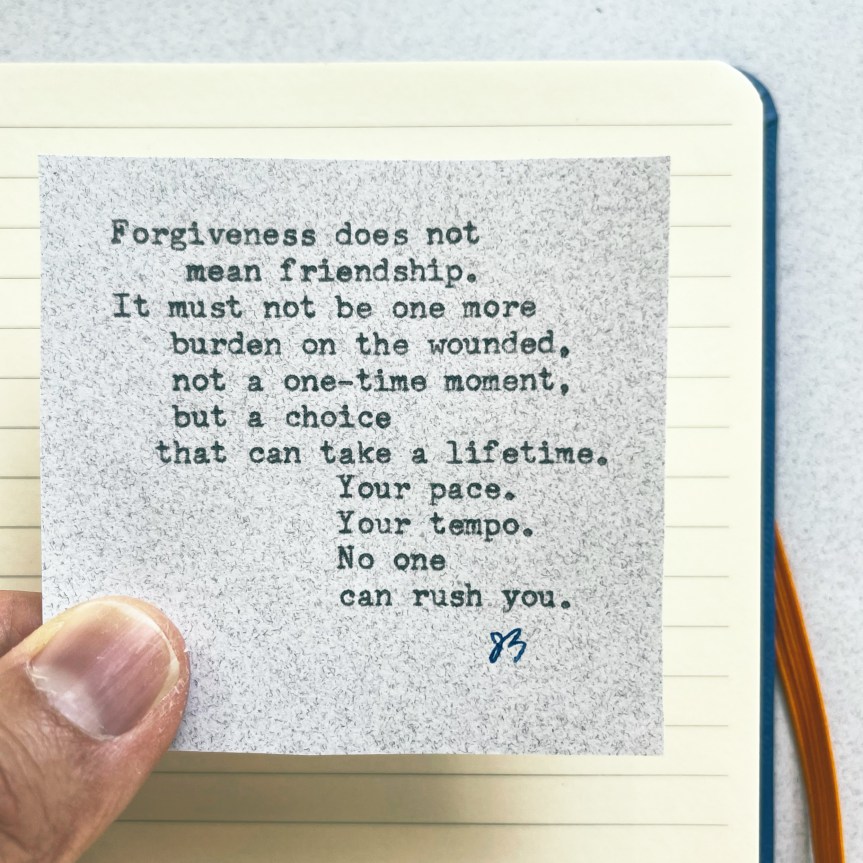
1) Forgiveness does not mean friendship.
2) Forgiveness is a daily choice that can take a lifetime.
3) No one can rush your forgiveness, ever.
4) You can be angry while forgiving.
5) Forgiveness does not negate justice.
6) If you have been abused and traumatized, then forgiveness is not a prerequisite for your recovery. To make forgiveness a burden on the abused only enables the abuser. It also mocks the abused. To skip anger is to bypass pain and therefore true recovery.
7) Do not make forgiveness an imperative burden to force a romanticized outcome of “peace,” especially on the abused and oppressed. All you’ll do is guilt trip already wounded people into a false truce.

— J.S.
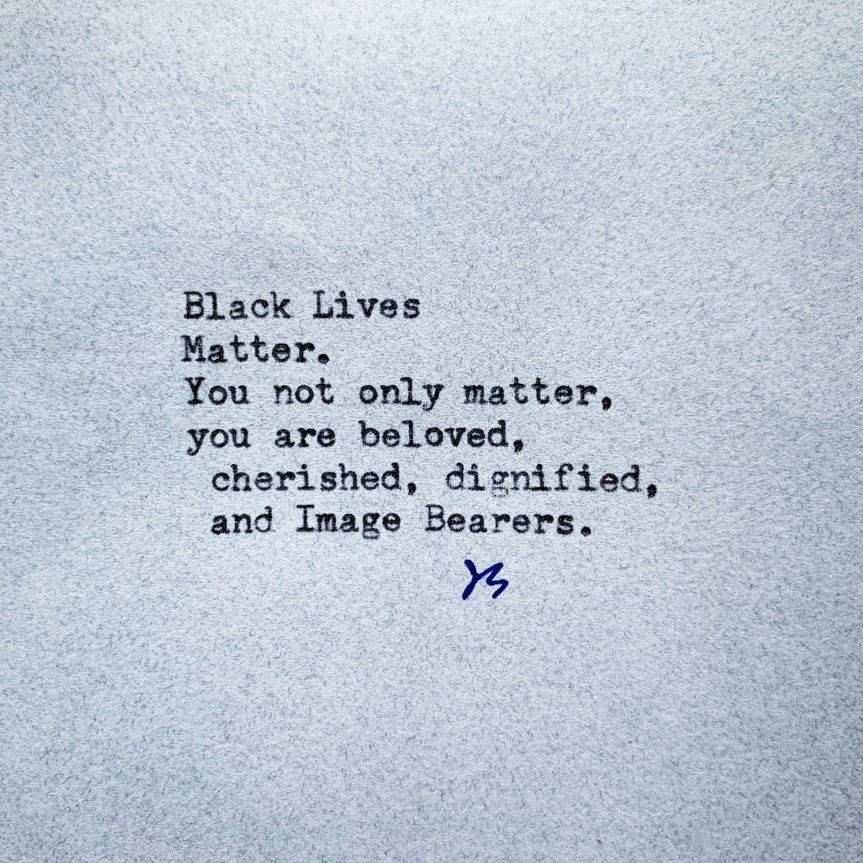
Black Lives Must Matter


You more than matter. Black lives are beloved, cherished, dignified, and bearers of the Image of God. It is a truth denied but it is no less true.

My friend “Shayla” (who gave me permission to share her story) was telling me that after the hundredth video of a Black person beaten in the streets, after one more citation of false facts and stats, after one more demand to “just work harder and get off welfare and quit drugs,” she had the terrible thought, “Maybe they’re right. I’m not human.”

After so many racist messages and images, it can become impossible not to believe, “I’m not human.” Or, “They’re right.”

The internalized trauma of racism is crushing. Day after day, the Black community is denied their lives, art, beauty, voices, stories, truth. Even when we know these racist messages are not true, they have a way of creeping in, suffocating, infiltrating our beliefs.

It cannot be overstated how much the trauma of racism deteriorates a soul. Trauma has a way of saying, “I am what has happened to me.”

I say as a chaplain but also as a human being: I have seen so many kinds of grief, but to believe your skin makes you deficient is one of the saddest, most haunting pains of all. It sticks so hard. It kills. It takes a thousand times more work to restore wholeness than to tear it down.

I will always be on the side of the wounded. I will do all I can to be part of that thousand steps towards wholeness.

For me, to say Black Lives Matter is a starting point to recognize the full worth of Black Lives. In Korean, the phrase Black Lives Matter is “huhg-in-eh seng-myung-un so-joong-hapnida,” which means Black Life Is Precious. I will continue to say Black Lives Matter, but even more, precious and worthy—not just worthy of protecting, but also having inherent worth.

If you are burned out, traumatized, overwhelmed by racist messages and images, please know the truth: you bear the Image of God. Your worth is not in what you’ve done or how you’ve been treated. It may be hard to believe today, but you are loved. I am with you and for you. As much as I love you, the Creator loves you infinitely more.

— J.S.

If You Hurt, I Hurt Too


I never want to politicize, moralize, or spiritualize someone’s pain.

I am always on the side of the wounded. Where there is loss, I am for the bereaved. Where you are hurting, I want to bring healing. Anything less is making us less human and not more.

It would take only a few seconds to consider the other person’s pain and perspective and point of view. That has the power to heal. The only cost to empathy is losing bigotry, self-righteousness, and pride. Empathy is that good.

It should never be on the wounded to explain their pain, defend their injury, or to forgive over and over the injustices that never should’ve happened but keep happening. Even if your hurt is not my hurt: because you’re hurting, I hurt too.

I want to empathize first, to listen first, to grieve first, and to be angry and to weep alongside. Not lecture, lessonize, or minimize. I don’t want to add burdens, nor demand explanations, nor kick you while you’re down. I want to crawl down there with you.

I cannot understand the hasty, vicious speed by which real hurting people are turned into talking points. I don’t mean the platforms for justice. I mean the ones that degrade and deny. I cannot understand the evil scorn and jeering and mockery: there is no honor in desecration, but only violence to the soul. And while I do not believe we must be forced to give our opinion all the time—so often the silence is chilling, and apathy can be the most destructive force of all.

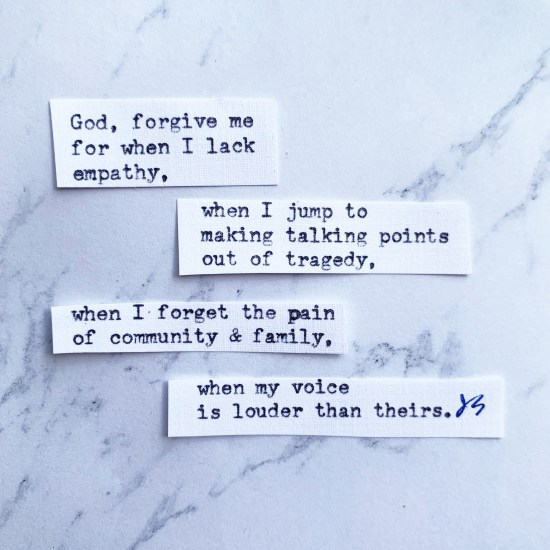
May I never lose sight of the wound and the wounded. May God forgive me for when I wasn’t listening, for not getting it right. Above all, I must grieve. Through tears, prayer, and action, I grieve with you.
— J.S.

#AhmaudArbery

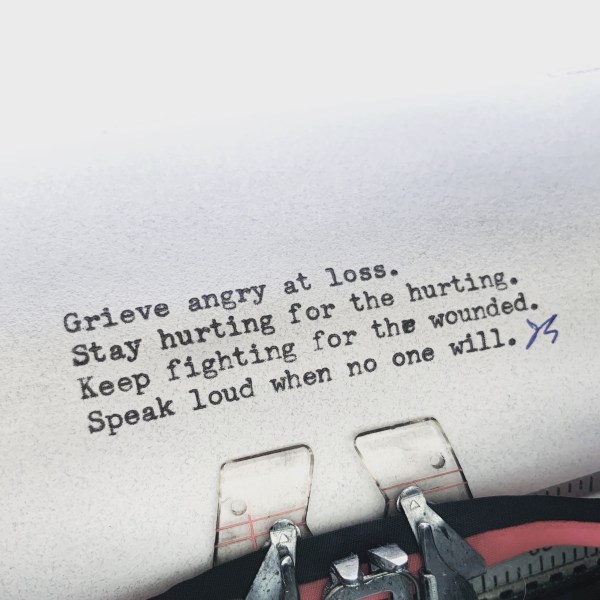
Grieve Angry


The other week, a shooting took six lives and I thought, “That’s not too bad.” I immediately felt sick. Because this isn’t normal. It isn’t okay. And I don’t want to get numb, desensitized, detached, withdrawn. I don’t ever want to get over the anger and grief of how “normal” this has become—whether it’s thirty, six, or one.

It’s a national habit to look at the death toll, but shootings really destroy lives twice. At the hospital, we regularly receive GSW (gunshot wound) patients through the ER. Many survive. Sometimes, surviving is worse. The trauma of it. The nightmares. To witness such a thing is a lifelong wound. The death tolls are horrific, but the mental and emotional toll is just as destructive. I’ve been up close with GSW victims and families—and I can’t watch the news with neutral disinterest. I can’t watch movie violence the same way. I will never get the smell out of my nostrils. When you sit among people with bullet wounds, you see most political “dialogue” for what it really is: fear, cowardice, pomp, rationalizations, and self-aggrandizing, all which speak past the victims instead of for them. I hope I’m not doing the same thing. Please tell me if I am. Please tell me what I can do.

I don’t know if anything will change. Again. It seems hopeless. But I want to grieve angry. I don’t want to calm down. I want courage. And compassion. And champions who will make waves so that something will change. God, keep us loud. God, give us strength.

J.S.

Justice and Dignity for Ryo Oyamada

image


Ryo Oyamada, a 24 year old student from Japan, was struck and killed by an NYPD vehicle in a hit & run.  Witnesses say the police car had no lights or sirens on and was going over 70 mph.  The released footage by NYPD was proven to be heavily altered in a cover-up, showing “lights” on the vehicle, when compared to footage from the NY Housing Authority on the same street with the same timestamp.

On a personal note: I know that this will probably not be shared or reblogged very much, because Asians are not very prominent in American culture.  I understand this, because Asians (like me) are partially at fault for being so passive.  But I am begging you to please consider signing this petition out of human decency.  Ryo was just a student walking home, then struck by a nearly silent police cruiser going at excess speed, and the NYPD covered it up.

Here is the side-by-side comparison of the released video footage, including updates from the case.  This article contains a link to a graphic video moments after the crash, showing the body of Ryo Oyamada and NY citizens yelling at the police.  Please advise, it is highly disturbing. 

And the following is an excerpt from the petition, which as of this writing only has 286 signatures.


This was originally posted on my Tumblr, and the post has now gone viral. It’s at over 33,000 notes and there are nearly 7000 signatures for the petition.


*Update* 8/28/14 – The petition has almost 12,000 signatures! Peter Chin, the one who started the petition, has also made an update on the petition page.


*Update* 9/8/14 – Over 66,000 signatures! Please keep it going!