Our Rest and Resolve: What Gets Us Through Deadlines, Demands, and Disorder

>Art by worshipgifs


Hello dear beloved friends! This is a message called, Rest and Resolve: What Gets Us Through Deadlines, Demands, and Disorder.

It’s about what gets us through when we want to give up. You can stream above or download directly here. I’m also on iTunes here.


I talk about Jesus versus Peter at the Transfiguration. Some other things I talk about are: That moment of exhaustion when you sigh for a long time before you walk through the door, the burn-out check-out from school and marriage and career, the strange beauty of enjoying something you can’t pay for with nothing to offer, the greatest miracle Jesus ever pulled, faith as a long-distance relationship, a word for both perfectionists and slackers, and the one crucial question they ask you at a car accident.

All messages can be streamed here. Be blessed and love y’all!
J.S.

How Do I Know If It’s God or the Devil? A Mega-Post On Pain, Evil, and Suffering

Anonymous asked a question:

Would God purposely put His children in a situation where they would be hurt in any way (rape, kidnapped, something like that)? Or is this the work of the devil? I don’t think He would, but I don’t know.

My dear friend: There’s probably a huge list of questions I’d like to ask God the second I see Him (right after I collect my eyeballs back into my head).  So right upfront: I’m not sure why the devil is given such a long leash.  I’m going to ask God about that one, probably with my arms crossed and eyes rolled (and my head on fire).

The Question of Evil has not been adequately answered by the greatest philosophers of history, and I probably won’t be the one to crack it today, either.  It’s the kind of stuff that makes me doubt God everyday.  Even if I did have some solid theology on why certain atrocities happen, I still doubt it would satisfy the victim of abuse and slavery and oppression and terminal illness, no matter how much “logical sense” it makes to the brain.  Even if I concluded, “All the bad stuff is really from Satan,” then a suffering person could only reply, “So what?”

I can only offer a few thoughts that might help you on your journey here, because this tension of why bad things happen will never be resolved by any single answer.  Anything we say on pain will always be inadequate for the actual suffering person.  No such all-encompassing answer from any belief system really exists. I say this as a chaplain who works in the hospital, who has seen the very worst kinds of suffering, knowing that any amount of inspiration or explanation will never be enough.

I can only say that I believe the Christian perspective best accommodates the problems we see today.  I’m also aware that some of us will never meet eye-to-eye on this and we can “deconstructively reduce” anything I’m saying with snark and cynicism. That’s easy mode.  And that’s okay.  We’re free to disagree and wrestle and think for ourselves.

And please know: I would never, ever enumerate these reasons out loud the moment after a person has been seriously harmed.  I would never bring this to the bedside of any of my patients in their inexplicable grief. None of this theology really matters as much as you being there in the trenches with a heart of listening and love.

As always, please feel free to skip around.

Continue reading “How Do I Know If It’s God or the Devil? A Mega-Post On Pain, Evil, and Suffering”

Jesus Welcomes the Worst of You.


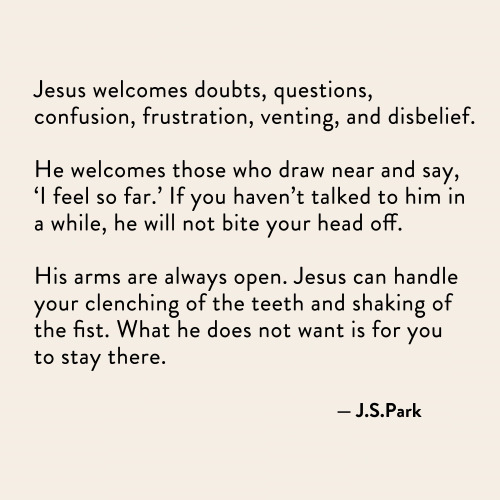
Jesus welcomes doubts, questions, confusion, frustration, venting, and disbelief. He welcomes those who draw near and say, “I feel so far.”

If you haven’t talked to him in a while, he will not bite your head off.

His arms are always open. Jesus can handle your clenching of the teeth and shaking of the fist. What he does not want is for you to stay there.

J.S.

Art from worshipgifs

A Faith Crisis: When My Theology Is Shaken by Science, Debates, and Headlines

Anonymous asked a question:

So I’m taking an honors world history class taught by an atheist teacher and we’re learning about evolution and it’s really really testing my faith. Honestly I don’t know what’s true right now. My theology isn’t the greatest because I’ve only accepted Christ for two years now. I’m just now finding it hard to believe in the Bible and God right now.

Hey dear friend, thank you for sharing this with such honesty.

The truth is, every single type of belief system will eventually get shaken somewhere. When this happens, we can 1) investigate deeper into what we really believe, and 2) incorporate the new information into our beliefs somehow.

We each experience a kind of cognitive dissonance when our worldview is shaken. It can actually make you disoriented, nauseous, and depressed. Sometimes it’s from learning more about the world, or it’s from a terribly brutal tragedy, or it can be a very persuasive argument that uses flowery language. And these experiences will inform our theology and philosophy, and vice versa. But none of this has to be a threatening, stomach-punching trauma.

While we’re certainly going to feel what we feel, we can still explore this new information in light of what we currently know, and then navigate a way through it. It’ll be tough, and you may be scared or surprised by your conclusions, but it can actually make you a more thoughtful, whole person, too.

Continue reading “A Faith Crisis: When My Theology Is Shaken by Science, Debates, and Headlines”

Can God Really Fill My Loneliness?

Anonymous asked a question:

As a christian how can we be intimate with God so that he fills the void of companionship?

Hey dear friend, I’m afraid that this might be a false dichotomy. In other words, intimacy with God and companionship with people are not two separate things. Jesus told us the Greatest Commandment is (paraphrased a bit), “Love God with heart, soul, mind, and strength … and love your neighbor as yourself.”

To quote Timothy Keller:

Adam was not lonely because he was imperfect. Adam was lonely because he was perfect. Adam was lonely because he was like God, and therefore, since he was like God, he had to have someone to love, someone to work with, someone to talk to, someone to share with.

All of our other problems—our anger, our anxiety, our fear, our cowardice—arise out of sin and our imperfections. Loneliness is the one problem you have because you’re made in the image of God.

Loneliness is not a sin, but points to a very real need that we’ve had since the very beginning. Certainly, if our loneliness leads us to idolize others or people-please or squeeze unhealthy expectations, then we will be crushed. On the other hand, if we only “rely on God” in a sort of monk-like asceticism, then we will either grow resentful of “these worldly people” or we will never participate in the stream of God’s loving activity, which involves people.

Continue reading “Can God Really Fill My Loneliness?”

Theology Showdown: The Narrow Gate Vs. the Broad Road

Anonymous asked a question:

I am a little confused about something and I was hoping you could help. In Matthew, it talks about the narrow path and gate into heaven. How can I, as a Christian perceive that to mean something other than that lots of people walk towards God but very few actually make it. This seems to go against grace? And also the profession of Jesus as a saviour?

Hey dear friend, this is certainly a troubling passage that is very off-putting at first glance: but I’d like to balance this passage with the entirety of Scripture.

Let’s look at the passage in question, Matthew 7:13-14, which says:

13 “Enter through the narrow gate. For wide is the gate and broad is the road that leads to destruction, and many enter through it. 14 But small is the gate and narrow the road that leads to life, and only a few find it.

So it looks like most people alive today will end up in Hell, an eternity under the wrath of God, while only a fraction will make it to Heaven.

But then, let’s look at Matthew 25:13 here, known as the Parable of the Ten Virgins (or Bridesmaids). To summarize, Jesus tells a tale about a wedding where ten bridesmaids are waiting for the bridegroom to begin the ceremony, but only five of the bridesmaids came prepared with extra oil in their lamps to greet him (this sounds like a weird custom back then, but weddings have always had weird customs throughout history, e.g. throwing bouquets or fishing for garters or dancing past a reasonably non-creepy age). So five of the bridesmaids make it, but five don’t. This implies that at least half of the people we know will end up in Heaven.

Lastly, let’s look at Matthew 13:24-30 here, known as the Parable of the Wheat and Tares. To summarize, Jesus tells a tale where a farmer’s field is sabotaged by weeds. The farmer, instead of pulling up the weeds, decides to let the wheat and weeds grow together, and at the time of harvest he will separate them. This implies that most people we know will end up in Heaven.

So which one is true? Is it the story of the Narrow Gate, or the Ten Bridesmaids, or the Wheat and Tares? Do only a few of us make it, or half of us, or most of us?

Continue reading “Theology Showdown: The Narrow Gate Vs. the Broad Road”

Mythical Messiahs vs. the Real Jesus: 10 Reasons That Jesus Is Unique Among Myths & Legends

Anonymous asked a question:

I don’t know if you’re familiar with Apollonius of Tyana but there are some people arguing that he also had followers, performed miracles and rose from the dead. That’s why they kept saying he’s the ~real~ Jesus. Thoughts?

Hey dear friend, here’s a cool fact:

A ton of people in the first century claimed they were the Messiah. Only one is really remembered today, and that’s a strange historical truth that must be taken seriously for both Christians and those exploring faith.

Here’s the context. The Jewish Israelites in the first century hadn’t heard from God or any of His prophets for about four-hundred years, since the prophet Malachi, who also wrote the last book of the Old Testament. They were waiting on either 1) another prophet, or 2) the prophesied Messiah, the “Suffering Servant,” who would apparently liberate them from the oppression of the Roman Empire.

The Jewish Israelites believed that God hadn’t spoken for centuries because of continuous idolatry and rebellion against God. This mindset incidentally formed a group called the Pharisees, who devised over 600 laws to follow, so that such perfection would honor God and possibly hasten the Messiah’s appearance. The Pharisees were so strict that any person who claimed to be the Messiah was almost immediately shut down, because worshiping any god outside the true God was only more idolatry, which had put them in this position of God-silence in the first place. So even though we dismiss the Pharisees today, I can definitely understand their mentality back then and how fast they were to condemn Jesus.

Many new Messiahs did appear. Two of them are mentioned in Acts 5 by a Pharisee named Gamaliel, who mentions Theudas and Judas the Galilean. History books also talk about Judah the Hammer, who enacted a siege against the Roman Empire but was just as quickly crushed. All of these “Messiahs” acted as warrior-presidents that used military force to throw a coup, like a militia attempting to oust the government. Nothing came of them. And the Pharisees were pretty happy about this, because in their mind, such false Messiahs only kept God at bay.

When Jesus came around, he was different than every other Messiah. Here are at least ten reasons why Jesus was unique compared to the religious leaders of his day, and perhaps among every other religious leader.

Continue reading “Mythical Messiahs vs. the Real Jesus: 10 Reasons That Jesus Is Unique Among Myths & Legends”

How Do You Keep Believing This Jesus Bulls__t?

Anonymous asked a question:

How do you believe when, pardon my french, you’ve been taught that everything about Jesus is bulls__t? I’d love to believe it, I really want to, it’s just hard to when you’ve been taught the opposite. Do I have to unlearn the foundation of my education?

Hey dear friend, to be truthful: you’re in the best place possible, with the single biggest advantage over someone who’s been raised in the church.

You get to be in a place where you’re starting with a hugely skeptical eye towards Christianity, which means that if God starts to lean in on you, you will have already encountered your biggest questions about faith. If only every Christian honestly encountered every doubt and argument and problem with Christian theology, with complete openness and abandon, then we might see how deep Christianity can really go.

Please do not think you have to unlearn anything you’ve learned. I suggest the opposite. Use your education to fairly weigh every piece of evidence you encounter. Keep digging into Christianity down to the bottom, to see that it’s both true and fulfilling, that it’s both intellectually coherent and existentially satisfying.

Continue reading “How Do You Keep Believing This Jesus Bulls__t?”

Hang In There.

hang in there world not final home worshipgifs


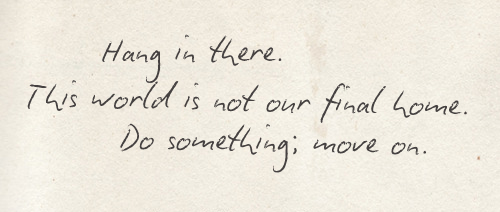
Hang in there. This world is not our final home. Do something; move on.
J.S.


Photo by worshipgifs

We Bleed, All The Way Up


The patient really believed her cancer was somehow “God’s amazing plan for my life.” She went on to say the things I always hear: “He won’t give me more than I can handle. Thank God we caught it early. God is going to use this for my good.”

I get why we say these things, because we’re such creatures of story that we rush for coherence. But even when such theology is true, I want to tell her that it’s okay to say this whole ordeal is terrible and that it really hurts and that we live in a disordered, chaotic, fractured, fallen world where the current of sin devours everything, that bad things happen to model citizens, that nothing is as it’s meant to be, and the people who don’t catch the cancer early aren’t well enough to thank God for anything, and that not every pain is meant to be a spiritualized, connect-the-dots lesson as if God is some cruel teacher waiting for us to “get it.”

Pain doesn’t always have to be dressed up as a blessing in disguise. God hears our frustration about injustice and illness: for He is just as mad at suffering as we are. He doesn’t rush our grief. He bled with us, too, in absolute solidarity, and broke what breaks us in a tomb. He is the friend who meets us in our pain, yet strong enough to lead us through. I can only hope, in some small measure, to do the same.

J.S.


From Mountain High to Valley Low: Finding an Oasis in the Darkest Desert

Photo by Lenny K, CC BY 2.0


Hello dear friends! This is a message I preached called, From Mountain High to Valley Low: Finding an Oasis in the Darkest Desert, on the story of Elijah from 1 Kings 18-19.

It’s about finding our way through discouragement, distress, and depression, and how God speaks to us in those seasons and how we speak to one another. As a lifelong sufferer of depression, this is hugely personal for me. Stream below or download directly here. I’m also on iTunes here.

Some things I talk about are: The sudden mental replay in the shower and the late-night regret twitch, the one common denial from every patient in the hospital, when you just need a hamburger and a really long nap, the hidden fear of men getting honest, the panic moment when someone sees your text messages and photos, how Yoda finally got through to Luke Skywalker, and Elijah versus depression versus the world.

All messages are here. Be immensely blessed and love y’all!
J.S.

Unchanging Heart.

heart of God unchanging changes you JS Park Instagram

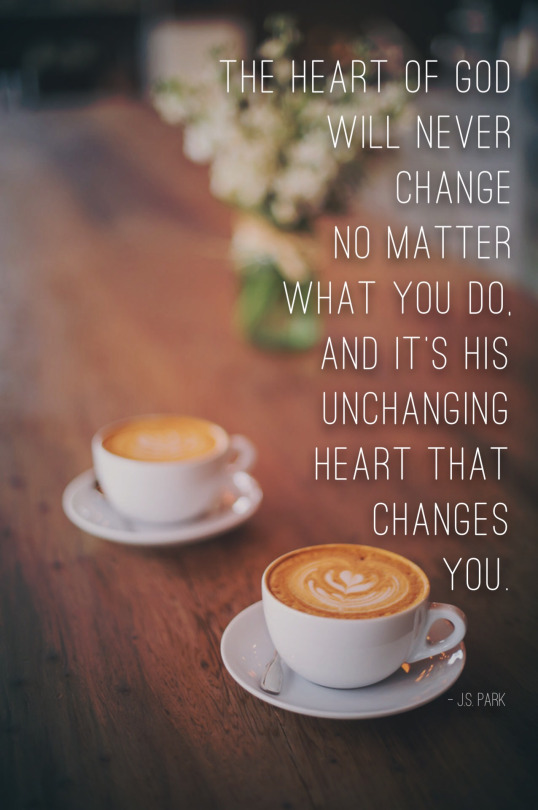
The heart of God will never change no matter what you do,
and it’s His unchanging heart that changes you.
J.S.


Foreword to My Newest Book, by T.B. LaBerge

Grace Be With You Foreword TB LaBerge


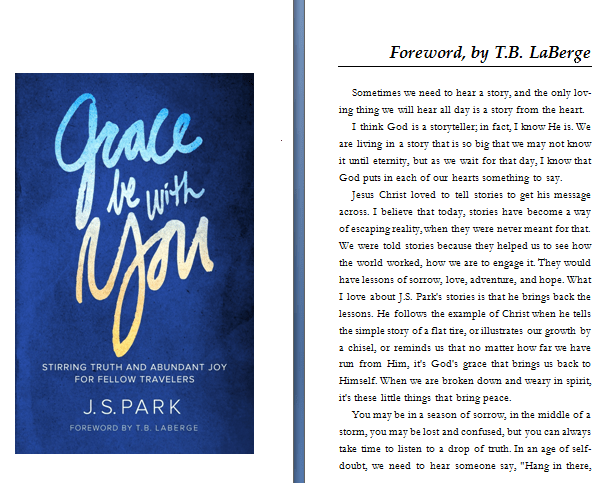
My very good friend and blogger T.B. LaBerge wrote the Foreword to my newest book, Grace Be With You.

The book is a collection of short stories, poems, and thoughts, many of which you’ve seen here on this blog.
It’s available now in paperback and ebook!


http://www.amazon.com/Grace-Be-With-You-paperback/dp/069269031X/

http://www.amazon.com/Grace-Be-With-You-ebook/dp/B01E4XXCVM


My Newest Book: Grace Be With You, a Compendium of Stories, Thoughts, & Poems

Grace Be With You paperback


Hey dear friends! This is my newest book, Grace Be With You: Stirring Truth and Abundant Joy for Fellow Travelers. It’s a collection of stories, quotes, and poems, most of which have gone “viral” on this blog, with all new content. The Foreword is also by my wonderful friend T.B. LaBerge.

The book has four chapters, each a unique theme: to encourage, convict, engage, and transcend. Contained are quick quotes, humbling plot twists, and everyday encounters on the road, at the hospital, at cafes and gas stations and funerals and churches.

The paperback is only 8.99 here and the ebook is only 3.99 here and it works on every device. If you’re blessed by the book, please consider leaving a review on Amazon.

Be immensely rocked by His grace!
J.S.


Paperback: http://www.amazon.com/Grace-Be-With-You-paperback/dp/069269031X

Ebook: http://www.amazon.com/Grace-Be-With-You-ebook/dp/B01E4XXCVM

Holiness, Humility, and How to Give Your Life Away


Hello wonderful friends! This is a message I preached called Holiness, Humility, and How to Give Your Life Away.

It’s about how the holiness of God irrevocably changes us in two ground-shaking ways. Stream below or download here.


Some of the things I talk about are: The two things I hear at every deathbed in the hospital, my body’s crazy involuntary response when I flew over the Grand Canyon, every instance of the Bible characters seeing God and falling over crying, the unseen thankless art of raising children, how to live generously with zero guarantees, and a letter from Belize.

My podcasts are on iTunes here (leave a review if you wish!).

Be immensely blessed, dear friends!
J.S.

The Two Words We Want Least But Need Most


Hello wonderful friends! This is a message I gave called, The Two Words We Want Least But Need the Most.

It’s about two words that we quickly avoid but desperately need for growth, healing, and wholeness, for our relationships, churches, politics, and faith. Stream below or download directly here.

Some things I talk about are: When you see someone else’s kid misbehaving in public, the most unappealing things about Christianity for Christians, thinking the sermon is for the guy in the next row, tracing the theme of water and chaos through ancient history and Scripture, and how Jesus’s war cry obliterated our worldly warfare.

I’m also on iTunes here. Be immensely blessed!
J.S.

The Gospel in Two and a Half Minutes


The entire storyline of the Bible in two and a half minutes. And a different way to see the Gospel.

Subscribe to my channel here.
Be blessed and love y’all!

— J.S.

[Thank you to Steven Hause of pudgyproductions]


Rolls The Stone Away.


In darkness, He rolls the stone away.
At your worst, He loves you anyway.
— J.S.


Finding Home in the Dark: A Fiber of Fine Light.


The hard part is that when you decide not to call on lesser idols to numb your hurt and you finally reach out to God, suddenly you’re inside the pain. It’s all there. You can’t do anything to hide it anymore. It seems like a terrible idea.

One of the toughest things about excruciating pain is that it’s embarrassing. There’s a humiliating stench of astonishment that this is happening to me. It’s malheur, or a pain about your pain. If you live with it long enough, you’ll begin to identify yourself by your hurt, as if this is your only value. It’s understandable, because it takes up so much space in your mind. It’s no wonder why we’re tempted to run to everything else.

The pain is blinding. But — blinding ourselves to the pain is even worse. In doing so, we erase ourselves down to the bottom.

So then: Calling out to God is remembering who you are.
Remembering where you come from.
Remembering what you were made for.
Remembering that you are not your pain.

Most of all, remembering who He is.

This will look different for everyone. It could mean taking a long drive to the shoreline. It could mean standing over the sea in total silence. It could mean opening your Bible to Isaiah 40 or Psalm 23. It means asking a friend to hot chocolate and hearing you out. It means actively seeking encouragement and community, because 1 John 4:12 says, “No one has ever seen God; but if we love one another, God lives in us and his love is made complete in us.” It means journaling, or busting out your guitar, or crying for a long time, or having an intense conversation with yourself. It means finding a need and serving that need. It means finding an older brother or sister and asking for wisdom on what to do next. It means dressing your Sunday best and singing at church at the top of your lungs, in hot tears and laughter.

A lot of this might feel rote and mechanical. You might not feel like doing any of it, and I don’t mean to add another burden on your hurt.

I just know that for a moment, when I can trace the sunbeam back to the sun, I remember who I am. It doesn’t make me instantly whole. It doesn’t solve things today. It’s often just a brief glimpse. But when I return to the heart who made me, I momentarily find something stronger than my pain. It is stronger than everything else that calls my name.

This is a difficult thing to do. It’s not merely psychological re-arrangement, because it requires getting up. It requires tapping into a very fine frequency, which is there for a flash and gone. But it’s there.

You might have even been on the other side of this and helped someone else remember. Maybe you took someone to lunch and listened to them without interruption for an hour. You made actual eye-to-eye contact, and you never knew, but you changed the course of that person’s day from driving off a cliff. You randomly volunteered. You wrote a thank you note. You picked up a call from a distant friend. You wrestled with someone’s questions, maybe not even fully paying attention, but you stayed with it to the end.

You didn’t know, but you were part of the frequency.
Once in a while, God breaks in. He reminds us of beauty. The pain doesn’t stop, but there’s a joy in the middle of it, just loud enough to remember.
We can break in, too.
You can pray. You can sing. You can seek others. You can visit home in His Word.

It is painful, sloppy, and scary. It’s not easy to turn our internal axis to Him, especially in hard times. But by slow, stumbling degrees, I can breathe Him in — and He is the only air that fills these crumpled lungs.
I remember: we’re not home yet.


J.S. Park | Mad About God

Does God Use Pain “For My Good”? Does Everything Happen For a Reason?


Is suffering a “part of God’s Plan”? Does God use trials to teach us a lesson? Does everything really happen for a reason?

A hard look at the Problem of God vs. Suffering, and why easy answers won’t work in the middle of the mess.

Get my book on persevering through trials & suffering, Mad About God.

— J.S.