Theology Is Complete with Our Hands and Feet


There’s a classic dispute among psychologists that’s best shown by the hair dryer story. It goes like this:

A woman believes her hair dryer is going to burn down her house. It gets to be a real problem; she’s driving back home twenty times a day. Her work life and love life and social life all take a hit.

Finally a therapist asks her, “Have you thought about just bringing the hair dryer with you?”

It works. When the fear creeps in, the woman opens her office drawer and sees the hair dryer and she’s fine.

Some psychologists see a major problem here: “Nothing was solved! She still has issues! She needs to get to the root of it!” But others say she found a solution that worked for her.

I lean toward the second camp. The problem was real to her and so was the solution. Maybe later she would get to the bottom of things. But until then, she had found a way to make it okay.

The big idea is her story was taken seriously. That was the start of her wholeness. Only when a story is fully heard is there the possibility of connection or challenge or growth.

The thing is: Too many of our injuries are real. It is not merely “in their head” or “their side of the story.” And it is not enough just to believe it happened.

Abuse, racialized trauma, mass violence, systemic failures, misogyny, manipulated power dynamics, and all the mental health issues not seemingly visible—all of these need empathy, but it doesn’t stop there. They also need presence, action, compassion, and a complete reframing of all the ways that things are done. Justice would make things so right that we would never need accountability or to convince others to “believe me.”

It is already hard enough proving my injury is real.
I have the scars to prove it.
But what I need is more than belief,
more than moved hearts, more than speech.

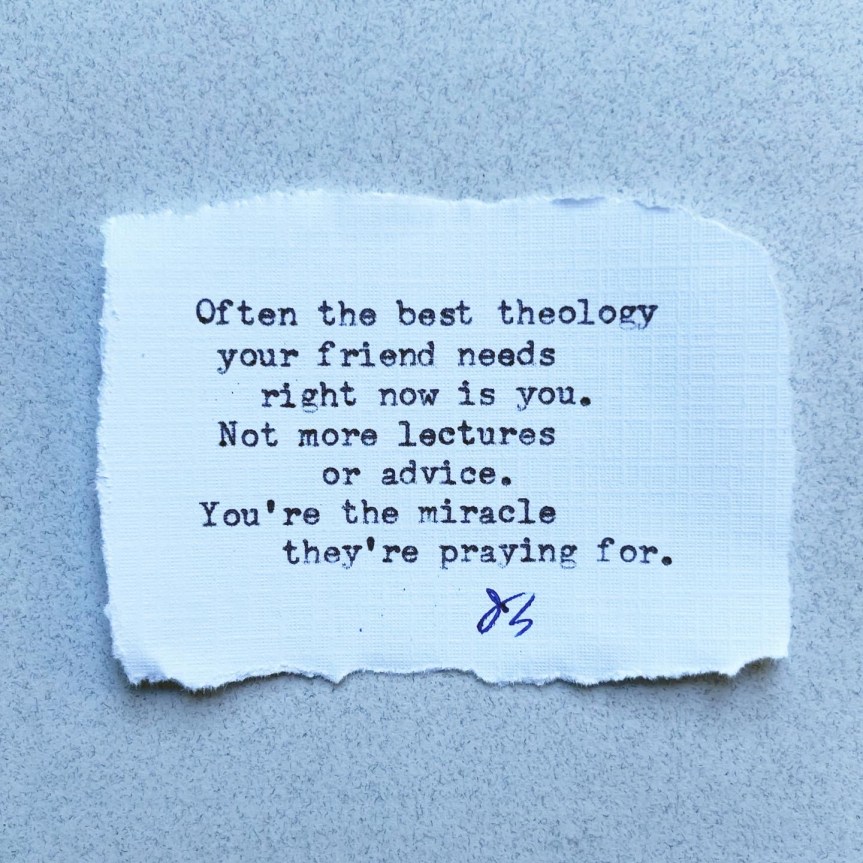
Theology is only complete with our hands and feet.
Psychology can diagnose and make valuable notes, but only heels in the field, in the dirt, bring us hope.
Even with all our treatment and remedies, I still need you to sit with me.
In grief, your advice is probably good, but not as good as being on the floor with me.
May your pain be mine,
and your hopes mine too.

— J.S.


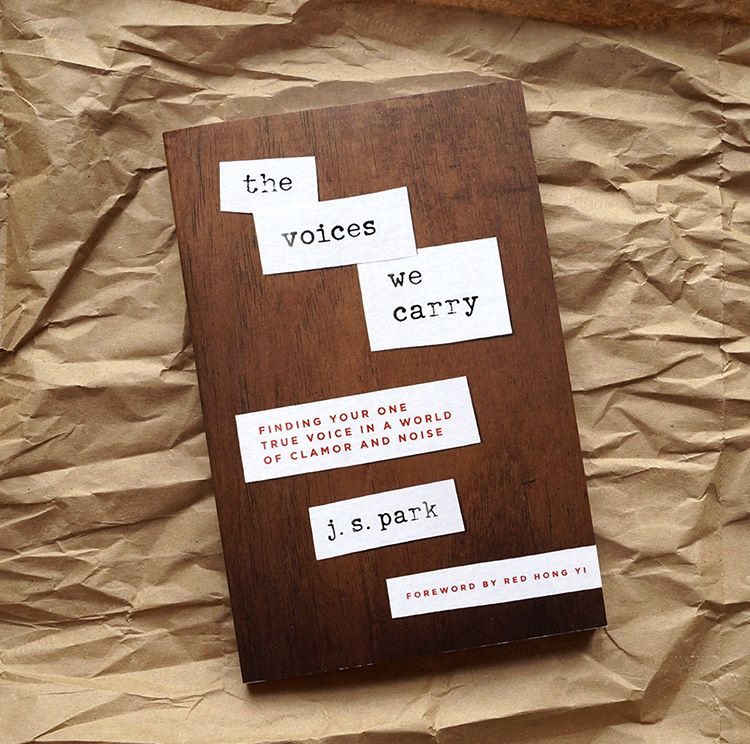
Part of this post is an excerpt from my book The Voices We Carry
I Am Invisible: Will You See Us?


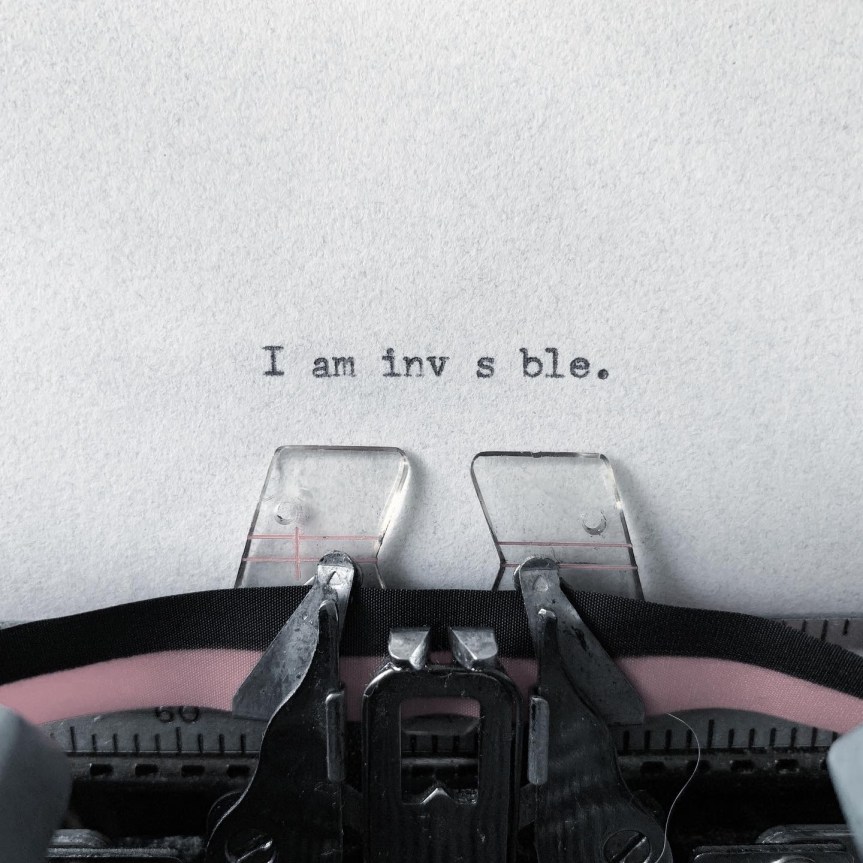
With the recent hate crimes against Asian-Americans, I am reminded again I am invisible.

When I was a boy, someone had spray-painted a swastika on my father’s dojo. My dad painted over it, but on hot humid days we could still see that Nazi symbol like a pulsing writhing scar.

We got a voicemail on our answering machine—maybe the same Nazi artists—who spent ten minutes making fun of my dad’s accent. I remember seeing my dad listen to it several times, staring quietly out a window. When he noticed me, he turned it off and said, “Just boys playing a joke.” The voices were from grown men.

In middle school I remember being assaulted, shoved around, called “ch-nk yellow belly,” having fries thrown at me during lunch (I sat alone) which were drenched in ketchup, some kid yelling “your dad killed my dad in the war” and then I watched his dad pick him up from detention.

At weddings, funerals, leadership meetings, conferences, I am often the only Asian. And I am invisible. I have literally sat in rooms before where I speak and no one looks my direction. Not even glances. I once called my wife in a dramatic panic, asking, “Do I exist?” And she knew what I meant. The invisibility.

I could tell you a hundred stories like this, and a hundred more. I have. And, well—no one hears. Or remembers. I know my experiences pale in comparison to racist violent acts done to so many others. I only wish I was heard. Seen.

A couple years ago I was a guest at a panel where we discussed race. I shared how I felt invisible. Afterwards, a wonderful Black woman approached me with tears in her eyes, hugged me and said, “I see you. I see you. God sees you.” Over and over, she whispered, “I see you.” And I was so moved, I wept with her. “I see you.”

I still hear her. Thinking of it now, I still weep. For a moment, at least, I was seen. We saw each other. We have so much work to do—but that day, that was enough for me. I was seen. To see is to make visible.

— J.S.

Book Launch: The Voices We Carry


Happy day, friends! My book The Voices We Carry is officially released.

The Voices We Carry is about wrestling with our voices, such as self-doubt, people-pleasing, trauma, grief, and family dynamics, and finding our own voice in world of mixed messages. I talk about my hospital chaplaincy, what I learned from patients at the edge of life and death, and giving a voice to those who have been silenced—those like you and me.

The month of May is also Mental Health Awareness Month and Asian Pacific American Heritage Month. My book talks about the challenges of both. I believe that the more we can share our stories and make room for our many voices, the better we become.

God bless and much love to you, friends. Thank you for allowing me to speak into your life, faith, and journey.
— J.S.


The Voices We Carry is published by Northfield of Moody Publishers.

#MentalHealthAwarenessMonth
#AsianPacificAmericanHeritageMonth


A Voice to Carry You


My book comes out on May 5th, in just a couple days. I’m grateful to so many.

I believe that no one is a self-made person. People enter our lives, whether for a second or a season or decades, and they support us. But perhaps more importantly, they speak into us.

I want to thank two people in particular. In grade school, I had a teacher that I’ll call Ms. Macklin. After we did a short story assignment, she took me aside after class and said, “You need an agent.” At first I thought she said, “You need an Asian.” Maybe she was telling me I needed an Asian friend, since I was the only one in the entire school. But she explained, “A literary agent. You know, to get your work published. It has to be published.”

Before this encounter, I had always wanted to be a writer. I had carried around a notepad since I was five or so. I wrote stories about the ducks at the local pond, especially about this one duck who had a lopsided wing. I made up an entire conspiracy about how the town was polluting the water and causing the ducks to be sideways. The twist: the ducks were fighting each other, and it was the violence that caused them to be lopsided (and yes, they eventually united to stop the pollution too).

Ms. Macklin believed in me. It was really the first time someone had commented on my writing. It put the bug in my ear: “It has to be published.”

In community college, I met Professor Marcus, who preferred to be called Rocky. She smelled like potpourri and was fond of wearing trench coats, probably made of hemp. She took me aside after class (this is a common tactic apparently), and told me, “I say this to everyone but I only mean it once in a blue moon. You have to be a writer.” Rocky coached me. That entire semester she poured into me: how to write, edit, edit, edit, simplify, clarify, amplify. It was hard. It was wonderful. Like an education at Hogwarts. What a gift she was.

Ms. Macklin and Professor Rocky are still a part of me. Their voice, the gentle way they corrected me, their kind way of saying hello when I entered. I was a lonely kid a lot of the time. But they made it bearable. And they made me a writer. Just thinking of them, my heart swells. Where would we be without the people who look us in the eye and with total confidence say, “You, you got the stuff, you got what it takes, and you, I even like you, and I like what you bring into the world” …?

I’m thankful. So thankful for the teachers, leaders, mentors, counselors, therapists, parents, random elders at the airport, the security guards who paused to chat, and the man who helped push my car out of the road after an accident in the rain: each of you made me a writer. I hope I spoke into you even a fraction of what you spoke into me.

I’m thankful for you. In a world such as this, you have been strength and beauty.
— J.S.

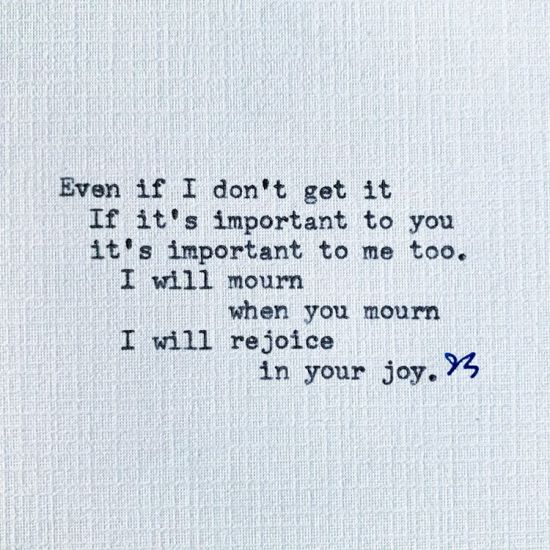
Even If I Don’t Get It


Once I had this friend who was embarrassed by my laughter. At the movies, he would literally shove my shoulder to tell me to quiet down. At first I just stopped laughing around him. But eventually I stifled my laughter around everybody.

That same friend couldn’t believe it when I was sad about something, or hurt, or not enjoying myself. I was being a downer, I guess. I was interrupting his life.

We went hiking once and he kept telling me to smile. “Why don’t you laugh?” he said. He knew I had lung issues and breathing problems. But he wouldn’t slow down for me, not for a second.

We’re not friends anymore, but here’s the thing: I don’t think we were ever friends. He wanted a customizable, checklisted, wishlisted type of robot that met his every whim. That was all. He couldn’t imagine another person with needs beyond his own. And I was happy to cater to him. There was something about his bully-like authority that I was attracted to, as if I got strength from his domineering. But no, we were never friends. I was his rug, his lapdog.

I could be mad at him, but I’m guilty of the same thing. Sometimes I don’t understand a person’s fears, dreams, and goals, and I judge them for it. I don’t get their hobbies or the movies or music they like or the fact they love quinoa and kale. Mentally I belittle them for being them.

We do this with mental health, gender, race, culture, their stories: it’s as if we withhold permission for people to feel hurt about the things that don’t hurt us. “It’s never happened to me, therefore it never happens” is the most destructive lie that destroys connection.

But I want to get it. I want to get your fear, anxiety, pain, your worries and heartaches and shame. Your whole story. To really listen means that another person’s story is more important than my own right then. But that’s how we grow. That’s how we heal. That’s how we find laughter, loud and free.

I’m sorry I didn’t listen earlier. I’m sorry I didn’t hear you. I want to. I want to hear you, and by hearing, fully see.

— J.S.

Believe It


You are loved.

You might have heard that a million times, but it’s no less true.

You do have a Creator. He is with you. He is bigger than your situation and closer than your deepest hurt. He’s not mad. He is cheering for you and rooting for you this very second. He’s okay about all the things before. He sent His Son for that very reason.

You can put down the blade. You can throw away the pills. You can quit replaying those regrets in your head. You can quit the inner-loop of self-condemnation. You can forget your ex. You can walk away from the things and people that destroy you. You can resolve your conflicts right now. You can sign up to volunteer at that shelter. You can have the courage to stand up for justice in the street, in your office, in your home. You can forgive your parents. You can forgive your children. You can draw boundaries and say no. You can go back to church. You don’t have to sit in the back. You don’t have to prove your worth to the people you’ve let down. You don’t have to live up to everyone else’s vision for your life. You’re finally, finally free.
You are loved. I am loved.

As much as I love you, dear friend, He loves you infinitely more.

Believe it. Walk in it. Walk with Him.

God is in the business of breathing life into hurting places.

This is what He does, even for the least likely like you and me.

— J.S.

Grieve Angry


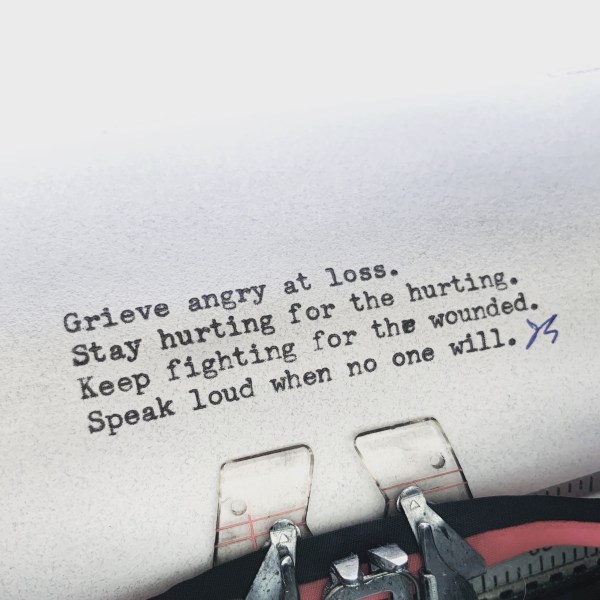
The other week, a shooting took six lives and I thought, “That’s not too bad.” I immediately felt sick. Because this isn’t normal. It isn’t okay. And I don’t want to get numb, desensitized, detached, withdrawn. I don’t ever want to get over the anger and grief of how “normal” this has become—whether it’s thirty, six, or one.

It’s a national habit to look at the death toll, but shootings really destroy lives twice. At the hospital, we regularly receive GSW (gunshot wound) patients through the ER. Many survive. Sometimes, surviving is worse. The trauma of it. The nightmares. To witness such a thing is a lifelong wound. The death tolls are horrific, but the mental and emotional toll is just as destructive. I’ve been up close with GSW victims and families—and I can’t watch the news with neutral disinterest. I can’t watch movie violence the same way. I will never get the smell out of my nostrils. When you sit among people with bullet wounds, you see most political “dialogue” for what it really is: fear, cowardice, pomp, rationalizations, and self-aggrandizing, all which speak past the victims instead of for them. I hope I’m not doing the same thing. Please tell me if I am. Please tell me what I can do.

I don’t know if anything will change. Again. It seems hopeless. But I want to grieve angry. I don’t want to calm down. I want courage. And compassion. And champions who will make waves so that something will change. God, keep us loud. God, give us strength.

J.S.

Turning Point.


Most testimonies have a turning point: “And then I met ___” or “Someone reached out” or “I got this text at the perfect time.” It seems random, but those people and encounters and messages of encouragement happened on purpose. Someone made a choice to reach out, get involved, get near another person’s heartache, and help them for one more step. It was enough to get them moving again. Maybe it was no big deal for the person who reached out. But to the person they helped, it meant everything. It was the turning point. It was the beginning of seeing new light, of finding a new dream, the start of healing. A little bit of your time and wisdom might turn someone’s life around. I’m thankful to those who pressed in and breathed life.
J.S.

Faith That Burns Slow.


I imagine that when Moses split the Red Sea, there were two groups of people.
The first group was composed of victorious triumphant warriors saying, “In your face, Egyptians! This is our God!” They were pumping their fists and thrusting their spears.

The second group was composed of doubtful, panicking screamers running full speed through whales and plankton.

I’m a Screamer. I’m a cynic. I’m a critic.

I’m a Peter, who can make a good start off the boat, but falls in the water when my eyes wander.

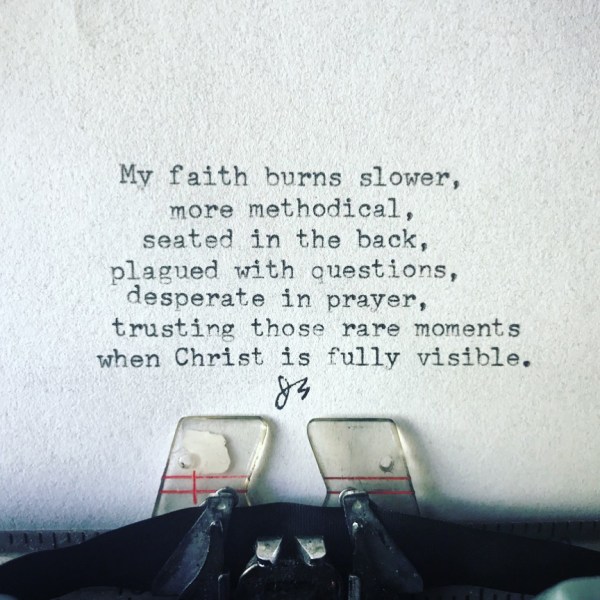
I’m not endorsing a halfway lukewarm faith. I believe God wants us to have a robust, vibrant, thriving relationship with Him. But as for me, I’ll be limping to the finish-line.

I’m more of a Thomas than a Paul. I’m more Martha than Mary. I’m more David than Daniel.

Yet the Warriors and Screamers all made it through.

It’s not easy to have faith the size of a mustard seed. But Jesus promised that this would be enough to move mountains, and I’m learning to be okay with that.

— J.S.