Holding Dignity


I have to tell you this story about “Ray,” who thought he didn’t deserve help.

I used to work at a nonprofit charity for the homeless and I met Ray when he finally got housing and landed a new job. But he needed a new tool belt.

My friend heard about his situation and bought a tool belt for Ray. A fifteen-pocket leather carpenter pouch, one of the nicest ones you could buy. Ray was beside himself.

A few weeks later, somebody asked Ray how he liked the tool belt.
“I haven’t used it,” he said. “I’m not sure that I can. I don’t deserve a thing like that.”

He thought he would ruin it with himself. “The things I’ve done,” he said, “pretty much disqualify me. I feel guilty.”

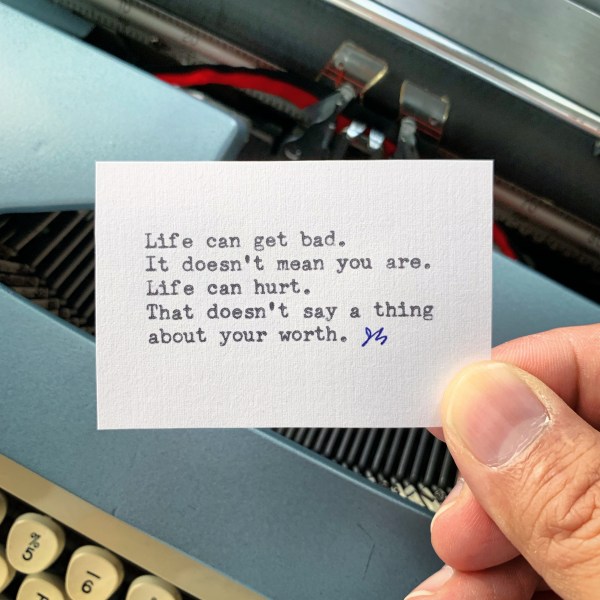
Ray had told us his story before: addictions, abuse, abandonment. He never had a chance, a lap behind from the start, stuck in systemic structures beyond him. He felt he deserved his fate. But Ray learned to believe a better story about himself. He didn’t need to be good enough for the gift; the gift was good enough for him. The things he had done and the things that happened to him didn’t disqualify him from what was good. Maybe Ray really was the kind of guy who didn’t deserve it. But that was the point. It was a gift. We need that sort of grace, a grace that invites us into a better story than the one we were given.

It’s true one act of kindness doesn’t dismantle a whole system. It doesn’t automatically mean we succeed. But a reminder of our dignity is the very least we need. Even as systems around us shrink us down, it never means we are small: only that we were always too big for all we were given.

I think of all the ways
our past selves
were never shown a chance
still hold us back
our bodies brutalized in headlines
our minds made hatred internalized
we believed tall tales about us
that told the whole story without us.

But all that does not see you
says nothing about you
only that they lack vision
and you are already made in an irrevocable Image.

To become someone new
often means returning to ourselves—
souls dignified, made divine,
forged in inherent worth.

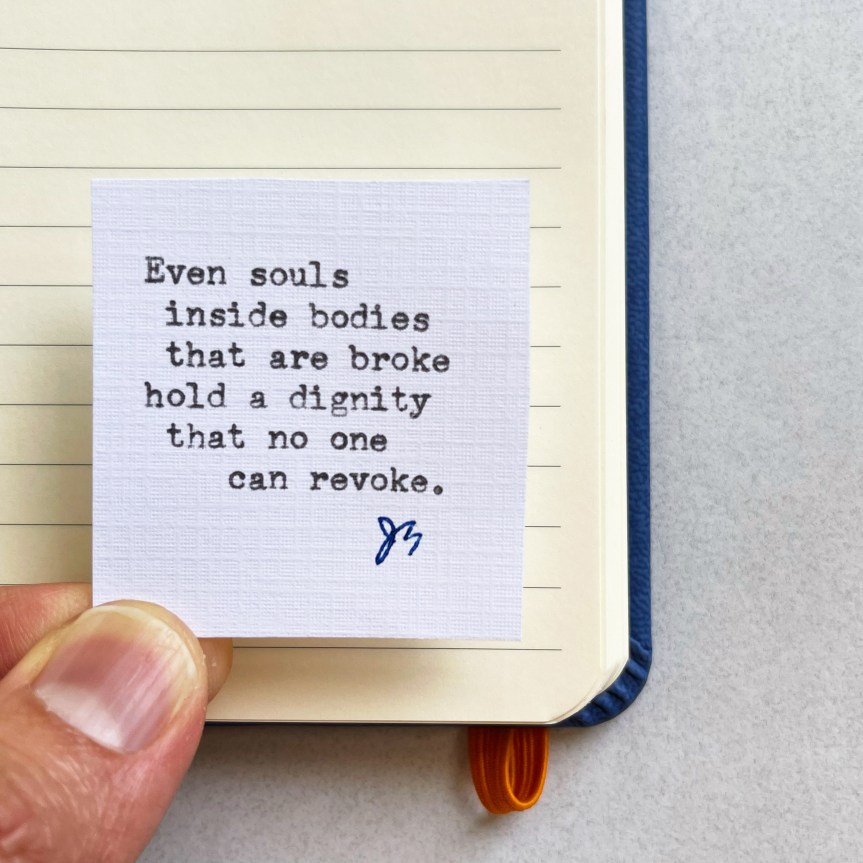
And even souls inside bodies that are broke
hold a dignity that no one can revoke.
In you, I see the face of God.

— J.S.


– Partially adapted from my book The Voices We Carry

What Forgiveness Is and Is Not: Seven Rules of Forgiveness


Too often forgiveness is a burden on the wounded. Instead the imperative of accountability must be on the abuser.

When I’m told to forgive, I think about

my math tutor when I was barely twelve years old, who shouted in my face and dug his fingers in my shoulders

a grown woman who beat me for “misbehaving” at a public pool when I was seven

students who randomly assaulted me in school calling me racial slurs

the thousands of hate crimes and murders both reported and unrecorded against POC

the dozens of stories I’ve heard from patients assaulted by their most trusted people.

But I’m told to just let go. “Forgiveness is a gift.”
Is it? How is it a gift to remove this knife from my gut that never should’ve been there? Why is abuse became the abused person’s problem to solve?

Forgiveness is powerful, yes. On the other side there’s freedom. But when forgiveness is demanded of a victim in a bad power dynamic—who benefits? Abusive people and systems often act in a remorseless repetition of violence. It’s that very violence which keeps power and profit.

I have learned it is more wrong
not to be angry at injustice.
Why demand the wounded
to be level-headed, neutral, watch their tone, to grow, be resilient, be the example, take the high road?
Sometimes the high road
goes right off a cliff.

Inside anger
I hear the voice of grief
because the abused person
had their life interrupted
and never asked for an apology
—they needed honor for their dignity.

Here are some of my rules on forgiveness.
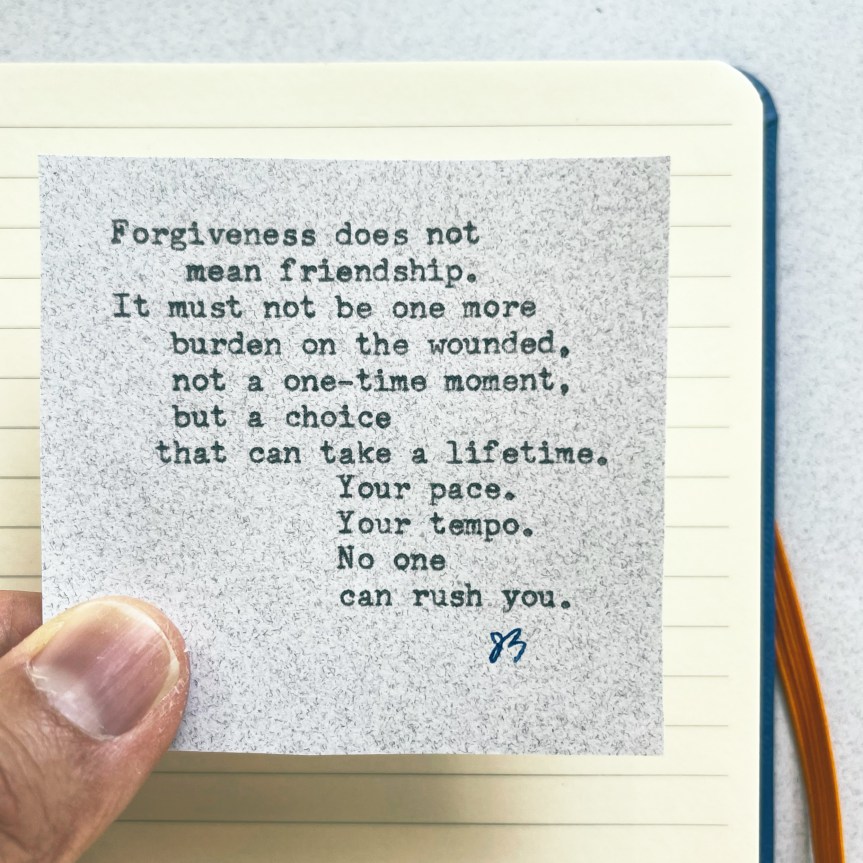
1) Forgiveness does not mean friendship.
2) Forgiveness is a daily choice that can take a lifetime.
3) No one can rush your forgiveness, ever.
4) You can be angry while forgiving.
5) Forgiveness does not negate justice.
6) If you have been abused and traumatized, then forgiveness is not a prerequisite for your recovery. To make forgiveness a burden on the abused only enables the abuser. It also mocks the abused. To skip anger is to bypass pain and therefore true recovery.
7) Do not make forgiveness an imperative burden to force a romanticized outcome of “peace,” especially on the abused and oppressed. All you’ll do is guilt trip already wounded people into a false truce.

— J.S.

More Than All That’s Happened


If you’ve grown up in the same town long enough, most people assume you’re the same person you always were. They can’t see past the past version of you.

I wonder a lot: Are we doomed to our former selves, time-stamped to who we used to be? Will the things we’ve done and used to do always drag at at our heels, a permanent anchor?

There are days I keep imagining what other people are saying about me. I imagine a room full of them shaking their heads. “A chaplain? Who’s he kidding? I know who he really is. He’s not the guy he pretends to be. Nobody like him could change.” It keeps me up at night. I mentally argue with them until I’ve finally proven I’m not that same guy. I’ll spend hours inside my own head explaining my side of the story and why you need to know I’m not a bad person and that I’m sorry for the person I was before.

But you know, no one may get to hear your side of the story. No one might believe you’ve changed. Even when you do the right thing, you’ll be accused of wrong motives. And you are still accountable to the wrong you’ve done, as much as others are accountable for how they’ve wronged you.

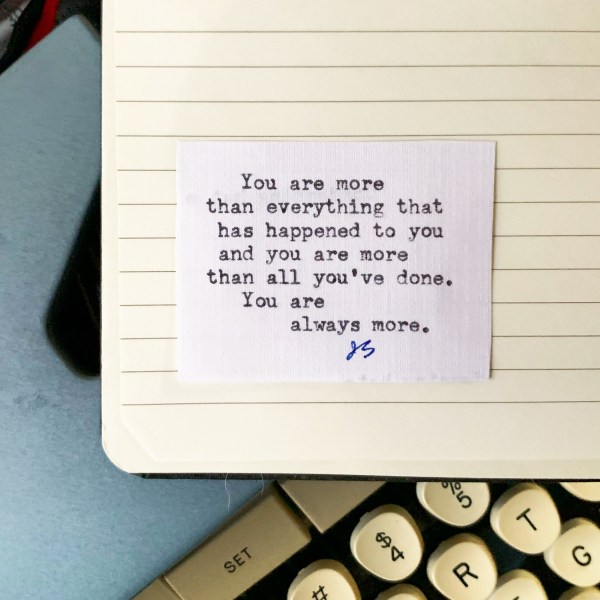
But there is a grace that says you are different now, and the old you is dead. Buried. No longer you. Maybe no one will know you’ve encountered the kind of grace that has not just changed you, but made you completely new. Your trauma, your guilt, your past, your labels: they’re taken in by grace, by a love that sees in whole and stays. Imagine that. The world may call you something, but you are more. You are new. You are always more.
— J.S.

Believe It


You are loved.

You might have heard that a million times, but it’s no less true.

You do have a Creator. He is with you. He is bigger than your situation and closer than your deepest hurt. He’s not mad. He is cheering for you and rooting for you this very second. He’s okay about all the things before. He sent His Son for that very reason.

You can put down the blade. You can throw away the pills. You can quit replaying those regrets in your head. You can quit the inner-loop of self-condemnation. You can forget your ex. You can walk away from the things and people that destroy you. You can resolve your conflicts right now. You can sign up to volunteer at that shelter. You can have the courage to stand up for justice in the street, in your office, in your home. You can forgive your parents. You can forgive your children. You can draw boundaries and say no. You can go back to church. You don’t have to sit in the back. You don’t have to prove your worth to the people you’ve let down. You don’t have to live up to everyone else’s vision for your life. You’re finally, finally free.
You are loved. I am loved.

As much as I love you, dear friend, He loves you infinitely more.

Believe it. Walk in it. Walk with Him.

God is in the business of breathing life into hurting places.

This is what He does, even for the least likely like you and me.

— J.S.

Faith That Burns Slow.


I imagine that when Moses split the Red Sea, there were two groups of people.
The first group was composed of victorious triumphant warriors saying, “In your face, Egyptians! This is our God!” They were pumping their fists and thrusting their spears.

The second group was composed of doubtful, panicking screamers running full speed through whales and plankton.

I’m a Screamer. I’m a cynic. I’m a critic.

I’m a Peter, who can make a good start off the boat, but falls in the water when my eyes wander.

I’m not endorsing a halfway lukewarm faith. I believe God wants us to have a robust, vibrant, thriving relationship with Him. But as for me, I’ll be limping to the finish-line.

I’m more of a Thomas than a Paul. I’m more Martha than Mary. I’m more David than Daniel.

Yet the Warriors and Screamers all made it through.

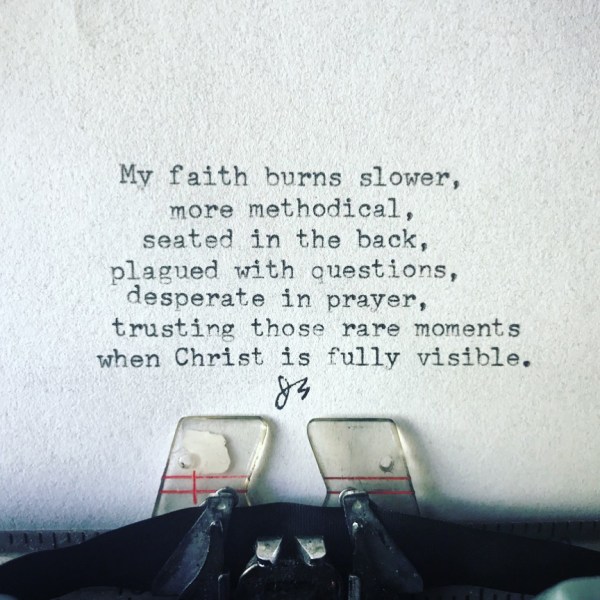
It’s not easy to have faith the size of a mustard seed. But Jesus promised that this would be enough to move mountains, and I’m learning to be okay with that.

— J.S.