
Knowing Ourselves Requires Knowing One Another


Last summer I wrote a piece on my own experience with race and racism. A blogger then publicly blasted some harmful views I was expressing.

As I read her words, I felt she was right—but I had a hard time seeing where I fell short. So I asked my friend, with her permission, to help me. How did I get this wrong? She first pointed out what was good. Then she kindly and firmly pointed out the various ways I missed the mark. Slowly and painfully, I saw how much I had messed up.

In particular: I was invalidating others’ experiences to boost my own; I was subtly drawing disproportionate comparisons, hijacking language and images that did not belong to me; I was mostly absorbed in self-pity and blame instead of sharing a vulnerable experience. When I saw it, it clicked: I was way, way, way off.

The easy thing to say here could be, “I’m still learning, I had no idea, show me grace, I’m sorry.” And that’s true. But my words were harmful. There’s no way out of that. I have to sit down, take the L, and simply be wrong. There’s no defense, excuse, rationalization, “but”—I was wrong, plain and simple.

This can’t be about my realization or epiphany, but about tending to the injury I caused.

Even though I’m a POC, that doesn’t make me free of criticism in matters of race and racism. Even though I wrestle with depression and anxiety, I still get it wrong about mental health. And as a chaplain dealing with grief: I’ve gotten that wrong too.

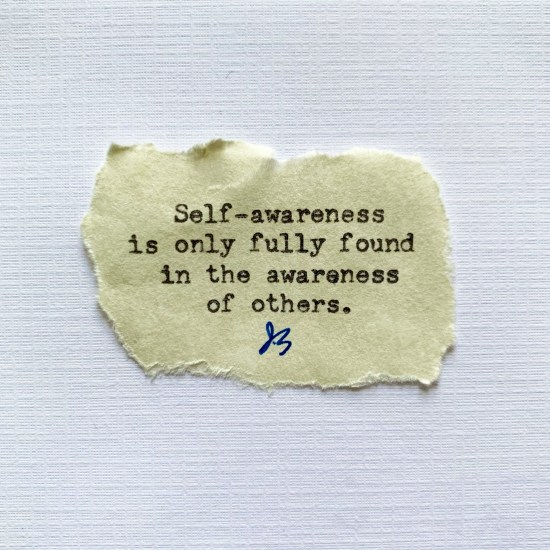
We can only become self-aware through the awareness of others. Or like C.S. Lewis says, “My own eyes are not enough for me; I will see through those of others.” To see is painful but necessary. We need others to see where we have fallen for deception, conspiracies, biases, agendas. It can truly happen to any of us. And even though I’d like to think I’m a friend to the wounded and weary, I still miss the mark. A lot. What I can do is not only examine how I went wrong, but act based on those new convictions. To rethink how I enter for the wounded, not just for my own catharsis. It shouldn’t be anyone’s burden to educate someone on the basics of humanity, but thank God for sending friends who took time to school me.

J.S.

My Friend Called Me a Racial Slur: Are They a Racist?

Anonymous asked a question:

If a friend of yours who showed no signs of racism ever just happened to get mad at you about something and called you a racial slur, what would you do?

Hey my friend. That’s terrible that this happened to you, and I’m sorry.

That’s also a very, very big yikes for me.

The short answer here is that your friend is most likely a racist, and it’s a good idea to drop them.

Some words are so charged, violent, and historically poisonous that they should never be spoken, certainly never from a friend you trusted, whether they were angry or not. For me, that would be a red flag, dealbreaker, and burned bridge all in one. I would have an extremely difficult time forgiving, much less trusting, this person again.

Before that sounds too harsh, here’s a story that my friend told me.

Continue reading “My Friend Called Me a Racial Slur: Are They a Racist?”

How Do I Confront a Friend Who Is “Sinning”?

Anonymous asked a question:

What do you do if you’re asking a non-Christian friend what they’re up to and they respond with telling you they’re doing some activity you know is sinful? Let’s say they could tell you they’re smoking or doing something dishonest or they’re practicing wicca. What’s the proper response to something like that?

Hey dear friend, just a few thoughts on this.

– I would first determine what is “sinful.” Why is it sinful to you? What makes it sin? Is it based on your preference or discomfort? Is there real harm being done? What is the sin against?

– If you lead with, “You’re a sinning sinner and you’re sinful,” I wouldn’t expect that person to hear you out. It has to start with dialogue first.

– If you find that your friend is truly being destructive towards their neighbors and themselves, then I would ask questions. I once knew a person who eventually trusted me enough to say, “I’m going to kill someone today.” My first instinct was to slowly back away and climb out the window. But I asked, “How do you think that would work out for you?” After a few minutes, that person finally said, “Yeah, I guess it wouldn’t work out at all.”

Continue reading “How Do I Confront a Friend Who Is “Sinning”?”

Can God Really Fill My Loneliness?

Anonymous asked a question:

As a christian how can we be intimate with God so that he fills the void of companionship?

Hey dear friend, I’m afraid that this might be a false dichotomy. In other words, intimacy with God and companionship with people are not two separate things. Jesus told us the Greatest Commandment is (paraphrased a bit), “Love God with heart, soul, mind, and strength … and love your neighbor as yourself.”

To quote Timothy Keller:

Adam was not lonely because he was imperfect. Adam was lonely because he was perfect. Adam was lonely because he was like God, and therefore, since he was like God, he had to have someone to love, someone to work with, someone to talk to, someone to share with.

All of our other problems—our anger, our anxiety, our fear, our cowardice—arise out of sin and our imperfections. Loneliness is the one problem you have because you’re made in the image of God.

Loneliness is not a sin, but points to a very real need that we’ve had since the very beginning. Certainly, if our loneliness leads us to idolize others or people-please or squeeze unhealthy expectations, then we will be crushed. On the other hand, if we only “rely on God” in a sort of monk-like asceticism, then we will either grow resentful of “these worldly people” or we will never participate in the stream of God’s loving activity, which involves people.

Continue reading “Can God Really Fill My Loneliness?”