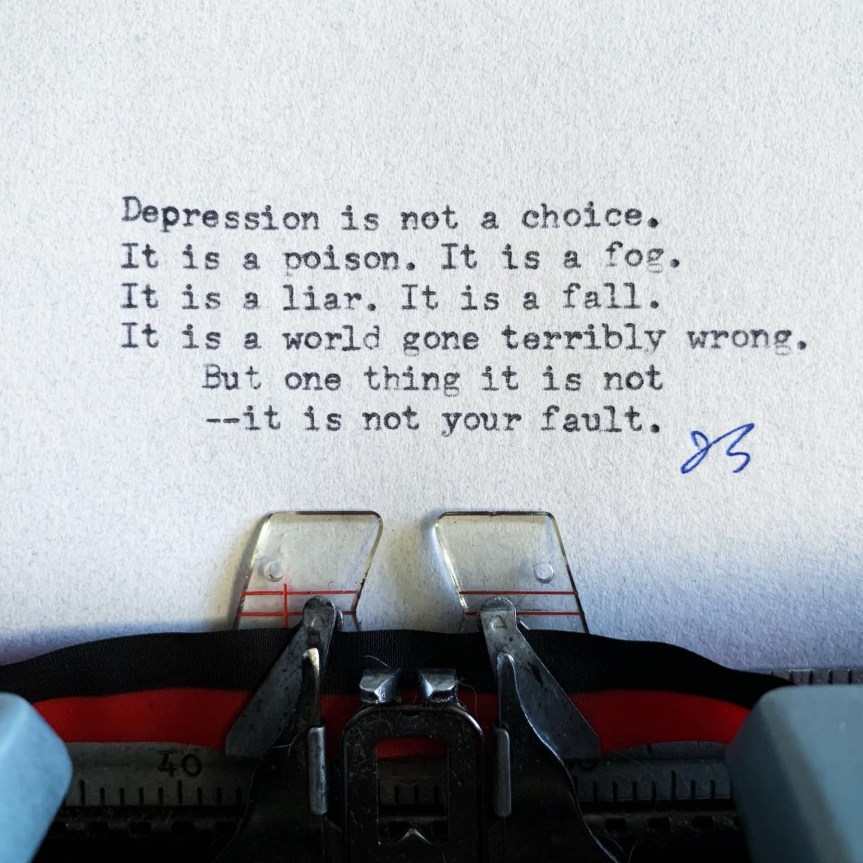
I’m Still Alive


CW/TW

A year ago I began taking antidepressants.

Almost twenty years ago I tried to take my life. I spent three days hospitalized after ingesting half a bottle of pills.

Over ten years ago I fell into one of the worst depressions of my life. I was laughed at by the pastor of the church where I worked.

There was a time I would’ve been deeply ashamed to tell you all this. We’ve made a lot of progress on the stigma around mental health, but so many myths are still ingrained.

This year is the first time I’ve had entire weeks without thinking about suicide. I never knew it was possible. I used to think about it every single day. That was my norm. It still happens sometimes, but I don’t dread when it will. I also don’t dread happiness either. Antidepressants don’t suddenly make you “happy,” but they open the possibility that happiness is not attached to a trap door, small print, a karmic pay-off. It turns impossible into imaginable. For even a moment, joy becomes guilt-free.

A few months ago I managed to stopped taking medication for five weeks. But on week five, I spiraled out and went back on. I thought somehow I had failed. I knew that was objectively false, but that’s how deep the stigma goes. I’m finding it okay to be on medication for life, if I need it. And today, I need it. I’m thankful.

I don’t know if the next one will win. But I’m here. I’m still here. Thank God, I am here.

Thank you friends for your prayers, messages, stories.
You keep me alive too.

— J.S.
Who I Speak For


I need to tell you this story.

When I was a pastor over ten years ago, I preached at a tiny conference and afterwards a young woman approached me. She had tears in her eyes, said she was single and anxious all the time and nearing forty years old and had “accomplished nothing.” I hurt for her.

Then suddenly—
I drew a blank on what to say. My seminary hadn’t prepared me for this. And I was scared for her. How would her church reply? Her pastor? Was this place safe? All I could do was process with her, validate her feelings, remind her of her inherent value, pray with her. Was that enough?

After I had met this young anxious woman, I changed two things.
1) I rewrote the rest of my sermons for the week.
2) I vowed to always think of this woman and others like her every time I spoke or wrote.

I knew up to then, to my own shame, I had never preached for the ones in the back row.

How could I have forgotten? I was once in the back row too. But my eagerness to keep “sound” and sound pretty and to please my professors overshadowed grace.

To this day, if anything I say does not speak to the person in the back row, to someone like me or her, it’s not worth saying. I have to remember where people really live. Hope cannot smother or bypass, but must only gently enter.

If our words only work for the well-off, able-bodied, and undisturbed, then maybe we’re
1) only speaking to popular powerful folks,
2) expecting profit from big pockets, or
3) comfortable outside reality.

I have a litmus test when new theological movements pop up. Will it matter to one of my dying patients and their families? Maybe that’s basic and unfair. But that litmus test has simplified and clarified my faith.

I still make this mistake, but always a reminder to myself: If it doesn’t work in the end, it won’t work at the start. If it doesn’t work for the wounded, it won’t make you whole. If it means a lot of arguing and posturing instead of compassion and action, I’m too tired to care. I don’t. Leave it out of the patient’s room and keep it on your platform.

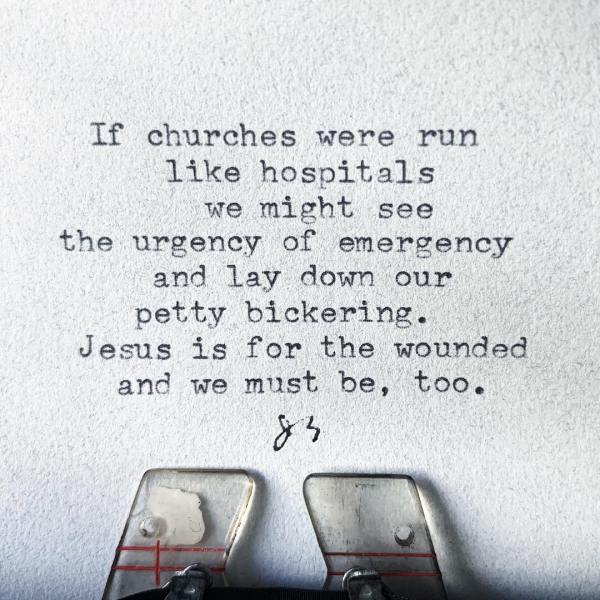
Jesus is with the wounded and that’s where I want to be. Bottom line, dotted line, and end of the line.

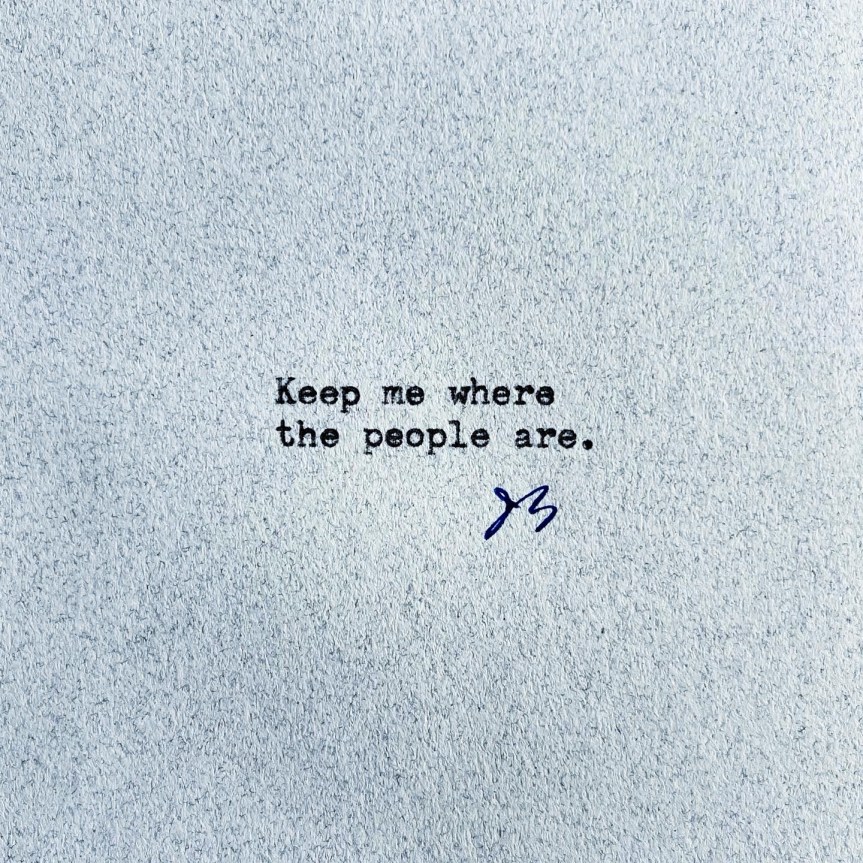
Keep me where the people are.

— J.S.

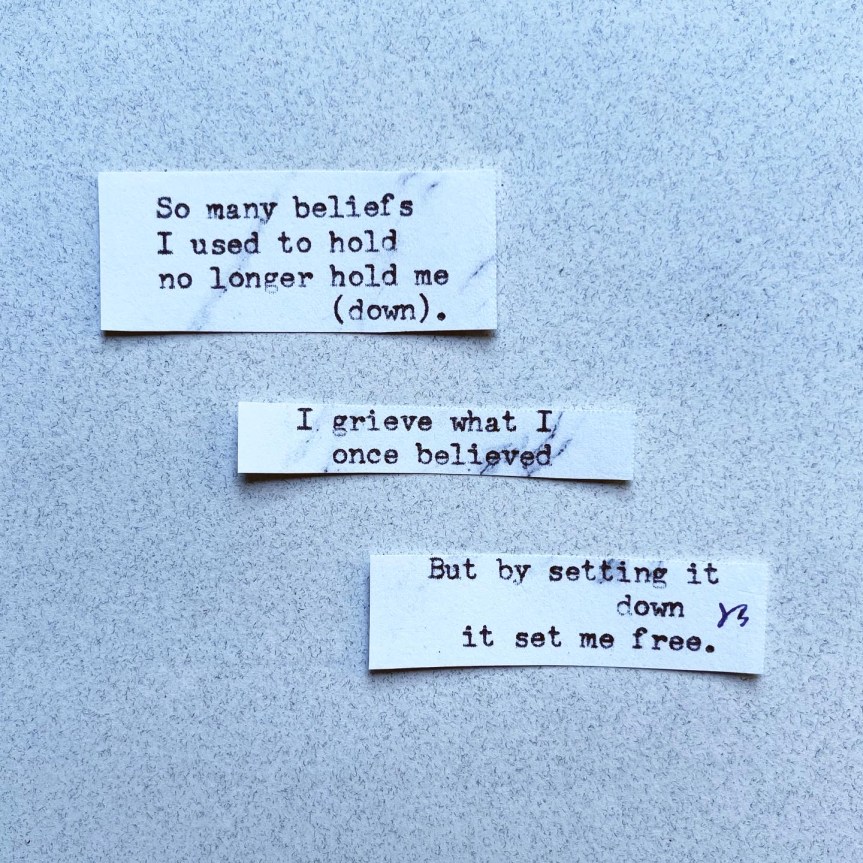
What I Used to Believe


What do you no longer believe?
What are old beliefs you grieve?

I used to believe
all anger was wrong, so I was the captain of the tone police—
until I discovered politeness is not rightness, that anger is not always hate, but hurt, and to be loving is to be fiercely angry at injustice.

I used to believe
forgiveness meant friendship and even a flicker of pain meant I hadn’t forgiven my abusers—
but I found I can forgive from afar, over a lifetime, and that the pain was not my lack of forgiveness but how deep the wound was carved.

I used to believe
that death could bring people together—
until I saw covid take hundreds of thousands of lives and not even their deaths could evoke compassion,
until I saw refugees ceaselessly die in the headlines and too many justified their demise.

I used to believe
that god was American, homophobic, emotionless, and secretly disappointed in me—
until I found God had a vision of grace far greater than our sight, an imagination that far outweighed mine.

I used to believe
my value was found in my usefulness and contribution,
instead of inherently being human,
in an irrevocable Image.

I used to believe
every pain had a purpose, a connect-the-dots lesson, a fire to refine us, a reason to teach us—
until I saw pain is pain, it is not mine to explain, and maybe the only reason it happened was evil and abuse and systems that need to be unmade.

I used to believe
my depression was from a lack of prayer or faith or moral grit or fortitude—
but my mental health only lacked the help I needed and I found that therapy and medicine were not giving up, but giving life.

I used to believe
those who looked like me chose to be silent and passive—
except we were not silent, but silenced, and we had always spoken up despite this.

I used to believe
we could never unravel lopsided power dynamics and racist systems—
until I saw heels in the dirt making moves insistent, for years they had woven new stitches by inches.

I used to believe
everything I believed
was so certain.
I grieve my certainty
but I trust the mystery, to know
there is always more unknown.
Being “right” is to be alone,
but in discovery
we walk each other home.

— J.S.

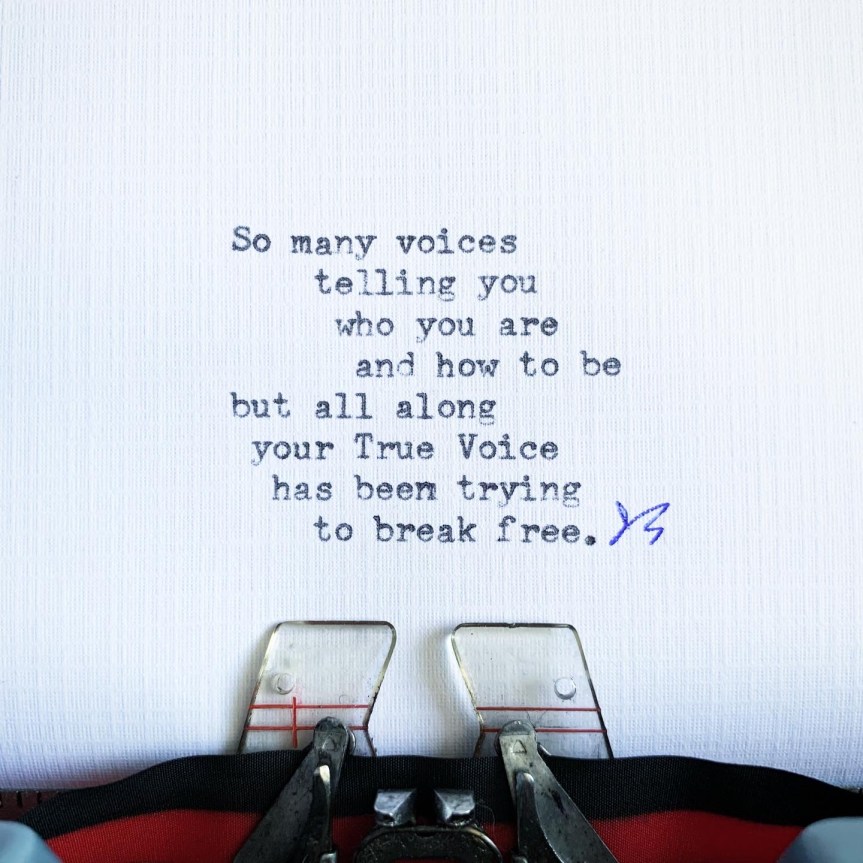
My Voice Was Taken


These last few week I’ve been reading about the many assaults against Asian-Americans, and I was hit with a lightning bolt of a memory I had nearly forgotten.

It is my very first memory. I was four on my first day of preschool. The only Asian in class. I didn’t speak English. When the teacher found out, she forced me to sit in the corner all day. She told me not to talk or turn around. I wept the entire day.

My mother, when she picked me up, cussed out the teacher and switched me to another school. But it was too late. A year or two later, as I learned English, I lost much of my Korean. The trauma destroyed my native language. My tongue had been burned of its millennia of heritage in my still-forming mouth.

To this day I can still understand Korean just enough, but when I try to speak I get tongue-tied. A block. It is apparent why. My voice was strangled. A teacher failed her “non-compliant” student. A system allowed racist violence against a child. A teacher did not understand she had a non-English-speaking American in her class, and instead of including him with even the smallest gesture, simply cut him off in a corner. The teacher was a cog in a system not funded with resources to equip their educators. That child never had a chance.

Our voices are still strangled. When I am yelled at violently in traffic because “Asian driver.” Spoken very slowly to by a cashier. Spoken over constantly in meetings. When people I supervise don’t take me seriously because they are not used to an Asian in the lead. When Asian jokes are told with zero hesitation. When people who look like my father go on a walk and are killed.

I realize I am lucky. My experiences are not as bad as others. My pain though, like any pain, is still pain. And I am not tougher for what I have gone through. I was made less. I was stripped of my home tongue. But no: I will not be stripped of my voice. It will not be taken. We each have a voice, gifted by God, just the one we are given. You have a song and it must break free. You have a microphone to pass to a young uncertain child, that they may sing too. Your voice. Speak. Your voice will carry you.
— J.S.

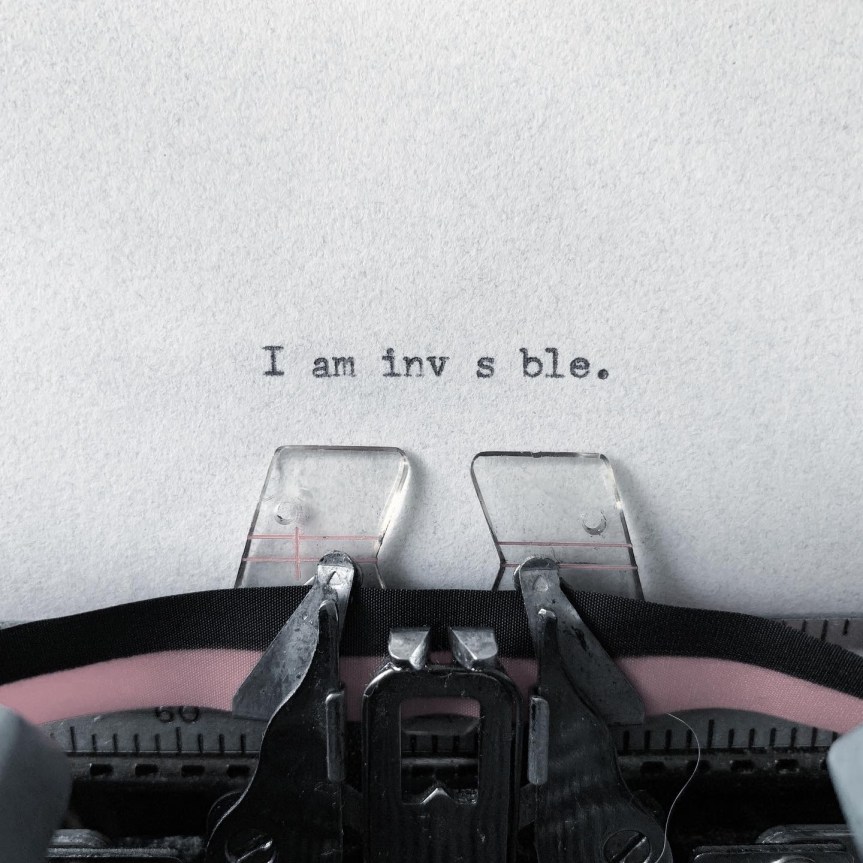
I Am Invisible: Will You See Us?


With the recent hate crimes against Asian-Americans, I am reminded again I am invisible.

When I was a boy, someone had spray-painted a swastika on my father’s dojo. My dad painted over it, but on hot humid days we could still see that Nazi symbol like a pulsing writhing scar.

We got a voicemail on our answering machine—maybe the same Nazi artists—who spent ten minutes making fun of my dad’s accent. I remember seeing my dad listen to it several times, staring quietly out a window. When he noticed me, he turned it off and said, “Just boys playing a joke.” The voices were from grown men.

In middle school I remember being assaulted, shoved around, called “ch-nk yellow belly,” having fries thrown at me during lunch (I sat alone) which were drenched in ketchup, some kid yelling “your dad killed my dad in the war” and then I watched his dad pick him up from detention.

At weddings, funerals, leadership meetings, conferences, I am often the only Asian. And I am invisible. I have literally sat in rooms before where I speak and no one looks my direction. Not even glances. I once called my wife in a dramatic panic, asking, “Do I exist?” And she knew what I meant. The invisibility.

I could tell you a hundred stories like this, and a hundred more. I have. And, well—no one hears. Or remembers. I know my experiences pale in comparison to racist violent acts done to so many others. I only wish I was heard. Seen.

A couple years ago I was a guest at a panel where we discussed race. I shared how I felt invisible. Afterwards, a wonderful Black woman approached me with tears in her eyes, hugged me and said, “I see you. I see you. God sees you.” Over and over, she whispered, “I see you.” And I was so moved, I wept with her. “I see you.”

I still hear her. Thinking of it now, I still weep. For a moment, at least, I was seen. We saw each other. We have so much work to do—but that day, that was enough for me. I was seen. To see is to make visible.

— J.S.

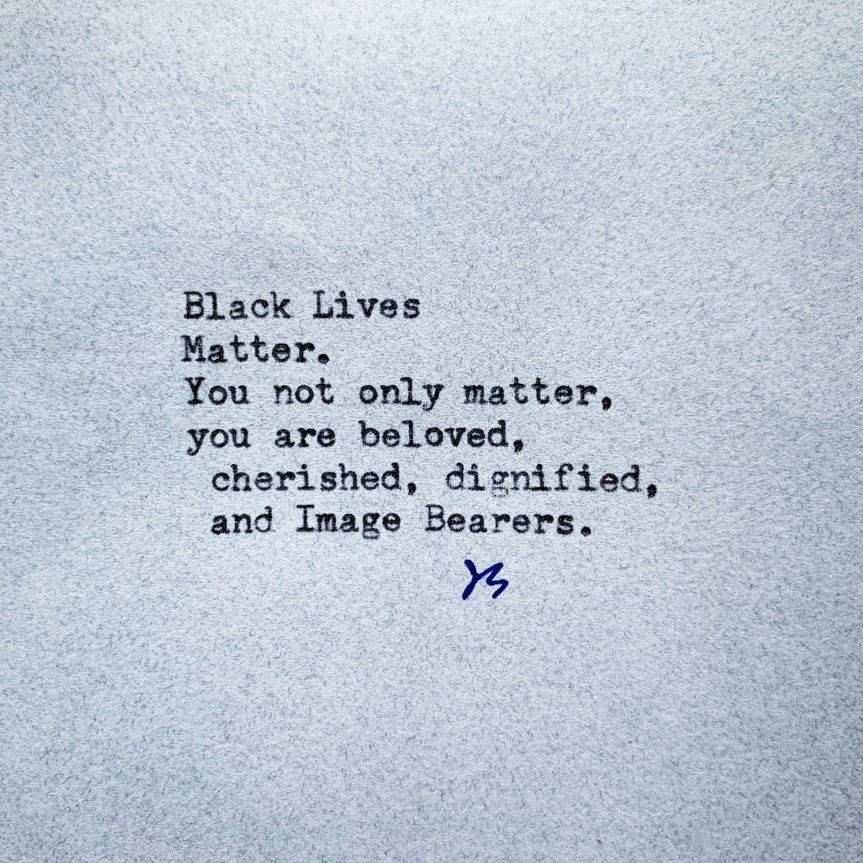
Black Lives Must Matter


You more than matter. Black lives are beloved, cherished, dignified, and bearers of the Image of God. It is a truth denied but it is no less true.

My friend “Shayla” (who gave me permission to share her story) was telling me that after the hundredth video of a Black person beaten in the streets, after one more citation of false facts and stats, after one more demand to “just work harder and get off welfare and quit drugs,” she had the terrible thought, “Maybe they’re right. I’m not human.”

After so many racist messages and images, it can become impossible not to believe, “I’m not human.” Or, “They’re right.”

The internalized trauma of racism is crushing. Day after day, the Black community is denied their lives, art, beauty, voices, stories, truth. Even when we know these racist messages are not true, they have a way of creeping in, suffocating, infiltrating our beliefs.

It cannot be overstated how much the trauma of racism deteriorates a soul. Trauma has a way of saying, “I am what has happened to me.”

I say as a chaplain but also as a human being: I have seen so many kinds of grief, but to believe your skin makes you deficient is one of the saddest, most haunting pains of all. It sticks so hard. It kills. It takes a thousand times more work to restore wholeness than to tear it down.

I will always be on the side of the wounded. I will do all I can to be part of that thousand steps towards wholeness.

For me, to say Black Lives Matter is a starting point to recognize the full worth of Black Lives. In Korean, the phrase Black Lives Matter is “huhg-in-eh seng-myung-un so-joong-hapnida,” which means Black Life Is Precious. I will continue to say Black Lives Matter, but even more, precious and worthy—not just worthy of protecting, but also having inherent worth.

If you are burned out, traumatized, overwhelmed by racist messages and images, please know the truth: you bear the Image of God. Your worth is not in what you’ve done or how you’ve been treated. It may be hard to believe today, but you are loved. I am with you and for you. As much as I love you, the Creator loves you infinitely more.

— J.S.

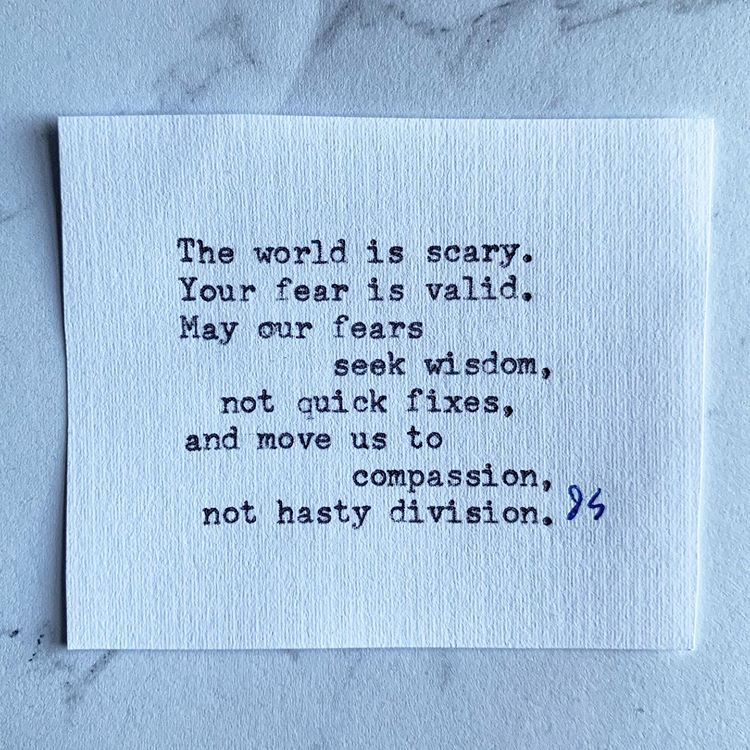
May Our Fears Seek Wisdom


I’d like to think I’m not a fearful person. But I am. I never look like I worry, but I do. A lot.

This week I made the mistake of very publicly bringing up my fears about coronavirus in the workplace. I don’t mind catching the flu, but my wife is pregnant and the flu can adversely affect our baby in utero. I said some uncomfortable things in front of coworkers, when I’m supposed to be the calm voice of a chaplain.

I was not helpful. I probably incited panic and anxiety. I apologized for my behavior. Maybe the fear of being a dad in our current world really got to me. It was still not a good look.

I’m trying to balance the fear we‘re experiencing versus being calm, safe, and rational. I want to validate our anxiety without letting it consume us. I want to be vigilant, but not so on edge that I’m scaring everyone else. I want to say “God is in control,” but also run screaming and lock every window. It’s a tough, strange balance.

We’ve seen where the fear can take us: there’s been multiple racist assaults against Asians, blaming them for the pandemic. We’ve seen misinformation about drinking water and eating garlic and avoiding packages from China. We’ve seen the ugly finger-pointing of political leaders using the panic for vote-bait, promoting xenophobia and catering to the worst leanings of their base. And everyone—including me here—has some take about what to do, how to be, what to say.

I’m trying to stay cool. To be both cautious and optimistic. It’s hard. It’s scary right now. I keep thinking of raising a daughter in this world and how I’m so incapable, unsure, uncertain, lacking the wisdom to say the right thing, to be a pillar when she needs me. I hope I can be strength for her even when I have so little of it in myself.

I’m trying to validate fear without giving into it, to let fear ask questions and seek wisdom and move towards compassionate curiosity, rather than hate or rash decisions. God be with us, who navigates our fears, who hears our worries, who gives us wisdom amidst division, who offers us a peace like no other.
— J.S.

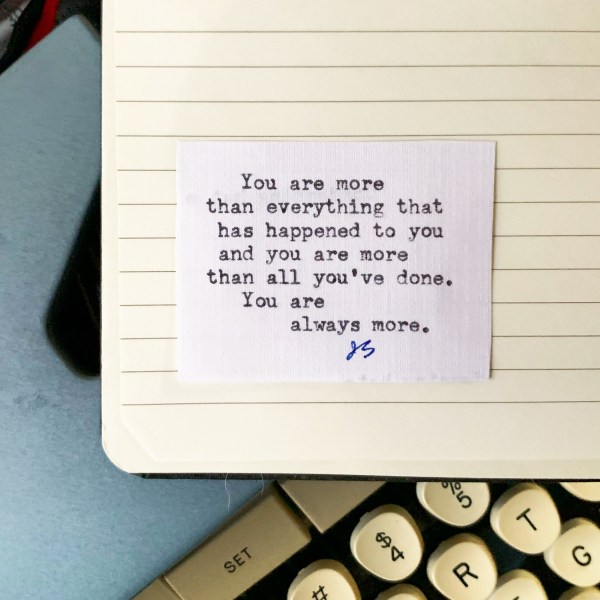
More Than All That’s Happened


If you’ve grown up in the same town long enough, most people assume you’re the same person you always were. They can’t see past the past version of you.

I wonder a lot: Are we doomed to our former selves, time-stamped to who we used to be? Will the things we’ve done and used to do always drag at at our heels, a permanent anchor?

There are days I keep imagining what other people are saying about me. I imagine a room full of them shaking their heads. “A chaplain? Who’s he kidding? I know who he really is. He’s not the guy he pretends to be. Nobody like him could change.” It keeps me up at night. I mentally argue with them until I’ve finally proven I’m not that same guy. I’ll spend hours inside my own head explaining my side of the story and why you need to know I’m not a bad person and that I’m sorry for the person I was before.

But you know, no one may get to hear your side of the story. No one might believe you’ve changed. Even when you do the right thing, you’ll be accused of wrong motives. And you are still accountable to the wrong you’ve done, as much as others are accountable for how they’ve wronged you.

But there is a grace that says you are different now, and the old you is dead. Buried. No longer you. Maybe no one will know you’ve encountered the kind of grace that has not just changed you, but made you completely new. Your trauma, your guilt, your past, your labels: they’re taken in by grace, by a love that sees in whole and stays. Imagine that. The world may call you something, but you are more. You are new. You are always more.
— J.S.

Believe It


You are loved.

You might have heard that a million times, but it’s no less true.

You do have a Creator. He is with you. He is bigger than your situation and closer than your deepest hurt. He’s not mad. He is cheering for you and rooting for you this very second. He’s okay about all the things before. He sent His Son for that very reason.

You can put down the blade. You can throw away the pills. You can quit replaying those regrets in your head. You can quit the inner-loop of self-condemnation. You can forget your ex. You can walk away from the things and people that destroy you. You can resolve your conflicts right now. You can sign up to volunteer at that shelter. You can have the courage to stand up for justice in the street, in your office, in your home. You can forgive your parents. You can forgive your children. You can draw boundaries and say no. You can go back to church. You don’t have to sit in the back. You don’t have to prove your worth to the people you’ve let down. You don’t have to live up to everyone else’s vision for your life. You’re finally, finally free.
You are loved. I am loved.

As much as I love you, dear friend, He loves you infinitely more.

Believe it. Walk in it. Walk with Him.

God is in the business of breathing life into hurting places.

This is what He does, even for the least likely like you and me.

— J.S.

I Hope You Will Hear Me


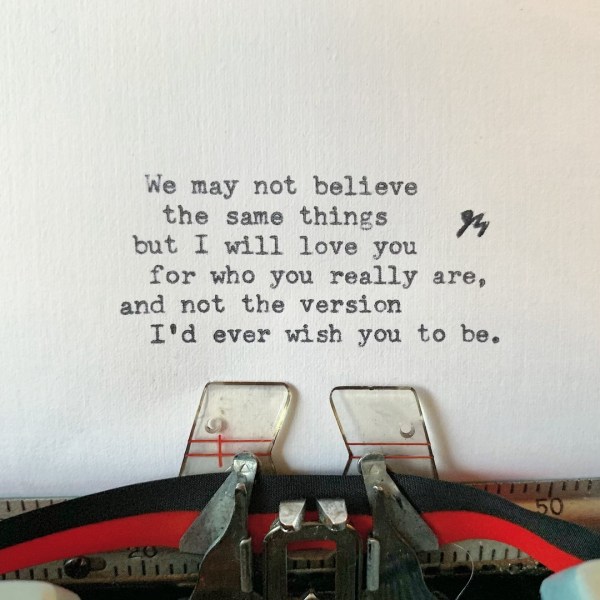
Eventually I’ll say something that you’ll disagree with. I will disappoint you. I’ll come off brash, inconsiderate, ignorant, and misinformed. Your favorite writer or pastor or celebrity will miss an angle or fumble a point or miss the whole thing. You’ll think, “How could I have ever liked this guy?” We then dismiss and demonize based off one sentence, one phrasing, one particular choice of word. I’ve done it, too. You know, farewell forever.

Maybe it’s for a legitimate reason, and they really did go too far. Then farewell, sure. But I wish we could give a little space for a conversation. Even over coffee. It’s possible this person misspoke because they’re just a person and they don’t always get it right. It could be that they need the patience of dialogue to re-examine what they said, instead of the hasty hate-train that offers no fair exchange. It could be they really didn’t know better, or they just needed a nap.

I want your help. I want to know when I’m wrong – but it’s hard to hear what’s right when everyone is yelling. I want the freedom to make mistakes so that I’m not afraid to learn from you. I don’t want to be afraid that you’ll throw things when I don’t phrase things exactly the perfect way. And really, I’m not sure if you would listen to yelling, either. I’d want the same chance you’d want for you, too.

I know there are some non-negotiables that can never be compromised. I cannot say every “side” is equal or that every platform is good. None of us will ever agree on everything. Sometimes we must part ways. And that’s okay. I just don’t want to judge an entire life over a few degrees of difference. We can disagree and still be friends. Even if we must part, I want to become better from our disagreements, to see what I had not seen before, and mostly, to see you. I will hear you.

— J.S.


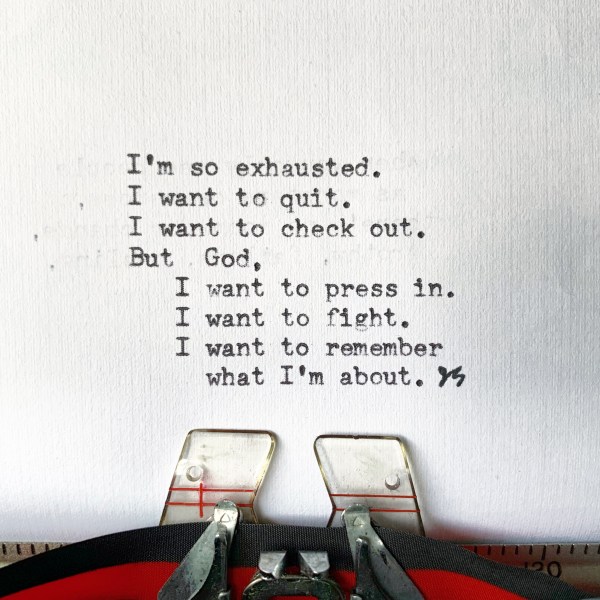
What I’m About


Discouraged, exhausted, beat down, beat up, clawing and falling, it’s so far, but my God, by God, another inch I crawl.
J.S.

I Am With You.


I am with you.
I am for you.
I am sorry.
I love you.
How can I help?
J.S.


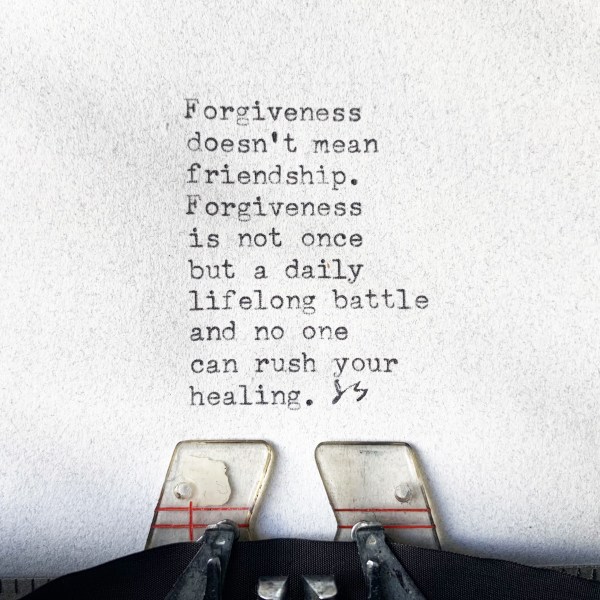
Forgiveness Is Not Friendship


It’s unfair to rush someone into forgiveness. It’s powerful and necessary, but forgiveness is not a one-time moment that magically seals up the wound. It takes a deliberate, daily battle over a lifetime. That occasional angry twitch doesn’t mean you’ve failed at finding peace; it’s only part of the process. Let it happen. It hurts because it meant something. It has to pass through your body, like flushing out poison. No one is allowed to rush your healing, including you. No one can just “get over it.” It’s your pain, your pacing, your tempo. But I do hope to see you on the other side, where there’s freedom. You can take all the time you need, and I’m with you.
J.S.

Turning Point.


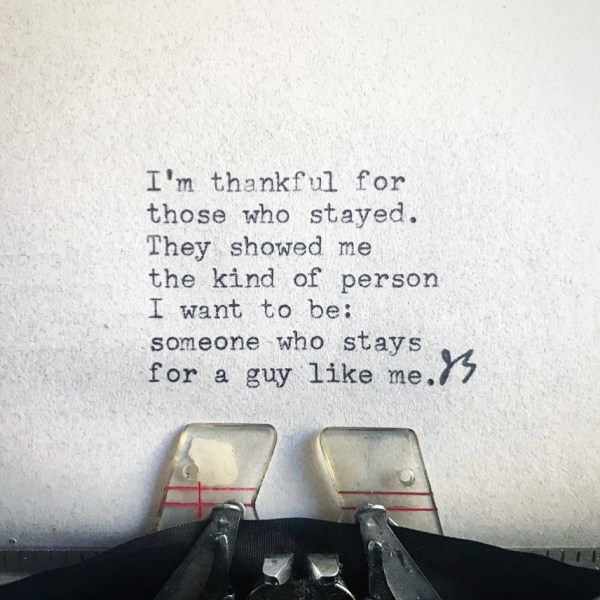
Most testimonies have a turning point: “And then I met ___” or “Someone reached out” or “I got this text at the perfect time.” It seems random, but those people and encounters and messages of encouragement happened on purpose. Someone made a choice to reach out, get involved, get near another person’s heartache, and help them for one more step. It was enough to get them moving again. Maybe it was no big deal for the person who reached out. But to the person they helped, it meant everything. It was the turning point. It was the beginning of seeing new light, of finding a new dream, the start of healing. A little bit of your time and wisdom might turn someone’s life around. I’m thankful to those who pressed in and breathed life.
J.S.

Everyone Has a Vision for Your Life


Everyone has a vision for your life. Everyone knows who you ought to be. Everyone has advice, the right answer, the easy fix.

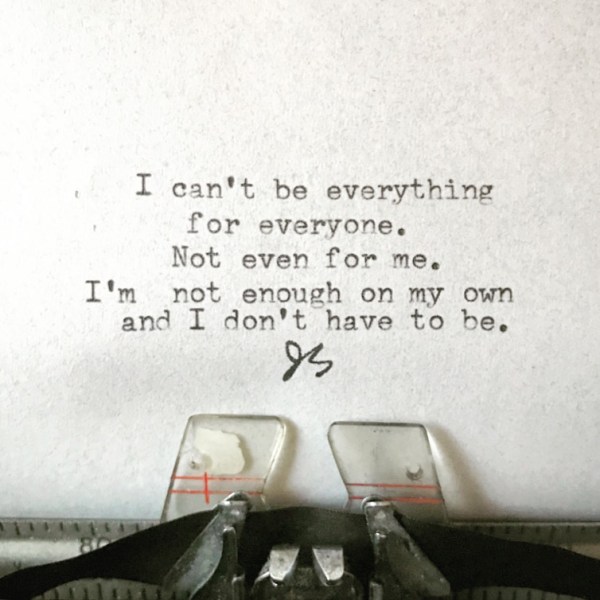
But no one can bear the burden of those expectations. You can’t be enough all the time, not even for yourself.

You will disappoint people. You will disappoint you. It happens. It hurts. And that’s how it goes. The eventualities of life have a way of creeping in, regardless of best efforts and right motives.

You will get crushed by the weight of others’ plans. But you’re not obligated to respond to everyone’s criticism all the time. There’s no pleasing everyone. Some will have already made up their mind about you, no matter how much you sing and dance. Your side of the story won’t always be heard. Your intentions will be negatively filtered and your words shot down at first glance. That’s okay. Criticism is important, but you can’t speak on what you didn’t say. You can only mean what you did say, and mean it well.

Be encouraged, friends. You are doing a good thing. A new thing. By the grace of God we do our best and get up again.
— J.S.

Faith That Burns Slow.


I imagine that when Moses split the Red Sea, there were two groups of people.
The first group was composed of victorious triumphant warriors saying, “In your face, Egyptians! This is our God!” They were pumping their fists and thrusting their spears.

The second group was composed of doubtful, panicking screamers running full speed through whales and plankton.

I’m a Screamer. I’m a cynic. I’m a critic.

I’m a Peter, who can make a good start off the boat, but falls in the water when my eyes wander.

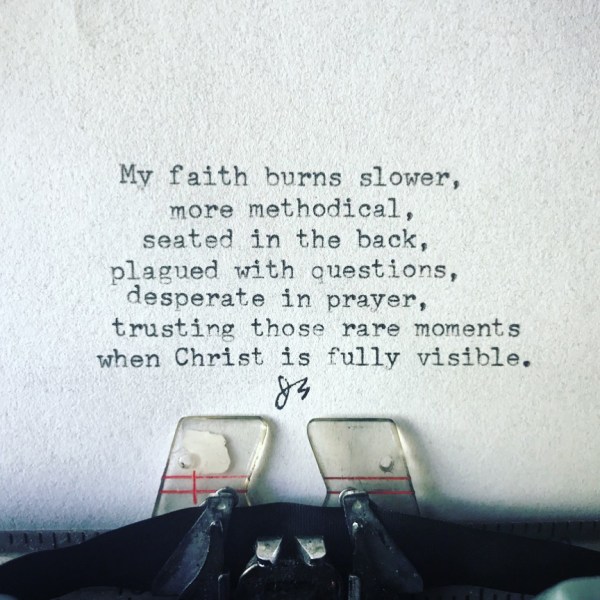
I’m not endorsing a halfway lukewarm faith. I believe God wants us to have a robust, vibrant, thriving relationship with Him. But as for me, I’ll be limping to the finish-line.

I’m more of a Thomas than a Paul. I’m more Martha than Mary. I’m more David than Daniel.

Yet the Warriors and Screamers all made it through.

It’s not easy to have faith the size of a mustard seed. But Jesus promised that this would be enough to move mountains, and I’m learning to be okay with that.

— J.S.

We Wear Casts.


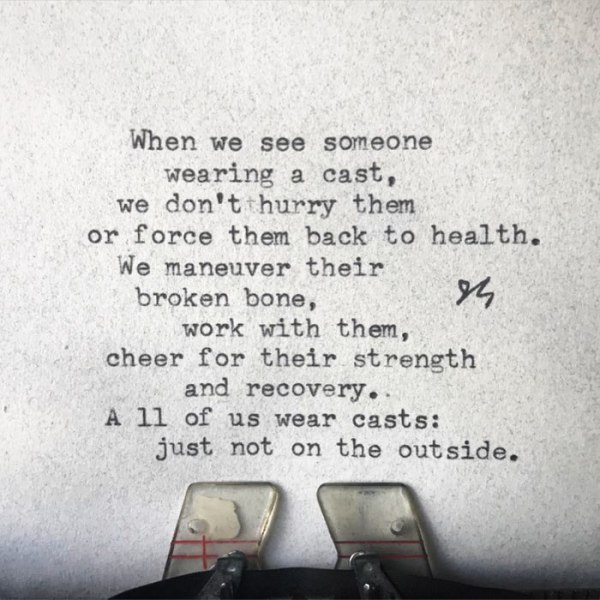
God, forgive me for when I lack empathy,
when I jump to making talking points out of tragedy,
when I forget the pain of community and family,
when my voice is louder than theirs.
— J.S.