A Response to “Stop Looking at People, Look to God”

Anonymous said:

i just want to say i think it’s ok to be skeptical and have questions and doubts but it’s bad when you start making the christian faith about people rather than Jesus. stop looking toward to people for faith and focus on Jesus and encourage that more as well


Hey there, thank you for your concern and for bringing this up. I hear what you are saying and I can agree, and I’m also not sure it’s the whole picture.

I heard those types of statements last year dozens of times: “Stop looking at people, look at God. Stop focusing on the church, focus on Jesus. Stop putting your hope in people” etc.

I understand this to be a meaningful truth. In fact, I can say this: People let me down so much last year that the only one I could really trust was God. It was only my tiny bit of faith that kept me alive, kept me from completely unraveling in my depression and anxiety. I doubted and questioned people. Did I doubt God? Sometimes. But absolutely not as much as I did the church. When nothing else was good, I trusted that God was the only one who is.

Most people of faith know that they ought to focus on the center of their faith rather than what people are doing. It is such a basic and obvious truth, that again, it was basically my only option.

Back to your statement. I want us to consider a few things.

Continue reading “A Response to “Stop Looking at People, Look to God””

If My Father Abused Me, How Could I Ever Say “Heavenly Father”?

Anonymous asked a question:

My father is an abuser and maybe it’s stupid, but how can people can not be afraid of the words “our father in heaven”?

Hey my friend, thank you for sharing so honestly and I’m sorry you experienced such abuse. I hope and pray you are at a safe distance today and that you are recovering.

Your concern is not “stupid” at all. It’s absolutely valid. I work as a chaplain at two places, the hospital and a homeless shelter, and when I address God, at both places I am very careful when I say “God our father.” Especially at the homeless shelter. Many of the low income families I encounter have not had good experiences with any sort of male figure. To say “father” is okay for some, but also devastating for others.

Continue reading “If My Father Abused Me, How Could I Ever Say “Heavenly Father”?”

Top 19 Posts of 2019

Here are my Top Ten Posts of 2019, from leaving church to codependency to suicide awareness to my favorite female influences.


Runner-Up: I Signed a Book Deal

19) Grace Is Something Different

18) “God Is in Control,” but What This Really Means

17) The Only Time a Christian Goes First

16) Healing from a Breakdown Over a Break-Up

15) Are You Secretly a Liberal Who Hates Conservatives?

14) What Am I About: On Codependency

13) How Do We Show Love for Hate Groups Like Westboro?

12) Why Do You Love Your Wife?

11) My Favorite Female Influences

10) About to Get a Therapist: How Do I Do This?

9) My Greatest Fear Is Death

8) Lessons I Learned from Leaving My Evangelical Church

7) How Do I Confront a Friend Who Is “Sinning”?

6) When You Have to Save Everyone: The Warning Signs of Hero-Savior-Martyr Syndrome

5) Is Suicide the One Unforgivable Sin?

4) The Dangers & Myths of Personality Tests

3) How Do I Open Myself Up to Friends Again?

2) Compassion Fatigue: The Heartache of a Job That Requires All Heart

1) I Am Not My Depression

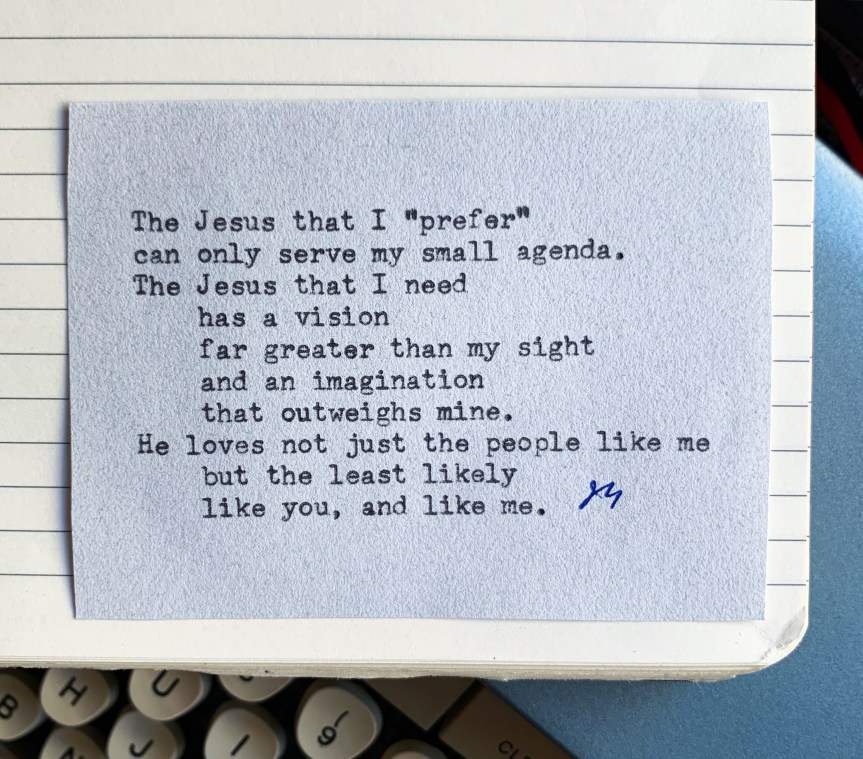
The Jesus That I “Prefer”


The Jesus that I want would only serve me and my own interests and align with my theological leanings and plans and dreams.

The Jesus that I need would serve the people that I forgot existed, who lived outside my best-laid plans and doctrinal camps, and he would just as quickly subvert my interests to care about others’ interests above my own.

The Jesus that I want would probably listen to my music, look like my race, match my Myers Briggs, and fight for my ideology.

The Jesus that I need would knock me over with songs I never knew I craved, enter my culture without condescending or conforming, would accept and challenge who I am, and transcend my time-locked ideas of ideologies.

The Jesus that I want would probably die for people who liked me or were like me or were most likely.

The Jesus that I need died for the people who were nothing like him and he loved them, and even liked them, and he rose to find them. He even rose to find you and me: the least likely, because he’s the love we want, and need.

— J.S.

Is It Okay to Be Angry with God?

Anonymous asked a question:

What if I am angry at God. How do you cope with the frustration and anger towards Him?

Hey dear friend, I’m really sorry. There must be many things happening internally and externally, and I’m with you and for you. So is everyone here.

I have to tell you up front: I’d much rather be mad with God than mad without Him.

That’s not some cute little statement that only works abstractly on Instagram. I’m dead serious. If you’re angry with God, at the very least, you’re talking with Him. He’d rather you be mad at Him than displacing that anywhere else. God isn’t put off by our barest, most raw emotions: because He made them, and He made you, and He’s going to work with that.

Continue reading “Is It Okay to Be Angry with God?”

How Do I Know If It’s God or the Devil? A Mega-Post On Pain, Evil, and Suffering

Anonymous asked a question:

Would God purposely put His children in a situation where they would be hurt in any way (rape, kidnapped, something like that)? Or is this the work of the devil? I don’t think He would, but I don’t know.

My dear friend: There’s probably a huge list of questions I’d like to ask God the second I see Him (right after I collect my eyeballs back into my head).  So right upfront: I’m not sure why the devil is given such a long leash.  I’m going to ask God about that one, probably with my arms crossed and eyes rolled (and my head on fire).

The Question of Evil has not been adequately answered by the greatest philosophers of history, and I probably won’t be the one to crack it today, either.  It’s the kind of stuff that makes me doubt God everyday.  Even if I did have some solid theology on why certain atrocities happen, I still doubt it would satisfy the victim of abuse and slavery and oppression and terminal illness, no matter how much “logical sense” it makes to the brain.  Even if I concluded, “All the bad stuff is really from Satan,” then a suffering person could only reply, “So what?”

I can only offer a few thoughts that might help you on your journey here, because this tension of why bad things happen will never be resolved by any single answer.  Anything we say on pain will always be inadequate for the actual suffering person.  No such all-encompassing answer from any belief system really exists. I say this as a chaplain who works in the hospital, who has seen the very worst kinds of suffering, knowing that any amount of inspiration or explanation will never be enough.

I can only say that I believe the Christian perspective best accommodates the problems we see today.  I’m also aware that some of us will never meet eye-to-eye on this and we can “deconstructively reduce” anything I’m saying with snark and cynicism. That’s easy mode.  And that’s okay.  We’re free to disagree and wrestle and think for ourselves.

And please know: I would never, ever enumerate these reasons out loud the moment after a person has been seriously harmed.  I would never bring this to the bedside of any of my patients in their inexplicable grief. None of this theology really matters as much as you being there in the trenches with a heart of listening and love.

As always, please feel free to skip around.

Continue reading “How Do I Know If It’s God or the Devil? A Mega-Post On Pain, Evil, and Suffering”

A Faith Crisis: When My Theology Is Shaken by Science, Debates, and Headlines

Anonymous asked a question:

So I’m taking an honors world history class taught by an atheist teacher and we’re learning about evolution and it’s really really testing my faith. Honestly I don’t know what’s true right now. My theology isn’t the greatest because I’ve only accepted Christ for two years now. I’m just now finding it hard to believe in the Bible and God right now.

Hey dear friend, thank you for sharing this with such honesty.

The truth is, every single type of belief system will eventually get shaken somewhere. When this happens, we can 1) investigate deeper into what we really believe, and 2) incorporate the new information into our beliefs somehow.

We each experience a kind of cognitive dissonance when our worldview is shaken. It can actually make you disoriented, nauseous, and depressed. Sometimes it’s from learning more about the world, or it’s from a terribly brutal tragedy, or it can be a very persuasive argument that uses flowery language. And these experiences will inform our theology and philosophy, and vice versa. But none of this has to be a threatening, stomach-punching trauma.

While we’re certainly going to feel what we feel, we can still explore this new information in light of what we currently know, and then navigate a way through it. It’ll be tough, and you may be scared or surprised by your conclusions, but it can actually make you a more thoughtful, whole person, too.

Continue reading “A Faith Crisis: When My Theology Is Shaken by Science, Debates, and Headlines”

Theology Showdown: The Narrow Gate Vs. the Broad Road

Anonymous asked a question:

I am a little confused about something and I was hoping you could help. In Matthew, it talks about the narrow path and gate into heaven. How can I, as a Christian perceive that to mean something other than that lots of people walk towards God but very few actually make it. This seems to go against grace? And also the profession of Jesus as a saviour?

Hey dear friend, this is certainly a troubling passage that is very off-putting at first glance: but I’d like to balance this passage with the entirety of Scripture.

Let’s look at the passage in question, Matthew 7:13-14, which says:

13 “Enter through the narrow gate. For wide is the gate and broad is the road that leads to destruction, and many enter through it. 14 But small is the gate and narrow the road that leads to life, and only a few find it.

So it looks like most people alive today will end up in Hell, an eternity under the wrath of God, while only a fraction will make it to Heaven.

But then, let’s look at Matthew 25:13 here, known as the Parable of the Ten Virgins (or Bridesmaids). To summarize, Jesus tells a tale about a wedding where ten bridesmaids are waiting for the bridegroom to begin the ceremony, but only five of the bridesmaids came prepared with extra oil in their lamps to greet him (this sounds like a weird custom back then, but weddings have always had weird customs throughout history, e.g. throwing bouquets or fishing for garters or dancing past a reasonably non-creepy age). So five of the bridesmaids make it, but five don’t. This implies that at least half of the people we know will end up in Heaven.

Lastly, let’s look at Matthew 13:24-30 here, known as the Parable of the Wheat and Tares. To summarize, Jesus tells a tale where a farmer’s field is sabotaged by weeds. The farmer, instead of pulling up the weeds, decides to let the wheat and weeds grow together, and at the time of harvest he will separate them. This implies that most people we know will end up in Heaven.

So which one is true? Is it the story of the Narrow Gate, or the Ten Bridesmaids, or the Wheat and Tares? Do only a few of us make it, or half of us, or most of us?

Continue reading “Theology Showdown: The Narrow Gate Vs. the Broad Road”

Mythical Messiahs vs. the Real Jesus: 10 Reasons That Jesus Is Unique Among Myths & Legends

Anonymous asked a question:

I don’t know if you’re familiar with Apollonius of Tyana but there are some people arguing that he also had followers, performed miracles and rose from the dead. That’s why they kept saying he’s the ~real~ Jesus. Thoughts?

Hey dear friend, here’s a cool fact:

A ton of people in the first century claimed they were the Messiah. Only one is really remembered today, and that’s a strange historical truth that must be taken seriously for both Christians and those exploring faith.

Here’s the context. The Jewish Israelites in the first century hadn’t heard from God or any of His prophets for about four-hundred years, since the prophet Malachi, who also wrote the last book of the Old Testament. They were waiting on either 1) another prophet, or 2) the prophesied Messiah, the “Suffering Servant,” who would apparently liberate them from the oppression of the Roman Empire.

The Jewish Israelites believed that God hadn’t spoken for centuries because of continuous idolatry and rebellion against God. This mindset incidentally formed a group called the Pharisees, who devised over 600 laws to follow, so that such perfection would honor God and possibly hasten the Messiah’s appearance. The Pharisees were so strict that any person who claimed to be the Messiah was almost immediately shut down, because worshiping any god outside the true God was only more idolatry, which had put them in this position of God-silence in the first place. So even though we dismiss the Pharisees today, I can definitely understand their mentality back then and how fast they were to condemn Jesus.

Many new Messiahs did appear. Two of them are mentioned in Acts 5 by a Pharisee named Gamaliel, who mentions Theudas and Judas the Galilean. History books also talk about Judah the Hammer, who enacted a siege against the Roman Empire but was just as quickly crushed. All of these “Messiahs” acted as warrior-presidents that used military force to throw a coup, like a militia attempting to oust the government. Nothing came of them. And the Pharisees were pretty happy about this, because in their mind, such false Messiahs only kept God at bay.

When Jesus came around, he was different than every other Messiah. Here are at least ten reasons why Jesus was unique compared to the religious leaders of his day, and perhaps among every other religious leader.

Continue reading “Mythical Messiahs vs. the Real Jesus: 10 Reasons That Jesus Is Unique Among Myths & Legends”

How Do You Keep Believing This Jesus Bulls__t?

Anonymous asked a question:

How do you believe when, pardon my french, you’ve been taught that everything about Jesus is bulls__t? I’d love to believe it, I really want to, it’s just hard to when you’ve been taught the opposite. Do I have to unlearn the foundation of my education?

Hey dear friend, to be truthful: you’re in the best place possible, with the single biggest advantage over someone who’s been raised in the church.

You get to be in a place where you’re starting with a hugely skeptical eye towards Christianity, which means that if God starts to lean in on you, you will have already encountered your biggest questions about faith. If only every Christian honestly encountered every doubt and argument and problem with Christian theology, with complete openness and abandon, then we might see how deep Christianity can really go.

Please do not think you have to unlearn anything you’ve learned. I suggest the opposite. Use your education to fairly weigh every piece of evidence you encounter. Keep digging into Christianity down to the bottom, to see that it’s both true and fulfilling, that it’s both intellectually coherent and existentially satisfying.

Continue reading “How Do You Keep Believing This Jesus Bulls__t?”

Is Christianity Just an “Imperialist White Man’s Tool”?

Anonymous asked a question:

How should I respond to people seeing Christianity as a eurocentric tool for imperialism?? I’m sometimes embarrassed that I’m still holding onto Christianity when it seems like it’s only the “popular religion” that it is today because of its adoption by white westerners and the imperialistic conquests, genocides, physical and cultural displacement, etc. caused by efforts to spread it. I don’t know what to think of this haha. Thanks (for a lot of things i don’t have room to explain here haha)!

Hey dear friend, thank you so much for this question — I believe it’s absolutely important to get this one straightened out, quickly and completely.

First please know: I’m responding as an Asian-American Easterner born and raised in the West, who is fully aware and infuriated by the danger of Western imperialism and the cultural gentrification of “manifest destiny.” In other words, I have every reason to be disgusted by Christian/western/imperialist attitudes. My own country’s history (South Korea) also has a terrible past of being oppressed by particular people-groups that have nearly stamped out my heritage.

There’s no doubt that Christianity has been associated with some awfully terrible injustices. The Crusades, witch hunts, slavery, child abuse, and the early church’s indulgences and cycles of corrupted power are just a few of the detestable atrocities that, whether directly or indirectly, were fueled by religious fervor. We must be held accountable for every single infraction.

When a Christian asks me, “How do I defend Christianity’s history?” — I can only say, “Don’t.” Christianity ought to be the most self-critical life philosophy, always asking the simple question: Is this making us better or worse? We must own up to our past, not avoid it, and if anyone challenges us on how Christianity has been harmful, we must give ground to these righteous accusations. Many people are mad (including me), and understandably so, at how Christianity has danced around its mistreatment of others.

Having said that: I believe the idea of the Christian Imperialist, while obviously holding some credence in very specific instances, is largely a tired, exaggerated myth if we look at the whole picture of Christian contribution.

Continue reading “Is Christianity Just an “Imperialist White Man’s Tool”?”

Bible Showdown: Literal Vs. Allegorical Interpretation

horizontescuriosos asked:

I came across one interpretation of Genesis that I thought might be insightful to ask someone about. The idea I found is that Genesis is really an allegory about human sin … Like before sin, Adam and Eve were naked and unashamed. Then Eve tried to sneak eating the apple, sin entered, and from then on Adam and Eve wore clothes out of shame … As a pastor, do you think this idea of Genesis being an allegory for human sin has credit? (Edited for length)

Hey dear friend, I’ve definitely seen Genesis (and much of the Bible) interpreted as allegory, and it’s a legitimate way of reading the Bible, called the Alexandrian method, that’s been around for centuries.

However, I personally view most of the Bible as literal, factual history — or at the very least, I assume that the Bible authors had an original intention that wasn’t meant to be stretched towards a “spiritualized” meaning that says whatever we fancy.

Scripture doesn’t read as an allegorical account, but more like a news periodical. There are parts of Scripture that are definitely allegory, but it’s usually obvious, with the author even saying so.

Ancient accounts of legend only revealed details that were much like Chekov’s gun, which were set-ups for a moral lesson. From the Epic of Gilgamesh to Beowulf to The Odyssey, no detail was wasted. But Scripture would describe things that had no other purpose but to describe them. Jonah talks about buying an actual ticket to board a ship. Peter and his fellow fisherman caught 153 fish, which has no other meaning, except that they caught 153 fish. When Jesus is arrested, a naked guy totally flees the scene. Mythological stories never read this way. Most of Scripture has a prosaic, open-ended description that was not a type of genre for myths back then, but for eyewitness testimony.

While the Alexandrian method certainly has merit, here’s one huge advantage of the literal interpretation of Scripture.

Continue reading “Bible Showdown: Literal Vs. Allegorical Interpretation”

The Gospel in Two and a Half Minutes


The entire storyline of the Bible in two and a half minutes. And a different way to see the Gospel.

Subscribe to my channel here.
Be blessed and love y’all!

— J.S.

[Thank you to Steven Hause of pudgyproductions]


Does God Use Pain “For My Good”? Does Everything Happen For a Reason?


Is suffering a “part of God’s Plan”? Does God use trials to teach us a lesson? Does everything really happen for a reason?

A hard look at the Problem of God vs. Suffering, and why easy answers won’t work in the middle of the mess.

Get my book on persevering through trials & suffering, Mad About God.

— J.S.