Foreword to My Newest Book, by T.B. LaBerge

Grace Be With You Foreword TB LaBerge


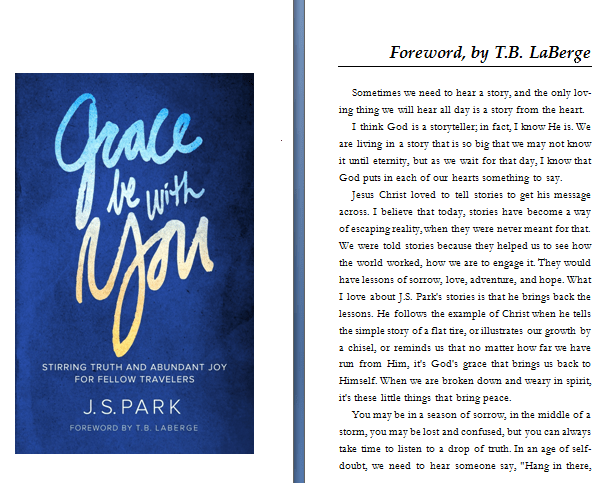
My very good friend and blogger T.B. LaBerge wrote the Foreword to my newest book, Grace Be With You.

The book is a collection of short stories, poems, and thoughts, many of which you’ve seen here on this blog.
It’s available now in paperback and ebook!


http://www.amazon.com/Grace-Be-With-You-paperback/dp/069269031X/

http://www.amazon.com/Grace-Be-With-You-ebook/dp/B01E4XXCVM


My Newest Book: Grace Be With You, a Compendium of Stories, Thoughts, & Poems

Grace Be With You paperback


Hey dear friends! This is my newest book, Grace Be With You: Stirring Truth and Abundant Joy for Fellow Travelers. It’s a collection of stories, quotes, and poems, most of which have gone “viral” on this blog, with all new content. The Foreword is also by my wonderful friend T.B. LaBerge.

The book has four chapters, each a unique theme: to encourage, convict, engage, and transcend. Contained are quick quotes, humbling plot twists, and everyday encounters on the road, at the hospital, at cafes and gas stations and funerals and churches.

The paperback is only 8.99 here and the ebook is only 3.99 here and it works on every device. If you’re blessed by the book, please consider leaving a review on Amazon.

Be immensely rocked by His grace!
J.S.


Paperback: http://www.amazon.com/Grace-Be-With-You-paperback/dp/069269031X

Ebook: http://www.amazon.com/Grace-Be-With-You-ebook/dp/B01E4XXCVM

The Brutally Honest Surgical Self-Confrontation


Why doesn’t Nathan simply rebuke David on the spot? Why the long story and the strategic side-tackle?

It’s because before confronting ourselves, we need to undo our self-righteousness.

We each have a nearly impenetrable fortress of resistance when we’re called out on our wrongs. It keeps us blind to our blindness.

The way that God punches through David’s self-deception is one of the most lauded turns of literary brilliance in written history. Nathan doesn’t simply accuse David. Nathan peels back David’s self-righteousness by turning his rules against him. David is knocked over by the weight of his own standards. The very mechanism by which David has condemned the guilty to cover his guilt is turned on himself. His excuses have become his own liability, like a sword with a blade on both ends. It’s what Jesus meant when he said, “For in the same way you judge others, you will be judged, and with the measure you use, it will be measured to you.”  

David required a brutally honest confrontation, but it would take more than a lesson in theology or a list of sins. No one changes that way.

God rebukes David by first removing any possibility of an excuse or objection.
God revokes David’s self-righteous capacity to absolve his own sin.
David needed to confront himself, before the sight of God, without the slimmest avenue of escape or deflection.

If you want any hope of change, freedom, progress, recovery, and growth: you’ll need to confront yourself, too. It’ll be the most painful thing you’ve ever done, because we’re so used to protecting our fragile, brittle egos. But it’s more painful to stay stuck in the lie.

If you’ve ever tried to confront your friend about their thing, you were amazed at their automatic defenses and sudden snarling. I’m sometimes surprised by my own excuses, too. When I’m guilty, I attack. It’s the perfect way to get out of accountability. When someone does something wrong, it’s all their fault, but when I do something wrong, it’s my environment or my family or my stress. When we get caught red-handed, we go into a monologue of rehearsed responses that we almost really believe, because it took so many steps of rationalizations to get there.

When you want to escape by saying, “Well-what-about-them?” — God will twist you around to say, “Well-what-about-me?” The only thing that will destroy hypocrisy is humility. Part of humility is to quit holding up a mirror at others and to use it on myself first.

For the first time in a long time, David is being honest with himself before God. He lets the truth undress him. There’s no place for him to run. His own judgment has betrayed him, and this is how God will work on us, too. He will dislocate your blame, one excuse at a time, until you really take a look at yourself and see you as you really are.

J.S. Park | The Life of King David

The Hardest Thing About Perseverance Is the Whole Thing


I wrote a guest post for the wonderful Pursuit NYC, headed by my friend Sam Won.
The post is about perseverance and what it really means.

An excerpt:

Plenty of us can quit without physically quitting. We can live this way for years, thinking that “showing up” is enough and we can skate by on the bare minimum.

In other words, perseverance is not just staying in, but being in. It’s being present and engaged.

It’s not that we don’t have it in us to persevere. It’s that all of us wasn’t in the task at hand. Even a person who gets to the finish-line, who didn’t put their all into it, hasn’t really persevered.

I do this, too. I can be there but not there. And I’m learning that being disengaged begins with my expectations.

… No one ever told me, “Emotions are different than passion. Emotions are the little spark that gets it going. Passion is what keeps you running the marathon, even when it gets boring, even when things don’t go your way, even when the path takes a bunch of detours and it’s not as pretty as the picture in your head.”


Read the full post here!

J.S.

Taking Down Goliath Starts Here.


Right now, you might be facing a ton of giants, and others have told you to “be the bigger person.” This is good advice and I recommend it. Yet if everyone is trying to be the bigger person, we end up stomping on each other. If you treat every person and problem like Goliath, you’ll be bitter all the time. It’s a triumphalist, self-affirming theology that cries, “They’re in my way.” It stirs up a dichotomous conflict by turning people into obstacles and critics into haters. It keeps us in the cycle of retaliation.

Taking down Goliath means taking me down first. It’s me. I’m the giant. I’m the bad guy.

The thing is, the idea of the “underdog” shouldn’t even have to exist. It implies that there is “my side” versus “your side” and it forces me to demonize an opposition. We cheer when an underdog wins, but we forget that someone else had to lose. You might think you’re the good guy, but to someone else, you’re definitely the bad guy. So who is cheering for whom? Who gets to win?

Jesus is the only one who won every side by losing for them. In order to undo our back-and-forth, binary violence, Jesus stepped into the crossfire and called us all equally loved and heard, which meant that every side hated him for loving the other side. He got rid of sides. He crossed the dichotomous divide of demonization. The divide died on the cross with Jesus. He called you a friend when you called him an enemy. Jesus killed his enemies by making them friends. And that’s why they had to kill Jesus.

But I can’t be against them. I’m them. You’re them. And I’m crossing over, that grace might win.

— J.S. | The Life of King David