Choices, Decisions, Passion, Life


I think sometimes we desperately want others to understand our life-decisions and we want to explain our side of the story and make sure others understand why we are set on these dreams: and we feel that even if they really believed in us, they are still looking down on us somehow and that maybe fate or God or the universe will catch up to our subpar choices and pay us back. 

I wish others could see we are conflicted, that certain decisions are not easy, that nothing is as ideal as we hope, that we don’t always know if this is right or wrong, that we often decide what we feel is best at the time and that we really are trying our hardest while trying to make everyone happy.  But there is no pleasing everyone, and probably not even fully ourselves, and some decisions are bound to make others angry.

We are bound to accrue enemies over a lifetime for the decisions we make — and we can’t control that.  We can only control how we respond. 

It does not help our case to be rude to our “enemies.”  But it also does not help to constantly apologize for our life-choices and act sorry about the path we chose when it’s already so hard to figure out our one life on this earth.

Continue reading “Choices, Decisions, Passion, Life”

What Is The Definition of Grace?

dearaudre asked:

What would you say the christian definition of grace is?

Hey my friend: the technical Christian definition of grace is “unmerited favor, an undeserved gift that outweighs its own need.”

But I’ve never known grace to simply be boxed inside doctrinal boundaries. The second it becomes abstract, it tends to be enabling and pampering and a sugarcoated excuse to abuse the word “struggle.”  Grace is way too costly to be thrown around like cheap lingerie, and if it does not motivate you, then it’s not real grace.

True grace is love that costs everything.  It is sacrificial.  For God to show us grace, it cost Him the life of His very son.

Let’s consider the implications of this.  You create a race of sentient human beings who you’ve given paradise, and they give you the middle finger and begin to kill each other for fame and glory and pieces of green paper, and you keep sending other little beings to tell them about True Life, but they kill all those beings too.  So you become one of your toy-creations by limiting your infinite power and taking on all their weaknesses and only asking for them to believe you’re real, and they torture you and string you up and stab you with jagged metal spikes in your most tender flesh-covered places (which you willingly took on), and there under a sunless sky you still offer forgiveness and love for everyone because this is the best and only way to love them.  And to validate your claims, you come back to life from the grave and show yourself to hundreds of people and remind them of their real purpose, and even after all that, two-thirds of the world abuses your name for the worst of atrocities and the one-third who believes in you still chase after mindless powerless images or lies or approximations of the real thing.  And you still love them.

You see, romantic love is easy.  It lasts as long as the feelings last.  Maybe we have a good temperament so we’re patient and laidback.  Maybe your friends are all pretty cool and stable and rich and they’re not needy, so you like being with them.  Maybe you were genetically predisposed to being generous and truthful and reliable, so everyone around you likes you too.

But marriages that last fifty years take sweat, blood, heart.  Friendships that encounter flaws take a supernaturally forgiving power that is not inherent to our self-preservation.  Raising children requires you to stay home when you’d rather be out clubbing and chugging.  Serving the homeless and ex-convicts and orphans and the emotionally unstable will demand all your life.  Endorsing justice in the world takes more than a blog post or pink ribbons or an X on your hand.  Love is not love unless it costs you something, and grace is the love that costs you everything.

Continue reading “What Is The Definition of Grace?”

At the Intersection of Hip To Shoulder, Side by Side.

Each week, part of my chaplaincy training is to write a reflection on how it’s going. Here’s week number four. Some identities may be altered for privacy. All the writings are here.

I kept hearing stories in snippets, and I wondered about the whole thing.

There was a man who had survived stomach cancer, car accidents, a gasoline fire, a broken skull, and a direct hit by lightning.

A woman who suffered a heart attack because her mother and brother had died within weeks of each other.

Two different women, one young and one old, who were once very successful but kept burning themselves with flammable fluids because of the demons in their head. “I can’t help it,” one said. “I don’t know why I do this,” said the other.

A woman who was obviously abused by her husband, who wanted to stay longer in the hospital because she was afraid of the monster at home: but she wouldn’t admit what was happening.

I sat with a mother who was holding her baby in her hand. We had been called to NICU to offer a final blessing and a baptism, but we were too late. The baby had coded. Her lungs had become like melted wax and she couldn’t breathe on her own. She barely fit her mother’s palm. I wondered about the story she would never get to live. I wondered about God and why and “His Will” and the meaning and a reason and a crushed future and how life could keep going after this. I wanted to talk with the mother but the mother didn’t want to talk and I thought that was okay. Sometimes there are no words. Sometimes the stories are told in silence.

Continue reading “At the Intersection of Hip To Shoulder, Side by Side.”

Fitting Our Own Skin and Finding Ourselves Again.

Photo by faungg, CC BY 2.0

Each week, part of my chaplaincy training is to write a reflection on how it’s going. Here’s week number five. Some identities may be altered for privacy. All the writings are here.

I’m always trying to shake this feeling that I’m not fitting in my own skin. That ickiness is always there.

Even when I’m good at something, I constantly wonder if I’m getting it right. It’s like that strange phantom when you go on a trip: Did I grab everything? Do I have my wallet? Where’s my charger? Is the stove off? Am I wearing pants right now?

The moment I visit a patient, the finger-pointing phantom jumps right in my guts and starts twisting batter in my belly. It’s this nauseous churning of self-doubt and second-guessing and burning insecurity. This gleeful little rat-goblin chips away at me as words spill from my mouth.

Oh come on, you shouldn’t have said that.
Oh look, you’ve upset the patient.
Oh dude, your tone was really weird and nasally there.
Oh yeah, you’re doing that loud nose-breathing thing.
Okay, but no one will take you seriously with that hair.

I have a lot of trouble just announcing, “I’m a chaplain.” It’s a powerful thing to say who-you-are with confidence. I’m a doctor. I’m a nurse. I’m a chaplain. I’m a trained professional. I’m a big boy. What really gives me the right to say anything like this? I want to immediately apologize for my lack of knowledge and to explain I’ve only been here for five weeks and that maybe if they want someone more experienced, I’ll barrel roll to the nearest exit and grab a chaplain with normal human hair.

Oh hi, I have no clue what I’m doing and I got lost six times on the way to your room.

I have to act like my own skin really fits me, if not for my own sanity, then at least for the patient not to crawl away from me. I’m still pretending to be a big kid with a jacket that’s eight sizes too large, or I’m just eight sizes too small. That feeling: it’s always there.

Maybe God or fate or the universe knew about it, because I was forced into announcing myself all the time.

Continue reading “Fitting Our Own Skin and Finding Ourselves Again.”

Don’t Trust Me: Because I Will Let You Down

The Christian community fervently follows tons of bloggers, preachers, and voices to aid them in their spiritual walk, and I think this is awesome. Really.

But please, please, dear friend, you must also please think for yourself.

If something in a sermon sounds funny or off or weird, don’t believe it just because it’s coming out of the mouth of your favorite preacher.

If your favorite blogger is saying something you silently disagree with, it’s okay: you don’t have to fanwank them to protect their pedestal in your mind. It’s okay to disagree.

If they say something obviously wrong, it doesn’t make them a bad person: it just means they’re still learning, and so are you, and so are we, and no one gets it right every time. Most of them — and me too — are still working on the things they’re preaching.

Every single person you listen to is just as broken, crazy, and capable of error as you are. I’ll go further and say: some of these guys only care about blog hits and revenue and the number of followers and likes and reblogs, and don’t really care about you, and they have their prepackaged automatic statements ready to fire when they want to act like they care about you. We all do.
Some do love you, but are not truthful. Some are truthful, but don’t love you.
Don’t trust them; not fully, ever. Don’t trust me. Just trust Jesus.

I’m not saying this out of some kind of reverse-humility, as if to look more humble. I’m dead serious. Don’t trust me.

I’m also not as cool as I try to make myself. If you met me, I’m much shorter than you imagine, I laugh too loud in public, and my teeth are pretty crooked. You’d be disappointed.

None of these preachers and bloggers are heroes. They’re not the sacred hologram we might have built them up to be. I’ve seen many wonderful men and women of God completely melt down, freak out, throw tantrums, and go violent (including myself) — and again, it does not make them bad people. It just makes them people.

Continue reading “Don’t Trust Me: Because I Will Let You Down”

Sculpting a Life in Magazines.


In my chaplaincy class, we did arts and crafts, using pieces of magazines to tell our story. I was unashamedly giddy to be doing arts and crafts in a professional setting; I forgot how satisfying it was to put scissors through paper. We each took 30 minutes to present the posters. It’s incredible to hear other people’s stories and what’s most important to them, like carving a sculpture of a person and watching it come to life. It was also extremely vulnerable and itchy to share the deepest parts of us, and I was reminded of how little we actually get to connect with others face-to-face, how seldom we get to share how we got here. We’re comfortable in functional transactions; we’re afraid of depth. But one is living, and the other is alive. One is necessary for survival, but the other is why we survive. I hope we each have a place for that clumsy kind of openness. And for arts and crafts.
— J.S.


What Matters When Nothing Else Does.

Each week, part of my chaplaincy training is to write a reflection on how it’s going. Here’s week number two. Some identities may be altered for privacy. All the writings are here.

I watched someone die.

The trauma team did everything they could for him. That’s what the doctors told his wife, too. Her husband had stepped outside and suddenly fell over, his heart a fist in his chest. He was, as they say, in good health. The paramedics burst into the trauma bay with him on a stretcher, already in action, doing chest compressions and administering epinephrine. The nurses took turns. I was amazed at their clockwork efficiency. It wasn’t like the TV shows where everyone is frantic and yelling heavy-handed stuff at each other. No one yelled, We’re losing him. It was calm, the methodical pace of carving a pear with a pocketknife.  The team had a kind of choreographed trust that you only find in good acapella groups, or a school of fish. But the man was probably dead before they got him through the door. They had to try.

The doctors were very clear with the news. He died. The wife and her children were cut to pieces. There was a lot of screaming and hugging and anger in that suffocating space. I felt intrusive. There were three doctors and three chaplains standing around, and it was too many of us. Or maybe that was okay; maybe some people need more company so they don’t go crazy. I would want that for my family. I tried not to stare; I looked at the floor when the family wept and I wanted to jump in the wall. Someone asked me to grab a box of tissues and I dashed out, hoping to be respectful, and useful. I could hear them crying from the end of the hallway.

Continue reading “What Matters When Nothing Else Does.”

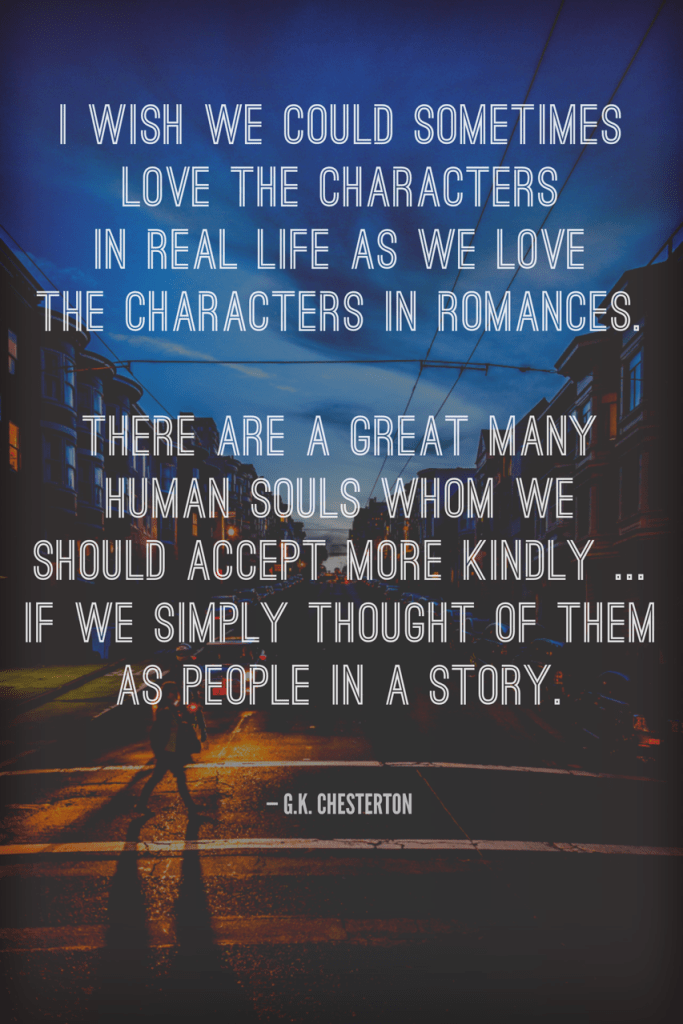
The Characters of Romance Vs. Real Life

GK Chesterton romance real life jspark


“I wish we could sometimes love the characters in real life as we love the characters in romances. There are a great many human souls whom we should accept more kindly … if we simply thought of them as people in a story.”
— G.K. Chesterton


Before We Get Hasty, I Hope You’ll Hear Me Out.


I’ve been blogging now for over fifteen years, and have noticed for a while an increasingly alarming surge of accusatory, polarized, one-sided comments that quickly shuts down any chance of discussion. It’s often so comically shrill and angry that it comes off as a parody, like all those news shows that make fun of other news shows to prove how narrow-minded the rhetoric really is. There’s an instant reflex to dismiss what’s being said. I can’t imagine anyone would be so serious about such binary, “black-and-white,” dogmatically stubborn remarks — but it’s deadly serious, with the flag raised higher than the pole, on the furthest side of the narrowest platform on the tiniest soapbox possible.

I can’t talk with someone whose mind is already made up. There’s no room for questions, a dialogue, a real conversation, a hope that others can learn. It’s so snide and abrupt that I wonder why the time was spent to comment. It doesn’t matter if I get to explain my side of the story or elaborate on my intentions or even take back something I said: it’s all dead in the water.

I’m guilty of jumping to the same one-dimensional box, in my safe little categories of predicting what the other “side” would say, as if I’m the only one with the valuable insider information. I constantly have to remind myself that it’s not the end of the world to say, “I’m wrong.” It’s only the end of my false, self-affirming, imprisoning world of circular bias. It’s not weak to say, “I want to know if you know a better way.” It would make us stronger.

C.S. Lewis in God in the Dock talks about his Oxford Socratic Club, in which people of different religions and philosophies got together to discuss what they believed. They discovered that no one actually knew about each other’s worldviews. “Everyone found how little he had known about everyone else,” he said. The Christians had only heard the weakest form of atheism while the atheists had heard the weakest forms of Christianity. They had all parodied each other into straw men. As each member of the club presented their case, Lewis noted that the arguments themselves had “a life of their own,” free from the emotional hype and attacks that so often accompanied them. And in this, their own doctrines could meet by common grace, so that they grew to understand each other while at the same time finding strength in their own beliefs.

In psychology, they teach you about heuristics, and how each of us have an automatic framework for judgment. We spend the least amount of mental faculties on perceiving things around us because the brain is designed to take as many shortcuts as it can, all while preserving our own justifications. This is a process that can only be fought and re-wired by deliberate effort and time. It requires getting to know those phantom enemies that we’ve demonized, to hear their back-stories and how they got there. It means fighting the urge to throw a verbal grenade over the fence, but instead ask a question for clarity. Even if we disagree in the end, we can quit perpetuating a cycle of hate and dismissal. Even if the other person’s worldview is inherently toxic and dangerous, maybe we can find a way through the towers they have built — and in doing so, we tear down our own.

I don’t want to be one more negative angry voice that assumes the worst in someone else. There are enough of those. I’ve done it too many times and it’s been done to me: and no one gets better for it. We end up reinforcing our own blindness and drowning in our misinformed traditions. I want to say something surprising and helpful and gentle and challenging and honest. I want to be the voice that I would actually listen to. It’s how we close the gap between us. It’s how we cross this man-made, made-up chasm to make up for our weaknesses, and to bring our strengths to the table. It’s how we’ll make it.

— J.S.

My Newest Book: The Life of King David


Hello wonderful friends! I’m excited to announce my newest book, The Life of King David: From Stone Slinger to Royal Sinner

This is a literary dynamic journey of David, from an unknown nobody to overnight celebrity, to his dark side as a chronic doubter and a royal sinner, and how his life ultimately points to Christ. It’s in a devotional style written for those who feel a bit intimidated by the Old Testament and have always wanted to get in-depth on David. Each chapter is wrapped in theology, philosophy, psychology, application, and the genre thrill of narrative. In discovering David’s story, we find our own.

It’s in paperback here and ebook here. The Preface is here or you can preview the book on Amazon. The rest of my books are here.

Be blessed and love y’all! — J.S.

What Does It Mean to “Surrender to God”?

mwspear96 asked a question:

Hey brother. I’ve been a Christian for about five years now, and I always hear people say that we have to surrender everything to God, (heck, I’ve even preached it myself.) Although, I’m not sure how to actually do that. I’ve been living for myself for so long that it seems like an impossible task. How do you actually surrender everything to God? Do I just need to pray more? I know there’s no formula for it, but I would deeply appreciate any input. Thanks, it means a lot.

Hey dear friend, thank you for sharing your concerns: it really is a scary thing to think about “surrendering to God.” It’s a very Christianese thing to say, and I think it carries a lot of unnecessary baggage that we might need to dismantle before finding true surrender.

The thing is, it seems that some of the church-culture has taken on an “Epic Hollywood” type thrill-seeking, and it assumes “radical” is the same as selling all your stuff and moving to a third world village and living off indigenous worms. The word “surrender” is sometimes abused to mean “your life only means something if you give up everything and become a pastor and evangelize in a hostile forbidden city.”

While it’s true that God might uppercut you into a completely crazy situation for His work, Jesus also said to count the cost. It means to know what you’re getting into. It means that we surrender our abilities and gifting and resources to the appropriate place for a sustainable daily sacrifice.

Continue reading “What Does It Mean to “Surrender to God”?”

How Love Really Is.


Love does not pamper. It prunes and perfects and pursues. It is a sweet embrace and a sanctifying chisel.
— J.S.


Self-Affirming Blog Bias: The Danger of Reinforcing Misinformation & Inaction from Isolated Viral Awareness

One of the problems with circular echo chambers like Tumblr, Facebook, WordPress, or Twitter is that we mostly follow the voices that confirm our own preconceived beliefs while shutting down the evidence that runs counter to our bias. We’ve locked ourselves up in self-preaching choirs and impregnable ivory towers. Our life philosophy is then reinforced by the buzzwords and bloggers we want to hear, and we demonize a phantom enemy that isn’t anything close to a real person or idea, neglecting to engage with the real world and the very real issues at hand.

On a long enough timeline, you and I become radicalized into a new kind of fanaticism, devoted to our out-of-touch, fact-devoid, isolated cages. With so many actual injustices abounding that need solutions, our faceless debating hijacks the limelight and resources from the deficit of the people we claim to be rooting for.

This is a vicious cycle that continually perpetuates misinformation disguised in pieces of truth. Some of these truths are necessary, which is all the more reason it’s a travesty that they’re buried under a blind clicking frenzy. We buy into an aggregated “fringe platform” of like-minded ideologies that only feeds itself, like the mythical dragon ouroboros that chokes on its own tail, which only attracts people who already agree and don’t want to be challenged. This common delusion appeals to our basest urge for socialization and vicariously victimizing ourselves on behalf of someone else’s “inspirational tragedy.” Never mind that it’s the other person’s everyday life and only your two second click of a like button.

It gives us a self-righteous tingle to think, “I have the insider knowledge and you don’t.” It’s a shiny trophy of “online education” that will swell your ego and high-five the hive-mind, but it does nothing and goes nowhere and has no real chance of dialogue.

If this makes you mad, then it might be too late for you. I understand though: we hate the possibility of being on the “wrong side” and “losing face.” Being rejected by your group of yes-men or criticized by the opposite side feels like death, and we either self-destruct or destroy others. And to actually work to understand the issue? It’s too hard. We’re in love with trying to change the world by looking like we’re trying to change it, with pretty text on a screen.

Continue reading “Self-Affirming Blog Bias: The Danger of Reinforcing Misinformation & Inaction from Isolated Viral Awareness”

Dialogue vs. Monologue

Photo by 3V, CC BY 2.0


If you try to trap someone with a question to prove a pre-judged bias, you’re having a monologue, not a dialogue.

If you drop a word-bomb of selective stats and facts and accusations disguised as satirical sass, it’s a monologue, not a dialogue.

If you preach to the choir to win internet-points and high-five your platform, it’s a monologue.

If you resort to name-calling, it’s a monologue.

If you set up a double-binding lose-lose situation with your mind already made up no matter the response, you don’t even care about dialogue.

If you’re not open to the possibility of being wrong, the worst part is that no one will hear you when you’re right. The good monologues go to waste.

If we listen: we’ll make it.

— J.S.

The Click-Bait Christian Media


I think the Christian media needs to quit this trend of latching onto vaguely spiritualized quotes from actors and artists and then labeling them “fearlessly faithful in a secular world.” It perpetuates a wrong divide between faith and culture, and at its core is merely smug ammo to secure our ivory towers. It’s already enough that we force mega-church pastors on a pedestal of celebrity. They’re people too, and such impossible expectations only breed false accusations of hypocrisy.

I don’t want to diminish the genuine faith of those in the spotlight, but I think the church needs to stop digging for non-existent nuggets of click-bait to validate an idolatrous “me-too” mentality. We can only pray for those who have been gifted with the unique platform of influence. And maybe support the unknown few who are doing the unsung work of ground-level change and charity.

— J.S.

The Christian: A Process in Progress


Remember, you are:


– A work in progress, looking towards the work finished, Jesus.

Under construction, in a process, two steps forward, one step back.

– On a journey of faith, because faith is not a light-switch.

– A messy, gritty, raw, real, complicated creation called a human being, and no one should ever shame you for being human.  Jesus was one of us, too.

Not defined by your mood, situation, or circumstance.

– Not defined by the “amount” of your faith, but rather by the perfect author of your faith who receives even your weakest stumbles towards Him.  It’s not about your grip, but rather the strength of the branch that holds you.

– So loved that God preempted your failures with the gift of His Son Jesus, who died to pay your price of Hell and who also died exactly for those times you would feel far from Him.

– Always allowed to approach the throne room of God with all your anxieties and fears and requests, no matter how petty, because God can handle your venting and clenching of teeth and He will not bite your head off.  It’s also His very grace and acceptance that begin to restore the broken pieces back together.

– A Christian, a profoundly broken person who has met Jesus the Messiah, who radically transforms you by being who he is: the Savior, Redeemer, King, Brother, Friend.

— J.S.


Blog Integrity: Forgetting To Practice What You Preach

I saw a quote written from a guy I know, and it was a great quote and he probably really meant it. 

I wanted to be gracious here, but — this thing he was telling everyone else to do is the very opposite of how he really is.  He knew the exact right words to phrase it, the keywords to tug the heartstrings, that slightly aggressive tone to preach to the choir, the vivid imagery and active verbs to pull it off. 

It felt so icky.  This was the paragon of a pot calling a kettle black.

If he had said it any other way, with any kind of nuance or self-awareness or humility: it would’ve made sense.  He’s not a bad person or anything, and there is value in hearing from someone who is still overcoming their own issues.  But this wasn’t that kind of honesty.  It was all finger-pointing, just abrasive and hollow and laughable.  It’s the sort of thing that instantly makes you say, “Well-what-bout-chu?”

Continue reading “Blog Integrity: Forgetting To Practice What You Preach”

Christians: You’re Allowed To Fail, But Don’t Be Mediocre

An open letter to Christian artists and creative minds.


The Christian subculture tends to celebrate mediocrity because we think it’s Christian to be “nice” even when something sucks.

I mean like, hey man, that’s my kid playing Noah up there in the annual performance of “The Loving Wrath of Jehovah.”  Never mind the boat is a rusty shopping cart.

Suburban churches have an extremely high tolerance for bad sermons, bad Christmas plays, bad drama skits, bad music, and all-around poor production values.

We lower our standards with an almost forceful resentment, as if having approval in God gives us permission to be cheap and shoddy.

Most Christianized media is a safe, sanitized, bubble-fringe ghetto that appeals to certain mindless demographics which will eat up anything labeled “for the Kingdom.”

But as the great DC Talk once said, “If it’s Christian, it ought to be better.”

Continue reading “Christians: You’re Allowed To Fail, But Don’t Be Mediocre”

The Heat of the Greatest Romance.


Romance is wonderful, but it’s one of the many things that actually points to the Creator of everything, just as a strand of sunlight points back to the author of the sun. The heat of romantic emotion is a window into the Eternal Romance that you were made for.

Before thinking about relationships, we’re designed to have relational intimacy with God. It’s not merely that Adam and Eve “disobeyed” God in the Garden, but they were disconnected from Him too. They severed their true source of love and goodness and glory. Our significance and validation comes from Him. Without this, we’ll merely pursue our latest loudest feelings to accumulate more feelings, which is a bottomless perpetuity that will crush others and crush ourselves. You know what I mean. If you finally land that relationship you so badly wanted, your initial illusions always go out the window, and suddenly this person isn’t fulfilling you like you’d hoped. It hurts that person and hurts you, too.

We must first know ourselves before we get to know anyone else, and our one irrevocable identity is found in Him.

— J.S.


The Adventure of Dating and The Reality of Relationships

Christianese Dating Logo


Hello beloved wonderful friends!

This is a seminar I gave on dating and relationships to a wonderful ministry of college students and young adults in Gainesville FL, aka Gator Town.

It’s called The Adventure of Dating and The Reality of Relationships. It’s about the exciting prospect of dating and the gritty, difficult, raw reality of relationships. Stream here or download directly here!

Some of the content is from my new book on relationships called The Christianese Dating Culture.

Be blessed and love y’all!

— J.S.