Pulpit Hero.

Photo by evcpics, CC BY 2.0


I get a little nervous when a preacher only preaches his hero-stories, when he seems to be his own marketing guy saying, “This is what Jesus does, and if you do what I’m doing, you’ll make it.”

But I always lean in when the pastor tells me about his failures. When he’s really for real. That time he blew up on someone in traffic. When he lost it with his family. When he quietly refused to help a homeless guy. His sudden shopping spree. Those seasons when he stopped praying and reading the Bible because he was so jaded and burnt out. His frustrations with the church culture, not in a sneering way that points out any one person, but really grieving over our collective lack of passion. The times when he doubted himself, when he doubted God.

It doesn’t mean we imitate all of the above, and pastors are held to a high bar for a reason: but I don’t want the act. I’d love it for a pastor to rip the mic and tell us how much he’s hurting right now and how much he still trusts Jesus to get him through all this and even tell us he’s barely holding on by a thread of his beat-up faith. Hero-stories are okay, but I want to know we’re in this uphill fight together.

Then the pastor isn’t some guy “up there” as if we’re “down here,” and it makes us a little more human too, and this points to our need for Jesus and for grace. The pulpit becomes a haven instead of a tower, a manger instead of a throne. I want to meet there inside our mess-ups, where Jesus is, the real hero of this story. With Him, we’ll make it down here.

J.S.

The Story of Us.

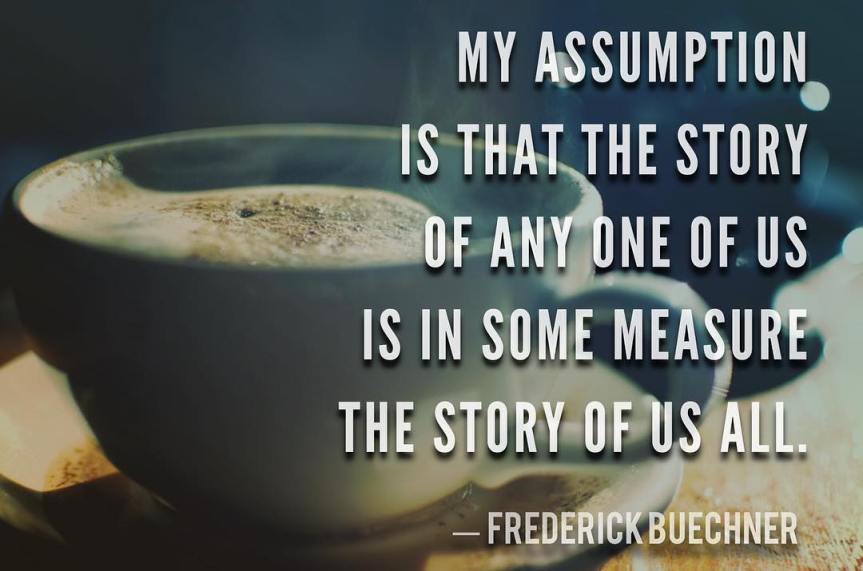
Frederick Buechner instagram story


“My assumption is that the story of any one of us is in some measure the story of us all.”
Frederick Buechner

Breaking Through Jealousy: Passing the Fire to the One Ahead

I’ve learned that the quickest thing that kills friendships is jealousy. Sometimes it’s a slow death; jealous people can act loving for a lifetime, but they waste their lives comparing to each other instead of helping each other out.

Jealousy can cut short the empowering work of friendship and all the joy and vision it brings forth.

I have two choices: I’m either your cheerleader or the loop of condemnation in your head. And I know which one I prefer to be around.

I just hate what jealousy does to people. The worst, most cutting words come from envy. Families, churches, and businesses rot from the inside. It causes even the nicest people to horde their own talents and hold others back, and they’d rather snuff out the torch then pass it on to a new generation. It turns us into small, shrewish versions of ourselves.

I’ve lost friends this way, and you can’t really call someone out on jealousy. It feels arrogant, and no one would confirm such a dirty accusation. No one confesses it, either. In my years of ministry, I’ve never heard someone tell me, “I’m just a jealous, insecure hater.” Have you ever said that in the mirror? Me, neither. You’ll hear about murder and drugs in the confession booth before envy. It blinds us into denial.

I’ve seen a lot of good friends get blown up when envy got a foothold. One friend would get successful in their field while the other stayed unseen, and the unseen friend starts to feel like their famous friend owes them. There’s a lot of fist-shaking at God and self-directed anger. It’s nasty stuff.

Preparation is half the battle. If you can name the demon, you have a better chance of beating it. Fighting sin means expecting the monster, and then tackling it in the doorway. It means laying down the worldly weapon to pick up a weapon of grace.

Continue reading “Breaking Through Jealousy: Passing the Fire to the One Ahead”

5 Ways to Diligently Discern All the Good and Bad “Christian Advice”

There’s a ton of Christianese literature out there, and some of it’s bad, bad, bad advice.

In my best movie trailer voice: In a world of Christian bestsellers, blogs, podcasts, and instagrams with Bible verses on ocean wallpaper, who are all coincidentally on an “authentic relevant struggling faith journey,” one ESV-carrying Christian millennial rises above the handlettering and “I’m not like those Pharisees” YouTube channels to authentically struggle with discerning what’s theologically sound and really works in the mess of real life.

But seriously: witty snark and pretty prose in bite-sized blog posts (like this one) don’t ever mean credibility. We really do need to know what “works in the mess of real life.” And it’s not going to be stitched-up quotes and here’s-what-I-would-do sort of fluff that sounds ideal but doesn’t work down here in the dirt.

I don’t claim to know any better on this. In fact, please don’t trust me, because I will let you down and inevitably disappoint you. Bloggers are not your counselors, no matter how flowery and fluffy their words. And your favorite “Christian celebrity” with the million followers might not be as inspirational as his tweets and t-shirts in his Etsy store.

Christians are called to discern everything we read, especially from sources that claim they’re fellow Christians. Here are a few questions to consider when we run into any kind of advice.

1) Where is it coming from? Says who?

It’s easy to start a blog and start preaching way further than our lives have actually lived. So much of Christian advice is idealistic guess-work that hasn’t been field-tested or approved by experience, much less cited or researched. In fact, a lot of it’s packaged to get hits and go viral, instead of actually caring about the real person it claims to help.

This will sound mean, but a lot of the shrill imperatives we see in blogs and books are from well-intentioned, untested upstarts who vicariously uphold an image that isn’t really them, either to compensate for their own shortcomings or to grab those precious followers. I only know this because I started that way, and I regress easily. Social media, for all its benefits, has made pedestal preachers of us all. I’d much rather someone tell me how it really is, with candid humble honesty, instead of how it “should be,” and to learn from their mistakes rather than get imprisoned by an impossible parameter—a paremeter, by the way, which is hardly practiced by the ones preaching it.

A suggestion: Check their bio. This isn’t to judge them or to assign value, but to see what they’ve actually been through. This also doesn’t mean that “youth” can’t say wise things, or that only experienced elders have knowledge. But rather, it’s to ask: What makes this person credible in this particular subject? What have they seen and who have they been around? How have their experiences informed their faith? And certainly there are those who have hardly been through much but can still write wonderful things, beyond their years, and it’s worth celebrating the exceptionally rare gift of youthful wisdom.

2) Is it reactionary?

I love snark and sass, but some advice is just a childish temper tantrum that caters to pseudo-outrage and preaches to a choir in an ivory tower. I call it Popular Discontent: find something wrong, multiply the fear and anger, call out some names, and you’re instantly viral. Also include, “I’m not like them, we’re like us, I’m protecting you, and everything is terrible and evil and I miss the good old days and these young people don’t even know.” Hashtag: Get off my lawn.

Another thing is that contrary to the cool postmodern professor, Christianity always challenges you to think for yourself. Discernment also means investigating every voice and giving it a fair hearing, no matter how dissenting, unpopular, or critical. But a church steeped in reactionary backlash tends to say, “My way is better than theirs and it’s the only way,” which becomes an echo-chamber cult of self-congratulatory chest-bumps.

A suggestion: This one’s tricky, because we do need to call out things that are obviously harmful, and I definitely sympathize with people who have been extremely hurt and must react as loudly as possible. The problem is building an entire platform on what you’re against instead of what you’re for. We go too far the other way, and it’s not hard to find something wrong with everything. Cynicism is easy mode. And everyone can tell when someone is secretly barking at a bone to pick or beating a dead hobby-horse. It’s a constant “throwing them under-the-bus.” I have to catch myself on that all the time (and I’m trying my darn hardest to balance that here). If the tone is passive-aggressive instead of pro-active, I let myself out. It’s a balancing act to be fair and firm, which leads us to—

Continue reading “5 Ways to Diligently Discern All the Good and Bad “Christian Advice””

From Mountain High to Valley Low: Finding an Oasis in the Darkest Desert

Photo by Lenny K, CC BY 2.0


Hello dear friends! This is a message I preached called, From Mountain High to Valley Low: Finding an Oasis in the Darkest Desert, on the story of Elijah from 1 Kings 18-19.

It’s about finding our way through discouragement, distress, and depression, and how God speaks to us in those seasons and how we speak to one another. As a lifelong sufferer of depression, this is hugely personal for me. Stream below or download directly here. I’m also on iTunes here.

Some things I talk about are: The sudden mental replay in the shower and the late-night regret twitch, the one common denial from every patient in the hospital, when you just need a hamburger and a really long nap, the hidden fear of men getting honest, the panic moment when someone sees your text messages and photos, how Yoda finally got through to Luke Skywalker, and Elijah versus depression versus the world.

All messages are here. Be immensely blessed and love y’all!
J.S.

Unchanging Heart.

heart of God unchanging changes you JS Park Instagram

The heart of God will never change no matter what you do,
and it’s His unchanging heart that changes you.
J.S.


Kindness, Kindly.

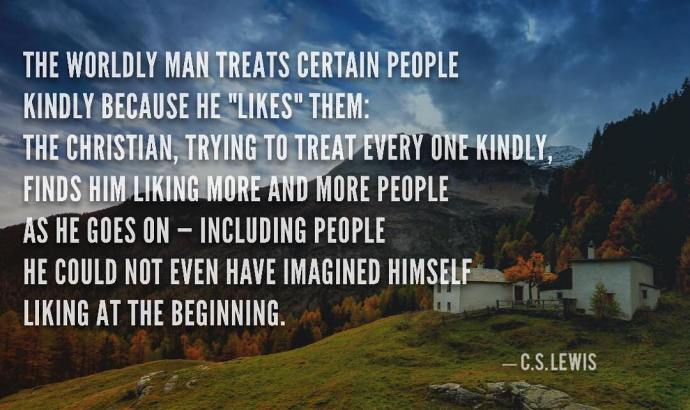
CS Lewis kindness instagram

“The worldly man treats certain people kindly because he ‘likes’ them: the Christian, trying to treat every one kindly, finds him liking more and more people as he goes on — including people he could not even have imagined himself liking at the beginning.”
C.S. Lewis

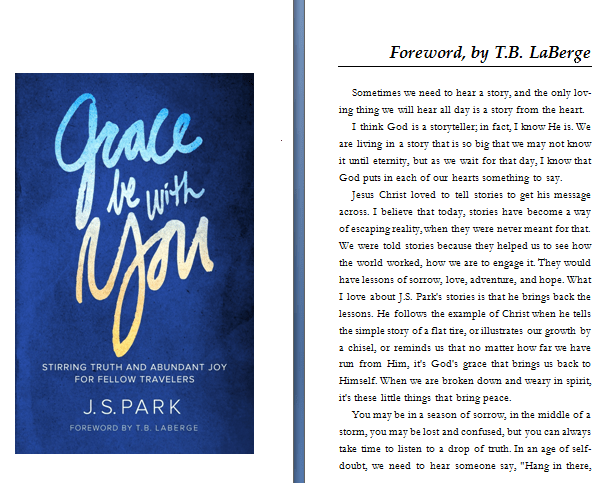
Foreword to My Newest Book, by T.B. LaBerge

Grace Be With You Foreword TB LaBerge


My very good friend and blogger T.B. LaBerge wrote the Foreword to my newest book, Grace Be With You.

The book is a collection of short stories, poems, and thoughts, many of which you’ve seen here on this blog.
It’s available now in paperback and ebook!


http://www.amazon.com/Grace-Be-With-You-paperback/dp/069269031X/

http://www.amazon.com/Grace-Be-With-You-ebook/dp/B01E4XXCVM


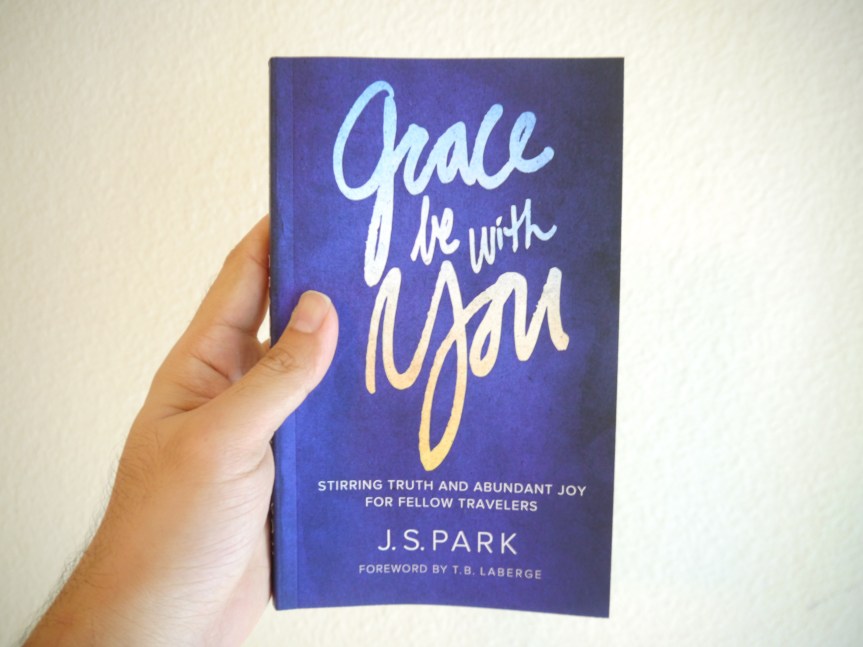
My Newest Book: Grace Be With You, a Compendium of Stories, Thoughts, & Poems

Grace Be With You paperback


Hey dear friends! This is my newest book, Grace Be With You: Stirring Truth and Abundant Joy for Fellow Travelers. It’s a collection of stories, quotes, and poems, most of which have gone “viral” on this blog, with all new content. The Foreword is also by my wonderful friend T.B. LaBerge.

The book has four chapters, each a unique theme: to encourage, convict, engage, and transcend. Contained are quick quotes, humbling plot twists, and everyday encounters on the road, at the hospital, at cafes and gas stations and funerals and churches.

The paperback is only 8.99 here and the ebook is only 3.99 here and it works on every device. If you’re blessed by the book, please consider leaving a review on Amazon.

Be immensely rocked by His grace!
J.S.


Paperback: http://www.amazon.com/Grace-Be-With-You-paperback/dp/069269031X

Ebook: http://www.amazon.com/Grace-Be-With-You-ebook/dp/B01E4XXCVM

Bible Showdown: Literal Vs. Allegorical Interpretation

horizontescuriosos asked:

I came across one interpretation of Genesis that I thought might be insightful to ask someone about. The idea I found is that Genesis is really an allegory about human sin … Like before sin, Adam and Eve were naked and unashamed. Then Eve tried to sneak eating the apple, sin entered, and from then on Adam and Eve wore clothes out of shame … As a pastor, do you think this idea of Genesis being an allegory for human sin has credit? (Edited for length)

Hey dear friend, I’ve definitely seen Genesis (and much of the Bible) interpreted as allegory, and it’s a legitimate way of reading the Bible, called the Alexandrian method, that’s been around for centuries.

However, I personally view most of the Bible as literal, factual history — or at the very least, I assume that the Bible authors had an original intention that wasn’t meant to be stretched towards a “spiritualized” meaning that says whatever we fancy.

Scripture doesn’t read as an allegorical account, but more like a news periodical. There are parts of Scripture that are definitely allegory, but it’s usually obvious, with the author even saying so.

Ancient accounts of legend only revealed details that were much like Chekov’s gun, which were set-ups for a moral lesson. From the Epic of Gilgamesh to Beowulf to The Odyssey, no detail was wasted. But Scripture would describe things that had no other purpose but to describe them. Jonah talks about buying an actual ticket to board a ship. Peter and his fellow fisherman caught 153 fish, which has no other meaning, except that they caught 153 fish. When Jesus is arrested, a naked guy totally flees the scene. Mythological stories never read this way. Most of Scripture has a prosaic, open-ended description that was not a type of genre for myths back then, but for eyewitness testimony.

While the Alexandrian method certainly has merit, here’s one huge advantage of the literal interpretation of Scripture.

Continue reading “Bible Showdown: Literal Vs. Allegorical Interpretation”

Holiness, Humility, and How to Give Your Life Away


Hello wonderful friends! This is a message I preached called Holiness, Humility, and How to Give Your Life Away.

It’s about how the holiness of God irrevocably changes us in two ground-shaking ways. Stream below or download here.


Some of the things I talk about are: The two things I hear at every deathbed in the hospital, my body’s crazy involuntary response when I flew over the Grand Canyon, every instance of the Bible characters seeing God and falling over crying, the unseen thankless art of raising children, how to live generously with zero guarantees, and a letter from Belize.

My podcasts are on iTunes here (leave a review if you wish!).

Be immensely blessed, dear friends!
J.S.

I Trusted My Guilt Until Grace Spoke The Truth

Photo from The Work of Chad


I trusted my guilt, my shame, my self-pity to move me.
I grit my fists, clenched my teeth,
I reached for the person I should be.
Yet I could not be shamed into change, because it only re-arranged my behavior. I could not fundamentally break my ego, for I was only restraining my nature.
I needed a new heart, a Savior.
Grace caught me: by faith, He had already raised me, and had moved me far much more than I dared to believe.
For I forgot the price of grace to bring me back, grace that cost His hands and feet.
I dared for a love stronger than all my shouting, my sickness, my shadow in the mirror.
A love busting at the seams of my heart, a new heart –
– a love that loosened my fists and my failure.


— J.S.


The Two Words We Want Least But Need Most


Hello wonderful friends! This is a message I gave called, The Two Words We Want Least But Need the Most.

It’s about two words that we quickly avoid but desperately need for growth, healing, and wholeness, for our relationships, churches, politics, and faith. Stream below or download directly here.

Some things I talk about are: When you see someone else’s kid misbehaving in public, the most unappealing things about Christianity for Christians, thinking the sermon is for the guy in the next row, tracing the theme of water and chaos through ancient history and Scripture, and how Jesus’s war cry obliterated our worldly warfare.

I’m also on iTunes here. Be immensely blessed!
J.S.

The Hardest Thing About Perseverance Is the Whole Thing


I wrote a guest post for the wonderful Pursuit NYC, headed by my friend Sam Won.
The post is about perseverance and what it really means.

An excerpt:

Plenty of us can quit without physically quitting. We can live this way for years, thinking that “showing up” is enough and we can skate by on the bare minimum.

In other words, perseverance is not just staying in, but being in. It’s being present and engaged.

It’s not that we don’t have it in us to persevere. It’s that all of us wasn’t in the task at hand. Even a person who gets to the finish-line, who didn’t put their all into it, hasn’t really persevered.

I do this, too. I can be there but not there. And I’m learning that being disengaged begins with my expectations.

… No one ever told me, “Emotions are different than passion. Emotions are the little spark that gets it going. Passion is what keeps you running the marathon, even when it gets boring, even when things don’t go your way, even when the path takes a bunch of detours and it’s not as pretty as the picture in your head.”


Read the full post here!

J.S.

A Quick Interview About Christian Faith.

Photo from Hillsong Gallery

An interview about my faith and denomination, from sjpark11 for his class.

1. What is your understanding and experience of spirituality?

– There exists a divine pulse to the universe, a breath of creation by a Creator. To experience spirituality is to be in touch with this pulse, to be “aligned” with creation in all its potential and possibility.

As a Christian, I also believe this divine pulse, God, revealed Himself on the earth at one point in time as one of us, to reverse the human condition of entropy and invite us into that story of healing.

2. What are some images or metaphors that support your understanding and/or your experience of spirituality?

– I like C.S. Lewis’s metaphor about the door. Currently, we are on one side. We get glimpses of a “reality” beyond us, something so grand and beautiful that we can hardly take it in. It’s evoked sometimes in our natural experience, whether by sunset or ice cream or romance or song, though these things in themselves come quickly and go. One day we will get to the other side of the door.

Faith is about the journey of looking through the keyhole, getting a glance of infinite beauty, until we permanently partake in the radiance of all that we hoped for.

Continue reading “A Quick Interview About Christian Faith.”

Eugene Cho’s Book “Overrated” Is Free Today


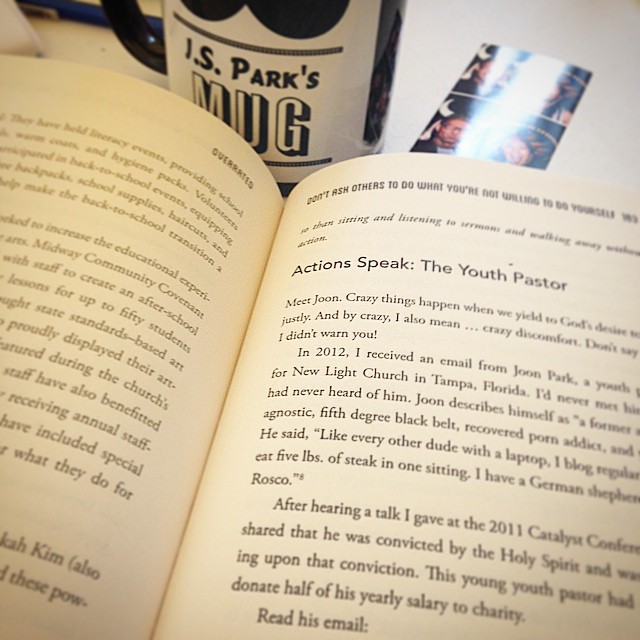
Eugene Cho‘s book “Overrated” is totally free today. He’s the founder of One Day’s Wages and very much the real deal. He also mentions my story in his book about the time I gave away half my year’s salary to fight human trafficking, a check for 10k, which was matched by contributing donations.

Grab his book here: www.amazon.com/Overratedebook/dp/B00K04IX9Q/

His book is incredibly good. The two parts that impacted me the most were his personal story about working as a janitor for years before being able to successfully launch a church (nothing wrong with being a janitor by the way, but throw in Asian cultural expectations), and the process of how he sits on an exciting idea for a while to see if it’s just emotional hype or truly deep passion. Powerful stuff.

The story about the donation here: https://eugenecho.com/2012/11/26/an-inspiring-story-of-courage-and-generosity-youth-pastor-donates-half-of-his-salary-to-fight-human-trafficking/


eugene cho overrated ODW book Joon

Finding Home in the Dark: A Fiber of Fine Light.


The hard part is that when you decide not to call on lesser idols to numb your hurt and you finally reach out to God, suddenly you’re inside the pain. It’s all there. You can’t do anything to hide it anymore. It seems like a terrible idea.

One of the toughest things about excruciating pain is that it’s embarrassing. There’s a humiliating stench of astonishment that this is happening to me. It’s malheur, or a pain about your pain. If you live with it long enough, you’ll begin to identify yourself by your hurt, as if this is your only value. It’s understandable, because it takes up so much space in your mind. It’s no wonder why we’re tempted to run to everything else.

The pain is blinding. But — blinding ourselves to the pain is even worse. In doing so, we erase ourselves down to the bottom.

So then: Calling out to God is remembering who you are.
Remembering where you come from.
Remembering what you were made for.
Remembering that you are not your pain.

Most of all, remembering who He is.

This will look different for everyone. It could mean taking a long drive to the shoreline. It could mean standing over the sea in total silence. It could mean opening your Bible to Isaiah 40 or Psalm 23. It means asking a friend to hot chocolate and hearing you out. It means actively seeking encouragement and community, because 1 John 4:12 says, “No one has ever seen God; but if we love one another, God lives in us and his love is made complete in us.” It means journaling, or busting out your guitar, or crying for a long time, or having an intense conversation with yourself. It means finding a need and serving that need. It means finding an older brother or sister and asking for wisdom on what to do next. It means dressing your Sunday best and singing at church at the top of your lungs, in hot tears and laughter.

A lot of this might feel rote and mechanical. You might not feel like doing any of it, and I don’t mean to add another burden on your hurt.

I just know that for a moment, when I can trace the sunbeam back to the sun, I remember who I am. It doesn’t make me instantly whole. It doesn’t solve things today. It’s often just a brief glimpse. But when I return to the heart who made me, I momentarily find something stronger than my pain. It is stronger than everything else that calls my name.

This is a difficult thing to do. It’s not merely psychological re-arrangement, because it requires getting up. It requires tapping into a very fine frequency, which is there for a flash and gone. But it’s there.

You might have even been on the other side of this and helped someone else remember. Maybe you took someone to lunch and listened to them without interruption for an hour. You made actual eye-to-eye contact, and you never knew, but you changed the course of that person’s day from driving off a cliff. You randomly volunteered. You wrote a thank you note. You picked up a call from a distant friend. You wrestled with someone’s questions, maybe not even fully paying attention, but you stayed with it to the end.

You didn’t know, but you were part of the frequency.
Once in a while, God breaks in. He reminds us of beauty. The pain doesn’t stop, but there’s a joy in the middle of it, just loud enough to remember.
We can break in, too.
You can pray. You can sing. You can seek others. You can visit home in His Word.

It is painful, sloppy, and scary. It’s not easy to turn our internal axis to Him, especially in hard times. But by slow, stumbling degrees, I can breathe Him in — and He is the only air that fills these crumpled lungs.
I remember: we’re not home yet.


J.S. Park | Mad About God


The Strength You Never Knew You Had.


Photo from Noel Shiveley


I know that not everything has a happily-ever-after. We do hurt, a lot. There are lifelong battles and unconquerable defeats and irreversible losses. There is, at times, unresolved tension that remains unresolved.

Yet our bold response to all these things can show a reservoir of strength we never knew we had. Our daily victories build scars that build stories that build bridges to broken hearts. Our boldness shows we don’t need to lose ourselves in loss, that we don’t need to fall apart when everything else does. The dark can make us more human, and not less. In our outright rebellion against apathy, we find a flash of divinity. We find a story better than the childish bleakness of tragedy, but instead the mature growth of comedy, where we have the humility to laugh at ourselves. We find hope in pain together. Maybe even the hope that there’s an ever-after. We don’t have to hope in solitude.

— J.S. from Mad About God


Does God Use Pain “For My Good”? Does Everything Happen For a Reason?


Is suffering a “part of God’s Plan”? Does God use trials to teach us a lesson? Does everything really happen for a reason?

A hard look at the Problem of God vs. Suffering, and why easy answers won’t work in the middle of the mess.

Get my book on persevering through trials & suffering, Mad About God.

— J.S.

Grace: A Galaxy in a Cup, a Memory of the Future.

I have a past that I’m not very proud of: and in a cafe, I saw someone from my past for just a flash of a second.

It was all I needed to remember. In that tiny compact parcel of a second, I replayed every terrible, awful, humiliating moment of self-indulgent excess in a nauseating loop, both the ways I used people and was used, and then: shame. Drowning shame. That awful sick-stomach feeling of tendrils racing up my gut, a stench that begins at the back of the throat to the tip of my nostrils, like choking in reverse.

A Christian might call this “condemnation.” I also call it “standing naked in town hall with every hurtful thing you’ve ever done on the wall, and also it’s very cold in there.”

Slipping, I reached for something in my head, fingernails scratching through a narrowing stone tunnel, spinning, up now down, the verdict pressing in, chains tightening. I felt like that guy on the news who has microphones shoved in his face after a scandal; you know, the carnival games were rigged the whole time, how dare you, you monster. Voices crowded in, the chorus shouting, “You’re not any different, you haven’t changed, I know who you really are”—and somewhere in that mess of lies, I found it.

Continue reading “Grace: A Galaxy in a Cup, a Memory of the Future.”