“How Do You Keep Believing In All This Faith S—t?”

[A pastor’s confession.]

Often I’ll have a friend from childhood find out that I’m a pastor and they’re downright incredulous; they’re just as surprised as I am that I ever went from atheism to Christianity, much less ministry. “I thought you were too smart for that” or “You were always the wild guy, never thought you’d settle down.” Most of my friends went the other way and fell out of faith like it was a varsity jacket, or an old diaper.  They ask, “How do you keep believing in all this faith s–t?” – not because they’re trying to trap me, but because they’re genuinely curious for a coherent explanation. They do want something.

To be truthful: most times, I don’t have a good answer.

I often wonder myself, How do I keep believing in all this faith s–t?

Sometimes, I find the whole thing just crazy. When I reduce Christianity down to one or two sentences, it sounds ridiculous coming out of my mouth. I believe that if I telepathically offer my cognitive affection to a Jewish zombie who tells us to eat his flesh and drink his blood, then I’ll have immortality and half a better chance to run for political office.

A fellow Christian will tell me, “Oh no, doubt is a good thing, it means you’re at the edge of solidifying a deeper faith by investigating your most foundational beliefs.” Which I guess could be true.

A fellow atheist will tell me, “Oh no, doubt is a good thing, it means you’re at the edge of coming back to reason and shedding a fear-based crutch that’s having less relevance and respect in the world.” Which I guess could also be true.

Both would say, “You’re finally being intellectually honest.” Both say, “You’ll come around.” Both say, “If they could just admit they don’t have everything right.” Both say, “They’re just so blind and have the same boring arguments and the ‘burden of proof‘ is on them.” Both are rude, unthoughtful, unmoving. And of course, they both love to yell ad hominem.

It all just sounds the same to me. I could quit believing. I could keep believing. I could walk away. I could walk harder.

Continue reading ““How Do You Keep Believing In All This Faith S—t?””

What About Female Leaders In The Church?

godgirlthings asked a question:

Hello pastor! I had a question and was thinking of someone who would help me, you came to my mind because of how much God uses you to inspire me. So, I’m a bit confused. My dad and I were talking about how women are not allowed to lead in certain churches and if it’s right for a woman to be the leader of a church, could you let me know what the Bible says about this? Thank you so much, God bless you!!


Hey dear friend, I know this is a very divisive issue with many viewpoints, and I know we won’t all see eye-to-eye on it. I did write a super-long post that partially answers your question here:

– Mega-Post: Female Pastors, Neo-Feminism, and The Scary Words Submission, Quiet, and Penis

(Please forgive the sassy, off-color title. I wrote this when I was a little bit more snarky, back in the day.)

I’m very much open to women being leaders in the church – mainly because the early church was so pro-women that it would be impossible to say it’s not. I mean the church herself is called the “bride,” and I just don’t think theologians can keep word-playing themselves out of that one. The verses we’ve used to “shut down” women in church are surrounded by a much larger context that requires some digging. And if anything, the Bible is incredibly tough on men, with a much more brash upright tone with them.

If men are about to use the Bible as a patriarchal tool, they better cut out all the parts from Genesis to maps. And if men are so desperate to be leaders: I hope we know what we’re getting into. That’s not some kind of easy position to play around with.

Continue reading “What About Female Leaders In The Church?”

What Does It Mean To Really Love Someone?


How do we actually love someone? What does it mean that God loves us? What is the “Christian” concept of love? Why is it unique?
Defining the gritty, painful, crazy depth of love in two and a half minutes.

Subscribe to my channel here. Love y’all!

— J.S.


[Thank you to Steven Hause of pudgyproductions]


The Constant Insecurity of Always Being a Hypocrite

appoljuce asked a question:

I love to share God’s Word and Truth on social media, but sometimes even when I know I have shared a sound biblical principle I sometimes feel odd. I sense a small fear of saying something incorrectly and I double guess myself. Does this ever happen to you?

Hey dear friend, yes it does.

The truth is, most Christians have a paranoia that we’re “tricking” people into a faith that we’re not entirely sure of ourselves. Some of it’s because we feel inadequate to say such glorious truths, some of it’s because we’re not fully living them, and some of it’s because we’re scared that some theologian will shoot us down from our perch.

It’s true that we might believe some incomplete things right now. But that’s true in all things of life. All our “first loves” are a little embarrassing and immature. Our first created song or poem or sermon or dance or painting will be looked back on with a little sheepish amusement. But that’s okay. This is all part of the journey. Learning too much technique and perfectionism can suck the fun right out of it – and if anything, knowing God is joyful at its very core.

Continue reading “The Constant Insecurity of Always Being a Hypocrite”

The Christianese Demonization of Secular Music & Media

Photo from Theron Humphrey at This Wild Idea

erelah-tabbris asked a question:

Do you like secular tv shows and movies? do you find this keeps us off the path of Jesus/condemns us?

Hey dear friend, to be very truthful, I’m a huge fan of TV shows and movies. My favorite TV show of all time is 24, and I currently watch Person of Interest and The Walking Dead.  I’m secretly a noir film buff and I love the old 1940s-50s black and white detective films, particularly with Humphrey Bogart. As an Asian-Easterner, these sort of Western tales are hugely fascinating, with their strong feminine characters and self-deprecating anti-heroes.  I’ve read nearly all of Raymond Chandler’s work. I’m also a sucker for Michael Crichton and Stephen King. Oh, and Marvel and DC (why not both?).

I try not to think of entertainment as “secular” versus “Christian,” because this “sacred/secular” divide unnecessarily stirs up a self-righteous superiority, as if art can only be art when “I say so.” There’s no special medal for skipping The DaVinci Code. It also excludes a wide variety of creative expression, which gets a little bit too much like an authoritarian tyranny to me.

Continue reading “The Christianese Demonization of Secular Music & Media”

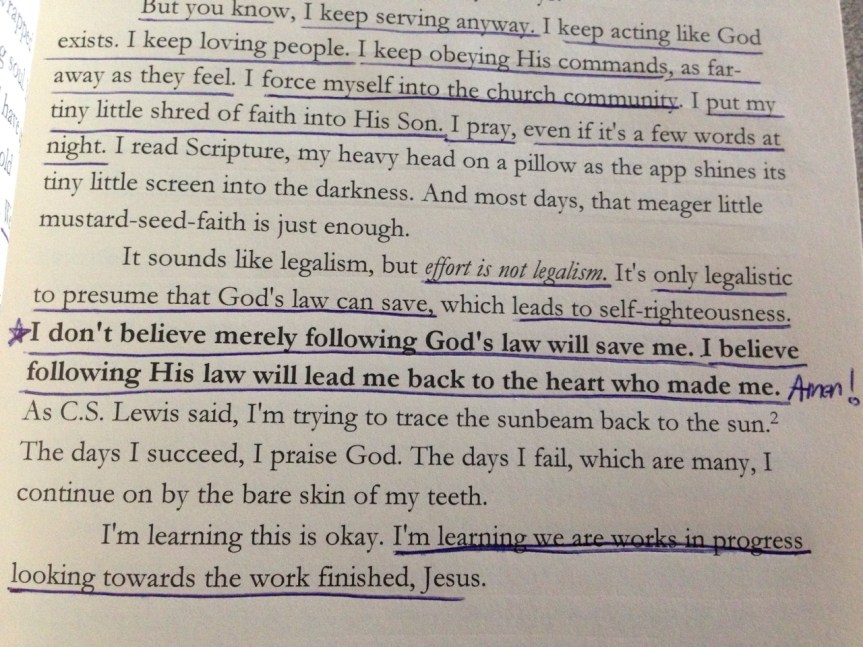
Effort Is Not Legalism.

Effort Vs Legalism David Choi


From David Choi! Love that you underlined almost everything.

Dear friends, my book is on Amazon here!

— J.S.


The Unlikely Power of the “Law of Attraction”

msjbobby asked a question:

Hi! May you share your thoughts regarding the law of attraction related to Christianity? At some point, it’s true that God asks us to be grateful for all things, ask for things we want, and have faith so strong that it could move the mountain. But really, what do you think?

Hey dear friend, as far as I know, I don’t believe the Law of Attraction can really mesh with Christianity all too well. As for me, I don’t always feel like my faith can move a mountain, much less a mole hill.

The Law of Attraction says “like attracts like,” so that if you want something bad enough, it will be drawn to you. I might be simplifying it, but that seems to be the whole concept in a sentence.

There’s a little bit of truth to this, as with all philosophies. If you’re a constantly negative person, then of course, it will cut off opportunities and disregard positive people. If you’re a constantly optimistic person, then the hard times can be handled with poise and perspective.

The problem with many of these self-help philosophies is that they will never work in impoverished areas and third world countries. That’s always my first test. Most bestsellers with a “prosperity” message only work for a certain demographic. My friend, who used to do music gigs for Scientologists, used to say, “You don’t see Scientology centers in the ghetto.” They have exorbitantly high costs to be a member.

Continue reading “The Unlikely Power of the “Law of Attraction””

Forgiveness: Not a One-Shot Moment, But a Daily Battle

setapartformyking asked a question:

What is your best method you have used or use to let God fully take away any remainder of bitterness? Been struggling with being free from the chains of bitterness and fully forgiving and I don’t like what it’s doing to me.

Hey dear friend, thank you for being so honest and please know: forgiveness is an immensely difficult, uphill climb that often takes a lifetime.

Perhaps the best thing I’ve learned about forgiveness is that forgiving someone doesn’t always happen in one shot. Though it can certainly happen this way, for most of us, it takes a daily wrestling to really be free of our old wounds. I tend to be a slow forgiver, and it’s a process that needs daily work, sometimes even multiple times per hour.

Continue reading “Forgiveness: Not a One-Shot Moment, But a Daily Battle”

What Is God “Teaching” Through Pain and Suffering?

Image by Jessi Lynn

imkwonjihye asked a question:

Hi pastor j.s! I think you may cover this in your new book, but still wanted to ask, does God aim to teach us something when we go through difficult circumstances or is it to bring us to him? Often times I feel like I have to justify my suffering and get something out of it, just so I don’t go crazy at the reason for it all. At the same time, constantly justifying suffering leaves me in a state of battle, instead of just being (?) I don’t know if I’m making sense. What does God want me to do…

Hello dear friend, this is very much covered in my newest book about persevering through pain, which you can find here.

The main crux of the book is that I don’t believe pain always has a lesson. In other words, I think it’s unfair to connect the dots to some epiphany on every instance of pain. When a preacher says, “God is using this for your good” or “God has an amazing plan for your life,” it can be very cruel and degrading to an actual suffering person.  This only works in the quiet suburban stillness of a privileged gated community. It hardly works for cancer, a car accident, or a dilapidated third world village.

Certainly, pain can bring us towards God. It can be sublimated for strength and wisdom and deeper friendships. But I don’t know if God is using it for those things. Pain is part of a fractured, fallen world. God is not some cold teacher who waits for us to “get it.” I believe He grieves with us, and there’s no bigger evidence of this than the sending of His Son.

Continue reading “What Is God “Teaching” Through Pain and Suffering?”

I Will, Anyway.


In the end, you can’t really force someone to do anything, even if it’s for their good.

You can’t force someone to respect your feelings or care about your passions or believe your dreams.
You can’t force someone to believe your side of the story, even when you’re right.
You can’t force an apology.
You can’t force someone to engage in social justice or fight for the poor or to become nuanced in culture and history.
You can’t force growth.
You can’t force someone to show up on time, or even show up at all.

In the end, I’ve learned that people will do whatever they want, even if that means stepping on you or neglecting you or abandoning you or belittling you or choosing others over you. I’ve probably done this as much as it’s been done to me. It’s a terrible cycle that leaves us bitter, suspicious, paranoid, and completely jaded.

I’ve also learned that I don’t care if you don’t care. I have to love anyway. I have to be patient anyway. I have to be jaded to being jaded. Because I don’t want to perpetuate someone else’s cycle of apathy and neglect. I don’t want to be one more rung in the ladder of indifference. I don’t want to be a reactionary pawn.

No, I cannot force anything on you, and I won’t. I can only pour out what I have. Even if you don’t care. Especially if you don’t care. I’ll pour out anyway. In the end, our lives will have been given over to dust. I’d rather mine will have been given over to you.

— J.S.


Thank you, Rachel Denk!


Very thankful for Rachel Denk’s wonderful review of my latest book, Mad About God.

An excerpt from her review:

“How many times do you feel like you have to be ‘in the right mindset’ or at a ‘good place’ with God in order to come before Him? Don’t you ever feel like you’ve been told since God is almighty and righteous that we have no right to be upset or angry with Him? And when we can’t suppress pain, anger, or bitterness, all of that is somehow transformed into guilt.

“… J.S. Park beautifully deconstructs all of these notions that have been drilled into us for far too long. And guess what? It’s okay to be upset. It’s okay to be angry. It’s okay to doubt. It’s okay to not understand why things happen and question God.

“J.S. asks the hard questions. He prompts the difficult ideas. He opens the can of worms that may never truly be shut. My favorite passages from the book include Hijacking And Reclaiming Jeremiah 29:11, Our Hollywood Craze To Live An Epic Life, and The Problem With Job: As We Bleed, We Find Our Deepest Need. Sound intriguing just from the titles? You better believe it. These passages floored me – I often caught myself reading this and thinking how someone seemed to understand this little aspect of my heart and soul that had been secretly struggling for so long.”


The Downright Impossibility of Friendship

yoonsense asked a question:

Is friendship supposed to be super hard? Or am I, are we, doing something wrong?

Hey dear friend — yes, friendship can be remarkably difficult. In fact, most of the time, it’s impossible. I guess you were hoping for good news, which there is, but it’s front-loaded by a whole bunch of bad news.

We’re each naturally going to be selfish. We’re all about self-preservation and protecting our egos. At the same time, we want company and community and we know that life is usually better together. In our friendships, we all tend to collide in those selfish areas, and our flaws and traumas and dysfunctions come spilling out in dramatic fashion. It’s unavoidable. You will eventually run up against someone else’s fault lines, just as you’ll have your own exposed too.

I used to think, “Well the good is worth the bad.” But that makes friendship sound transactional, as if I’m weighing how “good” it can be like an opportunistic salesman. Certainly there are some standards for friendship, and if it gets too toxic, we should consider walking away. Yet friendship is about accepting all the good we have yet to discover and all the bad we have yet to see. The deepest friend who exemplifies this, of course, is Jesus himself. He knows us as we are, yet loves us as we are.

Continue reading “The Downright Impossibility of Friendship”

I Don’t Have It All Figured Out Yet / Perpetually Skeptical


Hello dear friends! This is an audio preview of my book Mad About God: When We Over-Spiritualize Pain and Turn Tragedy Into a Lesson, about persevering through pain and suffering.

Preface 1 – I Don’t Have It All Figured Out, and That’s Okay
Preface 2 – Perpetually Skeptical: Screaming Through The Red Sea

Preface 1 is about our crazy need to connect pain with a lesson.
Preface 2 is about the constant, uncomfortable doubts about the existence and goodness of God.

Stream here or download directly here. The book is both in paperback and ebook.

Love y’all and be blessed!
— J.S.


3 Lessons I Learned Instantly In My First Week of Marriage (That I’ll Need For Life)

julettejoonengaged-041

They say everyone gets a honeymoon period at the start of your marriage, but whoever brandished that idea: I want a refund.

Marriage is hard work right out of the gate. Our sentimental ideas about romance get tossed out very, very quickly — and I want you to be ready. Everyone told me what to expect, but no matter how much you prepare, it’s still a jump in the deep end. The more you know about what’s coming, the quicker you can stand on your two feet.

I know that marriage isn’t for everyone (contrary to our culture, singleness is not an illness), but whether you’re not in the dating scene or you’ve been married for years, here are three things I learned instantly in the first week of marriage. These lessons could be valuable and necessary for our entire journey.

1) Marriage pulls down the hologram and brings about the gritty reality of your spouse (and yourself too).

My wife and I dated for six years before we were married, and in those six years, I have never heard her pass gas once. I would constantly tell her that it was okay, but my wife was dead-set on maintaining an air of elegance. No pun intended.

About four days into the marriage, on a wonderful crisp morning in Florida, I asked my wife, “Are you boiling eggs?”

She said, “No. I’m not boiling eggs.”

“Are the sprinklers on outside?”

“No. The sprinklers are not on.”

“But then what’s that sm—”

And it hit me. Pun intended.

[By the way, I have my wife’s permission to share this story. I’m proud to say that she now regularly passes gas around me with the most exuberant freedom.]

In dating, we’re often on our best behavior. It’s like a job interview, where both sides show off their impressive benefits and credentials. In marriage, you see the rough, raw edges of the entire person. Marriage creates perhaps the closest proximity you will ever have with another human being. You’ll see every insecurity and neurotic tendency. There will be friction.

This is more than just about keeping up a pretty image.

It’s also a way of learning how to love an entire person and not just the parts that you like.

In Timothy Keller’s The Meaning of Marriage, he discusses how we each have fault lines in our hearts, like the cracks of a great bridge. These fault lines get exposed when we collide with another person, so that we spill anger or jealousy or anxiety. A married couple, because they’re so close in space, will inevitably drive a truck through each other’s hearts: which exposes all the fault lines. Deep-seated flaws will shake out of us like shaking a tree in the autumn. It’s in this exposure that we can choose to face our flaws, so that they would be re-shaped by the love we share. The sooner, the better.

You’ll also see every dream, hope, talent, passion, and ambition in your spouse. You’ll see what lights them up and gets them excited. This means that marriage is often about showing grace for your spouse’s worst and promoting their very best. Love sees a greatness in someone who cannot see it in themselves. And if marriage is one of the most intimate unions in the universe, then it has the power to encourage a person beyond their self-imposed limits. Though this can happen in many types of relationships, marriage offers a profound intensity to spiritual growth. Finally, we can pull down our holograms of who we pretend to be, and actually become the people we were meant to be.

Continue reading “3 Lessons I Learned Instantly In My First Week of Marriage (That I’ll Need For Life)”

I Can’t Love A God Who Would Do That

forestwater87 asked a question:

I’m really struggling to love God. I don’t feel Him, so people say to read the Bible. But when I open it, I see stories of slaughter—often of children & innocents—& God hardening people’s hearts, & I find it really hard to love Him. Why does He create people just to destroy them? Are our lives so insignificant that He can end them just to prove a point? If faith itself is a gift from God, why doesn’t He give it to everyone & not send anyone to Hell? Most important, how do I love a God like this?

Hey dear friend, thank you for your honesty and may I simply say: I totally feel you on all this. I have so much love in my heart for you right now, really. I wrestle daily with some of the tough parts of the Bible, and I’ll probably ask those questions until my time on earth is over. I wish I had a more adequate intellectual answer for you, but I’m certain I’ll fall short of explaining away some of these things. There are also so many different interpretations that I couldn’t claim to be the one who’s unlocked all the mysteries today.

Here’s an attempt to offer a jump-off point for some of your concerns.

Continue reading “I Can’t Love A God Who Would Do That”

Keeping Faith in a Faithless Place

Anonymous asked a question:

Hi, Im taking up a BA in History and I get exposed to theories & philosophies that are either not in line with the truth of God or blatantly against Christianity. Sometimes I run out of arguments&words to stand up for my faith. I don’t know if I should be dealing with these or should I just ignore it. I hope you could help me out of this. I don’t want to drift away and be taken captive by hollow and deceptive philosophies just as what Paul wrote to the Colossians. Thanks for your response.

Hey dear friend, to be truthful, I’ve gotten rather jaded about defending my faith to myself and to others. I’ve found that there are just about equal piles of evidence both for and against the existence of God and Christianity. I could easily argue on either side and create a compelling argument for both. So ultimately, it’s about what I choose to believe. At the start and end of each day, I must make that choice.

The hard part is that we are naturally biased to believe that a personal God must not exist. We each have a rebellious streak against authority; no one likes being told what to do; we all want some kind of freedom, whether sexual or financial or psychological — so the deck is already stacked against God. We never walk into such a debate on neutral terms. We all have a conflict of interest when it comes to believing in Him. Nobody is without bias on every side of this.

Continue reading “Keeping Faith in a Faithless Place”

What Gives You The Right To Be Heard? And Our Fascination With Going Viral Instead of Being Alive

Whenever a blogger is telling me to do something, I want to know: “What gives you the right to teach something? What do you do? What have you done? Why should I listen? Are you just blogging to blog at me?”

I get the suspicion that some bloggers are only telling people what they’re not really doing themselves. I’ve been guilty of the same thing. Maybe it’s a vicarious self-punishment. Maybe it’s to look hard. Mostly though, I sense it’s just to go viral, because everyone eats that up. We always want to know the Top Twelve Things To Do Before We’re 22. We love those quotes from books we’ve never read that stir our guts for a few seconds. We love the insider secrets and pseudo-religious feelings of inspiration and guilt. So most bloggers are barely stitched up collections of quotes and inspirational zingers, like a literary Frankenstein with zero soul.

I’m sorry to sound so harsh: but those quotes weren’t written just to quote, you know. Great people wrote them to move us into greatness.

I see too many young-ish bloggers trying to go viral just by blogging. It’s a bit Kardashian-esque, like being famous for being famous. I don’t mean that blogging young is wrong. It’s great if you go viral with your words. But when the fancy articulation is over, I hope you actually care about people.

I want to know that you’re looking out for my best.
I want to know you have credibility.
I want to know you love real people’s stories and not your own glory.
I want to know you’re actually living out your blog.
And most of all, I’m preaching this to myself. I hope you’re preaching it to you, too.

Continue reading “What Gives You The Right To Be Heard? And Our Fascination With Going Viral Instead of Being Alive”

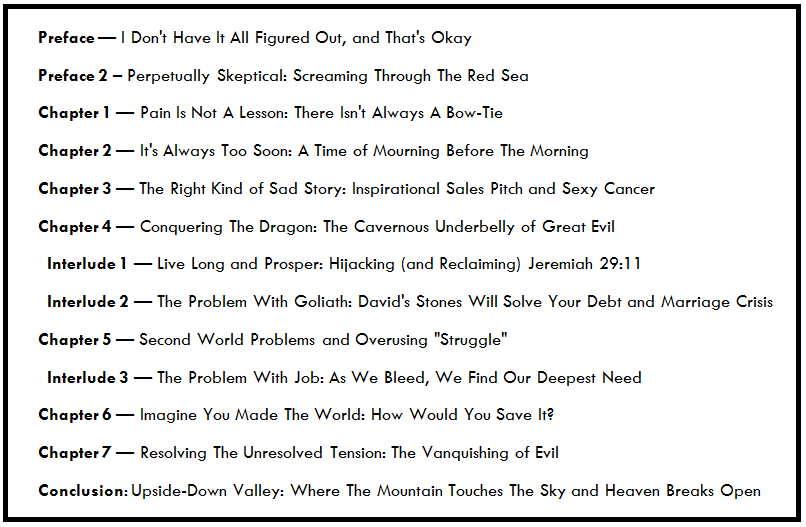
Table of Contents for “Mad About God”


This is the Table of Contents for my book on trials and suffering, called Mad About God.

The book also talks about True Detective, Louis C.K., the Serial podcast, the pressure to be “radical” and do “great things for God,” the romanticism of third world missionaries, overly inspirational Instagrams, The Shawshank Redemption, the misquoting of Jeremiah 29:11 and David & Goliath.

It’s now in both paperback and ebook. Be blessed and love y’all!

— J.S.


Breaking Codependency and Unhealthy Attachments

Anonymous asked a question:

How do you fix or work against codependency?

Hey dear friend, I wrestle with the very same thing, and I wish I had an easy answer for you. There are so many different reasons for codependency, and extracting ourselves is a messy process that requires a tough self-examination, sometimes daily. One of my reasons is that I constantly need approval to be certain of my self-worth. I’m hugely insecure for long stretches of time, so I tend to surround myself by people who are overly gushy or positive. When I hear criticism, it totally crushes me.

Other reasons might be that we affix value on ourselves by the number of relationships we have, or we need company to avoid facing our own inner-demons, or we need romantic love to fill the gap of love we never got as children.

There’s no easy fix, but here are two things to consider.

Continue reading “Breaking Codependency and Unhealthy Attachments”

The Cost of Friendship.


Image from Quote Mirror, used with permission


I’ve learned that if someone asks you for advice and you tell them the hard truth and they fight you in response, they weren’t really asking for advice — but self-affirmation to keep doing the wrong thing. That’s asking for less love, not more. And I can’t do that to you. Love means I have to tell you everything, even if my voice trembles and my hands shake and my eyes burn with weeping. Love means I will throw my body in front of you when you’re heading towards the cliff. It will cost my comfort with you. It’s a cost I’m willing to pay.

— J.S.