
Real love doesn’t meet you at your best.
It meets you in your mess.
— J.S.
Art by 1of1doodles

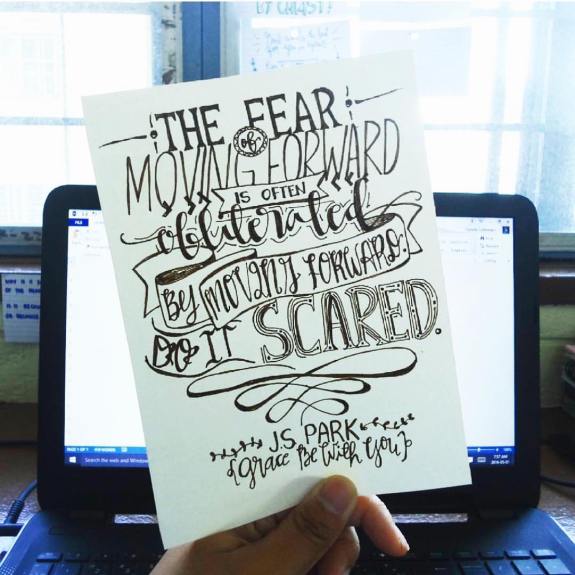
The fear of moving forward is often obliterated by moving forward. Do it scared.
— J.S.
Art by Pam Carbungco

Part of my hospital chaplaincy duties is to write a reflection on how it’s going. Identities are altered for privacy. All the writings are here.
The doctor tells him in one long breath, “Your wife didn’t make it, she’s dead.”
Just like that. Irrevocable, irreversible change. I’ve seen this so many times now, the air suddenly pulled out of the room, a drawstring closed shut around the stomach, doubling over, the floor opened up and the house caving in.
“Can I … can I see her?” he asks the doctor.
The doctor points at me and tells Michael that I can take him back. The doctor leaves, and Michael says, “I can’t yet. Can you wait, chaplain?” I nod, and after some silence, I ask him, “What was your wife like?” and Michael talks for forty-five minutes, starting from their first date, down to the very second that his wife’s eyes went blank and she began seizing and ended up here.
I’m in another room, with a father of two, Felipe, whose wife Melinda is dying of cancer. She’s in her thirties. She fought for three months but that was all the fight in her; she might have a few more days. Felipe is asking if his wife can travel, so she can die with her family in Guatemala. The kids are too young to fully comprehend, but they know something is wrong, and they blink slowly at their mother, who is all lines across greenish skin, clutching a rosary and begging God to see her parents one more time.
“Can I see them?” she asks the doctor.
Another room, with a man named Sam who has just lost his wife and kids in a car accident. Drunk driver, at a stop sign, in the middle of the day. Sam was at home cooking; his wife was picking up their two daughters from school; the car had flipped over twice. The drunk driver is dead; Sam doesn’t even have the option to be angry. Sam was hospitalized because when he heard the news, he instantly had a heart attack. He keeps weeping, panicked breaths, asking to hold my hand because he doesn’t know how he can live through this. He hasn’t seen the bodies of his wife and daughters yet.
“Can I see them?” he asks me.

I think “crushing” on someone is a natural thing, and in the right place and the right time, it can lead to something great. Most of the time it’ll pass, as it’s meant to, and we can look back and laugh at the ridiculous amount of time spent mentally replaying the one failed conversation that we still twitch about in the shower. Crushes happen, and they almost never equate to a magical romance materializing out of thin air.
But the darker problem with “crushing” is that it occasionally turns a real live person into a trophy, a sort of non-independent rubber statue imprisoned on a pedestal, and if you ever finally reached it, you’d either squeeze it too hard or please it too much. In both cases, both people lose.
Relationships are hard work, and absolutely require more than the initial illusion of fleeting chemicals in our easily tricked brains. That rush of first feelings is overwhelming, but it doesn’t mean a whole lot in the grander scheme: and we could save ourselves a lot of trouble if we took up Taylor Swift to “count to ten, take it in, this is life before you know who you’re gonna be.“
Here are five types of romanticized crushes that require a heavy dose of self-awareness. I apologize in advance for the snark: I’m only so impassioned here because I’ve seen how badly it can get out of control.
1) Hate Crush (aka Freudian Defense Mechanism)
What it looks like: You like someone, but you hate that you like them, so there’s a lot of passive-aggressive, mean-spirited, hyper-critical gas-lighting aimed their way. This looks cute in movies, but is often awful and humiliating to an actual human being with, you know, their own thoughts and dreams.
Problems: This can be irreversibly destructive if you drag someone long enough through your daily catharsis. I understand the psychology behind this—we resent what we can’t have or we just hate it when we feel so vulnerable with someone—but displacing anger out of confusion when you can’t “have someone” is a really dark, desperate issue that might require real help, immediately.
Continue reading “5 Kinds of Romanticized Crushes That Will Mess You Up”

I get a little nervous when a preacher only preaches his hero-stories, when he seems to be his own marketing guy saying, “This is what Jesus does, and if you do what I’m doing, you’ll make it.”
But I always lean in when the pastor tells me about his failures. When he’s really for real. That time he blew up on someone in traffic. When he lost it with his family. When he quietly refused to help a homeless guy. His sudden shopping spree. Those seasons when he stopped praying and reading the Bible because he was so jaded and burnt out. His frustrations with the church culture, not in a sneering way that points out any one person, but really grieving over our collective lack of passion. The times when he doubted himself, when he doubted God.
It doesn’t mean we imitate all of the above, and pastors are held to a high bar for a reason: but I don’t want the act. I’d love it for a pastor to rip the mic and tell us how much he’s hurting right now and how much he still trusts Jesus to get him through all this and even tell us he’s barely holding on by a thread of his beat-up faith. Hero-stories are okay, but I want to know we’re in this uphill fight together.
Then the pastor isn’t some guy “up there” as if we’re “down here,” and it makes us a little more human too, and this points to our need for Jesus and for grace. The pulpit becomes a haven instead of a tower, a manger instead of a throne. I want to meet there inside our mess-ups, where Jesus is, the real hero of this story. With Him, we’ll make it down here.
— J.S.
“My assumption is that the story of any one of us is in some measure the story of us all.”
— Frederick Buechner

I’ve learned that the quickest thing that kills friendships is jealousy. Sometimes it’s a slow death; jealous people can act loving for a lifetime, but they waste their lives comparing to each other instead of helping each other out.
Jealousy can cut short the empowering work of friendship and all the joy and vision it brings forth.
I have two choices: I’m either your cheerleader or the loop of condemnation in your head. And I know which one I prefer to be around.
I just hate what jealousy does to people. The worst, most cutting words come from envy. Families, churches, and businesses rot from the inside. It causes even the nicest people to horde their own talents and hold others back, and they’d rather snuff out the torch then pass it on to a new generation. It turns us into small, shrewish versions of ourselves.
I’ve lost friends this way, and you can’t really call someone out on jealousy. It feels arrogant, and no one would confirm such a dirty accusation. No one confesses it, either. In my years of ministry, I’ve never heard someone tell me, “I’m just a jealous, insecure hater.” Have you ever said that in the mirror? Me, neither. You’ll hear about murder and drugs in the confession booth before envy. It blinds us into denial.
I’ve seen a lot of good friends get blown up when envy got a foothold. One friend would get successful in their field while the other stayed unseen, and the unseen friend starts to feel like their famous friend owes them. There’s a lot of fist-shaking at God and self-directed anger. It’s nasty stuff.
Preparation is half the battle. If you can name the demon, you have a better chance of beating it. Fighting sin means expecting the monster, and then tackling it in the doorway. It means laying down the worldly weapon to pick up a weapon of grace.
Continue reading “Breaking Through Jealousy: Passing the Fire to the One Ahead”

There’s a ton of Christianese literature out there, and some of it’s bad, bad, bad advice.
In my best movie trailer voice: In a world of Christian bestsellers, blogs, podcasts, and instagrams with Bible verses on ocean wallpaper, who are all coincidentally on an “authentic relevant struggling faith journey,” one ESV-carrying Christian millennial rises above the handlettering and “I’m not like those Pharisees” YouTube channels to authentically struggle with discerning what’s theologically sound and really works in the mess of real life.
But seriously: witty snark and pretty prose in bite-sized blog posts (like this one) don’t ever mean credibility. We really do need to know what “works in the mess of real life.” And it’s not going to be stitched-up quotes and here’s-what-I-would-do sort of fluff that sounds ideal but doesn’t work down here in the dirt.
I don’t claim to know any better on this. In fact, please don’t trust me, because I will let you down and inevitably disappoint you. Bloggers are not your counselors, no matter how flowery and fluffy their words. And your favorite “Christian celebrity” with the million followers might not be as inspirational as his tweets and t-shirts in his Etsy store.
Christians are called to discern everything we read, especially from sources that claim they’re fellow Christians. Here are a few questions to consider when we run into any kind of advice.
1) Where is it coming from? Says who?
It’s easy to start a blog and start preaching way further than our lives have actually lived. So much of Christian advice is idealistic guess-work that hasn’t been field-tested or approved by experience, much less cited or researched. In fact, a lot of it’s packaged to get hits and go viral, instead of actually caring about the real person it claims to help.
This will sound mean, but a lot of the shrill imperatives we see in blogs and books are from well-intentioned, untested upstarts who vicariously uphold an image that isn’t really them, either to compensate for their own shortcomings or to grab those precious followers. I only know this because I started that way, and I regress easily. Social media, for all its benefits, has made pedestal preachers of us all. I’d much rather someone tell me how it really is, with candid humble honesty, instead of how it “should be,” and to learn from their mistakes rather than get imprisoned by an impossible parameter—a paremeter, by the way, which is hardly practiced by the ones preaching it.
A suggestion: Check their bio. This isn’t to judge them or to assign value, but to see what they’ve actually been through. This also doesn’t mean that “youth” can’t say wise things, or that only experienced elders have knowledge. But rather, it’s to ask: What makes this person credible in this particular subject? What have they seen and who have they been around? How have their experiences informed their faith? And certainly there are those who have hardly been through much but can still write wonderful things, beyond their years, and it’s worth celebrating the exceptionally rare gift of youthful wisdom.
2) Is it reactionary?
I love snark and sass, but some advice is just a childish temper tantrum that caters to pseudo-outrage and preaches to a choir in an ivory tower. I call it Popular Discontent: find something wrong, multiply the fear and anger, call out some names, and you’re instantly viral. Also include, “I’m not like them, we’re like us, I’m protecting you, and everything is terrible and evil and I miss the good old days and these young people don’t even know.” Hashtag: Get off my lawn.
Another thing is that contrary to the cool postmodern professor, Christianity always challenges you to think for yourself. Discernment also means investigating every voice and giving it a fair hearing, no matter how dissenting, unpopular, or critical. But a church steeped in reactionary backlash tends to say, “My way is better than theirs and it’s the only way,” which becomes an echo-chamber cult of self-congratulatory chest-bumps.
A suggestion: This one’s tricky, because we do need to call out things that are obviously harmful, and I definitely sympathize with people who have been extremely hurt and must react as loudly as possible. The problem is building an entire platform on what you’re against instead of what you’re for. We go too far the other way, and it’s not hard to find something wrong with everything. Cynicism is easy mode. And everyone can tell when someone is secretly barking at a bone to pick or beating a dead hobby-horse. It’s a constant “throwing them under-the-bus.” I have to catch myself on that all the time (and I’m trying my darn hardest to balance that here). If the tone is passive-aggressive instead of pro-active, I let myself out. It’s a balancing act to be fair and firm, which leads us to—
Continue reading “5 Ways to Diligently Discern All the Good and Bad “Christian Advice””

The patient really believed her cancer was somehow “God’s amazing plan for my life.” She went on to say the things I always hear: “He won’t give me more than I can handle. Thank God we caught it early. God is going to use this for my good.”
I get why we say these things, because we’re such creatures of story that we rush for coherence. But even when such theology is true, I want to tell her that it’s okay to say this whole ordeal is terrible and that it really hurts and that we live in a disordered, chaotic, fractured, fallen world where the current of sin devours everything, that bad things happen to model citizens, that nothing is as it’s meant to be, and the people who don’t catch the cancer early aren’t well enough to thank God for anything, and that not every pain is meant to be a spiritualized, connect-the-dots lesson as if God is some cruel teacher waiting for us to “get it.”
Pain doesn’t always have to be dressed up as a blessing in disguise. God hears our frustration about injustice and illness: for He is just as mad at suffering as we are. He doesn’t rush our grief. He bled with us, too, in absolute solidarity, and broke what breaks us in a tomb. He is the friend who meets us in our pain, yet strong enough to lead us through. I can only hope, in some small measure, to do the same.
— J.S.

Hello dear friends! This is a message I preached called, From Mountain High to Valley Low: Finding an Oasis in the Darkest Desert, on the story of Elijah from 1 Kings 18-19.
It’s about finding our way through discouragement, distress, and depression, and how God speaks to us in those seasons and how we speak to one another. As a lifelong sufferer of depression, this is hugely personal for me. Stream below or download directly here. I’m also on iTunes here.
Some things I talk about are: The sudden mental replay in the shower and the late-night regret twitch, the one common denial from every patient in the hospital, when you just need a hamburger and a really long nap, the hidden fear of men getting honest, the panic moment when someone sees your text messages and photos, how Yoda finally got through to Luke Skywalker, and Elijah versus depression versus the world.
All messages are here. Be immensely blessed and love y’all!
— J.S.

The heart of God will never change no matter what you do,
and it’s His unchanging heart that changes you.
— J.S.
“The worldly man treats certain people kindly because he ‘likes’ them: the Christian, trying to treat every one kindly, finds him liking more and more people as he goes on — including people he could not even have imagined himself liking at the beginning.”
— C.S. Lewis
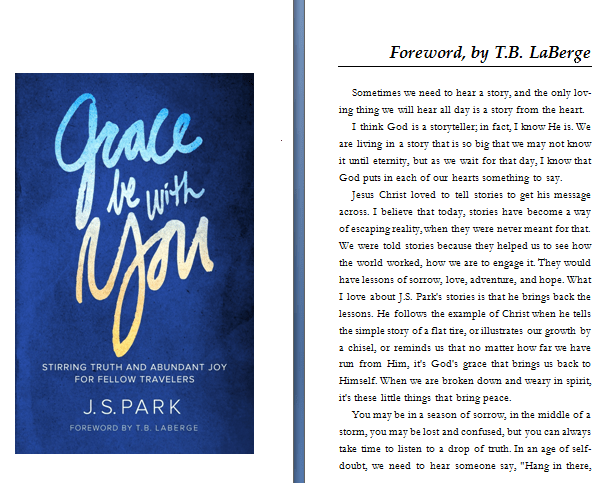
My very good friend and blogger T.B. LaBerge wrote the Foreword to my newest book, Grace Be With You.
The book is a collection of short stories, poems, and thoughts, many of which you’ve seen here on this blog.
It’s available now in paperback and ebook!
http://www.amazon.com/Grace-Be-With-You-paperback/dp/069269031X/
http://www.amazon.com/Grace-Be-With-You-ebook/dp/B01E4XXCVM

Hey dear friends! This is my newest book, Grace Be With You: Stirring Truth and Abundant Joy for Fellow Travelers. It’s a collection of stories, quotes, and poems, most of which have gone “viral” on this blog, with all new content. The Foreword is also by my wonderful friend T.B. LaBerge.
The book has four chapters, each a unique theme: to encourage, convict, engage, and transcend. Contained are quick quotes, humbling plot twists, and everyday encounters on the road, at the hospital, at cafes and gas stations and funerals and churches.
The paperback is only 8.99 here and the ebook is only 3.99 here and it works on every device. If you’re blessed by the book, please consider leaving a review on Amazon.
Be immensely rocked by His grace!
— J.S.
Paperback: http://www.amazon.com/Grace-Be-With-You-paperback/dp/069269031X
Ebook: http://www.amazon.com/Grace-Be-With-You-ebook/dp/B01E4XXCVM

horizontescuriosos asked:
I came across one interpretation of Genesis that I thought might be insightful to ask someone about. The idea I found is that Genesis is really an allegory about human sin … Like before sin, Adam and Eve were naked and unashamed. Then Eve tried to sneak eating the apple, sin entered, and from then on Adam and Eve wore clothes out of shame … As a pastor, do you think this idea of Genesis being an allegory for human sin has credit? (Edited for length)
Hey dear friend, I’ve definitely seen Genesis (and much of the Bible) interpreted as allegory, and it’s a legitimate way of reading the Bible, called the Alexandrian method, that’s been around for centuries.
However, I personally view most of the Bible as literal, factual history — or at the very least, I assume that the Bible authors had an original intention that wasn’t meant to be stretched towards a “spiritualized” meaning that says whatever we fancy.
Scripture doesn’t read as an allegorical account, but more like a news periodical. There are parts of Scripture that are definitely allegory, but it’s usually obvious, with the author even saying so.
Ancient accounts of legend only revealed details that were much like Chekov’s gun, which were set-ups for a moral lesson. From the Epic of Gilgamesh to Beowulf to The Odyssey, no detail was wasted. But Scripture would describe things that had no other purpose but to describe them. Jonah talks about buying an actual ticket to board a ship. Peter and his fellow fisherman caught 153 fish, which has no other meaning, except that they caught 153 fish. When Jesus is arrested, a naked guy totally flees the scene. Mythological stories never read this way. Most of Scripture has a prosaic, open-ended description that was not a type of genre for myths back then, but for eyewitness testimony.
While the Alexandrian method certainly has merit, here’s one huge advantage of the literal interpretation of Scripture.
Continue reading “Bible Showdown: Literal Vs. Allegorical Interpretation”

shatterrealm asked a question:
When Internet strangers rally together to assure a suicidal person that they are loved and precious, are we really helping? Or are we making things worse by arguing with their depression? Should we simply be referring them to professionals?
Hey dear friend, this is an excellent question that I can’t possibly hope to adequately cover, but I’ll offer a few thoughts on this to consider.
– On one hand, if you can save a life with words, do it. I think it’s absolutely a good idea to press in when someone expresses depression, anywhere, every time, all the time. It might really pull back someone from the edge, even for one more day.
I can’t really stop to evaluate the whole thing on whether it’s real or not, or if it’s really helping. That’s not for me to decide right then. If someone is drowning in a river headed towards a waterfall, I don’t ever want to think, “Am I enabling this person to not learn to swim?” I can think about that later. At this very second, I have to throw a lifeline, or I’ll jump in there myself.
– On the other hand, I’m less sure about how this will work for the long-term. It’s the old dilemma: “Give a person a fish for a day or teach them how to fish for life.”
In the short-term, rallying together online can certainly be helpful for a person who cries-for-help. I’ll be the first one there. But at some point, the online world becomes very limited in truly helping a depressed person. It doesn’t go deep enough, and in some cases, can actually be more harmful.
Continue reading “Does Social Media Really Help a Cry-for-Help?”

One of the reasons I’m so intensely insecure and self-conscious is because everyone keeps talking about “be yourself” — but the moment you open up, you’re only accepted when “being yourself” is a certain type of self. It’s really romantic that we push a magical version of vulnerable and unique, but the actual opening up part is dang hard and uncomfortable and requires a kind of love that most people won’t muster, since they’ve never really had to. It ain’t like Hollywood, ever.
If you find the sort of friend who truly loves you, I mean the weird obnoxious squeaky sweaty you, however imperfectly, keep them close and forgive them for when they do not understand. Friendship will take more than once and more than the pretty picture in our heads.
— J.S.

wherethecherryblossomsdance asked a question:
What can we do when we read evidence against faith and our faith wavers horribly? I know this is my case some days, and there are some arguments that my non believing friends bring up, along with comments in these posts that really shake my faith and I realize that I don’t know or have all the answers. What do you think about this?
Hey dear friend, to be truthful, I think it’s a good thing to have your faith shaken sometimes. I mean really, really beat up. Many of us are scared of being scared, but that’s part of life. We can’t protect ourselves from all the terrifying questions. If we avoid every scraped knee, we’ll eventually be too weak when the harder things happen—and so we need a faith that has questioned itself to its barest bones.
Every psych class will tell you that when your worldview is challenged, you’ll experience an actual physiological disorientation in the brain. It can cause nausea, depression, anxiety, and hostile anger. But if you know this is coming and you can work past the emotions, you can rationally approach both sides of the argument without it threatening you.
Continue reading “The Fearful Moment When Your Faith Is Utterly Shaken”

Hello wonderful friends! This is a message I preached called Holiness, Humility, and How to Give Your Life Away.
It’s about how the holiness of God irrevocably changes us in two ground-shaking ways. Stream below or download here.
Some of the things I talk about are: The two things I hear at every deathbed in the hospital, my body’s crazy involuntary response when I flew over the Grand Canyon, every instance of the Bible characters seeing God and falling over crying, the unseen thankless art of raising children, how to live generously with zero guarantees, and a letter from Belize.
My podcasts are on iTunes here (leave a review if you wish!).
Be immensely blessed, dear friends!
— J.S.

Why doesn’t Nathan simply rebuke David on the spot? Why the long story and the strategic side-tackle?
It’s because before confronting ourselves, we need to undo our self-righteousness.
We each have a nearly impenetrable fortress of resistance when we’re called out on our wrongs. It keeps us blind to our blindness.
The way that God punches through David’s self-deception is one of the most lauded turns of literary brilliance in written history. Nathan doesn’t simply accuse David. Nathan peels back David’s self-righteousness by turning his rules against him. David is knocked over by the weight of his own standards. The very mechanism by which David has condemned the guilty to cover his guilt is turned on himself. His excuses have become his own liability, like a sword with a blade on both ends. It’s what Jesus meant when he said, “For in the same way you judge others, you will be judged, and with the measure you use, it will be measured to you.”
David required a brutally honest confrontation, but it would take more than a lesson in theology or a list of sins. No one changes that way.
God rebukes David by first removing any possibility of an excuse or objection.
God revokes David’s self-righteous capacity to absolve his own sin.
David needed to confront himself, before the sight of God, without the slimmest avenue of escape or deflection.
If you want any hope of change, freedom, progress, recovery, and growth: you’ll need to confront yourself, too. It’ll be the most painful thing you’ve ever done, because we’re so used to protecting our fragile, brittle egos. But it’s more painful to stay stuck in the lie.
If you’ve ever tried to confront your friend about their thing, you were amazed at their automatic defenses and sudden snarling. I’m sometimes surprised by my own excuses, too. When I’m guilty, I attack. It’s the perfect way to get out of accountability. When someone does something wrong, it’s all their fault, but when I do something wrong, it’s my environment or my family or my stress. When we get caught red-handed, we go into a monologue of rehearsed responses that we almost really believe, because it took so many steps of rationalizations to get there.
When you want to escape by saying, “Well-what-about-them?” — God will twist you around to say, “Well-what-about-me?” The only thing that will destroy hypocrisy is humility. Part of humility is to quit holding up a mirror at others and to use it on myself first.
For the first time in a long time, David is being honest with himself before God. He lets the truth undress him. There’s no place for him to run. His own judgment has betrayed him, and this is how God will work on us, too. He will dislocate your blame, one excuse at a time, until you really take a look at yourself and see you as you really are.
— J.S. Park | The Life of King David
 J.S. Park: Hospital Chaplain