A Faith Crisis: When My Theology Is Shaken by Science, Debates, and Headlines

Anonymous asked a question:

So I’m taking an honors world history class taught by an atheist teacher and we’re learning about evolution and it’s really really testing my faith. Honestly I don’t know what’s true right now. My theology isn’t the greatest because I’ve only accepted Christ for two years now. I’m just now finding it hard to believe in the Bible and God right now.

Hey dear friend, thank you for sharing this with such honesty.

The truth is, every single type of belief system will eventually get shaken somewhere. When this happens, we can 1) investigate deeper into what we really believe, and 2) incorporate the new information into our beliefs somehow.

We each experience a kind of cognitive dissonance when our worldview is shaken. It can actually make you disoriented, nauseous, and depressed. Sometimes it’s from learning more about the world, or it’s from a terribly brutal tragedy, or it can be a very persuasive argument that uses flowery language. And these experiences will inform our theology and philosophy, and vice versa. But none of this has to be a threatening, stomach-punching trauma.

While we’re certainly going to feel what we feel, we can still explore this new information in light of what we currently know, and then navigate a way through it. It’ll be tough, and you may be scared or surprised by your conclusions, but it can actually make you a more thoughtful, whole person, too.

Continue reading “A Faith Crisis: When My Theology Is Shaken by Science, Debates, and Headlines”

I Don’t Feel Bad for the Bad Guy


[An angry post.]

You know, I’ve dealt with abusive, manipulative people nearly my entire life—and more and more, people want to show “empathy” for the abuser instead of the abused, and we’re too quick to explain away how much suffering that the abuser has actually caused.

One thing the movies get wrong is that they give the abuser some “depth” and “layers” and “multi-dimensionality.” Terrible villains are given backstories to justify their behavior and make them seem like “underdogs” who got dealt a bad hand. While this idea has some merit and it makes good movies, it also creates a harmful narrative where abusive people have a supposedly good reason to be abusive, or external factors are to blame, or you should feel really bad for them.

This completely leaves behind the abused person.

It’s as if abusive behavior can only be redeemed after the abuser sees how much suffering they’ve caused, and if that’s the cost to redeem an abuser, it’s too high of a price. Remorse shouldn’t be born at the expense of trauma.

I can see why the media would “feel bad” for a disgusting rapist and his future, because we’ve become trained in glorifying and empathizing with the bad guy. We offer way too much benefit-of-the-doubt. And yes, some people are just terrible. Not everyone has depth and layers and sad backstories. No, they’re not irredeemable, but we underestimate the detestable capacity for evil and we over-promote self-esteem (perhaps because we then must admit we’re also each capable of the same evil). We use words like “empathy” without also considering boundaries, safety, and trust. Good people get used up because they are fearfully obligated to a morally heightened, hyper-dramatic view of “love,” when it’s really just enabling. And some of us selfishly appear to have empathy to be awarded as outstanding citizens, when there’s neither an ounce of compassion for the abuser nor the abused.

In all this, we force the victim to take the “higher ground.” We trivialize and simplify the victim’s role to be the “bigger person” all the time.

But if we only place the impetus on the victim to forgive, to rise up, to heal, and to reconcile, then we’re not any better than the abuser. Doesn’t the victim have to be redeemed, too, from the pain that was caused? The abuser can certainly feel remorse, but are we going to ignore the remorse that the victim feels from both their pain and “blame”? The abuser can feel bad, but are we going to ignore how awful the victim feels from the actual wound?

It seems unfair to appeal to both sides when nothing about abuse is equal, and it must be on the abuser to pay for their crimes, to make reparations, and to be restricted unless they can prove otherwise that they can be trusted again.

I always want to hear “both sides of the story,” but in cases of obvious abuse, I’m not forfeiting justice out of some misguided sense of courtesy. Justice was already forfeited by the abuse. I must stand staunchly and stubbornly with the victim, and to do that, I must sit with them first, in their pain, not at my tempo but theirs, and to look evil in the eye with courage, unflinching at excuses and rationalizations, and to offer grace when it is no longer foolish, by the plumb line of wisdom and trust.
J.S.

Better Than You Think.


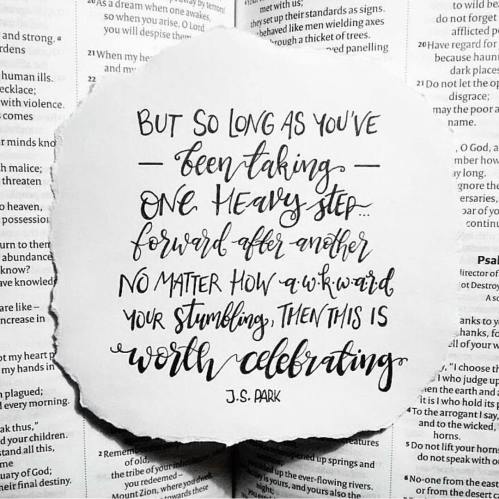
You’re doing better than you think. You’re in the middle of your motion, so it’s hard to see where you are. But so long as you’ve been taking one heavy step forward after another, no matter how awkward your stumbling, then this is worth celebrating. Every moment you’ve done right is a miracle in itself.
J.S.


Art by here_as_in_heaven

Can God Really Fill My Loneliness?

Anonymous asked a question:

As a christian how can we be intimate with God so that he fills the void of companionship?

Hey dear friend, I’m afraid that this might be a false dichotomy. In other words, intimacy with God and companionship with people are not two separate things. Jesus told us the Greatest Commandment is (paraphrased a bit), “Love God with heart, soul, mind, and strength … and love your neighbor as yourself.”

To quote Timothy Keller:

Adam was not lonely because he was imperfect. Adam was lonely because he was perfect. Adam was lonely because he was like God, and therefore, since he was like God, he had to have someone to love, someone to work with, someone to talk to, someone to share with.

All of our other problems—our anger, our anxiety, our fear, our cowardice—arise out of sin and our imperfections. Loneliness is the one problem you have because you’re made in the image of God.

Loneliness is not a sin, but points to a very real need that we’ve had since the very beginning. Certainly, if our loneliness leads us to idolize others or people-please or squeeze unhealthy expectations, then we will be crushed. On the other hand, if we only “rely on God” in a sort of monk-like asceticism, then we will either grow resentful of “these worldly people” or we will never participate in the stream of God’s loving activity, which involves people.

Continue reading “Can God Really Fill My Loneliness?”

I Believe It Is Enough.


I believe it is enough to know that God loves you.

Right where you are.

Before you got there.

And after you leave.

The simple truth: I am loved, no matter what, and that’s enough.

Jesus tells us that the itchy, pervasive, persistent gap of “never-enough” is probably true, because we’ll never be enough on our own.

But I believe He’s enough for me, so I don’t have to be.

I believe, yet again and again, that He loves you. He loves me. That is enough, for another day. It is enough for today.

J.S.


Photo by sonlight972, used with permission.

I Am With You.


I am with you.
I am for you.
I am sorry.
I love you.
I want to help.
J.S.


[Art from Nikolette Montaño]

Theology Showdown: The Narrow Gate Vs. the Broad Road

Anonymous asked a question:

I am a little confused about something and I was hoping you could help. In Matthew, it talks about the narrow path and gate into heaven. How can I, as a Christian perceive that to mean something other than that lots of people walk towards God but very few actually make it. This seems to go against grace? And also the profession of Jesus as a saviour?

Hey dear friend, this is certainly a troubling passage that is very off-putting at first glance: but I’d like to balance this passage with the entirety of Scripture.

Let’s look at the passage in question, Matthew 7:13-14, which says:

13 “Enter through the narrow gate. For wide is the gate and broad is the road that leads to destruction, and many enter through it. 14 But small is the gate and narrow the road that leads to life, and only a few find it.

So it looks like most people alive today will end up in Hell, an eternity under the wrath of God, while only a fraction will make it to Heaven.

But then, let’s look at Matthew 25:13 here, known as the Parable of the Ten Virgins (or Bridesmaids). To summarize, Jesus tells a tale about a wedding where ten bridesmaids are waiting for the bridegroom to begin the ceremony, but only five of the bridesmaids came prepared with extra oil in their lamps to greet him (this sounds like a weird custom back then, but weddings have always had weird customs throughout history, e.g. throwing bouquets or fishing for garters or dancing past a reasonably non-creepy age). So five of the bridesmaids make it, but five don’t. This implies that at least half of the people we know will end up in Heaven.

Lastly, let’s look at Matthew 13:24-30 here, known as the Parable of the Wheat and Tares. To summarize, Jesus tells a tale where a farmer’s field is sabotaged by weeds. The farmer, instead of pulling up the weeds, decides to let the wheat and weeds grow together, and at the time of harvest he will separate them. This implies that most people we know will end up in Heaven.

So which one is true? Is it the story of the Narrow Gate, or the Ten Bridesmaids, or the Wheat and Tares? Do only a few of us make it, or half of us, or most of us?

Continue reading “Theology Showdown: The Narrow Gate Vs. the Broad Road”

A Bridge to You and Me, of Purest Stone


This is the Preface for my book Grace Be With You. The Preface is about the gravitational power of story that connects us. The book is a compilation of my stories, encouraging quotes and poems, and everyday encounters from the road to the hospital to cafes and gas stations. Be blessed, dear friends.

There’s an old Star Trek episode where a particular alien species, the Tamarians, can only communicate in images and allegories. As the helpful android, Lt. Commander Data, puts it:

“Their ability to abstract is highly unusual. They seem to communicate through narrative imagery, a reference to the individuals and places which appear in their mytho-historical accounts.”

This strange constraint plays out to amusing fashion throughout the episode, as each party is frustrated by their miscommunication, and the tension nearly boils over into a knife-fight and all-out war (maybe your idea of amusement is different than mine). By the end, one of the Tamarians sacrifices himself in order to create a heroic narrative that both his people and the Federation can understand. It succeeds; this act of nobility becomes the bridge towards peace. The great Captain Picard realizes, “The Tamarian was willing to risk all of us, just for the hope of communication—connection.”

We’re not much different than the Tamarians. We risk the friction of our jagged edges to connect, not merely by formulas or flowcharts, but by a sloppy crawl through our shared, lived-in journey. We crave a common vocabulary beyond the heavy anvils of prose, crafted from imagination and our unified experiences.

Stories contain power because they seem to unveil secrets that have long been muddled, as if we’re unearthing lost royal treasure. But more than that, stories are a connective tissue, bringing us together by the longing and landing of a resolution.

Since a narrative thrust is essentially driven by an unresolved tension, with unassailable obstacles besetting a goal on every side, we discover in them the depth of our courage and cowardice, and we find out how to be. We find what we’re meant to look like.

We find, perhaps unwillingly, that we are not always the heroes, but in need of rescue: because we’re so often the cause of our own tension. And this is what puts us in the same boat, the same battle. The best stories require first an examination of our limitations, and then a cooperation as equals, through a slow-burning realization that we are not opposed to one another, but can reach the same goals with a little spunk and ingenuity. From Star Wars to The Karate Kid to The Lord of the Rings to Up, from the Epic of Gilgamesh to the Odyssey to a genie in a bottle, these are tales told side-by-side. We find we are fellow travelers, not so different, really, with a universal desire for shalom, a harmony—and we can’t get there alone. Heroes cannot fly solo, and villains are not beyond change.

Stories and symbols have a way of disarming us, too, getting to the inside of the matter with gentle precision. Propositions are a bit like bricks and beams: necessary for the foundation, but soon rigid and inflexible. Narratives and metaphors have a dynamic of growth to them, like seeds pushing through the dirt into the sun, and they give breath. Or maybe, as one theologian said, they are windows that light up the house and give it air. It’s why Nathan the prophet did not approach David with lectures and bullet points—”Three reasons that adultery and murder are bad!”—but instead with the innocent story of a poor man and his ewe lamb, ending on a twist that David could not negotiate. It forced David to rise from the dirt, into light.

Jesus himself spoke in parables with great aplomb, from mustard seeds and millstones to swords and sparrows to wedding feasts and rebel-runaways. Jesus’s disciples often had trouble deciphering his parables, which Jesus seemed to deliberately obscure at times—but ultimately, the parables were pointing to a future work on a cross and in a tomb. His stories pointed to his heart, and his heart sculpted the greatest story of them all: a final sacrifice to bring us peace with God and one another. He spoke of rescuing us, because we could not do that on our own. We were never meant to.

Only Jesus could become our bridge of peace, our shalom. And this kind of love is not merely the royal treasure, but the very purest stone from which all treasures are made.

The following pages are much like rotating the facets of such a jewel, pointing to the pulse of the galaxy-sculptor. These stories and poems and thoughts are chiseled by joy, sorrow, failure—and the great love that has cast a shadow on them all.

My hope is that we meet somewhere between the words, to connect, because I believe this is the truest stuff of life. Stories help us to mesh in this tapestry, that in our overlap, we’d find strength hand in hand. I’m excited. I’ll see you there.

J.S. Park // Grace Be With You


Photo at top by sonlight972, used with permission.
Scared of Love and Scared of God: What Do I Do?

Anonymous asked a question:

What do I do if I’m scared of love, especially from God?

Dear friend, I would say that you’re probably describing the entire human condition and the greatest fight of our lives.

One of the hardest battles we will ever face is to truly, fully, absolutely believe we are loved. So you’re definitely not alone in this fear. It’s this very fear that drives us to seek approval in illegitimate ways from sex, money, reputation, corporate greed, racial superiority, and a million other terrible stories throughout history.

The devil dropped two lies in the beginning to trick us, and the second lie was essentially, “Isn’t God holding back?” when Eve wondered if she should get the fruit off the tree (the first lie was, “Did God really say that?” to get us to doubt God’s truth). In other words, Satan got us with, “Does God really love you?” And that’s a lie we’ve been wrestling with ever since.

The fear of love is natural, but I really do hope you’ll find good people who will demonstrate God’s love to you. One of my favorite Bible verses is 1 John 4:12, which says, “No one has ever seen God; but if we love one another, God lives in us and his love is made complete in us.” That means we see the love of God when we experience the love of His people. There’s no shame in finding divine connection through human connection.

Continue reading “Scared of Love and Scared of God: What Do I Do?”

What Are Some Legitimately Good Christian Movies & TV Shows? 15 Quick Recommendations

Anonymous asked a question:

I’m sorry for the rant, I know it’s a common complaint. But there has to be a reason it’s a common complaint. I can’t tag on “Christian” music too much because it boasts a lot of great stuff, but Christian films are really slacking besides like 5. Idk. Do you have any recommendations?

Hey dear friend, I definitely believe that you’re not ranting. I’ve written on the topic of Christian art and its mediocrity before here.

My suspicion is that Christians are expected to “show grace and forgiveness,” so this somehow gets misapplied to Christians creating subpar art. There’s quite a lot of sloppy Christian niche-entertainment that gets away with mediocre production under the label of “Jesus,” when there was a time that Christians were the most celebrated of inventors, composers, artists, and musicians of their time. While I’m all for independent artists paving their way through the industry, I think it’s unfair to slip under a critical radar with the excuse, “It’s Christian, so it’s okay if it’s a little messy.” No, not when it’s unprofessional and pandering.

Saying that art is Christian doesn’t make it Christian, and there’s some “non-Christian” art that points to God more than so-called Christian art ever could.

Continue reading “What Are Some Legitimately Good Christian Movies & TV Shows? 15 Quick Recommendations”

The Church in the Real World.


I get a little bummed out by churches that are only designed for insiders without considering the actualities of the real world, when every sermon and service uses an exclusive buzzword language to measure Christians by getting “wrecked” and “on fire” all the time. Really though, a lot of that talk is an agenda to recruit free volunteers for perpetuating church programs, or it’s passive-aggressive flexing by the pastor to look better than those “other Christians” down the street. That might be church business, but it ain’t God’s business.

People who attend church also have hospital bills and rush hour and work stress and family troubles, and they’re mostly just trying to get through the day without falling apart at the seams. They need a refuge, a safe haven, a sanctuary, a holy ground to encounter glory. They need to know how faith can operate in a fractured, fallen world — and no, not all of them want to be pastors or missionaries or deacons. I don’t think our biggest concerns are false theology and church methodology and “you better have an authentic faith with everything you got.” That’s all important stuff, but Jesus doesn’t make us jump through those hoops to meet him. Only people do that.

Jesus is doing a work that’s bigger than our doctrinal squabbles and our ministry bubbles. He’s come to inaugurate a Kingdom. And he meets us where we are to bring that sort of healing, right in the dirt and grit of our very worst. We need him most between the back door of the church to the front seat of the car, in the real world again, in that uncertain space from Monday to Saturday, when the pressure is on. This is where Jesus does his best work. This is where we get to work, too.

— J.S.


Mythical Messiahs vs. the Real Jesus: 10 Reasons That Jesus Is Unique Among Myths & Legends

Anonymous asked a question:

I don’t know if you’re familiar with Apollonius of Tyana but there are some people arguing that he also had followers, performed miracles and rose from the dead. That’s why they kept saying he’s the ~real~ Jesus. Thoughts?

Hey dear friend, here’s a cool fact:

A ton of people in the first century claimed they were the Messiah. Only one is really remembered today, and that’s a strange historical truth that must be taken seriously for both Christians and those exploring faith.

Here’s the context. The Jewish Israelites in the first century hadn’t heard from God or any of His prophets for about four-hundred years, since the prophet Malachi, who also wrote the last book of the Old Testament. They were waiting on either 1) another prophet, or 2) the prophesied Messiah, the “Suffering Servant,” who would apparently liberate them from the oppression of the Roman Empire.

The Jewish Israelites believed that God hadn’t spoken for centuries because of continuous idolatry and rebellion against God. This mindset incidentally formed a group called the Pharisees, who devised over 600 laws to follow, so that such perfection would honor God and possibly hasten the Messiah’s appearance. The Pharisees were so strict that any person who claimed to be the Messiah was almost immediately shut down, because worshiping any god outside the true God was only more idolatry, which had put them in this position of God-silence in the first place. So even though we dismiss the Pharisees today, I can definitely understand their mentality back then and how fast they were to condemn Jesus.

Many new Messiahs did appear. Two of them are mentioned in Acts 5 by a Pharisee named Gamaliel, who mentions Theudas and Judas the Galilean. History books also talk about Judah the Hammer, who enacted a siege against the Roman Empire but was just as quickly crushed. All of these “Messiahs” acted as warrior-presidents that used military force to throw a coup, like a militia attempting to oust the government. Nothing came of them. And the Pharisees were pretty happy about this, because in their mind, such false Messiahs only kept God at bay.

When Jesus came around, he was different than every other Messiah. Here are at least ten reasons why Jesus was unique compared to the religious leaders of his day, and perhaps among every other religious leader.

Continue reading “Mythical Messiahs vs. the Real Jesus: 10 Reasons That Jesus Is Unique Among Myths & Legends”

I Hate My Life and Myself and I Want to Die: What Do I Do?

Anonymous asked a question:

I find myself begging God for death almost every day. On the days I don’t, I’m numb & I’m just going through the day hating my life. It’s hard not to compare myself to the rest of my peers who are doing great things & I’m just here painfully existing. My 1st degree didn’t get me any jobs in my state, so I’m stuck working a job that doesn’t pay much to help me afford a secondary degree. I know I’m not the only person suffering from the effects of a rigged economy, but how am I to remain positive?

Hey dear friend, I’m very sorry for all that’s happening. I want to tell you that you’re not alone, and that I got a ton of love for you, and I’m certain that everyone here does, too. I’m praying for you right now, even as I write this.

I have to say this too: If you feel like you’re in danger of hurting yourself at all, please go talk with a trusted friend and talk these things out. Please consider getting with a qualified, certified person who can help. I hope and pray that you won’t make any big rash decisions during a downward spiral, and that you’d first talk it over with someone, face-to-face, even if that means forcing yourself to get there and giving your decision-making power to someone else, however long it takes. Just talking about it can be enough sometimes to take another step.

I want to share that I’ve wrestled with depression for as long as I can remember, and I did attempt suicide over ten years ago (half a bottle of pills, I lost 13 lbs. in three days, and was Baker Act’ed into an institution). I get into self-loathing loops of hopelessness all the time, like someone has just yanked my guts through my chest in one fell swoop and I’m crumpled over with completely cold apathy, not caring about a thing. Several years ago, I had a complete breakdown at my workplace from the work environment (in which the boss laughed it off), and a year later, I was fired from that very same job. Co-workers got way ahead of me, which was absolutely fine, but many of the people that I called “friends” deserted me. Life is unfair. It can be cruel. Things don’t always work out.

The reality is, our dreams get crushed, and people will leave or cheat or abuse us, and our perseverance doesn’t always pay off. Prayers can go unanswered for a lifetime. I sit with some hospital patients who don’t want to leave because their life outside is so desperately miserable. Even a perfectly crafted life can come crashing down in a second, when external forces suddenly strip us of all we have built. Most of us are not prepared for how harsh and brutal that life can be, because no one gives the hard talk about what it’s really like.

Continue reading “I Hate My Life and Myself and I Want to Die: What Do I Do?”

How Do You Keep Believing This Jesus Bulls__t?

Anonymous asked a question:

How do you believe when, pardon my french, you’ve been taught that everything about Jesus is bulls__t? I’d love to believe it, I really want to, it’s just hard to when you’ve been taught the opposite. Do I have to unlearn the foundation of my education?

Hey dear friend, to be truthful: you’re in the best place possible, with the single biggest advantage over someone who’s been raised in the church.

You get to be in a place where you’re starting with a hugely skeptical eye towards Christianity, which means that if God starts to lean in on you, you will have already encountered your biggest questions about faith. If only every Christian honestly encountered every doubt and argument and problem with Christian theology, with complete openness and abandon, then we might see how deep Christianity can really go.

Please do not think you have to unlearn anything you’ve learned. I suggest the opposite. Use your education to fairly weigh every piece of evidence you encounter. Keep digging into Christianity down to the bottom, to see that it’s both true and fulfilling, that it’s both intellectually coherent and existentially satisfying.

Continue reading “How Do You Keep Believing This Jesus Bulls__t?”

The Flexibility of Pursuing a New Dream

Anonymous asked a question:

Do you think that it’s okay for me to latch onto my dream of becoming an artist and do everything in my power to reach my goal? I’m worried that that’s not God’s plan for me, but it’s what I love and I really really don’t know what it is that God wants from me. honestly, I’m just a keyboard slamming gremlin that somehow managed to grab hold of a pencil. (also I really love your blog and it’s helped me so much for the past year! thank you for your hard work!)

Hey dear friend, yes (and thank you for your kind words!). I do believe that’s an incredibly wonderful thing, to have a dream and to do all you can to get there.

Here’s the other thing. Sometimes a dream will not look the way you expected it to when you start to get there. Sometimes dreams will change. You may go in a particular direction, but another door opens that’s the perfect fit for you, if only you’d try. Do you have that flexibility? Because when a dream becomes an idol, it creates all kinds of unnecessary pain when we cannot see bigger than an imprisoning “vision” of success.

Continue reading “The Flexibility of Pursuing a New Dream”

I’m Sorry and I Was Wrong.


God help me, I’ve been a coward long enough, carefully curating my words not to make enemies, not to alienate, playing the passive agreeable token minority.

So let’s call it what it is. Racism. Systemic, culturalized, indoctrinated, institutionalized racism.

You say it doesn’t exist, but I’ll show you my scars. You say it isn’t real, but I see my brothers and sisters slain by a lawless authority that lacks sufficient accountability, feeding itself by Orwellian double-talk and distancing rationalizations, covering for each other’s inner-circle by playing the ambiguity-card with Walter-White-monologues, jumping to words like “healing” and “calm down” without acknowledging the injury. No, I have met and trained (yes, trained) and I continue to work with many good upholders of the law: but they remain the best of them because of their submission to the very sanctity of which they uphold.

It’s unsettling to confront the possibility of prejudice in our hearts, but it’s there, and we have to talk about it, uproot it, from the top of every system on down.

I’m reading dozens of thoughtless, cruel, heartless comments that neglect the actual human life that is gone, that invalidate such an atrocity to validate the comfortable status quo. If you find yourself justifying a horrible death without recognizing its grief and horror, then you make yourself and that person less human. I cannot fathom such a startling deficit of compassion and empathy.

God forgive me, I get scared of hate-mail and “unfollows” when the streets are covered in blood. God forgive us, we try to win our little “political points” but neglect the tragedy of what is happening right now, to real families who deserved better.

I’m sorry, I was wrong, and I want to help.
J.S.

Movies That Christians Should Watch: The Shawshank Redemption

andyred

Shawshank Redemption (1994)
Columbia Pictures

Summary:
Andy Dufresne is sent to prison for the murder of his wife and her extramarital lover. He is soon indoctrinated in a savage world of bargaining, machismo, corruption, and despair. But Andy is a silent unassailable force who through intellect and his child-like innocence gains favor with both the guards and the prisoners. He befriends Red, a longtime inmate, who berates hope but believes in Andy, and together they forge a bond that survives the decades.

Starring Tim Robbins, Morgan Freeman, Bob Gunton, William Sadler, Gil Bellows. Directed by Frank Darabont.

Questionable Content:
Graphic violence, quick visuals of a sex scene, language, implied prison rape, a vivid murder, and several suicides.

Why You Should See It:

Adapted from a short story by Stephen King, The Shawshank Redemption is one of the best American films ever made. It did poorly at the box office and wasn’t well received, but picked up steam on VHS and is now a beloved, timeless classic. Only three years ago, it managed to fill 151 hours of basic cable television in a year, tying with Scarface and second to Mrs. Doubtfire, and still paying residuals to its principal actors and crew.

The movie works because we like Andy Dufresne. He’s perfectly imperfect. Some movies manipulate the audience into rooting for the main character by throwing all sorts of contrivances at him (see The Pursuit of Happiness or Patch Adams), but Andy must do his sincere best in a broken system that does not allow for hopeful men like him.

Continue reading “Movies That Christians Should Watch: The Shawshank Redemption”

Is Christianity Just an “Imperialist White Man’s Tool”?

Anonymous asked a question:

How should I respond to people seeing Christianity as a eurocentric tool for imperialism?? I’m sometimes embarrassed that I’m still holding onto Christianity when it seems like it’s only the “popular religion” that it is today because of its adoption by white westerners and the imperialistic conquests, genocides, physical and cultural displacement, etc. caused by efforts to spread it. I don’t know what to think of this haha. Thanks (for a lot of things i don’t have room to explain here haha)!

Hey dear friend, thank you so much for this question — I believe it’s absolutely important to get this one straightened out, quickly and completely.

First please know: I’m responding as an Asian-American Easterner born and raised in the West, who is fully aware and infuriated by the danger of Western imperialism and the cultural gentrification of “manifest destiny.” In other words, I have every reason to be disgusted by Christian/western/imperialist attitudes. My own country’s history (South Korea) also has a terrible past of being oppressed by particular people-groups that have nearly stamped out my heritage.

There’s no doubt that Christianity has been associated with some awfully terrible injustices. The Crusades, witch hunts, slavery, child abuse, and the early church’s indulgences and cycles of corrupted power are just a few of the detestable atrocities that, whether directly or indirectly, were fueled by religious fervor. We must be held accountable for every single infraction.

When a Christian asks me, “How do I defend Christianity’s history?” — I can only say, “Don’t.” Christianity ought to be the most self-critical life philosophy, always asking the simple question: Is this making us better or worse? We must own up to our past, not avoid it, and if anyone challenges us on how Christianity has been harmful, we must give ground to these righteous accusations. Many people are mad (including me), and understandably so, at how Christianity has danced around its mistreatment of others.

Having said that: I believe the idea of the Christian Imperialist, while obviously holding some credence in very specific instances, is largely a tired, exaggerated myth if we look at the whole picture of Christian contribution.

Continue reading “Is Christianity Just an “Imperialist White Man’s Tool”?”

Is It Really a Sin to Worry?

Photo and art by Jodi Sparber

Anonymous asked a question:

My pastor has given two lessons on why worry is a sin and how to stop it. Is it really a sin if worry is somewhat out of your control? I have OCD and anxiety, and worry is at the root of both. Am I simply not trusting God enough? Am I a bad Christian?

Hey dear friend, I got a ton of love you. We’re fellow worriers! That doesn’t make you a bad Christian, just an honest one.

First things first: The Bible is very clear that we don’t need to be afraid or to worry. Every time an angel shows up in Scripture, the angel is always like, “Don’t be afraid!” Which is hilarious, because if an angel tore my roof off and yelled something in Hebrew at me, I would need to steam clean my floors. Twice.

So yes, your pastor is right, in that worry is a sin that will hurt you, especially when it gets carried away and exaggerates your fears into unrealistic over-phobias. It certainly doesn’t “help to worry.” It tries to conform reality to our expectations, but the more we try to bend the results, the more that we ourselves will break.

Yet on the other hand, God knows we’re going to worry. Some of us will worry more than others. Especially in your case, in which you deal with anxiety, and in my case, in which I deal with depression, we’re going to have an uphill battle. God doesn’t work in “ideals” all the time, but works in the actual gray-space of who-we-are. So while it would be very ideal if we never worried and always trusted Him, and that “not worrying” would be the healthiest things for us, it’s just not going to happen.

Continue reading “Is It Really a Sin to Worry?”

Movies That Christians Should Watch: The Truman Show


The Truman Show (1998)
Paramount Pictures

Summary:
Truman Burbank, in one of Jim Carrey’s finest performances, is a nice guy with a nice wife, the nice house, job, and neighbors — but it’s all been staged for Truman. He’s the center of a global reality show in which he’s the only one who doesn’t know. From birth, he’s been raised on an engineered island with hired actors and millions of hidden cameras. If you think I’ve given away the big secret, this is only the start of the movie. Truman’s world slowly unravels when he finds clues that reveal the seams. He knows something is wrong; we find he has probably known it his whole life. He must decide whether to discover his reality or stay content on his perfect island.

Also starring Ed Harris, Laura Linney, Noah Emmerich, and Natascha McElhone. Directed by Peter Weir.

Questionable Content:
Some suggestions of sex, an unethical premise, and a scene of a man nearly dying.

Why You Should See It (Some Spoilers Ahead):

Continue reading “Movies That Christians Should Watch: The Truman Show”