Church: What Are We Doing?


Disclaimer: Angry and disagreeable post to follow.

I’m still not over the American church of 2020 withholding comfort for pandemic anxiety, compassionate wisdom for masks and vaccines, and solidarity with POC—
but instead yelling election fraud and “my freedom.”
The church could’ve ended the pandemic in a summer and cut hate crimes by half.

Every Sunday of 2020, I was overwhelmed and hoped for a word of strength and wisdom. Instead the pulpit told me Black lives didn’t matter, masks were for cowards, and only far right Republicans could be Christians. Then had the gall to say “Don’t get political.”

I would’ve preferred the American evangelical church had said nothing, or at the least, “Let’s respect all sides.” Literally anything else. As someone who works in a hospital and is also a POC, mostly I felt embarrassment. Pastors in 2020 lived outside of reality.

I was told, “Not all pastors, not all churches, leaders, bosses, men”—
But we already know that. I’m grateful for good churches, especially now. But consider even one wounded person is 100% harmed and it matters to them. To say “not all” is to say “not me” which does nothing for those already harmed.
I was told,
“Just trust God.”
But God is all I trusted, especially in this lonely season.
I was told,
“Don’t look to people, look to God.”
But this was a complete cop-out, and I saw where God was looking: to the people.
I was told,
“Stop badmouthing the church.”
But not keeping leaders accountable was literally badmouthing the victims, the church.

I am grateful to the remnant who cared for these wounded. For the healthcare workers, therapists, and clergy over the last twenty-one months who have put compassion over conspiracy. For me, the wound is still too deep. I grieve the vision of what I knew the church could be and hardly was. I grieve knowing maybe this was who many churches really were. I grieve the many leaders I admired who were fooled. I grieve my optimism and complicity.

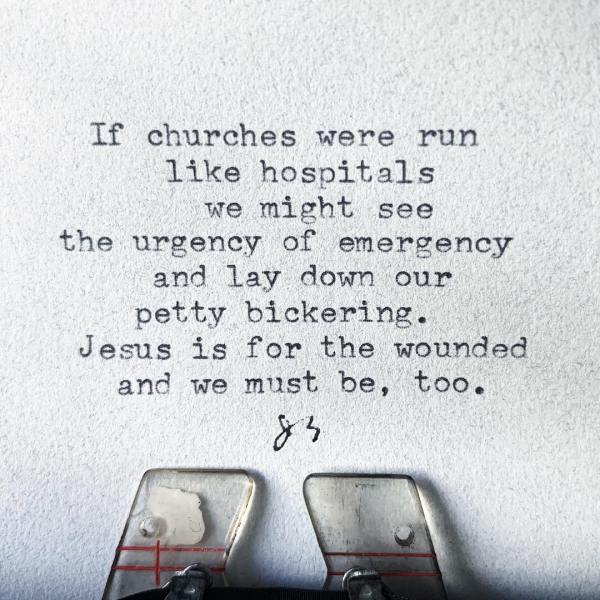
I’ll say it again. If your faith is making you a jerk, throw it out and start over. If Scripture is your guide, it must move us to justice, to be more kind. Otherwise it’s not what Jesus had in mind.

Over and over I heard stories of people wounded in church by abusers, predators, and political opportunists who worshiped a party over people. Pastors fired for not lifting up Trump. Victims who came forward to their pastors and were shut down or further abused. POC who needed hope and were told, “Calm down, God is in control, don’t worry about it, here’s a guest speaker who’s Black.”

I will never understand how Christian leaders are quicker to defend their denominations over the abused. The church isn’t some institutional concept that needs defending. The church is the people who needed our defense, the ones abused by leaders lording the institution.

When far right evangelicals throw insults because I talk about justice, masks, mental health, and fighting misogyny and racism, it is assumed I am “not in God’s Word.” I can assure you: the work of justice is straight outta the Word of God. Not a brag, but I’ve read the thing a lot. Six times now going on seven (not that the number matters; the words are there for anyone to read). Each time spoke differently. But on justice? That has always been the heart of God. Scripture, if anything, is the fuel for talking about these things. About the wounded.

My faith has changed a lot over the years, especially after becoming a chaplain. I am a witness to suffering around the clock. One of the truths that remain: the Bible is precious to me, which is why people are precious to me. Scripture calls me to see fully. And I hate when it’s used to abuse. It is *for* the abused. Even in the worst of my doubt and disappointment, Scripture calls me to compassion. Never less.

— J.S.
Who I Speak For


I need to tell you this story.

When I was a pastor over ten years ago, I preached at a tiny conference and afterwards a young woman approached me. She had tears in her eyes, said she was single and anxious all the time and nearing forty years old and had “accomplished nothing.” I hurt for her.

Then suddenly—
I drew a blank on what to say. My seminary hadn’t prepared me for this. And I was scared for her. How would her church reply? Her pastor? Was this place safe? All I could do was process with her, validate her feelings, remind her of her inherent value, pray with her. Was that enough?

After I had met this young anxious woman, I changed two things.
1) I rewrote the rest of my sermons for the week.
2) I vowed to always think of this woman and others like her every time I spoke or wrote.

I knew up to then, to my own shame, I had never preached for the ones in the back row.

How could I have forgotten? I was once in the back row too. But my eagerness to keep “sound” and sound pretty and to please my professors overshadowed grace.

To this day, if anything I say does not speak to the person in the back row, to someone like me or her, it’s not worth saying. I have to remember where people really live. Hope cannot smother or bypass, but must only gently enter.

If our words only work for the well-off, able-bodied, and undisturbed, then maybe we’re
1) only speaking to popular powerful folks,
2) expecting profit from big pockets, or
3) comfortable outside reality.

I have a litmus test when new theological movements pop up. Will it matter to one of my dying patients and their families? Maybe that’s basic and unfair. But that litmus test has simplified and clarified my faith.

I still make this mistake, but always a reminder to myself: If it doesn’t work in the end, it won’t work at the start. If it doesn’t work for the wounded, it won’t make you whole. If it means a lot of arguing and posturing instead of compassion and action, I’m too tired to care. I don’t. Leave it out of the patient’s room and keep it on your platform.

Jesus is with the wounded and that’s where I want to be. Bottom line, dotted line, and end of the line.

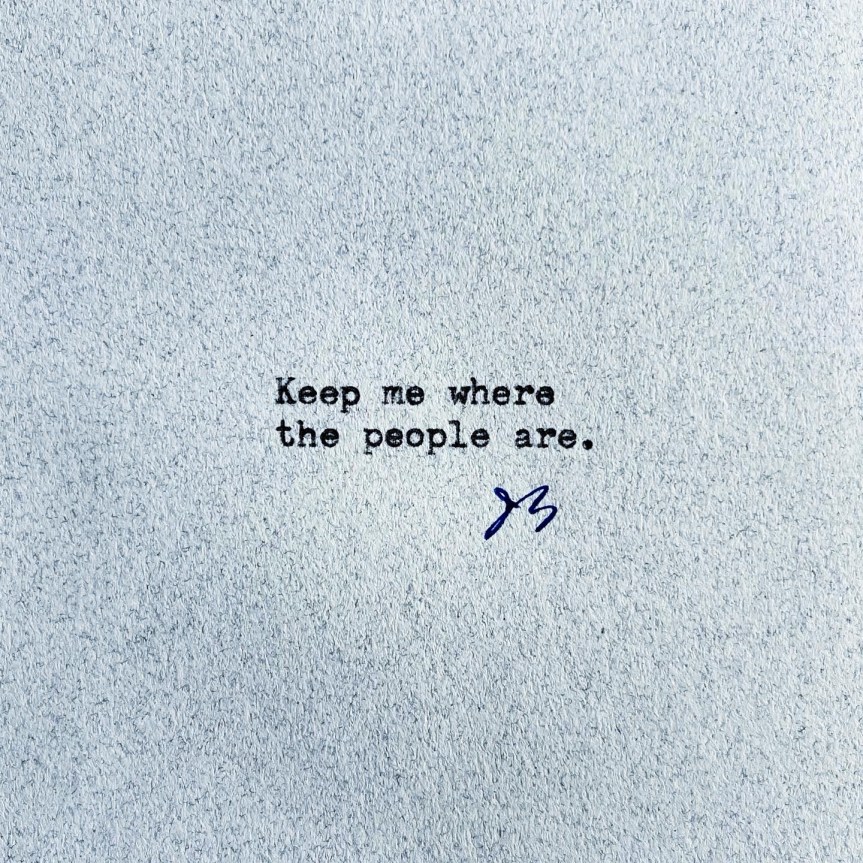
Keep me where the people are.

— J.S.

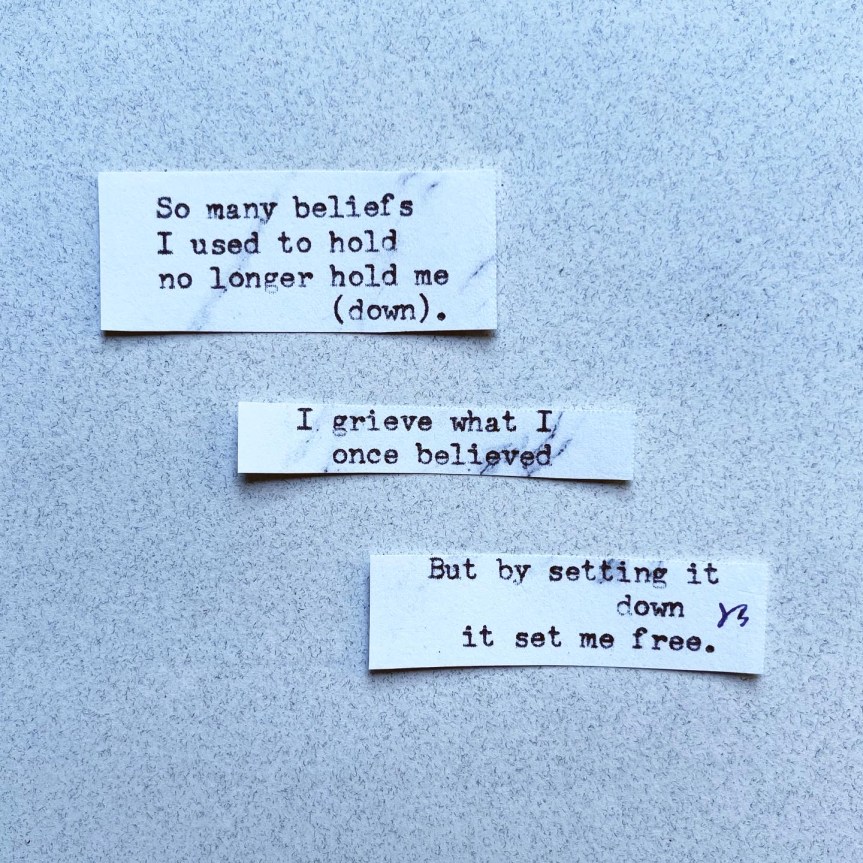
What I Used to Believe


What do you no longer believe?
What are old beliefs you grieve?

I used to believe
all anger was wrong, so I was the captain of the tone police—
until I discovered politeness is not rightness, that anger is not always hate, but hurt, and to be loving is to be fiercely angry at injustice.

I used to believe
forgiveness meant friendship and even a flicker of pain meant I hadn’t forgiven my abusers—
but I found I can forgive from afar, over a lifetime, and that the pain was not my lack of forgiveness but how deep the wound was carved.

I used to believe
that death could bring people together—
until I saw covid take hundreds of thousands of lives and not even their deaths could evoke compassion,
until I saw refugees ceaselessly die in the headlines and too many justified their demise.

I used to believe
that god was American, homophobic, emotionless, and secretly disappointed in me—
until I found God had a vision of grace far greater than our sight, an imagination that far outweighed mine.

I used to believe
my value was found in my usefulness and contribution,
instead of inherently being human,
in an irrevocable Image.

I used to believe
every pain had a purpose, a connect-the-dots lesson, a fire to refine us, a reason to teach us—
until I saw pain is pain, it is not mine to explain, and maybe the only reason it happened was evil and abuse and systems that need to be unmade.

I used to believe
my depression was from a lack of prayer or faith or moral grit or fortitude—
but my mental health only lacked the help I needed and I found that therapy and medicine were not giving up, but giving life.

I used to believe
those who looked like me chose to be silent and passive—
except we were not silent, but silenced, and we had always spoken up despite this.

I used to believe
we could never unravel lopsided power dynamics and racist systems—
until I saw heels in the dirt making moves insistent, for years they had woven new stitches by inches.

I used to believe
everything I believed
was so certain.
I grieve my certainty
but I trust the mystery, to know
there is always more unknown.
Being “right” is to be alone,
but in discovery
we walk each other home.

— J.S.

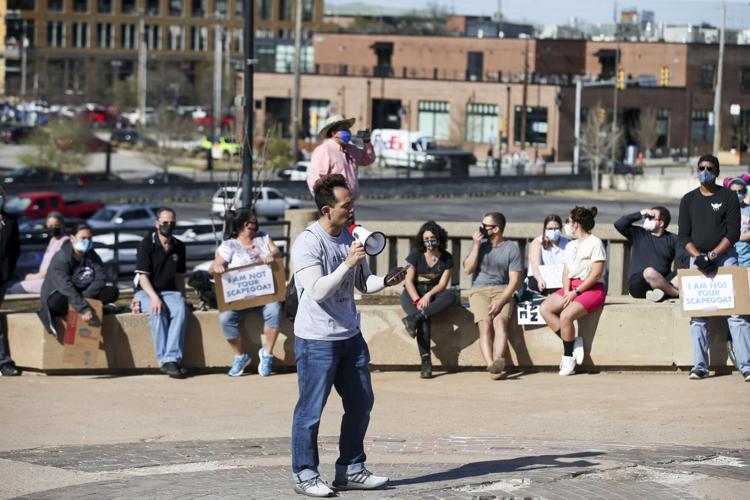
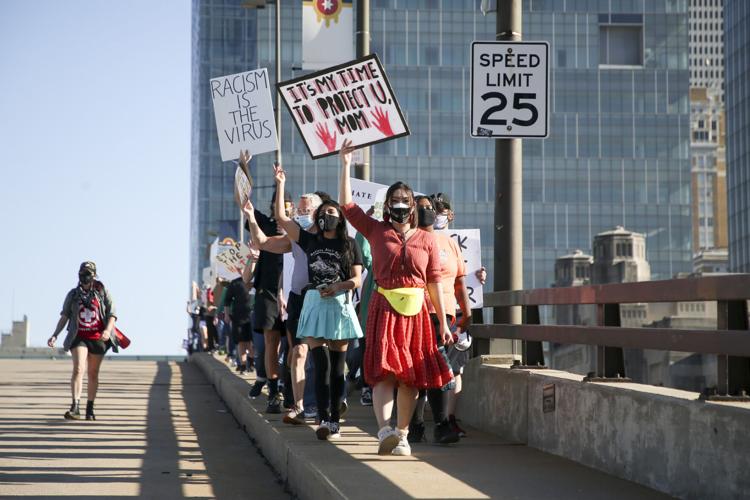
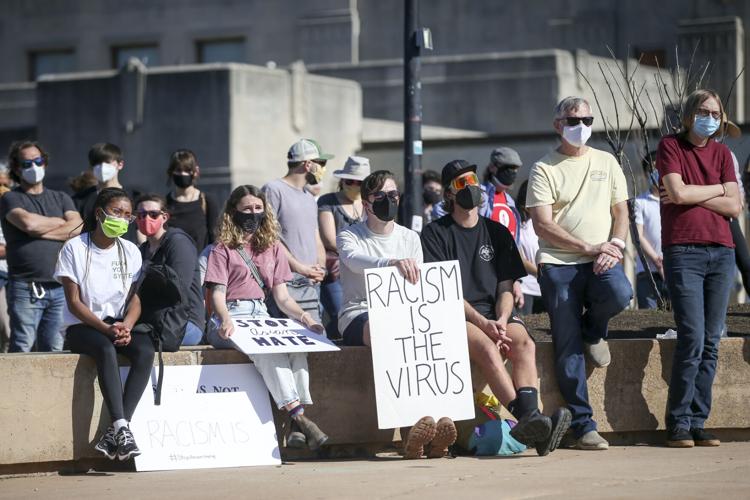
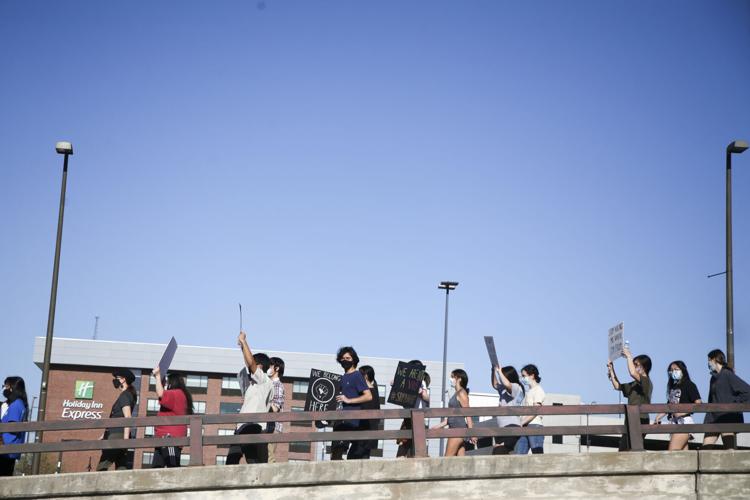
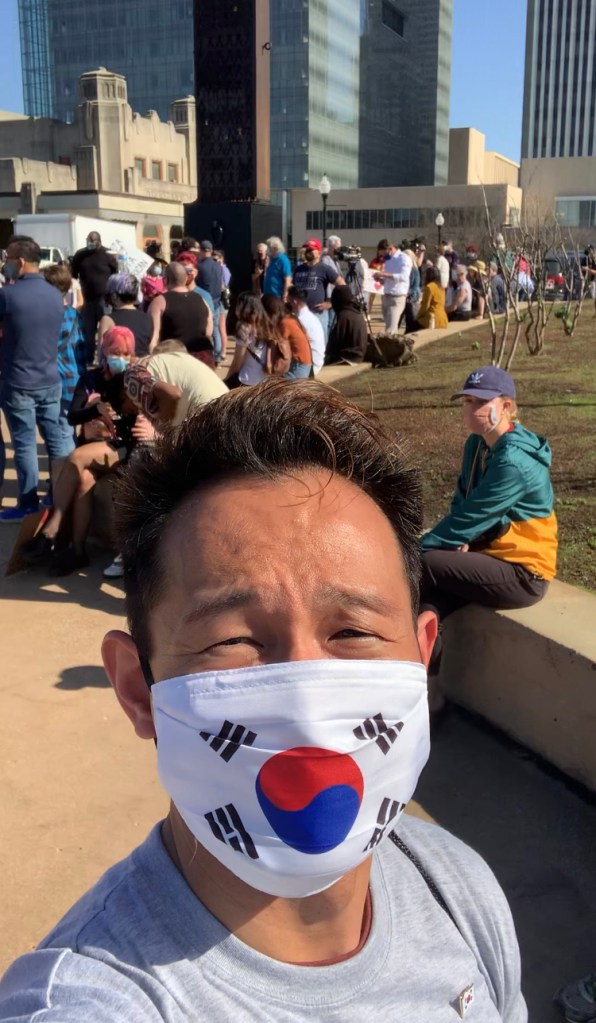
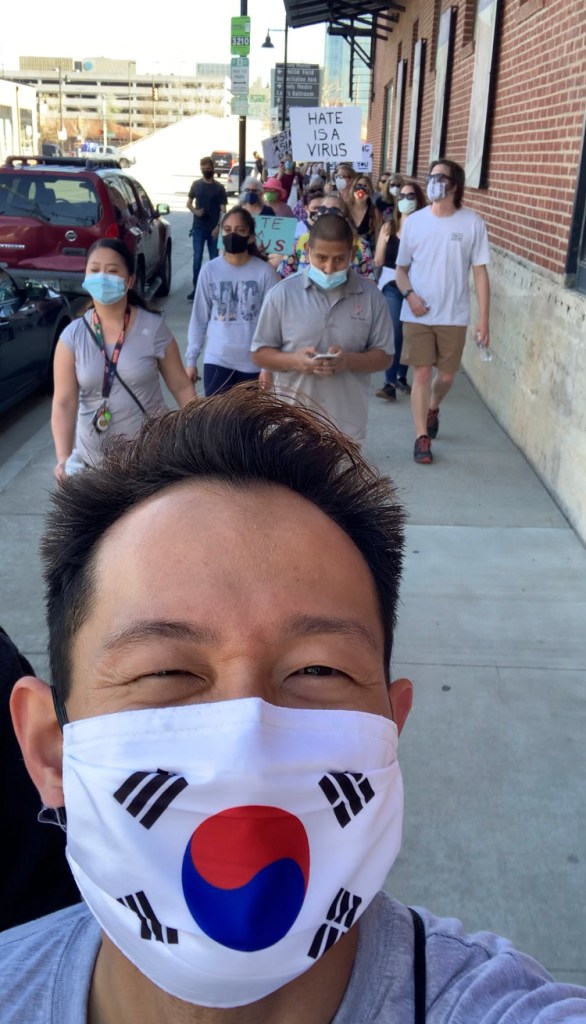
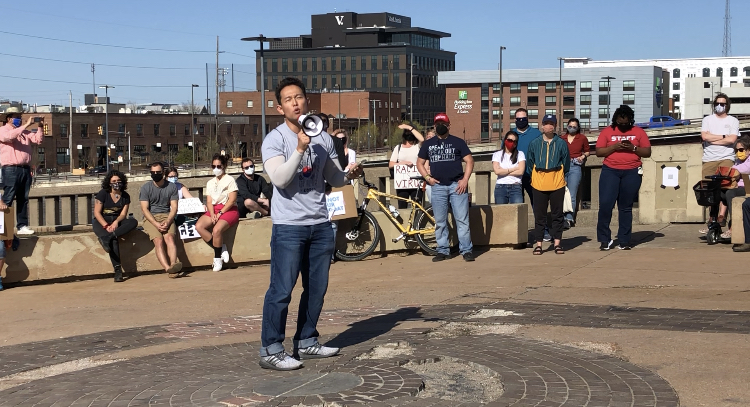
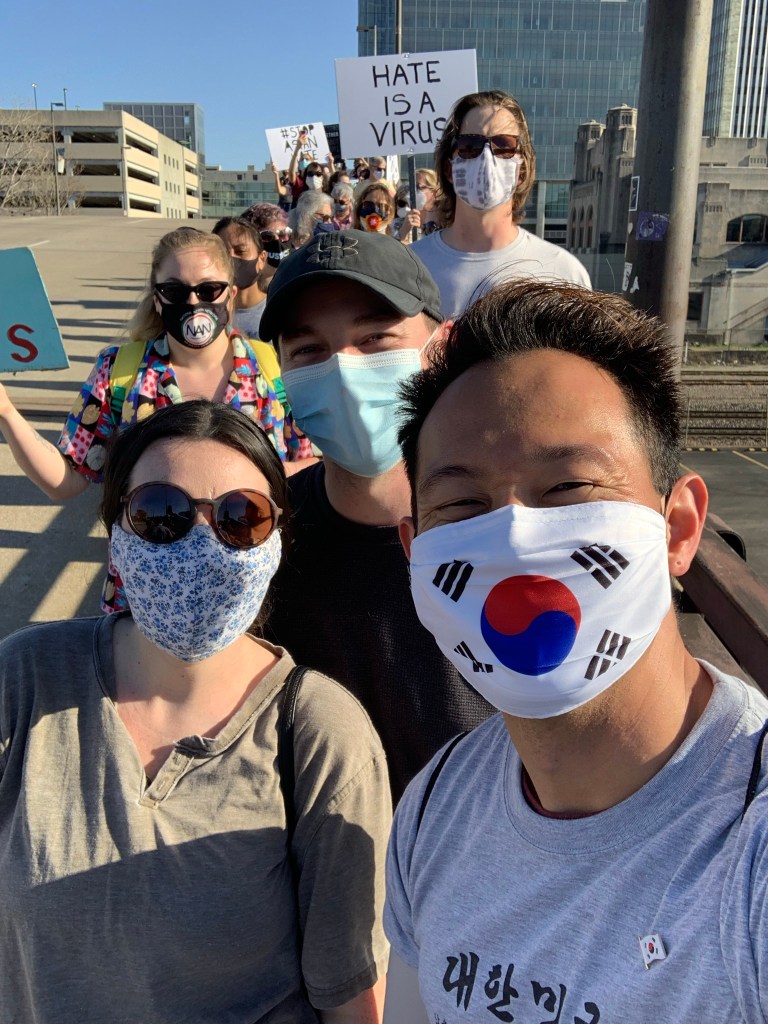
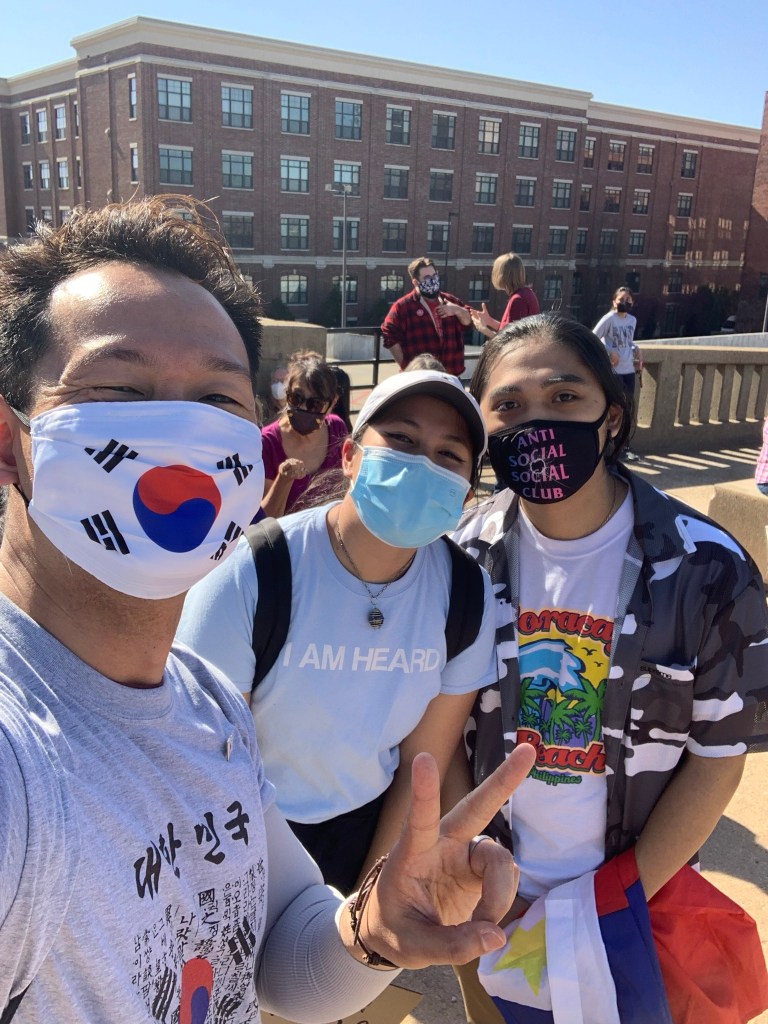
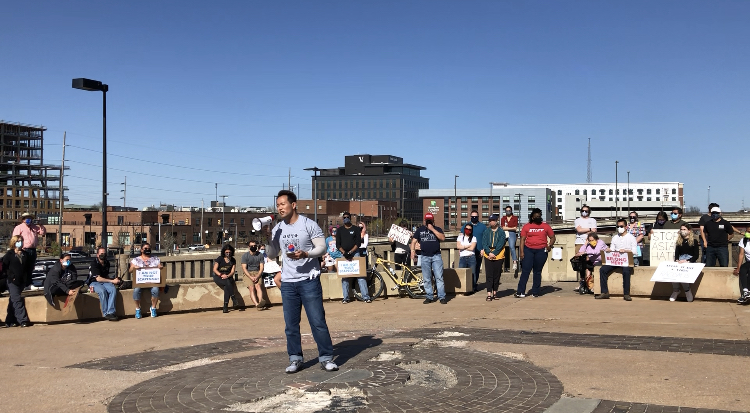
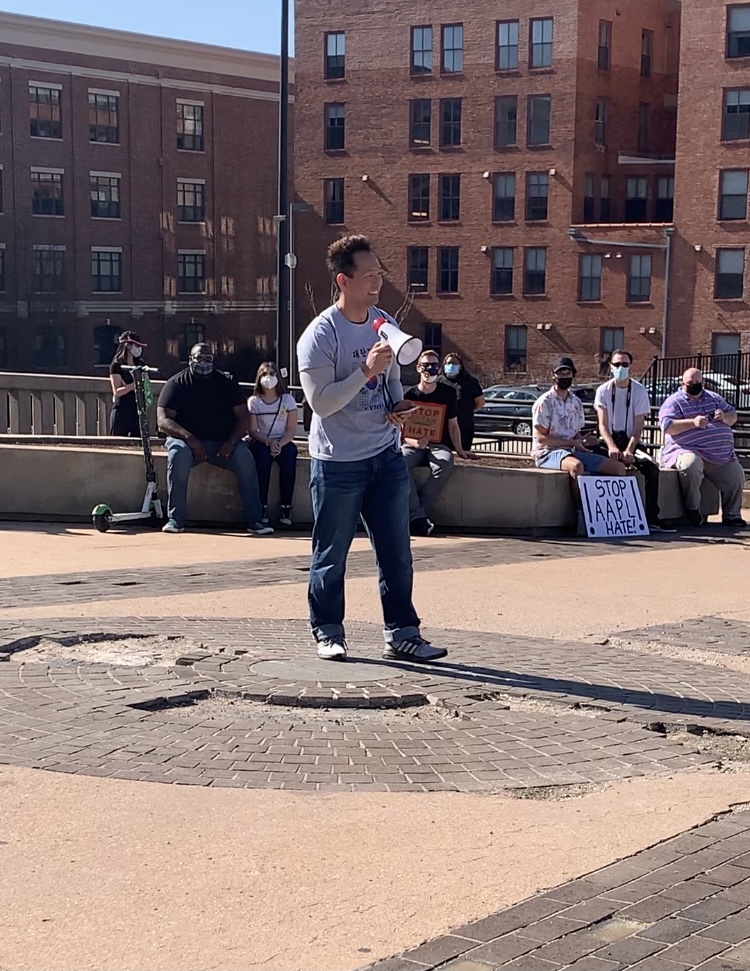
Protested in Tulsa OK for Stop Asian Hate


Protest for #StopAsianHate in Tulsa, OK. I spontaneously bought a plane ticket, my first one in years, and took a day off to protest with my AAPI family. Every single speaker had beautiful and painful stories. Honored to join them. In awe of a diverse crowd. Lots of news crews. Big shout-out to Jade Nguyen, one of the organizers, who gave me an opportunity to speak. I was just falling into the momentum already created by amazing people who worked like crazy to make this happen. My part was easy compared to the activists and advocates who have been doing this forever.

Love y’all, fam.

Part of my speech:

“Somehow we’ve become a punchline even though we’ve labored at the frontlines.

It is easy to believe after trauma and tragedy and violence that somehow, you are what has happened to you, that somehow racism has stained you or tarnished you, that we are the injuries that we bear.

But again I say: no.
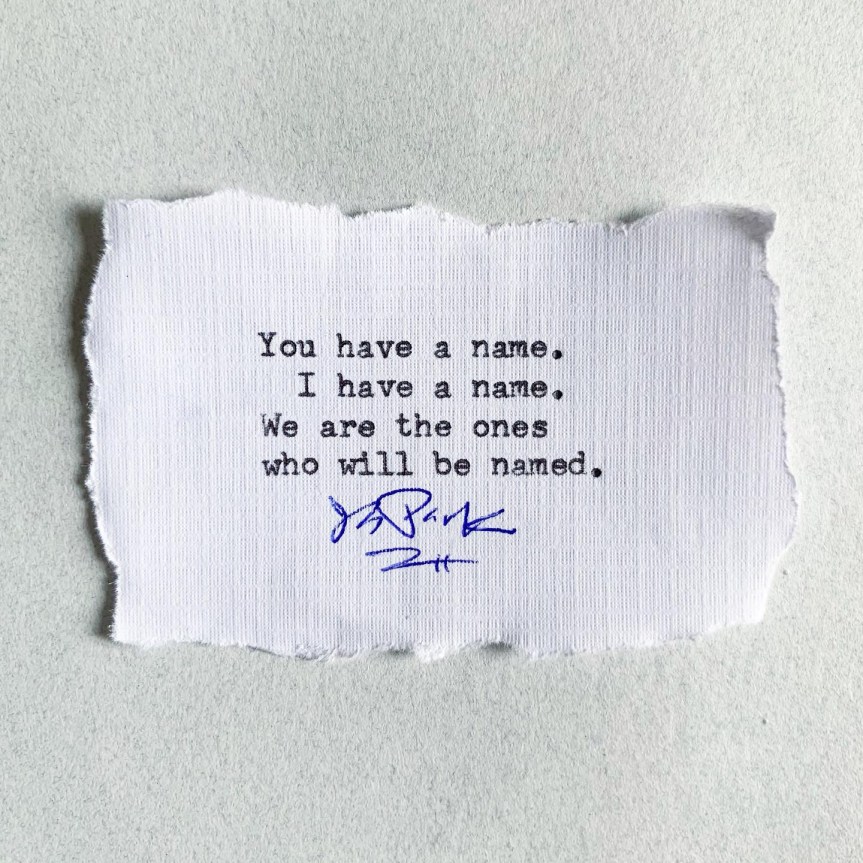
You have a name.
I have a name.
We have a name.

We are souls, completely whole and valued regardless of all that has been done to us.

You have a name.
I have a name.
We have a name.
We are the ones who will be named.
Not after the fact, not as a stat or a fact, not after trauma and tragedy, but you have a name, right now: you have a name.

Things can get bad, and they’ve gotten bad, but it never means you are. As author Min Jin Lee has said, ‘Racism is the shame of the racist. It is not our shame.’
Their shame cannot take your name.

Family, you have endured shameful things but it does not say anything shameful about you. It only says that / you / endured.

And the reality of your daily pain cannot define the value of your interior reality. You still have worth simply for being you.”

— J.S.


[Some of the photos found on TulsaWorld]

We Have Always Had a Voice: No One Is Voiceless


Who will tell your story?

In community college, I had an American History professor who got to the chapter Asian-American History. He grabbed the whole chapter with two fingers, flipped them, and said, “We’re skipping this. It’s a small chunk, anyway.” Everyone in class turned to the back to look at me. I said nothing. I stayed in my place.

In the same class, a student said, “We need to drop a nuke on South Korea, get rid of those communists.” I said, “Do you mean North Korea?” She replied, “It’s the same thing. Nuke them all.”

In third grade a kid named Danny ran by in the playground and punched me in the face. He went to a corner and started meditating like he was a ninja. He made whooping noises while chopping the air.

I was embarrassed to bring my bulgogi and kimchi to school. The smell brought out howls and hisses. I’d beg my mom for anything else. And that was the start of a dedicated measure to conformity. Even if I did not say it with my mouth, I said it with my heart: I began to hate my own skin. I wanted badly to be white. I am ashamed to tell you how ashamed I was.

I became a chameleon with the skin of a mirror. I fed the vanity of others, stoking their flames, crafting a personality out of the person in front of me, from bestsellers and banter and every hit show. Always nodding. I shrank myself so others could feel large.

My voice was strangled. In a place of manic conformity, where one wrong move could make others cold or “not one of the good ones”—What else could I have done? But fall in line? Fold in half? Forfeit myself so others were comfortable?

But always, I had a voice.
The one God gave and entrusted: it is mine.
They can take your pen and your microphone, they can tape your mouth to silence you:
but no, they cannot take your voice.
They cannot tell your story.
It is yours.

I see my baby daughter who is like her mother, other times like me. We laugh at how similar our daughter is to both of us. And then there’s this unique part of her. Not like me or my wife. That’s my daughter’s. It is hers. Her God-given voice. My prayer is that she can live fully into who she is. My hope is for her world to never ask her anything else.

— J.S.

We Are the Ones Who Will Be Named


Ryo Oyamada.

In 2013, Ryo Oyamada, a 24 year old student from Japan, was killed in a hit and run by an NYPD vehicle. The police car, according to witnesses, did not have its siren or lights on and was going 70 mph. The footage released by the NYPD showed the vehicles’s light were on, but this footage was proven to be altered—lights were apparently added to the vehicle.

I spoke about this in 2014, when it was finally covered in the news. I posted it on Tumblr, and to my surprise it gained almost 75,000 likes and reblogs. A petition to investigate the cover-up garnered almost 120,000 signatures. Finally, four years after Ryo was killed, after frustrating court proceedings, the family reluctantly took a settlement for half a million dollars.

There were vigils and rallies. Many did try to advocate for him and his family. But accountability? It’s as if he never existed.

Someone could argue that the murder of Ryo Oyamada was not a hate crime. But every subsequent action, from the cover-up to court battles to public silence to a meager settlement, is a failure at every level. Social, systemic, structural, relational. Forces both evil and complacent acted to erase Ryo from existence.

Why was his name not widely chanted? Was it too hard to pronounce? Too easy to think, “Just a foreigner from Japan”? How much was this family worn down to accept 0.00004% of the NYPD’s 11 billion dollar yearly budget?

Anti-Asian racism might be born in the heart, but it is woven into the system until it weaves its way into our DNA. We have been made to believe we deserve less, need less, are less. Asian-Americans and other POC may believe we are silent, but no. We have been silenced. We have a voice. It is our microphones that have been taken. Every single narrative pushed forth from pop culture to church culture to the dinner table is that we do not have a name. But we do. I do.

Names. Hyun Jung Kim. Soon Chung Park. Xiaojie Tan. Sun Cha Kim. Yong Yue. Daoyou Feng. Delaina Ashley Yuan. Paul Andre Michels.

I cannot read their names without weeping.
They have names.
You have a name.
I have a name.
We are the ones who will be named.
— J.S.

Hear Us, See Us, Know Us


Last summer during the protests, my friend told me:

“It feels like they won’t stop killing us until we start killing them.”

He was trying to express his feelings of helplessness and rage. The sheer insanity of all he was seeing and experiencing. The fatigue of wanting to do more, but already working twice as hard to be half as far. And even if I didn’t completely understand it then, I hurt so badly for my friend. When I protested, I walked for him. For so many—too many—I walked for those who felt what he felt.

I understand that feeling a little more these days. The stomach-sick, catch-your-throat, feverish, fist-clenching disbelief. The urge to shout and throw things, but somehow it is wrong to fight for our lives, so we must only be polite to survive.

To see a body like yours, like mine, brutalized over and over again, then told it was your fault, what were they even doing there, a million more where you came from—but let me eat your food, watch your movies, wear your robes, I’ll tell you about my Asian sister-in-law, let me say hello in your language to impress you, let me tell you about the Vietnam War and the Korean War and my time stationed in Japan, let me tell you how much I love kimchi and bulgogi, I love the K-Pop on Jimmy Fallon or was it Kimmel, make me fried rice some day, your English is so good by the way, and your baby daughter has the most interesting eyes, but tell me about your pain and I will tell you it’s not real, it happens to everyone anyway, tell us at this panel and Q&A, but we only have half an hour today, you have no history or future or feelings of your own, you are my decoration and my proof of diversity, you are the authority on all eastern culture so tell me your story and pronounce your name but leave out all your hopes and pain.

All I feel is rage.
This grief is only the surface.
I am enraged.
For the love of God,
see us,
hear us.

— J.S.
My Voice Was Taken


These last few week I’ve been reading about the many assaults against Asian-Americans, and I was hit with a lightning bolt of a memory I had nearly forgotten.

It is my very first memory. I was four on my first day of preschool. The only Asian in class. I didn’t speak English. When the teacher found out, she forced me to sit in the corner all day. She told me not to talk or turn around. I wept the entire day.

My mother, when she picked me up, cussed out the teacher and switched me to another school. But it was too late. A year or two later, as I learned English, I lost much of my Korean. The trauma destroyed my native language. My tongue had been burned of its millennia of heritage in my still-forming mouth.

To this day I can still understand Korean just enough, but when I try to speak I get tongue-tied. A block. It is apparent why. My voice was strangled. A teacher failed her “non-compliant” student. A system allowed racist violence against a child. A teacher did not understand she had a non-English-speaking American in her class, and instead of including him with even the smallest gesture, simply cut him off in a corner. The teacher was a cog in a system not funded with resources to equip their educators. That child never had a chance.

Our voices are still strangled. When I am yelled at violently in traffic because “Asian driver.” Spoken very slowly to by a cashier. Spoken over constantly in meetings. When people I supervise don’t take me seriously because they are not used to an Asian in the lead. When Asian jokes are told with zero hesitation. When people who look like my father go on a walk and are killed.

I realize I am lucky. My experiences are not as bad as others. My pain though, like any pain, is still pain. And I am not tougher for what I have gone through. I was made less. I was stripped of my home tongue. But no: I will not be stripped of my voice. It will not be taken. We each have a voice, gifted by God, just the one we are given. You have a song and it must break free. You have a microphone to pass to a young uncertain child, that they may sing too. Your voice. Speak. Your voice will carry you.
— J.S.
I Am Invisible: Will You See Us?


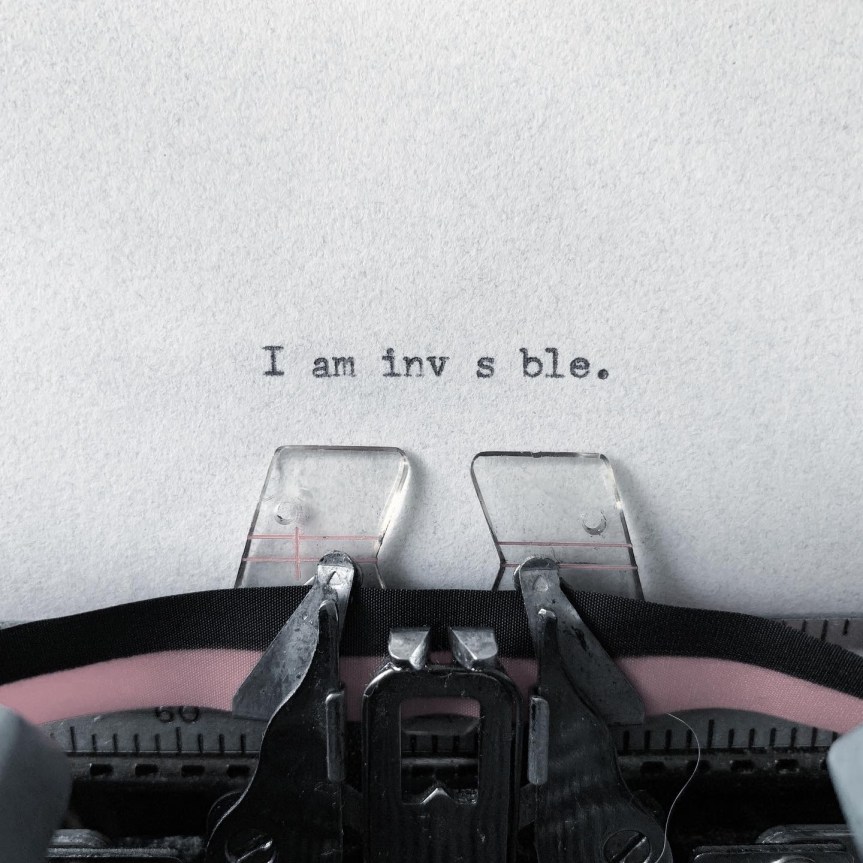
With the recent hate crimes against Asian-Americans, I am reminded again I am invisible.

When I was a boy, someone had spray-painted a swastika on my father’s dojo. My dad painted over it, but on hot humid days we could still see that Nazi symbol like a pulsing writhing scar.

We got a voicemail on our answering machine—maybe the same Nazi artists—who spent ten minutes making fun of my dad’s accent. I remember seeing my dad listen to it several times, staring quietly out a window. When he noticed me, he turned it off and said, “Just boys playing a joke.” The voices were from grown men.

In middle school I remember being assaulted, shoved around, called “ch-nk yellow belly,” having fries thrown at me during lunch (I sat alone) which were drenched in ketchup, some kid yelling “your dad killed my dad in the war” and then I watched his dad pick him up from detention.

At weddings, funerals, leadership meetings, conferences, I am often the only Asian. And I am invisible. I have literally sat in rooms before where I speak and no one looks my direction. Not even glances. I once called my wife in a dramatic panic, asking, “Do I exist?” And she knew what I meant. The invisibility.

I could tell you a hundred stories like this, and a hundred more. I have. And, well—no one hears. Or remembers. I know my experiences pale in comparison to racist violent acts done to so many others. I only wish I was heard. Seen.

A couple years ago I was a guest at a panel where we discussed race. I shared how I felt invisible. Afterwards, a wonderful Black woman approached me with tears in her eyes, hugged me and said, “I see you. I see you. God sees you.” Over and over, she whispered, “I see you.” And I was so moved, I wept with her. “I see you.”

I still hear her. Thinking of it now, I still weep. For a moment, at least, I was seen. We saw each other. We have so much work to do—but that day, that was enough for me. I was seen. To see is to make visible.

— J.S.

The Green Room Interview: About My Hospital Chaplain Work, Childhood, Faith, Author Journey, and the Pandemic

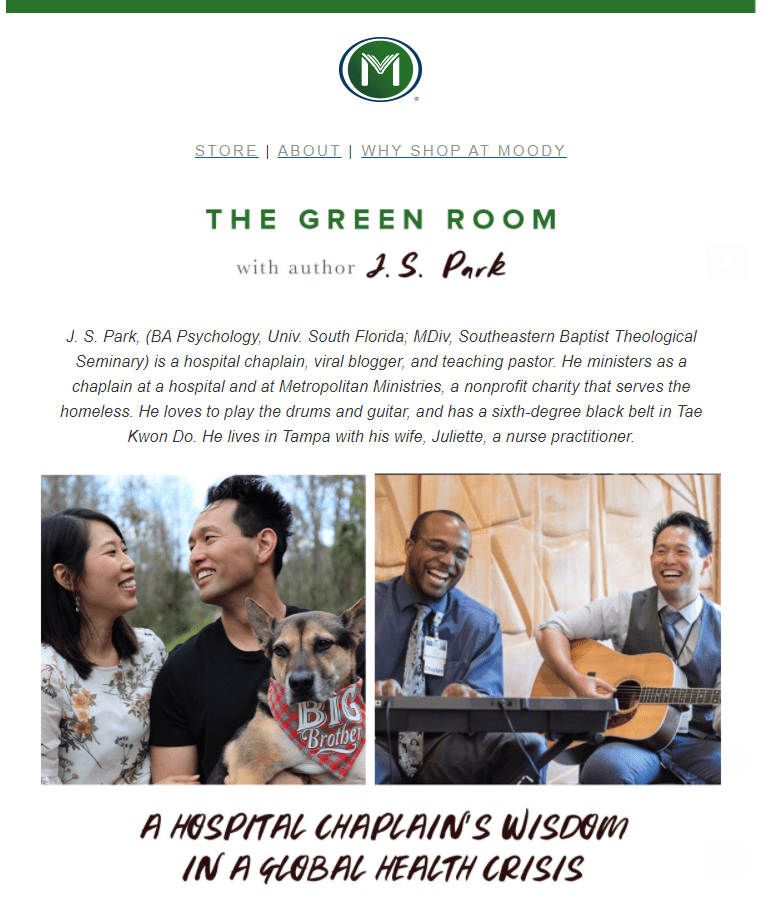
I was interviewed by my publisher Moody for their author series Green Room.
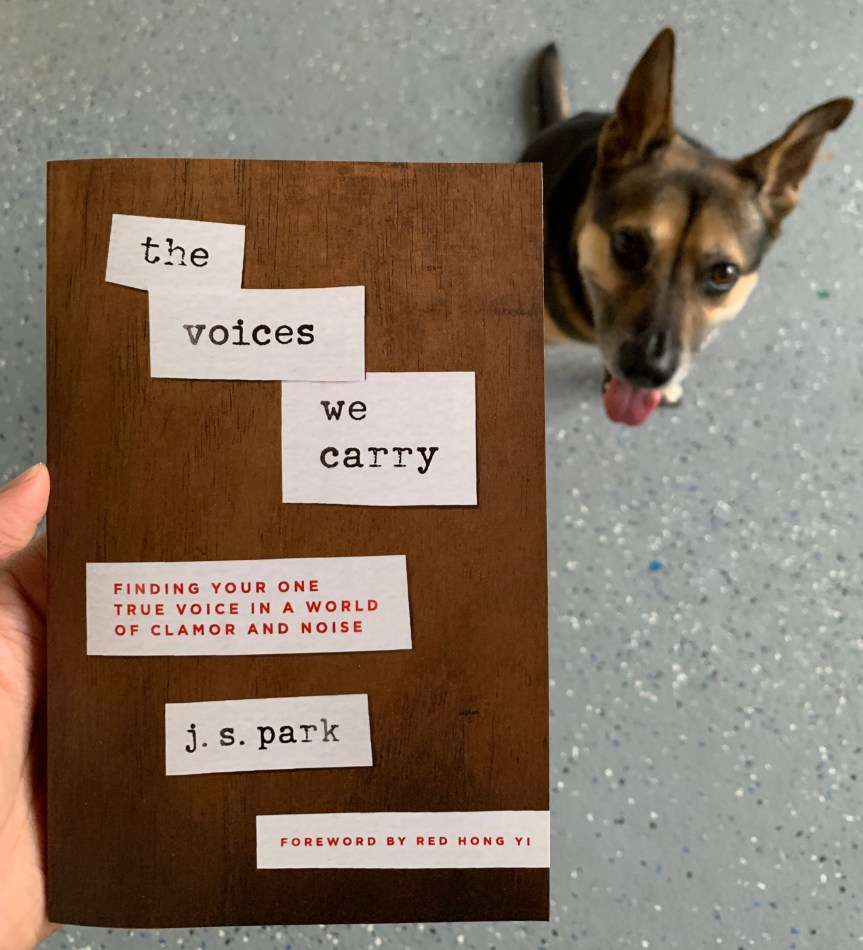
They asked me about my chaplain work, childhood, faith, my writing process, and my book The Voices We Carry, which is available in paperback, ebook, and audiobook.

With my publisher’s permission, here is the entire interview below.

Continue reading “The Green Room Interview: About My Hospital Chaplain Work, Childhood, Faith, Author Journey, and the Pandemic”

Knowing Ourselves Requires Knowing One Another


Last summer I wrote a piece on my own experience with race and racism. A blogger then publicly blasted some harmful views I was expressing.

As I read her words, I felt she was right—but I had a hard time seeing where I fell short. So I asked my friend, with her permission, to help me. How did I get this wrong? She first pointed out what was good. Then she kindly and firmly pointed out the various ways I missed the mark. Slowly and painfully, I saw how much I had messed up.

In particular: I was invalidating others’ experiences to boost my own; I was subtly drawing disproportionate comparisons, hijacking language and images that did not belong to me; I was mostly absorbed in self-pity and blame instead of sharing a vulnerable experience. When I saw it, it clicked: I was way, way, way off.

The easy thing to say here could be, “I’m still learning, I had no idea, show me grace, I’m sorry.” And that’s true. But my words were harmful. There’s no way out of that. I have to sit down, take the L, and simply be wrong. There’s no defense, excuse, rationalization, “but”—I was wrong, plain and simple.

This can’t be about my realization or epiphany, but about tending to the injury I caused.

Even though I’m a POC, that doesn’t make me free of criticism in matters of race and racism. Even though I wrestle with depression and anxiety, I still get it wrong about mental health. And as a chaplain dealing with grief: I’ve gotten that wrong too.

We can only become self-aware through the awareness of others. Or like C.S. Lewis says, “My own eyes are not enough for me; I will see through those of others.” To see is painful but necessary. We need others to see where we have fallen for deception, conspiracies, biases, agendas. It can truly happen to any of us. And even though I’d like to think I’m a friend to the wounded and weary, I still miss the mark. A lot. What I can do is not only examine how I went wrong, but act based on those new convictions. To rethink how I enter for the wounded, not just for my own catharsis. It shouldn’t be anyone’s burden to educate someone on the basics of humanity, but thank God for sending friends who took time to school me.

J.S.

A Response to “Stop Looking at People, Look to God”

Anonymous said:

i just want to say i think it’s ok to be skeptical and have questions and doubts but it’s bad when you start making the christian faith about people rather than Jesus. stop looking toward to people for faith and focus on Jesus and encourage that more as well


Hey there, thank you for your concern and for bringing this up. I hear what you are saying and I can agree, and I’m also not sure it’s the whole picture.

I heard those types of statements last year dozens of times: “Stop looking at people, look at God. Stop focusing on the church, focus on Jesus. Stop putting your hope in people” etc.

I understand this to be a meaningful truth. In fact, I can say this: People let me down so much last year that the only one I could really trust was God. It was only my tiny bit of faith that kept me alive, kept me from completely unraveling in my depression and anxiety. I doubted and questioned people. Did I doubt God? Sometimes. But absolutely not as much as I did the church. When nothing else was good, I trusted that God was the only one who is.

Most people of faith know that they ought to focus on the center of their faith rather than what people are doing. It is such a basic and obvious truth, that again, it was basically my only option.

Back to your statement. I want us to consider a few things.

Continue reading “A Response to “Stop Looking at People, Look to God””

Successfully Vaccinated: Covid Vaccine Journey, Dose 1 and 2

I was incredibly lucky and privileged to receive the covid vaccine from the hospital where I work. I’ve posted my journey through the vaccines, including the side effects and how it went.

The first dose had one sudden side effect which passed quickly.
The second dose had an unexpected side effect which also passed quickly.
It has now been nearly two weeks since my second dose, and there are no side effects at all.
Please feel free to ask me anything.


Black Lives Must Matter


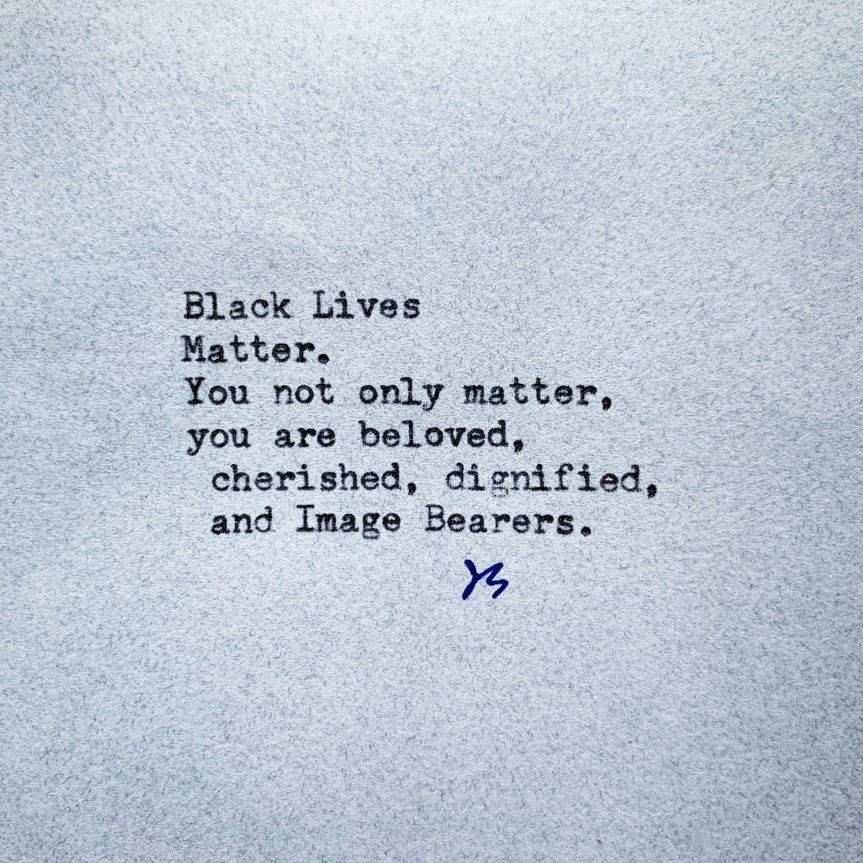
You more than matter. Black lives are beloved, cherished, dignified, and bearers of the Image of God. It is a truth denied but it is no less true.

My friend “Shayla” (who gave me permission to share her story) was telling me that after the hundredth video of a Black person beaten in the streets, after one more citation of false facts and stats, after one more demand to “just work harder and get off welfare and quit drugs,” she had the terrible thought, “Maybe they’re right. I’m not human.”

After so many racist messages and images, it can become impossible not to believe, “I’m not human.” Or, “They’re right.”

The internalized trauma of racism is crushing. Day after day, the Black community is denied their lives, art, beauty, voices, stories, truth. Even when we know these racist messages are not true, they have a way of creeping in, suffocating, infiltrating our beliefs.

It cannot be overstated how much the trauma of racism deteriorates a soul. Trauma has a way of saying, “I am what has happened to me.”

I say as a chaplain but also as a human being: I have seen so many kinds of grief, but to believe your skin makes you deficient is one of the saddest, most haunting pains of all. It sticks so hard. It kills. It takes a thousand times more work to restore wholeness than to tear it down.

I will always be on the side of the wounded. I will do all I can to be part of that thousand steps towards wholeness.

For me, to say Black Lives Matter is a starting point to recognize the full worth of Black Lives. In Korean, the phrase Black Lives Matter is “huhg-in-eh seng-myung-un so-joong-hapnida,” which means Black Life Is Precious. I will continue to say Black Lives Matter, but even more, precious and worthy—not just worthy of protecting, but also having inherent worth.

If you are burned out, traumatized, overwhelmed by racist messages and images, please know the truth: you bear the Image of God. Your worth is not in what you’ve done or how you’ve been treated. It may be hard to believe today, but you are loved. I am with you and for you. As much as I love you, the Creator loves you infinitely more.

— J.S.

Interviewed by Sean Bloch of Soul Tears


I was interviewed by Sean Bloch of Soul Tears. We talked about navigating grief through the pandemic and how I helped to plan a funeral, plus my book The Voices We Carry and what it means to own your voice.

On Apple Podcasts / iTunes here: https://podcasts.apple.com/us/podcast/how-to-own-your-voice-serve-others-hospital-chaplin/id1474418082?i=1000473378494

On Libsyn here: https://projectsoultears.libsyn.com/website/-how-to-own-your-voice-and-serve-others-with-hospital-chaplin-js-park

If You Hurt, I Hurt Too


I never want to politicize, moralize, or spiritualize someone’s pain.

I am always on the side of the wounded. Where there is loss, I am for the bereaved. Where you are hurting, I want to bring healing. Anything less is making us less human and not more.

It would take only a few seconds to consider the other person’s pain and perspective and point of view. That has the power to heal. The only cost to empathy is losing bigotry, self-righteousness, and pride. Empathy is that good.

It should never be on the wounded to explain their pain, defend their injury, or to forgive over and over the injustices that never should’ve happened but keep happening. Even if your hurt is not my hurt: because you’re hurting, I hurt too.

I want to empathize first, to listen first, to grieve first, and to be angry and to weep alongside. Not lecture, lessonize, or minimize. I don’t want to add burdens, nor demand explanations, nor kick you while you’re down. I want to crawl down there with you.

I cannot understand the hasty, vicious speed by which real hurting people are turned into talking points. I don’t mean the platforms for justice. I mean the ones that degrade and deny. I cannot understand the evil scorn and jeering and mockery: there is no honor in desecration, but only violence to the soul. And while I do not believe we must be forced to give our opinion all the time—so often the silence is chilling, and apathy can be the most destructive force of all.

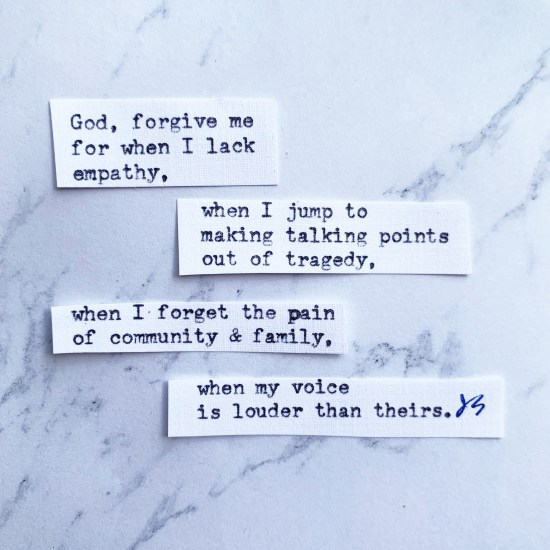
May I never lose sight of the wound and the wounded. May God forgive me for when I wasn’t listening, for not getting it right. Above all, I must grieve. Through tears, prayer, and action, I grieve with you.
— J.S.

#AhmaudArbery

A Voice to Carry You


My book comes out on May 5th, in just a couple days. I’m grateful to so many.

I believe that no one is a self-made person. People enter our lives, whether for a second or a season or decades, and they support us. But perhaps more importantly, they speak into us.

I want to thank two people in particular. In grade school, I had a teacher that I’ll call Ms. Macklin. After we did a short story assignment, she took me aside after class and said, “You need an agent.” At first I thought she said, “You need an Asian.” Maybe she was telling me I needed an Asian friend, since I was the only one in the entire school. But she explained, “A literary agent. You know, to get your work published. It has to be published.”

Before this encounter, I had always wanted to be a writer. I had carried around a notepad since I was five or so. I wrote stories about the ducks at the local pond, especially about this one duck who had a lopsided wing. I made up an entire conspiracy about how the town was polluting the water and causing the ducks to be sideways. The twist: the ducks were fighting each other, and it was the violence that caused them to be lopsided (and yes, they eventually united to stop the pollution too).

Ms. Macklin believed in me. It was really the first time someone had commented on my writing. It put the bug in my ear: “It has to be published.”

In community college, I met Professor Marcus, who preferred to be called Rocky. She smelled like potpourri and was fond of wearing trench coats, probably made of hemp. She took me aside after class (this is a common tactic apparently), and told me, “I say this to everyone but I only mean it once in a blue moon. You have to be a writer.” Rocky coached me. That entire semester she poured into me: how to write, edit, edit, edit, simplify, clarify, amplify. It was hard. It was wonderful. Like an education at Hogwarts. What a gift she was.

Ms. Macklin and Professor Rocky are still a part of me. Their voice, the gentle way they corrected me, their kind way of saying hello when I entered. I was a lonely kid a lot of the time. But they made it bearable. And they made me a writer. Just thinking of them, my heart swells. Where would we be without the people who look us in the eye and with total confidence say, “You, you got the stuff, you got what it takes, and you, I even like you, and I like what you bring into the world” …?

I’m thankful. So thankful for the teachers, leaders, mentors, counselors, therapists, parents, random elders at the airport, the security guards who paused to chat, and the man who helped push my car out of the road after an accident in the rain: each of you made me a writer. I hope I spoke into you even a fraction of what you spoke into me.

I’m thankful for you. In a world such as this, you have been strength and beauty.
— J.S.

I Messed Up. I Hugged Someone.


I messed up. I hugged someone. We’re supposed to practice social distancing, but my friend badly needed a hug. I know I shouldn’t have. I couldn’t help it.
— J.S.

The Storm Doesn’t Always Pass


Not everyone can stay home to wait it out.
Some have to keep working.
Some have lost their jobs.
Some have never had a home.
Some will never go back.

Maybe things are “not that bad” for you. Maybe “this too shall pass”—in your world. But someone you know doesn’t have that luxury. Someone you know is permanently affected. They’re grieving a loss, whether it’s loss of their autonomy or a whole person. Our advice doesn’t apply to them, because it can’t.

Stats and facts gloss over real loss. Two in one-hundred doesn’t sound like a lot, but if any two people I knew had died this week, it would be absolutely devastating.

To downplay any grief and loss doesn’t help, and if you keep quoting statistics to show “it’s not that bad,” you’d be the last person I would go to for help.

No, we shouldn’t panic.
But please don’t tell people it’s fine
when they’re not.

The storm doesn’t always pass. Not for everyone. Pain can last for a lifetime. We can only hope to adjust to the new normal. By the grace of God, I will crawl down there with you.
— J.S.

Why I Needed Parasite

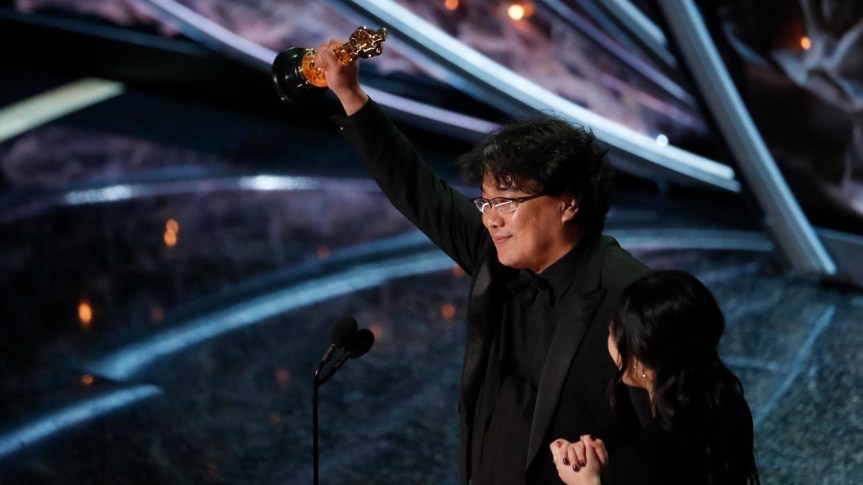
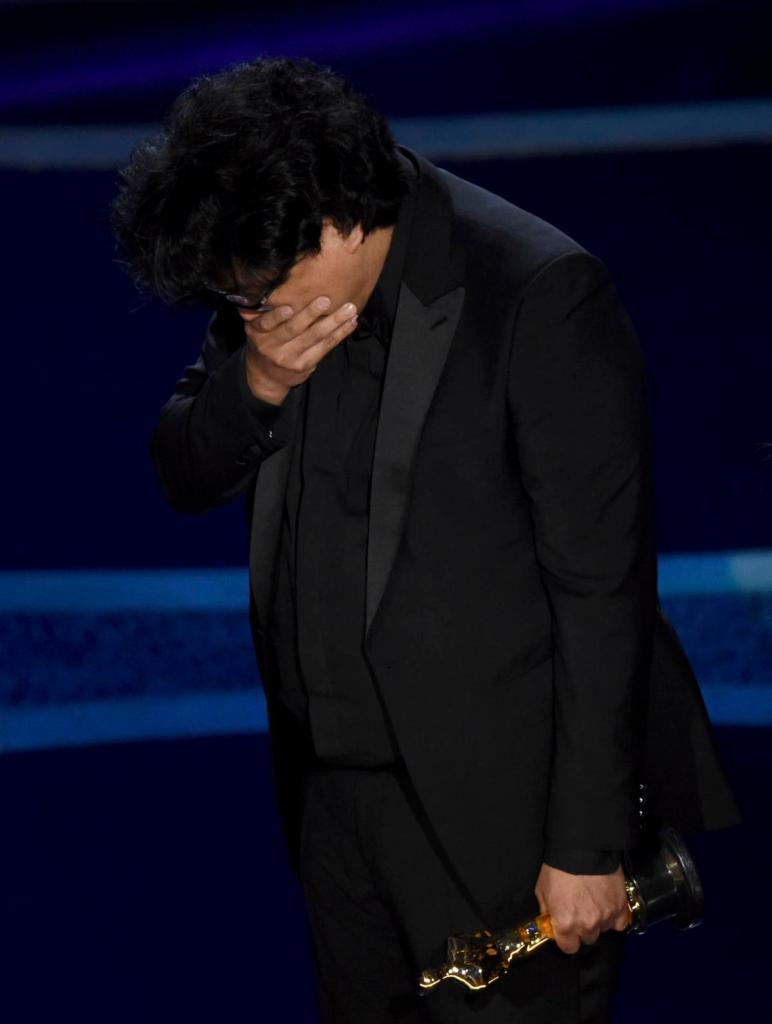
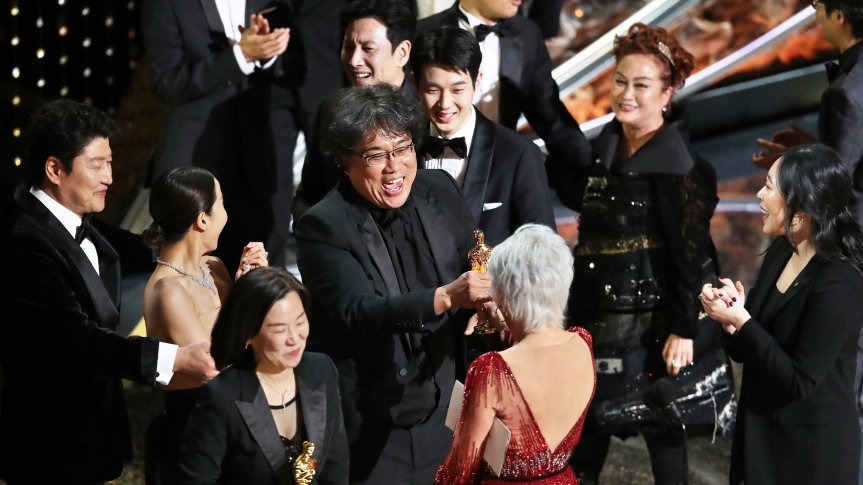
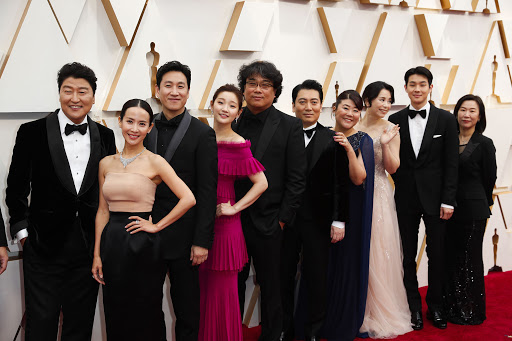
The cast and crew of "Parasite," including Yang Jinmo, Han Jin Won, Kwak Sin Ae, Lee Ha Jun, Yang-kwon Moon, Song Kang Ho, Cho Yeo Jeong Lee Sun Kyun, and Bong Joon Ho arrive at the 92nd Academy Awards on Sunday, Feb. 9, 2020, at the Dolby Theatre at Hollywood & Highland Center in Hollywood. (Jay L. Clendenin/Los Angeles Times/TNS)


I saw Parasite / 기생충 in a packed theater with a diverse crowd. Looking around, I never could’ve imagined a day in the States when such an audience would watch a movie in my language, with my people, telling our stories.

It really meant a lot to me. I have to tell you why.

I remember in middle school when someone assaulted me while yelling “you ch_nk yellow belly.” Someone shoving me in a hallway telling me to go back to where I came from. Multiple times someone would squint their eyes, do their version of an Asian accent, pose at me like Bruce Lee, all while high-fiving each other. Having to endure that scene in Breakfast at Tiffany’s, being told it was “art.” Someone in my college history class telling me that Korea needed to be nuked, and “it doesn’t matter which one.” I remember when my dad’s business was spray-painted with a swastika. I remember inexplicable rage when some kid yelled “your dad killed my dad in the war,” and his dad picking him up later after he was sent to detention.

Art, music, film, books: these things have the power to take away our fear, our bigotry, our assumptions. They turn masses into individuals. They turn cartoons into real people. For someone like me, I have to prove daily I am a real person. For art to put my story into public consciousness is allowing me more room to breathe, to exist.

A part of me wishes a movie like Parasite could’ve been accepted earlier. Seeing a face like mine on a big screen has an immense affect on how we see each other. But more than that, a good story, like the one in Parasite, makes us more human. Hearing more stories makes us better, more whole, more gracious. We need diverse stories, and good ones.

During the movie, I looked around. Seeing so many faces enraptured by a powerful story, taken in by faces that looked like mine, I wept. Certainly I wept because the movie was incredible. But I wept feeling something I never had before: a kinship with strangers. Humanization. The image of the divine, seen and known.

After the movie ended, we all sat in our seats for a while. Collectively, our breath was taken away. And collectively, we were sharing breath. Maybe I’m making too much of a movie. I suppose it’s a silly thing to weep about. It only tells me how long I have been deprived of such connection. These stories, they’re important to tell.

J.S.


This was posted on my Facebook here and Instagram here.