
Forgetting How To Be, Reclaiming How To Breathe


I met with my counselor the other day, a semi-famous mega-church pastor here in town, and I had really forgotten what it’s like to be around someone who is so comfortable with himself that it made me comfortable with myself.

My counselor is one of those cool pastors who smokes cigars and uses dirty words and he used to be a rich drug dealer, so he owns this huge house and hosts these extravagant church parties with hundreds of curious people looking for real spirituality. He does this without even really trying to impress anyone, and with sort of a wink. Once I was leaving his office after a meet and he yells down the hallway of his church, “I’ll keep praying about your porn problem.” The very conservative staff glanced at me and I ran and he couldn’t stop laughing.  My counselor reminds me of Jesus.

So I told him everything. How I blew up on someone the other day. How I was juggling multiple ministries plus a growing blog.  How dissatisfied I was with the mainstream church.  How I haven’t talked to my dad in over a year.  How I was fighting anger and unforgiveness and lust. How I always felt like I was pouring out of an empty cup, and that the same grace I preached for others was almost never reserved for myself.

I told him I had this monster inside me, barely underneath the surface just coiled around my guts, and just when I thought I was making “Christian progress” and it was dead, it would lash out and destroy everything I love and then go right back to hiding.  I wanted this thing inside me to really, truly, eternally die.

Then he looks at me and says, “You’re not really walking with God.”
I was almost offended.  But he was right.  He went on.

“You’re doing so much, just do, and you lost who you are.  You find who you are, then you can do again.”

“So what do I do now?”  As soon as I said it, I heard it.  I said “do” again.
He said, “Pray.  I mean we’re both in ministry, you already know that.  But you see how we’re talking?  How you can tell me anything?  How I can just be me around you?  That’s prayer.  Praying is like breathing.  It’s a way of life that can happen all the time.  That’s walking with Him.”

I think I was trying not to weep. I remember when it was like that, when I felt like I was walking with Him all the time. When being with God was like breathing. I did want that again. And it was not a matter of doing, but being.

He said, “It’s okay to pour out when you’re empty. You can’t do that for a long time, but that’s grace. You can preach grace all day and be a legalist to yourself.  Quit listening to yourself and listen to Him. And don’t preach too far ahead of yourself. If it’s been hard, then preach that it’s been hard.”

We hugged for a long time. He told me he loved me. Before we parted, he said, “I wish I could tear that monster out of you.  Let God inside, and He will.”

— J.S.
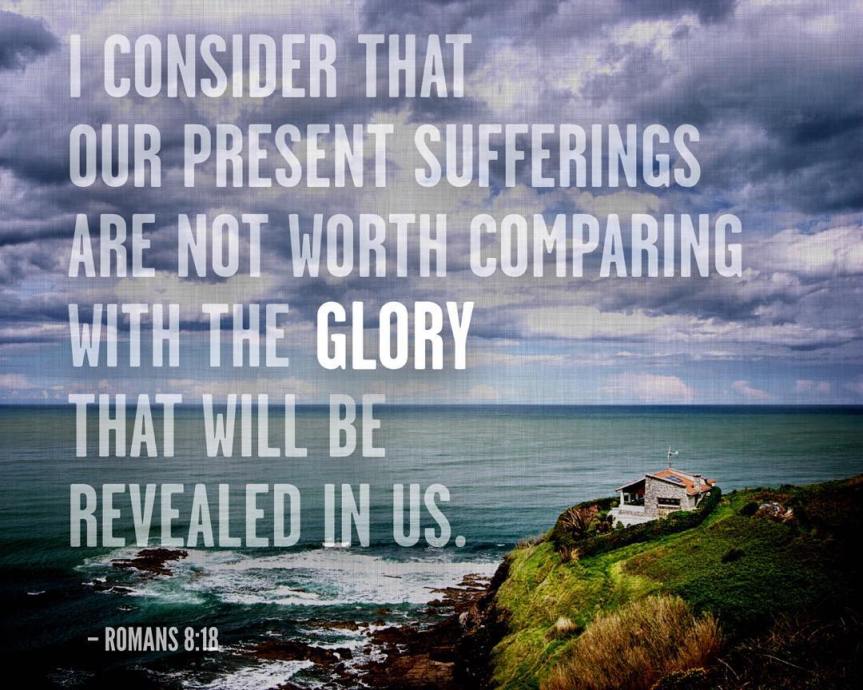
Suffering and Glory.


“I consider that our present sufferings are not worth comparing with the glory that will be revealed in us.”
— Romans 8:18


If You Haven’t Been Told “You’re Wrong” In A While — You Have No Real Friends and You’re Not One Either

image

I’ve never met a single person who has maturely handled rebuke. Not a single one. Including me.

I don’t blame them. It’s hard to hear the awful truth about yourself.

When we give rebuke, we can expect melt-downs, flip-outs, childish tantrums, tons of backpedaling, and an ugly look into the self-justifying human heart. It’s not pretty. We think we’re okay with saying “I’m wrong” until we really have to say it, without excuses, and then we’re desperately clawing to protect our ego-fortresses because being wrong feels like death.

But we need this.  We need to push past the initial hostility of our overreactions.  Some of us need to die to this. It is a good death.

Continue reading “If You Haven’t Been Told “You’re Wrong” In A While — You Have No Real Friends and You’re Not One Either”

Don’t Trust Me: Because I Will Let You Down

The Christian community fervently follows tons of bloggers, preachers, and voices to aid them in their spiritual walk, and I think this is awesome. Really.

But please, please, dear friend, you must also please think for yourself.

If something in a sermon sounds funny or off or weird, don’t believe it just because it’s coming out of the mouth of your favorite preacher.

If your favorite blogger is saying something you silently disagree with, it’s okay: you don’t have to fanwank them to protect their pedestal in your mind. It’s okay to disagree.

If they say something obviously wrong, it doesn’t make them a bad person: it just means they’re still learning, and so are you, and so are we, and no one gets it right every time. Most of them — and me too — are still working on the things they’re preaching.

Every single person you listen to is just as broken, crazy, and capable of error as you are. I’ll go further and say: some of these guys only care about blog hits and revenue and the number of followers and likes and reblogs, and don’t really care about you, and they have their prepackaged automatic statements ready to fire when they want to act like they care about you. We all do.
Some do love you, but are not truthful. Some are truthful, but don’t love you.
Don’t trust them; not fully, ever. Don’t trust me. Just trust Jesus.

I’m not saying this out of some kind of reverse-humility, as if to look more humble. I’m dead serious. Don’t trust me.

I’m also not as cool as I try to make myself. If you met me, I’m much shorter than you imagine, I laugh too loud in public, and my teeth are pretty crooked. You’d be disappointed.

None of these preachers and bloggers are heroes. They’re not the sacred hologram we might have built them up to be. I’ve seen many wonderful men and women of God completely melt down, freak out, throw tantrums, and go violent (including myself) — and again, it does not make them bad people. It just makes them people.

Continue reading “Don’t Trust Me: Because I Will Let You Down”

Sculpting a Life in Magazines.


In my chaplaincy class, we did arts and crafts, using pieces of magazines to tell our story. I was unashamedly giddy to be doing arts and crafts in a professional setting; I forgot how satisfying it was to put scissors through paper. We each took 30 minutes to present the posters. It’s incredible to hear other people’s stories and what’s most important to them, like carving a sculpture of a person and watching it come to life. It was also extremely vulnerable and itchy to share the deepest parts of us, and I was reminded of how little we actually get to connect with others face-to-face, how seldom we get to share how we got here. We’re comfortable in functional transactions; we’re afraid of depth. But one is living, and the other is alive. One is necessary for survival, but the other is why we survive. I hope we each have a place for that clumsy kind of openness. And for arts and crafts.
— J.S.


What Matters When Nothing Else Does.

Each week, part of my chaplaincy training is to write a reflection on how it’s going. Here’s week number two. Some identities may be altered for privacy. All the writings are here.

I watched someone die.

The trauma team did everything they could for him. That’s what the doctors told his wife, too. Her husband had stepped outside and suddenly fell over, his heart a fist in his chest. He was, as they say, in good health. The paramedics burst into the trauma bay with him on a stretcher, already in action, doing chest compressions and administering epinephrine. The nurses took turns. I was amazed at their clockwork efficiency. It wasn’t like the TV shows where everyone is frantic and yelling heavy-handed stuff at each other. No one yelled, We’re losing him. It was calm, the methodical pace of carving a pear with a pocketknife.  The team had a kind of choreographed trust that you only find in good acapella groups, or a school of fish. But the man was probably dead before they got him through the door. They had to try.

The doctors were very clear with the news. He died. The wife and her children were cut to pieces. There was a lot of screaming and hugging and anger in that suffocating space. I felt intrusive. There were three doctors and three chaplains standing around, and it was too many of us. Or maybe that was okay; maybe some people need more company so they don’t go crazy. I would want that for my family. I tried not to stare; I looked at the floor when the family wept and I wanted to jump in the wall. Someone asked me to grab a box of tissues and I dashed out, hoping to be respectful, and useful. I could hear them crying from the end of the hallway.

Continue reading “What Matters When Nothing Else Does.”

The Characters of Romance Vs. Real Life

GK Chesterton romance real life jspark


“I wish we could sometimes love the characters in real life as we love the characters in romances. There are a great many human souls whom we should accept more kindly … if we simply thought of them as people in a story.”
— G.K. Chesterton


To Be Good or To Be Christian.

Being a Christian good person only who is good Instagram JSPark


Being a Christian doesn’t mean being a good person. It means following the Only One who is good.
— J.S.


Marriage at Your Worst.


Sharing love for a lifetime is going to be difficult: it’s full of a million misunderstandings, shrill melt-downs, crazy eyeballs, and totally ugly cry-face. But that’s the point. It’s only a matter of who you choose to share the worst of you with. I’ve chosen. I’ll keep choosing. So has she.
— J.S.


Before We Get Hasty, I Hope You’ll Hear Me Out.


I’ve been blogging now for over fifteen years, and have noticed for a while an increasingly alarming surge of accusatory, polarized, one-sided comments that quickly shuts down any chance of discussion. It’s often so comically shrill and angry that it comes off as a parody, like all those news shows that make fun of other news shows to prove how narrow-minded the rhetoric really is. There’s an instant reflex to dismiss what’s being said. I can’t imagine anyone would be so serious about such binary, “black-and-white,” dogmatically stubborn remarks — but it’s deadly serious, with the flag raised higher than the pole, on the furthest side of the narrowest platform on the tiniest soapbox possible.

I can’t talk with someone whose mind is already made up. There’s no room for questions, a dialogue, a real conversation, a hope that others can learn. It’s so snide and abrupt that I wonder why the time was spent to comment. It doesn’t matter if I get to explain my side of the story or elaborate on my intentions or even take back something I said: it’s all dead in the water.

I’m guilty of jumping to the same one-dimensional box, in my safe little categories of predicting what the other “side” would say, as if I’m the only one with the valuable insider information. I constantly have to remind myself that it’s not the end of the world to say, “I’m wrong.” It’s only the end of my false, self-affirming, imprisoning world of circular bias. It’s not weak to say, “I want to know if you know a better way.” It would make us stronger.

C.S. Lewis in God in the Dock talks about his Oxford Socratic Club, in which people of different religions and philosophies got together to discuss what they believed. They discovered that no one actually knew about each other’s worldviews. “Everyone found how little he had known about everyone else,” he said. The Christians had only heard the weakest form of atheism while the atheists had heard the weakest forms of Christianity. They had all parodied each other into straw men. As each member of the club presented their case, Lewis noted that the arguments themselves had “a life of their own,” free from the emotional hype and attacks that so often accompanied them. And in this, their own doctrines could meet by common grace, so that they grew to understand each other while at the same time finding strength in their own beliefs.

In psychology, they teach you about heuristics, and how each of us have an automatic framework for judgment. We spend the least amount of mental faculties on perceiving things around us because the brain is designed to take as many shortcuts as it can, all while preserving our own justifications. This is a process that can only be fought and re-wired by deliberate effort and time. It requires getting to know those phantom enemies that we’ve demonized, to hear their back-stories and how they got there. It means fighting the urge to throw a verbal grenade over the fence, but instead ask a question for clarity. Even if we disagree in the end, we can quit perpetuating a cycle of hate and dismissal. Even if the other person’s worldview is inherently toxic and dangerous, maybe we can find a way through the towers they have built — and in doing so, we tear down our own.

I don’t want to be one more negative angry voice that assumes the worst in someone else. There are enough of those. I’ve done it too many times and it’s been done to me: and no one gets better for it. We end up reinforcing our own blindness and drowning in our misinformed traditions. I want to say something surprising and helpful and gentle and challenging and honest. I want to be the voice that I would actually listen to. It’s how we close the gap between us. It’s how we cross this man-made, made-up chasm to make up for our weaknesses, and to bring our strengths to the table. It’s how we’ll make it.

— J.S.


Grace Is For You, Too.


“Not that I have already obtained all this, or have already arrived at my goal, but I press on to take hold of that for which Christ Jesus took hold of me. Brothers and sisters, I do not consider myself yet to have taken hold of it. But one thing I do: Forgetting what is behind and straining toward what is ahead, I press on toward the goal to win the prize for which God has called me heavenward in Christ Jesus.”
— Philippians 3:12-14


Starting at the End of the Door.

Each week, part of my chaplaincy training is to write a reflection on how it’s going. Here’s week number one. Some identities may be altered for privacy. All the writings are here.

I had a very romanticized expectation of chaplaincy, as if I should have a divine epiphany complete with a vision of singing cherubim and filtered lights through the slits of the curtain. I could say something like, This is what I was made for. Sometimes I pretend to be a pessimist because it’s much more vogue and relevant, the whole cynical stoic thing, but I’m always hoping for those Hollywood moments when I have the meaningful conversation with some desperate guy on the last lap of his faith. 

I really had little idea what to expect in my first week of chaplaincy training. Certainly I had spoken with other chaplains about their experience — “You’ll love it, really” or “You’ll regret it, really”— but no one can really know about a thing until they’re on the other side of the door, like marriage, or like changing a flat tire. I’ve only just seen the door open. 

Continue reading “Starting at the End of the Door.”

Like John or Like Judas.

Gods Will John Judas CS Lewis Instagram jspark


“For you will certainly carry out God’s purpose, however you act, but it makes a difference to you whether you serve like Judas or like John.”
— C.S. Lewis


Let Your Religion.

GK Chesterton Let your religion theory love affair Instagram jspark


“Let your religion be less of a theory and more of a love affair.”
— G.K. Chesterton


My Testimony and Calling: Where I Came From, Where I’m Going

1-preparation-072-X2

I was seven years old when I got in my first street fight in the only tenements that my parents — struggling poor Koreans they were — could afford. I had fought a much older single mother and lost. To my credit, she started it. At twelve years old, I decided I was an atheist. At fourteen, my parents divorced, as if to confirm that God couldn’t exist. At sixteen, I had my first drop of an ensuing ocean of alcohol. That same year, I went to what they called a “Gentleman’s Club” and stumbled upon a terrible addiction. By nineteen, I had lost my college scholarship and dropped out with a 0.9 GPA. By twenty-two, I had swallowed a bottle of pills over the girl I was living with, who had cheated on me twice. I spent time in what they call a “mental institution,” which was perhaps an improvement over the Gentleman’s Club.

I understand these problems do not compare to those of the world over: but the contrast was that I hardly felt anything. I was following the latest, loudest emotion, just the exit ramps to the bigger neon sign. And soon I was staring into the mouth of a senseless life with little purpose and no meaning — and it was all rather hilarious.

In my apprehension towards all-things-God, I would stay up until three in the morning watching the ceiling fan, knowing there was more to life than the empty vacuum of sweaty drunk faces and the smear of red-and-blue cop car lights. At some point in college I was certain that God was at least a real being, if only because I had looked into the face of nothingness and knew that no one could possibly sustain a life in that direction. But I didn’t want there to be a God, not with a capital G. It was horrifying to think so. It was crazy to think I couldn’t call my own shots and that I was somehow not the main character of my own existence.

I went to church anyway. Quite faithfully, too. I got caught up in the music, the messages, the social fervor, that moment after the sermon in the lobby when no one talks about the sermon. I started bringing my friends by the dozens because I was good at that sort of thing. And somewhere along the line, almost imperceptibly by degrees, I started hearing the messages. I really started listening. I heard about a God who loves us and became one of us and died for us and defeated death and invited us into the best relationship there is. Not a God who gives us everything we want, because that would be no better than Santa Claus with a pager. But a glorious, grand, dynamic, pulsating God, who was writing this incredible drama with His Son at the apex of history and letting us all in. Even letting me in. Almost by accident, to my growing disdain, I was feeling alive for the first time.

Continue reading “My Testimony and Calling: Where I Came From, Where I’m Going”

Love Sees Greatness.

JS Park love sees a greatness instagram


Love sees a greatness in someone who cannot see it in themselves.
— J.S.


My Newest Book: The Life of King David


Hello wonderful friends! I’m excited to announce my newest book, The Life of King David: From Stone Slinger to Royal Sinner

This is a literary dynamic journey of David, from an unknown nobody to overnight celebrity, to his dark side as a chronic doubter and a royal sinner, and how his life ultimately points to Christ. It’s in a devotional style written for those who feel a bit intimidated by the Old Testament and have always wanted to get in-depth on David. Each chapter is wrapped in theology, philosophy, psychology, application, and the genre thrill of narrative. In discovering David’s story, we find our own.

It’s in paperback here and ebook here. The Preface is here or you can preview the book on Amazon. The rest of my books are here.

Be blessed and love y’all! — J.S.

True All Along.


“All along, I was worse than I thought. But all long, I was more loved than I thought.”
— Timothy Keller


What Does It Mean to “Surrender to God”?

mwspear96 asked a question:

Hey brother. I’ve been a Christian for about five years now, and I always hear people say that we have to surrender everything to God, (heck, I’ve even preached it myself.) Although, I’m not sure how to actually do that. I’ve been living for myself for so long that it seems like an impossible task. How do you actually surrender everything to God? Do I just need to pray more? I know there’s no formula for it, but I would deeply appreciate any input. Thanks, it means a lot.

Hey dear friend, thank you for sharing your concerns: it really is a scary thing to think about “surrendering to God.” It’s a very Christianese thing to say, and I think it carries a lot of unnecessary baggage that we might need to dismantle before finding true surrender.

The thing is, it seems that some of the church-culture has taken on an “Epic Hollywood” type thrill-seeking, and it assumes “radical” is the same as selling all your stuff and moving to a third world village and living off indigenous worms. The word “surrender” is sometimes abused to mean “your life only means something if you give up everything and become a pastor and evangelize in a hostile forbidden city.”

While it’s true that God might uppercut you into a completely crazy situation for His work, Jesus also said to count the cost. It means to know what you’re getting into. It means that we surrender our abilities and gifting and resources to the appropriate place for a sustainable daily sacrifice.

Continue reading “What Does It Mean to “Surrender to God”?”

How Love Really Is.


Love does not pamper. It prunes and perfects and pursues. It is a sweet embrace and a sanctifying chisel.
— J.S.