
16) Christianity Isn’t About Whether It Works
13) “Since It Doesn’t Happen to Me …”
6) The Christian Life Is Not a One-Shot Deal
5) When It Hurts, I’m Sure of One Thing
1) But This Is What Jesus Does
Photo by Image Catalog, CC BY PDM


Our two year anniversary. Adventure, challenge, and lots and lots of laughter.
— J.S.

Here are the Top 16 Most Viral Posts of 2016 from my blog, ranging from topics such as porn addiction, feminism, neo-Nazis, being at the bedside of death, and the time my wife and I broke up for six months.
16) The Christian Life Isn’t a One-Shot Deal, But a Walk Painted by Steps
The Christian walk isn’t a “one chance and it’s over,” but a life-long mosaic.

15) The Irretrievable Vacuum of Unhappily Never After.
Sometimes it doesn’t work out; the prayers go unanswered; we won’t know why.
14) I’m Not Okay. Is That Okay?
I need to know I can tell you everything.

13) How Do You Keep Believing This Jesus Bulls__t?
I’m often asked how I keep believing, and I can’t believe that I keep believing.
12) A Few Quick Things About Forgiveness: What It Is and What It’s Not
Seven truths and myths about forgiveness.

11) Movies That Christians Should Watch: The Truman Show
In my movie analysis series, I go over the spiritual and cultural themes of The Truman Show, a deeply tragic comedy about opportunism and freedom.
10) I Hate My Life and Myself and I Want to Die: What Do I Do?
The reality is, our dreams get crushed, and people will leave or cheat or abuse us, and our perseverance doesn’t always pay off. Most of us are not prepared for how harsh and brutal that life can be, because no one gives the hard talk about what it’s really like.

9) “4 Unexpected Things That Happen When You Quit Porn”
An article I wrote for X3Church about four incredible things that happen when you quit pornography.
(My book on quitting porn is here.)
8) Breaking Up and Getting Back Together: About Me and My Wife
My wife and I had a six-month break-up. We needed it.

On a whirlwind day at the hospital, I visit five husbands who have lost their spouses.
(My other chaplain stories are here.)
Contrary to pop opinion, the Bible is one of the most, if not the most, pro-women document in history.

A girl gets mad at her boyfriend and tries to cheat with me, and things only get worse from there.
4) You Won’t Like This But I Hope You Hear Me
No one likes to hear the hard truth about themselves: but without it, we will never grow, never heal, never go.

At the hospital, I visit a patient who tried to bite a nurse and threw urine at a surgeon, and happens to have a tattoo of a swastika.
2) 5 Kinds of Romanticized Crushes That Will Mess You Up
When “romantic feelings” overtake you, here’s a little guide to see where that goes.

1) 15 Things I’ve Learned Not to Say at the Hospital
My work as a hospital chaplain has helped me to know what not to say to patients and the hurting.
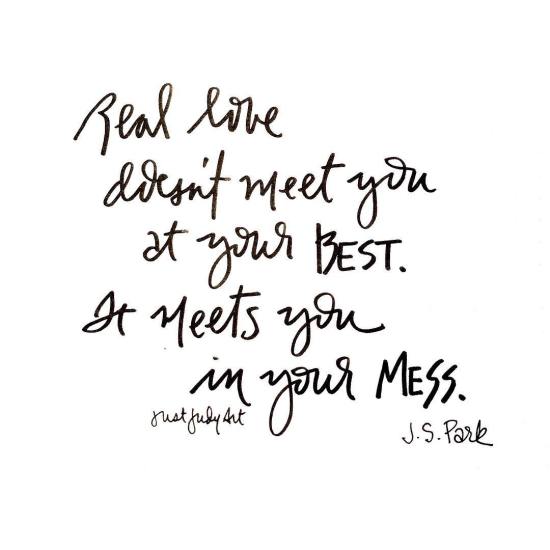
Real love doesn’t meet you at your best.
It meets you in your mess.
— J.S.
[Art from Judith Bernice]

Part of my hospital chaplaincy duties is to write a reflection on how it’s going. Identities may be altered for privacy. All the writings are here.
—
No—it doesn’t always work out.
The storm doesn’t always pass.
There isn’t always closure.
Not everything will be all right.
I won’t know why.
There’s a moment in the hospital when our illusion of safety is shattered and the stark reality sets in:
Things won’t change,
they won’t get better,
there won’t be a miracle,
and there won’t be a happily ever after.
It looks like God has exited the building, and that maybe He’s not coming back, and that we will never, ever know why this awful tragedy had to happen.
Babies die. Spouses drop dead at thirty. Diseases take and they take and they take. Prayers go unanswered. Drunk drivers walk free and their victims die slowly in a fire. People die alone. Some people don’t know who they are when they die; some people don’t have a single number they can call. They’re cremated by the county without a trace.
I soon found that I was having a series of tiny panic attacks over faith, more and more disorienting, these little underground bombs that threw me into crisis and left me scrambling for answers.
After a particularly hard case where a young woman’s dad shot her mom and then himself, I came home and tried to pick up some random inspirational book from my bookcase. What I found inside was so unimaginably distant and disgusting that I nearly threw it at the wall. I went through a few more books, and words that had once comforted me were crass and trivial. I couldn’t possibly believe that any of these authors had really suffered or seen suffering. I’m sure they had—and that’s what I wanted to see. Their raw edges. Not these luxurious, over-privileged travels and extra tips on mental re-arrangement, completely removed from the wounded. I saw these first-world tales as they really were: shallow, out-of-touch, and bereft of consequence.
I was lost in the whirlwind of malheur, the pain underneath our pain. I was struck by intrapsychic grief, from the loss of what “could be” and would never come to pass. I was a wax thread in a hot oven, my old beliefs dripping and frayed.
I suddenly understood the intensity of the Psalms, all the anger and violence and whiplashes of doubt, encapsulating the moments when we can no longer un-see this garish void of the nether, the unreturned.
I wondered if maybe it was easier not to believe, because believing was so dangerously painful.
Continue reading “The Irretrievable Vacuum of Unhappily Never After.”

I believe people are worse than we think.
I believe people are better than we think.
As a Christian, I’m both a pessimist and an optimist at the same time.
I’m painfully aware that we are capable of the worst sorts of evil, and worse, that we too easily turn a blind eye to the real grief of others. Many of us are so sheltered that we deny how deep such depravity runs in our veins. We laugh it off, we whistle past the graveyard, we gloss over the wounded. I’m pessimistic because I see how awful we can be.
I’m also painfully aware that we can be manipulated into thinking people are one-dimensional cartoon caricatures, so much that we become cynical and jaded over the possibility of change. Our very real fears are often exaggerated by a binary social narrative that has us ravenous for blood. We forget that each of us do have hopes and dreams and passions that overlap and interweave. I’m optimistic because I see how harmonious we can be.
I’m hopeful that the best of us, within us and among us, can build bridges through open scars and new stories through broken hearts. That we can give a voice to our uncertainty. That we are on hand one not extremely dismissive, and on the other hand not completely nihilistic. That we validate each other’s concerns and lean into our very real wounds, while not buying into the back-and-forth backlash of answering hurt with hurt.
I am holding space for our fears.
I am holding space for our hopes.
I’m a cynic and a critic.
I’m a believer and I’m with you.
Will you be with me, too?
— J.S.
Photo by Image Catalog, CC BY PDM
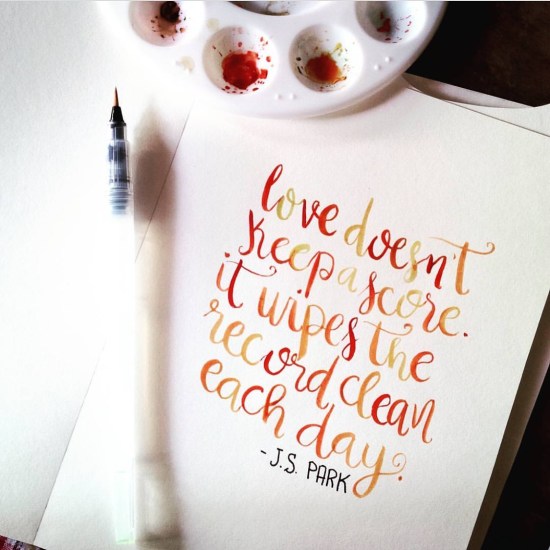
Love doesn’t keep a score. It wipes the record clean each day. It says good morning today and goodbye to yesterday.
— J.S.
Art by jeannedarvin

Hello dear beloved friends! This is a message called, Rest and Resolve: What Gets Us Through Deadlines, Demands, and Disorder.
It’s about what gets us through when we want to give up. You can stream above or download directly here. I’m also on iTunes here.
I talk about Jesus versus Peter at the Transfiguration. Some other things I talk about are: That moment of exhaustion when you sigh for a long time before you walk through the door, the burn-out check-out from school and marriage and career, the strange beauty of enjoying something you can’t pay for with nothing to offer, the greatest miracle Jesus ever pulled, faith as a long-distance relationship, a word for both perfectionists and slackers, and the one crucial question they ask you at a car accident.
All messages can be streamed here. Be blessed and love y’all!
— J.S.

Today I’m unusually bitter and sad about people, and I’m so very tired and cynical over everything, including myself.
May I be honest here? People are people and sometimes people will drive you insane, and some days I just want to pack up and take the next spaceship off the planet.
I know I’m not supposed to say any of this because Christian bloggers and pastors are so inspirational and full of “never-give-up” pep. We love our slogans and re-tweetable one-liners. I want to be part of the cute punchy Instagrams with the sugary Christianese quotes. But days like today, I just want to give up on everyone. At times being positive makes me feel downright sick. I want to flip a table and go to sleep for a month and I look at my Bible and laugh.
People can be so maddeningly frustrating, and I know this because I disappoint myself too. We can be in the trenches with someone for months and months, pouring out grace and absorbing all the hurt and sharing life to the bottom, but that person might do what they want anyway. I know that no one owes me anything and this isn’t about “listening to me.” I’m not trying to pull pity here. It just hurts to see a person that you invested in so completely lose it and drop off the face of the earth.
I usually hear from people when they’re desperately in need. I never get to see the other side when it’s better, and maybe I have to be okay with the unresolved-ness of it all. What I’m asking for sounds petty and unreasonable, and again, that’s not to say, “Oh poor me.” But I wish I had more reason to hope, more reason to stay. It’s so selfish, but I wonder why I keep doing this.
I’m learning that faithfulness is more important than fruitfulness, because even when there are no results and rewards, I’m still meant to run this race. Yet I’m also learning that most of the race will be hard work, in silence, amidst people who often don’t care, with little evidence that we’re making a difference and many failed heartbreaks of seeing others walk away. I’m learning this can be a cruel, thoughtless, heartless world, and to be a fleeting flash of light is so much better, and so rare. I’m learning again and again to trust God for what I cannot see, because He’s the only one who heals hearts to glory. I’m learning to encourage others along the way, because so many never get to hear that they’re doing all right, and I want to be the one voice in the crowd that actually breathes life, even when it’s for a second and forgotten.
— J.S.

germandreambaby asked a question:
Do you think that the love God has for us and for the entire creation is somehow different than what we understand as love? I mean, does the love of God have (entirely) different characteristics than human love? thanks for answering!
Hey dear friend, the short answer is: sort of yes and sort of no.
The love of the Christian God is so unique in that it purports no agenda, has no need for reciprocation, and has the motive of no-motive. God’s love exists simply because it does, for no reason except that He loves. There is no transaction, no equal exchange, no real economy. It is like a waterfall with no source and no ending, a constant wave after wave.
At the same time, God is unflinching when it comes to justice as being a part of love. Love is not merely sentimental, but also incorporates the safety and health of the other. That means telling the truth and keeping others accountable and gently persuading others away from the cliff of self-destruction. C.S. Lewis said it best: “Love is not affectionate feeling, but a steady wish for the loved person’s ultimate good as far as it can be obtained.” In fact, Lewis said this within the context of WWII, in the midst of atrocities, referring to how we can love the “enemy.”
Many of us will lean too much to one side or the other. In other words, every culture will have an incomplete misinformed idea of “love” because it’s either too sentimental or too safe. We go for sappy careless love and end up enabling and spoiling. We go for “tough love” and end up controlling and wounding. We get our boundaries wrong all the time, either too much or too little. We might pour out until we’re irresponsibly draining ourselves, or we might speak so much truth that we come off shrill and unapproachable. Sometimes we hold on too long or we let go too early. Such a perfectly balanced love is impossible for us, and we will never get it completely right.
Continue reading “How Is God’s Love Different Than Human Love?”

My very first pastor, Pastor Paul, was a ridiculous person. What I mean is, he kept pouring out his life to other people without any kind of tactical advantage to himself, and he never asked for anything back. He took strangers to job interviews, frequented the local hospitals, sent handwritten letters to everyone in the church and across the street, volunteered for clean-up at the park, brought bottled water to the beach all the time, counseled every church member at any hour, and somehow managed a marriage while making it to 6:00 am prayer every morning and preaching three times per week. Try to picture Korean Jesus, and that’s him.
I started attending church a bit late in life, around college, and I was one of those punk kids that any pulpit-pounder should’ve written off. I showed up hung-over on Sundays and bleary-eyed from partying on Saturday nights. I talked loudly in the back-row during the sermon. Church was just an extension of socializing at the club, and I endured the service stuff because I liked the hanging-out stuff. But Pastor Paul was just one of those guys who really brought it in the pulpit, and more than that, he was the real deal outside of it. Some of his sermons started to creep into my brain, and when I met up with him, he never judged me and never flinched at how I lived. He just loved. And without really knowing it, I became drawn to that supernatural pulse that was beating in his veins. I wanted to be like him—and by extension, like Korean Jesus.
I’ve thought about how my pastor’s job was often a thankless role with so much resistance against him, sometimes for no other reason than people just have their own thing going on. He took the hits and stayed around. He somehow served very personally without ever taking it personally. He was really for the other, never using ministry as a way to validate himself first, not as some kind of catharsis, but because he was invited into a story and a calling and a life that was meant to be given away. I loved that about him. I still do. He’s always looking for an angle or avenue to serve, even when he’s not wanted, not in an intrusive way, but to be available. I want to be about that, too.
— J.S.

Anonymous asked a question:
Can you please give the testimony of you and your wife?
Hey dear friend, I wrote on that a little bit here.
I met my wife about nine years ago (!) and while I eventually grew interested in her, she really did not want to be with me. At some point, she said she’d pray about it, and I waited about seven months. We sort of semi-dated, and at the three year mark, she broke it off. I was devastated, but I also understood: she had seen my darkness and it was too much for her. I was addicted to porn, I had anger problems, I lacked self-control, I was not the man I could be. Any rational woman would’ve broken it off with me.
She thought it was over but I kept a bit of hope. Over the ensuing months, I quit porn, sought counseling, and I had a complete breakdown. I took a two month sabbatical to really confront my own issues and reinvigorate my faith.
Here’s the cool part. During the two month break, I happened to be traveling up north on a personal road trip, and my wife-to-be, who I hadn’t seen in about six months, happened to be in the area I was driving through. She had just quit med school to rediscover her own career path. And we met at a cafe. I told her I still loved her, and she said, “Okay. Let’s try again.” Three years later, we were married.
Continue reading “Breaking Up and Getting Back Together: About Me and My Wife”

Some questions to ask ourselves before voting:
How will my vote affect the story and direction of our country?
Is this candidate I’m voting for going to help defuse our current racial tensions?
Is this candidate going to hold themselves accountable as an example?
Is this candidate capable of proper foreign policy as well as bridging the divisions between American individuals?
Is this candidate a step forward in the tapestry of progress and history?
Is this candidate the kind of person who can address grief, loss, and prayers with sincerity and movement?
Who are we more or less comfortable with in directing our social and cultural narrative?
— J.S.
Photo by Saint Julian, CC BY-ND 2.0

It’s a crazy, incredible thing to be in a place where people slow down and listen, where they hear your whole story and let you paint your full heart in the air.
I was telling one of my fellow hospital chaplains about life lately, about my health problems and secret panics and suddenly about a billion other things, every humiliating and painful and neurotic moment that had been twitching my eye for the longest time, and I didn’t realize how much I had bottled up in my neatly wrapped fortress. I was embarrassed, but my chaplain friend only nodded, never flinched, stayed engaged. She then prayed for me, a really beautiful prayer, like cool water for bruised purple hands, one of those prayers where it sounded like God was her best friend down the street. And I wept. A lot. Quietly, but inside, loudly. Something then shifted and settled and became still for a moment, like the leaves of a tree coming together after a strong wind, a momentary painting. I left lighter.
Later I visited a patient who had nearly died from a brain bleed, and when I offered prayer, the nurse grabbed me and said, “Me, too.” I took her to the side, and she whispered, “Cancer. I might have breast cancer, and I’m afraid, chaplain. I’m so damn afraid.” She clenched her teeth and tried not to weep, but I put a quick hand on her shoulder and she wept anyway. She talked. I listened. There was nothing for me to say but to be there. And maybe nothing had changed—except we were made light somehow, and together drew something bigger than us. We drew colors into the gray.
There are still places, I believe, even in a busy and unhearing time, where we can draw free. I hope to meet you there, where we are not okay, but less gray than yesterday. I hope to pray for you, that we become bigger.
— J.S.
Photo by Image Catalog, CC BY PDM

I hope we have eyes to see that God is doing something we cannot see. This takes discipline, but we have help. God has a vision far greater than my sight. He has an imagination that infinitely outweighs mine. We think a person is an impossible case: but God is in the business of the impossible. After all, He saved you and me.
— J.S.
Art from thehopeletter

Anonymous asked a question:
Would God purposely put His children in a situation where they would be hurt in any way (rape, kidnapped, something like that)? Or is this the work of the devil? I don’t think He would, but I don’t know.
My dear friend: There’s probably a huge list of questions I’d like to ask God the second I see Him (right after I collect my eyeballs back into my head). So right upfront: I’m not sure why the devil is given such a long leash. I’m going to ask God about that one, probably with my arms crossed and eyes rolled (and my head on fire).
The Question of Evil has not been adequately answered by the greatest philosophers of history, and I probably won’t be the one to crack it today, either. It’s the kind of stuff that makes me doubt God everyday. Even if I did have some solid theology on why certain atrocities happen, I still doubt it would satisfy the victim of abuse and slavery and oppression and terminal illness, no matter how much “logical sense” it makes to the brain. Even if I concluded, “All the bad stuff is really from Satan,” then a suffering person could only reply, “So what?”
I can only offer a few thoughts that might help you on your journey here, because this tension of why bad things happen will never be resolved by any single answer. Anything we say on pain will always be inadequate for the actual suffering person. No such all-encompassing answer from any belief system really exists. I say this as a chaplain who works in the hospital, who has seen the very worst kinds of suffering, knowing that any amount of inspiration or explanation will never be enough.
I can only say that I believe the Christian perspective best accommodates the problems we see today. I’m also aware that some of us will never meet eye-to-eye on this and we can “deconstructively reduce” anything I’m saying with snark and cynicism. That’s easy mode. And that’s okay. We’re free to disagree and wrestle and think for ourselves.
And please know: I would never, ever enumerate these reasons out loud the moment after a person has been seriously harmed. I would never bring this to the bedside of any of my patients in their inexplicable grief. None of this theology really matters as much as you being there in the trenches with a heart of listening and love.
As always, please feel free to skip around.
Continue reading “How Do I Know If It’s God or the Devil? A Mega-Post On Pain, Evil, and Suffering”
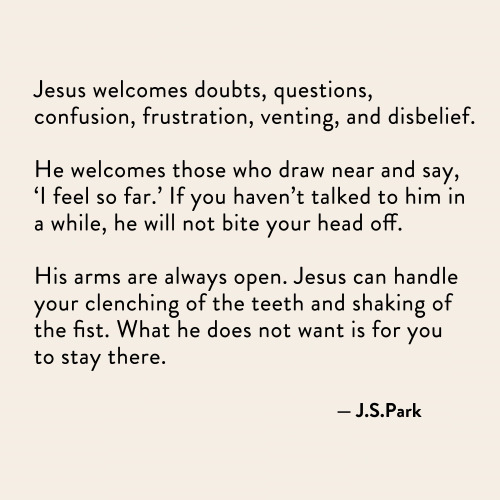
Jesus welcomes doubts, questions, confusion, frustration, venting, and disbelief. He welcomes those who draw near and say, “I feel so far.”
If you haven’t talked to him in a while, he will not bite your head off.
His arms are always open. Jesus can handle your clenching of the teeth and shaking of the fist. What he does not want is for you to stay there.
— J.S.
Art from worshipgifs

Occasionally I’ll binge-read atheism blogs to re-examine my faith and to remember what it was like when I was an atheist. Some of the online debates are absolutely terrible, but a rare few are civil, compelling, and thoughtful. I have to really pause and consider the implications of a godless universe.
It’s always such a balancing act to question your own faith, but I also think most Christians are too afraid to look over the edge, to dance on that precarious cliff of hard questions, so we run to easy answers and bad arguments. We’re too scared to investigate doubt. We’ve equated a lack of confidence in faith to some kind of moral value judgment, as if “doubt” means personal failure. I refuse to believe that questions must mean a lack of character. I propose the very opposite: that we must have a place of safety to ask those questions and to not be threatened by curiosity.
I hope that whatever you believe, you would investigate it thoroughly to the very bottom and think through every foundation. Please do not let anyone do this for you. Simplistic platitudes will not get us through the darker times, but we also believe more lies than we think.
— J.S.

Anonymous asked a question:
So I’m taking an honors world history class taught by an atheist teacher and we’re learning about evolution and it’s really really testing my faith. Honestly I don’t know what’s true right now. My theology isn’t the greatest because I’ve only accepted Christ for two years now. I’m just now finding it hard to believe in the Bible and God right now.
Hey dear friend, thank you for sharing this with such honesty.
The truth is, every single type of belief system will eventually get shaken somewhere. When this happens, we can 1) investigate deeper into what we really believe, and 2) incorporate the new information into our beliefs somehow.
We each experience a kind of cognitive dissonance when our worldview is shaken. It can actually make you disoriented, nauseous, and depressed. Sometimes it’s from learning more about the world, or it’s from a terribly brutal tragedy, or it can be a very persuasive argument that uses flowery language. And these experiences will inform our theology and philosophy, and vice versa. But none of this has to be a threatening, stomach-punching trauma.
While we’re certainly going to feel what we feel, we can still explore this new information in light of what we currently know, and then navigate a way through it. It’ll be tough, and you may be scared or surprised by your conclusions, but it can actually make you a more thoughtful, whole person, too.
Continue reading “A Faith Crisis: When My Theology Is Shaken by Science, Debates, and Headlines”
 J.S. Park: Hospital Chaplain