Is anxiety a sin? God says to be anxious for nothing. I googled it and apparently lots of Christians say anxiety is a sin. Means you don’t fully trust God
Hey dear friend: No, I don’t believe that anxiety is a sin.
Anxiety results from a broken brain, originating from a world that is flawed, fractured, and has fallen short. At most, anxiety is the result of a sin-torn world. But no, it is not a sin that you’re premeditating, as if you’re somehow planning on having an anxiety attack.
When Scripture says “Be anxious for nothing,” well—that word anxious also means distracted or divided or pulled in every direction. Later Paul says he is content with being hungry or well fed, living in plenty or in want. In other words, he does not have a consuming preoccupation with a perfect situation. He is not basing his happiness on a full stomach or material pleasures. He is writing from prison, after all, and has chosen not to to base his value on his surroundings.
I think there’s a kind of anxiety not related to mental health, which is more of a restlessness for “better,” and it can never be content. This is not about mental health, but rather a moral choice of internal character. Paul says that by praying we’ll have “the peace of God that transcends all understanding,” which in context appears to mean that we’re not always consumed with upgrading our circumstances. It means trusting God even when we don’t have everything that we want. That sort of peace is not easy to find, but it’s possible.
But let’s assume Paul was talking about anxiety the way we understand it.
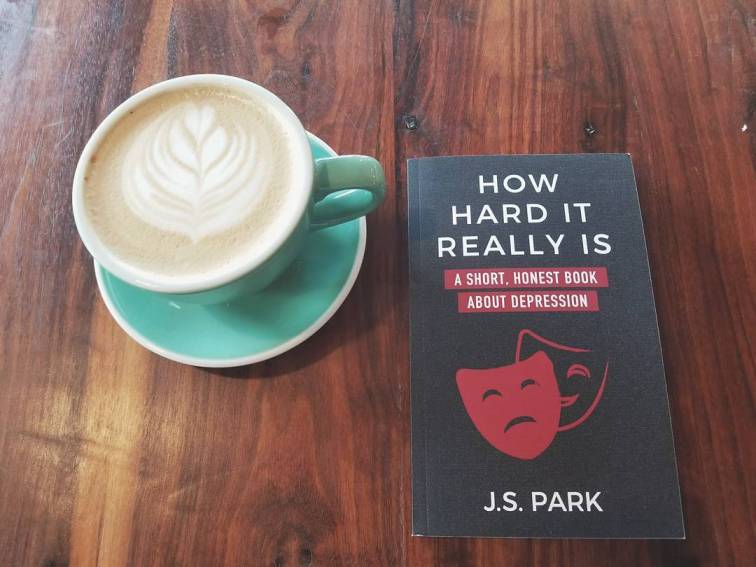
Good Friday to you, friends. My publisher sent my books early for me. It’s incredible and surreal to finally hold my book in my hands.
My book launch team is still open if you would like to help support the book release. You get an advance copy of the book, giveaways (like art by Red Hong Yi), Q&As, and live video chats: https://www.facebook.com/groups/thevoiceswecarry
Hey friends! My book is releasing in one month, and my Book Launch Team is now live!
The Book Launch Team is for those who want to support my book release. If you’re committed to joining the team and writing an honest review, check it here: https://www.facebook.com/groups/thevoiceswecarry
You’ll get a free advance copy of the book and giveaway prizes, and I’ll be doing live chats and Q&As. There will be some really awesome discussion and fun activities along the way. Space is limited!
My book is available for preorder here and releases on May 5th.
To find out what the book is about, check here.
I messed up. I hugged someone. We’re supposed to practice social distancing, but my friend badly needed a hug. I know I shouldn’t have. I couldn’t help it. — J.S.
Not everyone can stay home to wait it out.
Some have to keep working.
Some have lost their jobs.
Some have never had a home.
Some will never go back.
Maybe things are “not that bad” for you. Maybe “this too shall pass”—in your world. But someone you know doesn’t have that luxury. Someone you know is permanently affected. They’re grieving a loss, whether it’s loss of their autonomy or a whole person. Our advice doesn’t apply to them, because it can’t.
Stats and facts gloss over real loss. Two in one-hundred doesn’t sound like a lot, but if any two people I knew had died this week, it would be absolutely devastating.
To downplay any grief and loss doesn’t help, and if you keep quoting statistics to show “it’s not that bad,” you’d be the last person I would go to for help.
No, we shouldn’t panic.
But please don’t tell people it’s fine
when they’re not.
The storm doesn’t always pass. Not for everyone. Pain can last for a lifetime. We can only hope to adjust to the new normal. By the grace of God, I will crawl down there with you. — J.S.
Hey friends, I did a video with my publisher Moody Publishers to talk about COVID-19.
I go through five points: How to approach the pandemic from a chaplain’s perspective—dealing with our fear, with each other, and with ourselves—and I directly address those who have tested positive for COVID-19 or have lost someone to it.
I hope even a single sentence will help you through this time.
(Also, this might be the first time you’ve heard my voice or seen me in video, I apologize in advance.)
God bless and much love to each of you, friends.
— J.S.
I’d like to think I’m not a fearful person. But I am. I never look like I worry, but I do. A lot.
This week I made the mistake of very publicly bringing up my fears about coronavirus in the workplace. I don’t mind catching the flu, but my wife is pregnant and the flu can adversely affect our baby in utero. I said some uncomfortable things in front of coworkers, when I’m supposed to be the calm voice of a chaplain.
I was not helpful. I probably incited panic and anxiety. I apologized for my behavior. Maybe the fear of being a dad in our current world really got to me. It was still not a good look.
I’m trying to balance the fear we‘re experiencing versus being calm, safe, and rational. I want to validate our anxiety without letting it consume us. I want to be vigilant, but not so on edge that I’m scaring everyone else. I want to say “God is in control,” but also run screaming and lock every window. It’s a tough, strange balance.
We’ve seen where the fear can take us: there’s been multiple racist assaults against Asians, blaming them for the pandemic. We’ve seen misinformation about drinking water and eating garlic and avoiding packages from China. We’ve seen the ugly finger-pointing of political leaders using the panic for vote-bait, promoting xenophobia and catering to the worst leanings of their base. And everyone—including me here—has some take about what to do, how to be, what to say.
I’m trying to stay cool. To be both cautious and optimistic. It’s hard. It’s scary right now. I keep thinking of raising a daughter in this world and how I’m so incapable, unsure, uncertain, lacking the wisdom to say the right thing, to be a pillar when she needs me. I hope I can be strength for her even when I have so little of it in myself.
I’m trying to validate fear without giving into it, to let fear ask questions and seek wisdom and move towards compassionate curiosity, rather than hate or rash decisions. God be with us, who navigates our fears, who hears our worries, who gives us wisdom amidst division, who offers us a peace like no other. — J.S.
Hey J, I know the Bible contains God’s instructions for us, but in this modern time, I wonder if it’s ok to also look at “secular advice” on topics like developing your career (especially as a young person), money management and general life stuff (e.g. being organised and good mental health). I don’t refer to anything against God, but what if the source of the advice is still someone non-Christian? I hope you know what I mean. What do you think?
Hey dear friend, I absolutely believe that “all good knowledge is God’s knowledge,” and that anything useful to you is divinely anointed.
While we might not see eye-to-eye on this, I don’t believe there’s a “sacred/secular” divide. It’s a strangely false dichotomy. As a Christian, to reject “non-Christian sources” is no better than when the evangelical church boycotts a movie or a department store. If we had to boycott the things we disagree with, we’d have nothing left.
My father is an abuser and maybe it’s stupid, but how can people can not be afraid of the words “our father in heaven”?
Hey my friend, thank you for sharing so honestly and I’m sorry you experienced such abuse. I hope and pray you are at a safe distance today and that you are recovering.
Your concern is not “stupid” at all. It’s absolutely valid. I work as a chaplain at two places, the hospital and a homeless shelter, and when I address God, at both places I am very careful when I say “God our father.” Especially at the homeless shelter. Many of the low income families I encounter have not had good experiences with any sort of male figure. To say “father” is okay for some, but also devastating for others.
The cast and crew of "Parasite," including Yang Jinmo, Han Jin Won, Kwak Sin Ae, Lee Ha Jun, Yang-kwon Moon, Song Kang Ho, Cho Yeo Jeong Lee Sun Kyun, and Bong Joon Ho arrive at the 92nd Academy Awards on Sunday, Feb. 9, 2020, at the Dolby Theatre at Hollywood & Highland Center in Hollywood. (Jay L. Clendenin/Los Angeles Times/TNS)
I saw Parasite / 기생충 in a packed theater with a diverse crowd. Looking around, I never could’ve imagined a day in the States when such an audience would watch a movie in my language, with my people, telling our stories.
It really meant a lot to me. I have to tell you why.
I remember in middle school when someone assaulted me while yelling “you ch_nk yellow belly.” Someone shoving me in a hallway telling me to go back to where I came from. Multiple times someone would squint their eyes, do their version of an Asian accent, pose at me like Bruce Lee, all while high-fiving each other. Having to endure that scene in Breakfast at Tiffany’s, being told it was “art.” Someone in my college history class telling me that Korea needed to be nuked, and “it doesn’t matter which one.” I remember when my dad’s business was spray-painted with a swastika. I remember inexplicable rage when some kid yelled “your dad killed my dad in the war,” and his dad picking him up later after he was sent to detention.
Art, music, film, books: these things have the power to take away our fear, our bigotry, our assumptions. They turn masses into individuals. They turn cartoons into real people. For someone like me, I have to prove daily I am a real person. For art to put my story into public consciousness is allowing me more room to breathe, to exist.
A part of me wishes a movie like Parasite could’ve been accepted earlier. Seeing a face like mine on a big screen has an immense affect on how we see each other. But more than that, a good story, like the one in Parasite, makes us more human. Hearing more stories makes us better, more whole, more gracious. We need diverse stories, and good ones.
During the movie, I looked around. Seeing so many faces enraptured by a powerful story, taken in by faces that looked like mine, I wept. Certainly I wept because the movie was incredible. But I wept feeling something I never had before: a kinship with strangers. Humanization. The image of the divine, seen and known.
After the movie ended, we all sat in our seats for a while. Collectively, our breath was taken away. And collectively, we were sharing breath. Maybe I’m making too much of a movie. I suppose it’s a silly thing to weep about. It only tells me how long I have been deprived of such connection. These stories, they’re important to tell.
What do you do if every time you bring up God in a conversation someone changes the subject?
Hey dear friend, I would say: Let them. Be kind and let them.
That doesn’t mean you never talk about your faith around that person. But my guess is that
1) the topic of God is painful for that person,
2) the topic of God is repulsive for that person,
3) it is not entirely relevant for that person, or
4) I say this with much love, but maybe the manner in which faith is brought up has not been gentle or understanding.
You cannot force someone to talk about something they don’t want to. I’m not saying you’re doing that. But if they’re changing the subject and your goal is to “bring them back to God” all the time, you’re coercing that person into a subject that they obviously don’t want to discuss.
A Christian’s goal is never to transmit information until another person is persuaded. That’s a very westernized way of evangelism. It assumes that a “threshold of theological knowledge” is what makes a Christian. Modern church evangelism is a memorized checklist of systematic facts, and it seems that once you can recite those facts, this must mean you’re close to God. This, of course, is not true.
In the end, you can’t force someone to do anything, even if it’s for their good.
You can’t force someone to respect your feelings or care about your passions or believe your dreams.
You can’t force someone to believe your side of the story, even when you’re right.
You can’t force an apology.
You can’t force someone to engage in justice or fight for the poor or to become nuanced in culture and history.
You can’t force growth.
You can’t force someone to show up on time, or even show up at all.
In the end, I’ve learned that people will do whatever they want, even if that means stepping on you or neglecting you or abandoning you or belittling you or choosing others over you. I’ve probably done this to others as much as it’s been done to me. It’s a terrible cycle that can leave us bitter, suspicious, paranoid, and completely jaded.
I’ve also learned that I don’t care if others don’t care. I have to love anyway. I have to be patient anyway. I have to be cynical to cynicism. Because I don’t want to perpetuate one more cycle of apathy and neglect. I don’t want to be one more rung in the ladder of indifference. I don’t want to react to someone’s reaction all the time. And I must believe the best of others, because change does not happen by standing over, but standing with, in trust.
No, I cannot force change on you, and I won’t. I can only pour out what I have. Even if you don’t care. Especially if you don’t care. I’ll pour out anyway. In the end, our lives will have been given over to dust. I’d rather mine will have been given over to you.
I’m not a therapist or doctor, but as a hospital chaplain, I’ve seen the terrible and awful effects of loneliness on mental health. The problem is that it’s tough to admit, almost embarrassing to say, “I’m hurting from loneliness.”
Loneliness is a double-bind in that in order to find comfort, it requires reaching out to people or for people to be near. But some of us have been alone so long, it’s unthinkable that we can connect with another human without risking rejection—which fuels more loneliness.
The unhelpful reply I hear to “I’m lonely” is “Why don’t you just make friends?” But that’s like saying, “Why don’t you just get rich?” or “Why can’t you just go to the gym?” We’re already in deficit, a lap behind, because we fear connection in proportion to how alone we feel.
It’s difficult to make friends and keep them. It’s hard to have real friendships that are not just functional transactions. Even when someone is surrounded by crowds or well connected, they may be the loneliest people on earth, because all their “friends” are transactional.
I don’t know the answer to loneliness. But I know what the answer is not: We can’t just snap out of it. We can’t just cure it with a party, a bar, a church, a dating app. It requires intentional investment and yes, the risk of rejection. The opposite of loneliness is courage. It takes courage to reach out, to enter each other’s orbit, to risk trust, and to be alone in our thoughts and fears.
Friends, this week may be lonely. This season can be brutal. They can remind you of all that’s missing. As trite as it sounds: You may feel lonely, but you are not alone. May you find the courage to reach out, to enter the possibilities of love in all its heaven and heartache. — J.S.
When I preach love in a time like this, my words aren’t credible because the church is not. I can’t help but feel the church is always part of the problem. We contributed to this mess.
The church is called to be the safest, most gracious place on the face of the earth. Not perfect, but passionate, with arms open as wide as the cross. I know I’ve fallen short. God help us. God start with me.
If your faith is making you a jerk, throw it out and start over. If your faith makes you want to fight “worldly people” all the time and you‘re always shaking your head at “this generation,” then your god is too small and your god is probably you.
One of the reasons I was an atheist for so long is because I often wondered if religion makes people worse. Objectively worse. Religion seems to set up a battle position in which “I must guard the truth” and “If you disagree, you’re the enemy, the infidel, the heathen, and evidence of the apocalypse.”
Instead of serving the poor and welcoming foreigners and loving the rejected—you know, the stuff that the Bible cares about—money is spent basically enforcing a kid’s fort with passwords and Don’t Enter signs and alarmist war strategies against a phantom caricature that’s only made up to feel like something important is being fought for.
My guess is that some religious folks do not see their faith as a gift that has saved them, but rather as a weapon by which they must “save” everyone else. So then, the kingdom-military-triumphalist language in the Bible is lifted to boost the ego and separate from “worldliness” and to claim that any criticism against the church is “an attack against the family.” It makes Christians look really weird. I don’t mean that in a good way, like “Wow she’s so weird for giving away money to fight human trafficking.” I mean weird as in “He just hurled that venti Starbucks coffee at the barista because it didn’t say Christmas on it.”
Yes, persecution exists. Which is all the more reason that saying persecution can never, ever be used in a comfortable context. God stop me if I ever think I’m being persecuted when I’m really being called out and held accountable. God help me if I ever use my faith to divide, out of superiority, as a lens of cynicism, instead of giving me hope that we are all within God’s grasp, His grace, His peace. — J.S.
Hey friends! I’m super excited: My book is going to be released in exactly five months, on May 5th 2020. Home stretch!
Soon I’ll be launching a book campaign where you can get an advance copy of the book, plus I’ll be live on webcam to meet you, answer questions, possibly present my dog. If you’d definitely like to be part of the group, please message me your email!
Next year in April, I’ll be going to Chicago to give a chapel message at the Moody Bible Institute. And in May, I’ll be at the NY BookExpo in the Javits Center, at a stand with my publisher. Hopefully I’ll get to meet you in Chicago or NY! (Sorry, my dog has other plans. He’s a midnight yodeler back in Florida.)
I would love your prayers during this time. Writing a book is crazy hard. This is on top of a wild full-time job, part-time job, marriage, and yep, my dog. Totally not complaining, it’s all a blessing. But I humbly ask for prayers of strength and rest. Thank you in advance, truly. Please let me know how I may pray for you, too.
You need to know: Each of you helped to make this book happen with your constant presence and kind words. Thank you. I’ve learned so much from your stories and comments and dialogue.
God bless friends, and much love to each of you. — J.S.
I was telling my story to somebody the other day and I got to the various injustices of racism I’ve endured, and he told me, “That doesn’t happen. Not anymore.” I insisted it did, and he counter-insisted, “That’s just something everybody goes through, you’re just injecting race into it.” I tried to tell him about the times someone had physically assaulted me while yelling “ch_nk” or “go_k” or “yellow kid” or “your dad killed my dad in the war,” but he kept telling me, “That’s not that bad.”
So I excused myself from the conversation. I felt a bit humiliated, honestly. This was a guy I really trusted, who I was sure would understand. He was absolutely adamant he was right.
I’ve seen this sort of thing with mental health, sexual abuse, family upbringing, classism, gender, religion—you try to tell your story, and a wall comes up. You get the reply, “It’s never happened to me, therefore it never happens.” And you start to wonder: Am I the crazy one? Is it just in my head? Am I overreacting and too sensitive, like they’re saying?
But then I’ve found those who heard me. Who listened. Who weren’t just treating me like a sad pity project or asking out of voyeuristic curiosity. I’ve found safe people who may not have gone through the same thing, but they can literally become the other. They pause to believe.
I’ve also found those who have walked in the same shoes and skin. Sometimes they thought they were walking alone, against insurmountable forces with no community and zero support—until they heard someone say a similar story and they knew they weren’t crazy. That gives me enough courage to keep speaking, to keep sharing. It’s in the telling of our stories we find healing, and each other. You may be lonely for a while, but you are not alone. — J.S.