A Theology of Loss, Love, and Leaning In

For my chaplaincy, I had to answer the questions:

Where is God in the midst of suffering, loss, illness, tragedy?
Where is God for the patients?
Where is God for you?

Here’s my meager attempt to answer these very huge questions.

In the worst moments of our lives — the cancer, the car accident, the phone call that changes everything — I’m not always sure where God is. Even the most trusting and devout are spouting, “God’s got this” with quivering lips and a shaking voice, with the slight clench of a fist, with feverish bewilderment: because the words fall flat on the cold linoleum of the hospital.

No matter how much theology we know in our three lb. brains, it all goes out the window when the floor opens up and steals us into the abyss of loss, the irreversible before and after, and the world becomes a chaotic, unsafe place of random disaster.

I can’t say where God is.

I can only say with some certainty where God is not.

I don’t believe God is distant and detached from our pain. I don’t believe He’s gloating over us behind a glass cage. I don’t believe He uses pain to teach us a lesson. I don’t believe that trials are part of “God’s amazing plan for your life.”

I don’t believe that God is some stoic, abstract teacher who waits for us to “get it.” Pain is pain, and it hurts, and no amount of theology is going to glamorize a special reason that it happens.

Not every pain has a connect-the-dots theology. When a hurricane misses a city and everyone “praises God,” it’s only condemning the millions of people who are hit by the same storm. When a child dies of preventable diseases or drunk drivers or a genetic anomaly, there’s no curse or blame upon the child. We can’t force such a tragedy into easily quantifiable boxes. To make such a correlation, if anything, is worse than the pain itself.

The truth is that we live in loss every single second, just by the mere fact that our lives won’t turn out the way we want them to. We live within absolute suffering just by losing time on the clock in the inevitable march towards death. The hospital only puts a neon sign around the coffin that awaits us all.

But my Christian faith tells me that this is completely expected. We live on a fallen world where the thread of sin has woven its tendrils into every part of our being, and that something will always be missing. Rather than deny pain, the Christian faces it head-on and acknowledges the tension. From our grief in loss to our hunger for approval to our need for intimacy: we float in this strange limbo of discontent, where nothing is ever quite the way we want it.

At the same time: My faith holds onto the hope that total fulfillment really exists. Our pain is unbearably awful, but it actually points to our desire for a healing of everything that has ever fallen apart. The inverse irony of pain is that when we’re hurting, it conveys a contrast to a very real wholeness. It’s why pain hurts. Pain tells us that something is terribly wrong and we know it ought to be put right. Or as C.S. Lewis said, “Nothing is yet in its true form.” The very reality of suffering points to our need for an ultimate comfort and justice: for God Himself.

This means there is some perfect song on the other side of the door; a light at the end of the tunnel that fills the tunnel; a beauty that doesn’t explain our pain, but is stronger and louder and bigger than all that has happened to us. We know this because we know bad notes, we know the darkness of a tunnel, we know the scars of marred beauty. Christianity says that the only real beauty is the infinitely satisfying perfection of God, who is the only being in existence that fulfills every longing we’ve ever had for truth and beauty and wholeness.

But I believe that Christianity fulfills us not only by perfection, but also by descending. Christianity says that God became one of us, out of solidarity, to suffer with us, not as a mere deity in an abstract palace, but a flesh-dwelling person in a sand-swept desert, so that, though God is so above us, He knows what it’s like to be one of us. The Christian believes in a God who wept and bled and suffered, an infinite God who infinitely compensated for our hurt, thereby cosmically answering for our afflictions and fulfilling the deep need to be heard and known at our very worst.

This must mean that God is just as mad at suffering as we are. God must be grieving with us, too. And in fact, my Christian faith tells me that because God is mad at our pain and still perfect, we’re also allowed to be as mad as He is at the very same things.

Maybe there’s an intellectually satisfying answer why we’re suffering: but what I want is someone who relates instead of debates. This is why we get flustered when someone connects the dots on our tragedies. It’s better they get with me in the trenches.

This means my job is not to solve for the other person’s pain. It’s not to bring diagrams and flowcharts. It’s to sit inside the uncertainty and anxiety of suffering and to shout against the dark, until we have shouted ourselves out. This is when God can begin to show up at all, for at our rock-bottom, He is already there.

Continue reading “A Theology of Loss, Love, and Leaning In”

I Want a Better Church (And the Church Is Me)

Photo from worshipgifs

Anonymous asked a question:

Sometimes I get really angry at the Western-Protestant church for our consumerism in Christianity and how we base our worship services on emotional highs and raise our hands to the bridges and hooks of songs, out of emotion, and neglect the God they are being sung to.

Hey dear friend, I get mad about that, too. There’s a lot of strange fakery out there and I think people are catching on.

Here’s one thing I’d gently like to suggest, and as I have no pastoral authority with you and I’m just a stranger online, you may please feel free to dismiss what I’m saying and to disagree. I hope you will hear me with a pure heart of grace and love for you.

I absolutely believe you’re coming from a genuine place of desiring authenticity. The only thing is, I wouldn’t want that to make you run the opposite way against a certain subculture or a group of people, as if “I’m not gonna be like those Christians” is going to help. I can promise you with guaranteed certainty that it will not.

Consumerist Christianity is bad; emotionalism is bad; legalism and fundamentalism is bad; those are true sentiments. But at times these sincere convictions can filter the way we see all of church, so that by slow degrees we begin to think buildings are bad, programs are bad, techniques are bad, schedules are bad, and let’s not do it like those guys with big speakers and jumbotrons, and we’ll show them what it really looks like, and I’m so anti-institutional and counter-cultural, and I’m so over the plastic manufactured Sunday machine, and let’s be organic and “get back to our roots.” This is such a common temptation to every Christian that I’m sure it’s Satan’s favorite game-plan.

An over-desire to be “purist” is still idolatry. It’s exactly how Satan fractures the church so that Christians will bicker and grumble at each other instead of looking past the box and getting into the battlefield.

Continue reading “I Want a Better Church (And the Church Is Me)”

Before Jesus, After Jesus.


Maybe you’re way further along than you thought you were. Every blip and spurt of righteousness in your life is nothing short of a supernatural God-made miracle, because naturally in our own fleshly skin, we’re incapable of True Good. Before you met Jesus, you didn’t even care about trying to live right or to make a difference or to help people — and if you did care, it was motivated by self-promotion, image maintenance, social standards, and Darwin-esque survival.

But after Jesus, you have the reason of No-Reason, because now you’re lit up by a Person who out of his own initiated love dared to die in your place on the cross and put His Holy Spirit in you to live out your true calling: which is to love him and love others without expecting anything back. You’re re-created with a new heart to care about what God cares about, and the Father is proud even of your stumbles. Any step forward into your purpose is like the birth of a new life: it is momentous, surprising, awesome, and worth celebrating.

— J.S. Park | What The Church Won’t Talk About


Photo by athenagracee

An Artist Turned My Words Into Art.

Quote Alyssa Wans


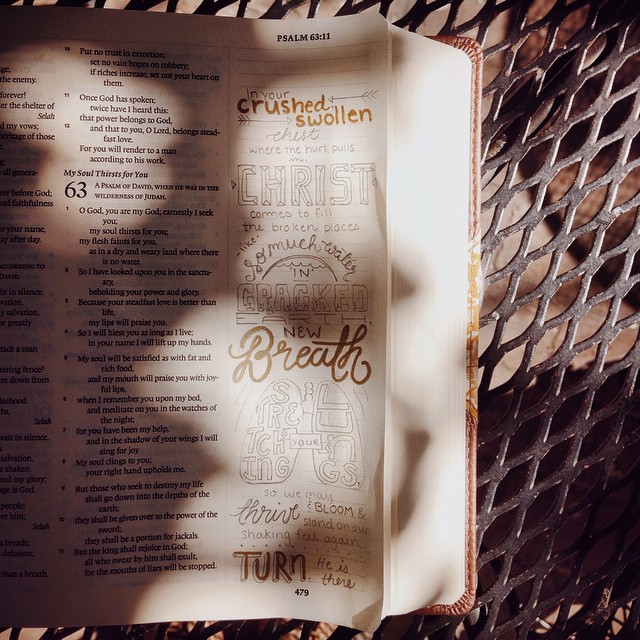
This is the first time anyone has ever made art out of my words. A quote from my book. I’m absolutely amazed by the beautiful skill and artistry, and the fact that anyone would make art out of anything I’ve said. Thank you so much, Alyssa!

Alyssa’s Tumblr blog and Instagram! Her art is incredible.


“In your crushed swollen chest where the hurt pulls in: Christ comes to fill the broken places like so much water in cracked earth, new breath stretching your lungs, so we may thrive and bloom and stand on our shaking feet again.
Turn. He is there.”


My book What The Church Won’t Talk About is here.

Everyone’s Screwed Up, Busted Up, and Catching Up: And That’s Okay

image

I don’t think I’ve ever really met anyone who is living out of a full cup.

What I mean is: Everyone lives a lot further ahead than they really are, giving advice they don’t follow and loving others without any love for themselves and running on empty all the time. We’re all on fumes.

I’m finding out this is okay for today, and no lifetime is meant to be lived in a day.

There’s this Secret Guilt going around that we’re all halfway hypocritical frauds who will maybe one day catch up to an awesome version of ourselves. It’s a desperate hope that we’ll eventually do what we’re preaching with our mouths and our blogs. And then we blow up or flip a table or punch a wall and that monster comes out, and we think “Where did that even come from?” — and the Guilt chokes the pit of our stomach again.

The finality of settling into your own skin never arrives.

We co-exist with the monster.

I remember a famous pastor who deleted his entire backlog of podcasts from his first years of preaching.  Because he “no longer agreed” with those old messages.  I thought it was pretty humble.  But I also thought, What about those people who heard those old messages?  What if they followed through on that stuff?  Are they just screwed?  And ten years from now will you delete your stuff from today?

Every artist I’ve met says their first drawing, song, poem, novel, or dance routine was unworthy. They’re hard on their first creations. You know, that whole “you are your own worst critic” paranoia. But: Don’t we all have to purge these things before moving onto greatness?  And what about those people who enjoyed the first creations?  Are they just idiots?

Everyone keeps saying, “I used to be so stupid.”  Or, “I was so empty when I taught that thing.”  Or, “I didn’t even deserve to preach that sermon on marriage, my own marriage was failing.”  Or, “I wasn’t even following my own advice.”

It’s a reoccurring pattern.  No one ever thinks they’re good enough to do what they’re doing.  Or they think now they’re okay, but everything before today was terrible.  “I finally found my voice,” they say, which is at once a victory and an admission of defeat.

It’s scary to think we’re always walking in the dark, the light dissipating just out of reach.

Continue reading “Everyone’s Screwed Up, Busted Up, and Catching Up: And That’s Okay”

“How Do You Keep Believing In All This Faith S—t?”

[A pastor’s confession.]

Often I’ll have a friend from childhood find out that I’m a pastor and they’re downright incredulous; they’re just as surprised as I am that I ever went from atheism to Christianity, much less ministry. “I thought you were too smart for that” or “You were always the wild guy, never thought you’d settle down.” Most of my friends went the other way and fell out of faith like it was a varsity jacket, or an old diaper.  They ask, “How do you keep believing in all this faith s–t?” – not because they’re trying to trap me, but because they’re genuinely curious for a coherent explanation. They do want something.

To be truthful: most times, I don’t have a good answer.

I often wonder myself, How do I keep believing in all this faith s–t?

Sometimes, I find the whole thing just crazy. When I reduce Christianity down to one or two sentences, it sounds ridiculous coming out of my mouth. I believe that if I telepathically offer my cognitive affection to a Jewish zombie who tells us to eat his flesh and drink his blood, then I’ll have immortality and half a better chance to run for political office.

A fellow Christian will tell me, “Oh no, doubt is a good thing, it means you’re at the edge of solidifying a deeper faith by investigating your most foundational beliefs.” Which I guess could be true.

A fellow atheist will tell me, “Oh no, doubt is a good thing, it means you’re at the edge of coming back to reason and shedding a fear-based crutch that’s having less relevance and respect in the world.” Which I guess could also be true.

Both would say, “You’re finally being intellectually honest.” Both say, “You’ll come around.” Both say, “If they could just admit they don’t have everything right.” Both say, “They’re just so blind and have the same boring arguments and the ‘burden of proof‘ is on them.” Both are rude, unthoughtful, unmoving. And of course, they both love to yell ad hominem.

It all just sounds the same to me. I could quit believing. I could keep believing. I could walk away. I could walk harder.

Continue reading ““How Do You Keep Believing In All This Faith S—t?””

How C.S. Lewis Felt About Everything


A rare picture of C.S. Lewis.

It has been fifty-years since the passing of C.S. Lewis, as well as JFK and Aldous Huxley. It’s also been one-hundred twenty years since Lewis was born.

C.S. Lewis has been the most influential Christian writer in my spiritual journey. He has shaped my spirituality more than any other writer I know. I do not agree with all he says (when do we ever find such a person anyway?) — but he is absolutely a kindred soul. I also love his tales of pulling pranks on his dear hapless friends.

To commemorate, here are some of my favorite Lewis quotes.

Continue reading “How C.S. Lewis Felt About Everything”

Birthday Campaign to Fight Human Trafficking


Birthday Campaign to Fight Human Trafficking

Last year I donated half my salary ($10,000) to fight human trafficking.

Today, March 7th, is my birthday.  Instead of gifts, I’m asking that you consider donating with me to fight for this cause together ..!

You can donate here to my campaign (scroll to the middle of the page), and all proceeds go directly to fighting human trafficking and sex slavery. 

Please consider giving $5, 10, 25, or any amount you’d like!


Here’s what your contribution can do:

  • $50 provides one month of education/vocation training for one rescued girl (age ranged from middle school/highschool)
  • $37.50 provides one month of Health + Hygiene (Medication, toiletries, medical visits, water) for a rescued girl 
  • $250 covers the cost of 6 days of aftercare for a trafficked victim
  • $500 covers the cost of 7 days of legal advocacy

Thanks for considering.  Love y’all!


— J.S

An Interview with One Day’s Wages About Giving $10,000 To Charity


The organization One Day’s Wages to which I had donated $10,000 wrote up an interview with me. Check it out here.

You can also help contribute to fight human trafficking with me.


Here’s an excerpt:

You are donating half of your salary. This is crazy and some might say even stupid. Why did you choose to do this?

Earlier in the year, I listened to a sermon in the car by Pastor Eugene Cho (founder of ODW) from the Catalyst 2011 Lab, and I was pretty much struck dead. The main thing that kept rocking my gut was: You can’t ask other people to do what you’re not first doing yourself.

I had been playing it pretty safe for a while — the typical blogging pastor hoping to stir up his little youth group to bigger and better things, and while there was growth, I just knew I was missing it. Every week I thought, “Well next week we’ll be fired up. God is cooking up something.” But Ephesians 2:10 had been pressing me — you know, those good works God prepared in advance for us to do. I just didn’t know how to fulfill the “do.”

I don’t make a lot of money, but I’m filthy stinking rich compared to the world. I’m sure you’ve heard other preachers go bananas on that before. On that night in the car, Pastor Eugene laid this on pretty thick, but that particular night was different: something just tore open raw inside.

By the time I got to my destination, my face was a slobbery mess. I was kind of crying and laughing and shaking my fist at God all at the same time. My level of “radical” was being challenged to become the biblical norm. I knew I’d be called crazy, but I decided: it would be crazy not to go for it either.

Read the full interview