
Seven Quick Tips for Wedding Planning

2-details-039-L

Photo from my wedding, taken by Angel He

see-the-good-life asked a question:

Any advice for a young couple planning a wedding?

Hey dear friend, first of all: congratulations on your engagement if you’ve indeed been engaged! It’s an exciting and scary time, and can be very stressful, too. Here are a few things I learned both during and after the wedding to help. It will be a different experience for everyone and you may feel free to take these as you like.

1) Please enjoy the whole process. My wife and I tended to freak out about the tiniest details, and after the wedding, we realized how much we could’ve relaxed and enjoyed our engagement together. A lot of our fears about the planning turned out to be completely unfounded, like most fears often do. Every married couple told us the same thing, to just relax and enjoy. If there’s anything I could go back to change, it would’ve been this.

2) The wedding doesn’t have to be perfect. Your wedding cake might have fingerprints on it. Your florist might get sick. Your photographer might not be as great as their website. It seems the more you add on to your wedding, the more it can go wrong. But these little things are not very important in the bigger picture. They can, in fact, be totally memorable.

The night before my wedding, our hotel caught fire and everyone had to evacuate. There were about twenty police cars and fire trucks outside, and the entire wedding party slept just a few hours. We were cranky, but we also laughed the whole time like crazy. What a night, you know. The hotel also gave us all the rooms for free.

Continue reading “Seven Quick Tips for Wedding Planning”

The Christian: A Process in Progress


Remember, you are:


– A work in progress, looking towards the work finished, Jesus.

Under construction, in a process, two steps forward, one step back.

– On a journey of faith, because faith is not a light-switch.

– A messy, gritty, raw, real, complicated creation called a human being, and no one should ever shame you for being human.  Jesus was one of us, too.

Not defined by your mood, situation, or circumstance.

– Not defined by the “amount” of your faith, but rather by the perfect author of your faith who receives even your weakest stumbles towards Him.  It’s not about your grip, but rather the strength of the branch that holds you.

– So loved that God preempted your failures with the gift of His Son Jesus, who died to pay your price of Hell and who also died exactly for those times you would feel far from Him.

– Always allowed to approach the throne room of God with all your anxieties and fears and requests, no matter how petty, because God can handle your venting and clenching of teeth and He will not bite your head off.  It’s also His very grace and acceptance that begin to restore the broken pieces back together.

– A Christian, a profoundly broken person who has met Jesus the Messiah, who radically transforms you by being who he is: the Savior, Redeemer, King, Brother, Friend.

— J.S.


Blog Integrity: Forgetting To Practice What You Preach

I saw a quote written from a guy I know, and it was a great quote and he probably really meant it. 

I wanted to be gracious here, but — this thing he was telling everyone else to do is the very opposite of how he really is.  He knew the exact right words to phrase it, the keywords to tug the heartstrings, that slightly aggressive tone to preach to the choir, the vivid imagery and active verbs to pull it off. 

It felt so icky.  This was the paragon of a pot calling a kettle black.

If he had said it any other way, with any kind of nuance or self-awareness or humility: it would’ve made sense.  He’s not a bad person or anything, and there is value in hearing from someone who is still overcoming their own issues.  But this wasn’t that kind of honesty.  It was all finger-pointing, just abrasive and hollow and laughable.  It’s the sort of thing that instantly makes you say, “Well-what-bout-chu?”

Continue reading “Blog Integrity: Forgetting To Practice What You Preach”

Six Things I Write At The Top of Every Sermon


I always have six phrases at the top of every sermon I preach.  Here they are, explained.

Continue reading “Six Things I Write At The Top of Every Sermon”

Christians: You’re Allowed To Fail, But Don’t Be Mediocre

An open letter to Christian artists and creative minds.


The Christian subculture tends to celebrate mediocrity because we think it’s Christian to be “nice” even when something sucks.

I mean like, hey man, that’s my kid playing Noah up there in the annual performance of “The Loving Wrath of Jehovah.”  Never mind the boat is a rusty shopping cart.

Suburban churches have an extremely high tolerance for bad sermons, bad Christmas plays, bad drama skits, bad music, and all-around poor production values.

We lower our standards with an almost forceful resentment, as if having approval in God gives us permission to be cheap and shoddy.

Most Christianized media is a safe, sanitized, bubble-fringe ghetto that appeals to certain mindless demographics which will eat up anything labeled “for the Kingdom.”

But as the great DC Talk once said, “If it’s Christian, it ought to be better.”

Continue reading “Christians: You’re Allowed To Fail, But Don’t Be Mediocre”

I Have To Know This Is Okay.

coffee cups woods trees winter

Photo by Joel


Sometimes we have to admit:

I’m not doing so well.

If you’ve never admitted this, then I have to say: you’re probably not doing so well.

Is it okay to say so? Can I be honest about that? I know I’m not supposed to stay there in that dark place, not for long. I know the proper inspiration and theology and clichés to bring me back. I understand I have to crawl to the light soon. But before I climb, I need to tell you:

I’m not doing so well. It hurts. I’m not okay. This is not all right. It’s twisting me in the guts and I’m bleeding from everywhere. Man down. No me gusta. I’m busting up at the seams. And I’ll be down here for a while.

Look me in the eye and tell me it’s okay to say this out loud. Let me feel this out. Let me bleed a little before we clean it up so fast like it never happened. I need to hurt. Then it might be okay.

— J.S.


The Heat of the Greatest Romance.


Romance is wonderful, but it’s one of the many things that actually points to the Creator of everything, just as a strand of sunlight points back to the author of the sun. The heat of romantic emotion is a window into the Eternal Romance that you were made for.

Before thinking about relationships, we’re designed to have relational intimacy with God. It’s not merely that Adam and Eve “disobeyed” God in the Garden, but they were disconnected from Him too. They severed their true source of love and goodness and glory. Our significance and validation comes from Him. Without this, we’ll merely pursue our latest loudest feelings to accumulate more feelings, which is a bottomless perpetuity that will crush others and crush ourselves. You know what I mean. If you finally land that relationship you so badly wanted, your initial illusions always go out the window, and suddenly this person isn’t fulfilling you like you’d hoped. It hurts that person and hurts you, too.

We must first know ourselves before we get to know anyone else, and our one irrevocable identity is found in Him.

— J.S.


The Adventure of Dating and The Reality of Relationships

Christianese Dating Logo


Hello beloved wonderful friends!

This is a seminar I gave on dating and relationships to a wonderful ministry of college students and young adults in Gainesville FL, aka Gator Town.

It’s called The Adventure of Dating and The Reality of Relationships. It’s about the exciting prospect of dating and the gritty, difficult, raw reality of relationships. Stream here or download directly here!

Some of the content is from my new book on relationships called The Christianese Dating Culture.

Be blessed and love y’all!

— J.S.


The Hidden Treasure of the Pentecostal/Charismatic Movement

adventures-from-fiction asked a question:

Can you talk a little bit more about the pentecostal church and how it works in Asian communities and even other ones? Because I really find that stuff super useful and important to know, and I dont know very much about it at all.

Hey dear friend! You’re referring to this post.

As far as I know, the Pentecostal or “Charismatic” movement (I’m using these terms interchangeably, though I understand that one is a denomination and the other is a tradition) has been a huge part of churches in the last two or three decades, though it’s actually been a part of first century Christians, too. I think it appeals to Asian, Eastern, and third world communities because the spiritual/transcendent aspect of faith is more emphasized, such as communing with the Spirit, getting visions, interpreting dreams, gifts of healing, and exuberant praise.

While I know that we can get carried away with these things, the Bible is pretty clear that believers are meant to have a full spectrum of faith that covers both intellectual and metaphysical elements. God is always trying to make us more human, and that means we grasp the entire range of the spiritual experience in all its glory.

Continue reading “The Hidden Treasure of the Pentecostal/Charismatic Movement”

Singleness Is Not Waiting For “Completion”


Singleness doesn’t define your value, ever.

What exactly is “singleness”? I wish we would stop defining things by the absence of something else. Being single doesn’t mean you’re somehow “incomplete” until someone else completes you. Let’s pause to consider that even the idea of singleness is false at its best, and oppression at its worst.

In the first century, Apostle Paul wrote 1 Corinthians 7 specifically to address single people. To paraphrase, he said, “If you want to get married, good. If you want to stay single, good, and it could be better.” To you, this might sound ordinary. But at the time, it was a loaded bombshell. This was actually an entirely revolutionary view of sexuality that had been previously unheard of.

During Paul’s life, the Emperor of the Roman Empire was actually charging a fee for the unmarried because it was considered bad for the economy and the family (never mind that Caesar was already bad for both). Being married with a family was considered the gold status of society, and a single person could only have been a widow or prostitute; there was no middle ground.

So Paul comes along, and moved by the Spirit of God, completely wrecked the whole idea of family and marriage and singles. Though marriage is desirable, it’s not a “state of completion,” and we have an entire church of brothers and sisters in Christ who are meant for deep soul-community, for both singles and couples. Paul legitimized singleness as an absolutely acceptable life-choice, but more than that, said it can often be better for carrying out God’s mission on earth (1 Cor. 7:29-35). Paul himself was single, which itself would’ve been quite a scandal.


— J.S.


The Dilemma Between Our Work Versus God’s Salvation

Image from Sharon Kuo

nenakristiani asked a question:

Hi, lately I’ve been confused about “working on our salvation” that’s generally our job after receiving Jesus. How do we do that exactly? How do we know we’re doing it right? And I’ve just listened to a local sermon and it says that after we received Jesus, we have to seek perfection through our struggles and efforts to meet His standard level of perfection. We have to strive for a perfect life, no flaws in His eyes. That’s what Christian life is about. Is that how we do it?

Hey dear friend, thank you for your honesty and candor. Before I say anything, I hope you’ll consider watching this sermon. I watch it about once a month and it continually feeds my soul, especially in moments of confusion about my faith. (There are a couple glitches in the video but they pass quickly.)

Essentially, one of the biggest points of the Christian Gospel is that it takes burdens off and will never add them on. Everything else in the world is squeezing you by demands, deadlines, dichotomies, and impossible standards that will destroy you the second you infringe on them. Every community will kick you out or kill you if you disobey their directives, and that includes Tumblr, Facebook, a high school football team, and political tribes. Every other religion and philosophy and system of thinking is prodding you to close the gap between who-you-are and who-you-want-to-be by striving for an arbitrary goal-line, only to move it further away when you get there.

Only Christianity says that the gap has been closed for you by grace, that every demand has been met in God’s very own provision, and that it’s from this gift of grace that you strive, and not for. In other words, the Christian Gospel is the news of what God has done through His Son, and not advice or formulas for a better life. It can certainly advise you, and there are certainly divine laws that are for our good, but the motive to follow His way is because of the grace He has given us. It’s inside His preemptive approval that we can find both rest and resolve. Since we’re no longer “working off” our existence to justify who we are, we can move outward from God’s fixed love without worrying about getting better or getting results. Perhaps ironically, when you have such a supernatural confidence, you actually get better and get results.

Continue reading “The Dilemma Between Our Work Versus God’s Salvation”

How To Improve On Public Speaking and Preaching

mustardseedguy asked a question:

How do you improve your public speaking? I pause a lot and I don’t like it. I think it’s because I think about what I’m going to say a lot.

Hey dear friend, thank you for trusting me with this question. I’m honestly much more comfortable with writing than speaking, and I know the trepidation of being on-your-feet without the safety net of going back to edit. Preaching a sermon is one of the hardest things you’ll ever have to do. Even teaching a Bible study or just sharing your testimony is extremely unnerving. Most surveys will show that public speaking is one of the top three fears in the world, even more than death or spiders. People would rather die by spiders than speak in public. If you’re introverted like me, it’s preferable.

I’m not qualified to be an authority on speaking, but the absolute number one piece of wisdom that has helped me is to know exactly what I want to say and to care about saying it. That probably sounds obvious, but it makes a huge difference when you’re passionate about your message, regardless of your speaking ability or style. When I have my message down cold and I’m fired up by the content, there’s an urgency where I can’t wait to get to the next point. It creates a kind of excitement and enthusiasm that can’t be faked or replicated by someone else.

If you find yourself forgetting what you want to say next, it’s possible you have too much to say. Try a 3am test. If someone were to wake you up at three in the morning and ask, “What’s your message in one sentence?” – you should be able to answer. Think of it this way: if you can’t remember your own points, no one else will, either. I have an entire file that’s a “cutting room floor” of extra stuff I never used for a message. As they say in English class, “Kill your darlings” and keep it simple. (By the way, you mentioned you have a pausing issue, but there’s nothing wrong with pausing sometimes. A dramatic silence can punctuate your point.)

Here’s another thing. Speaking has a learning curve, like any other ability. I heard in seminary that your first one-hundred sermons will always be terrible. It’s growing pains, sort of like a song-writer’s very first songs or a writer’s first poems – they always cringe at those. Most parents raise their first child with a lot of worries and extra attention, but by the third child the parents are laid-back and relaxed. The more you speak, the more you’ll find your voice and what works best for you.

Continue reading “How To Improve On Public Speaking and Preaching”

My Latest Book In A Nutshell

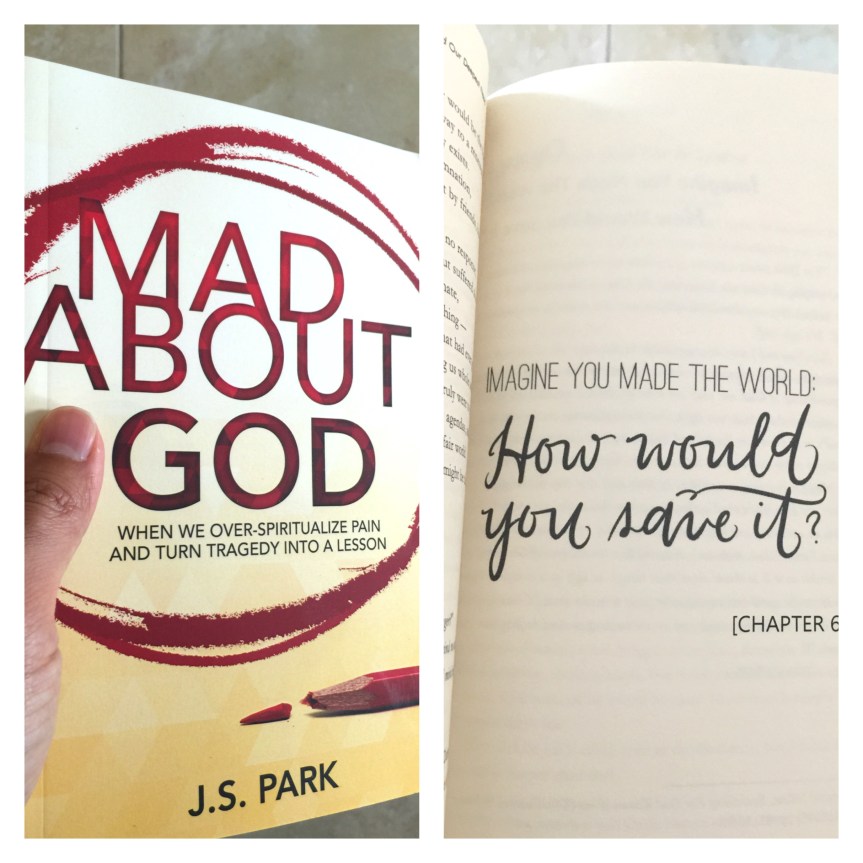
Mad About God Crae art


starlight— asked a question:

What is your book “Mad About God” about?


Hey dear friend, thank you so much for asking. The book is about persevering through suffering, without glossy pep-talks and spiritualizing our hurt. The main premise is that both the church and pop culture usually offer platitudes and feel-good-isms about pain, when the reality of heartache is extremely gritty and staggering. I don’t believe every pain has a lesson; I believe life will hurt, and it’s okay to say it stinks. I talk about various ways we’ve over-romanticized pain, including statements like “Everything happens for a reason” and “God is using cancer to teach you a lesson.” I try not to resolve the tension too easily; there are no simple answers for suffering.

It’s probably my most personal and favorite book I’ve written. I talk about surviving suicide, my battle with depression, my friend’s battle with a rare terminal illness, losing my friend to murder, my bed-ridden cousin, my married friends dealing with a disabled child, and a ton of other real stories. I also go over Jeremiah 29:11, David & Goliath, Job, struggling versus selfishness, and facing injustice in the world. Please know, the book requires a little patience at the start and it can be a tough read – but I think it pays off in the end.

It’s on sale right now for 8.99 in paperback, with art by craelligraphy. It’s 3.99 in ebook and works on every device. To read an excerpt, check here. To hear an audiobook preview of the opening chapters, check here. You can read the reviews on Amazon if you’d like other opinions as well.

Be blessed dear friend, and much love to you. – J.S.

http://www.amazon.com/Mad-About-God/dp/0692390472/


Preface for My Book on King David


My next book is on the Life of King David. He’s endlessly fascinating and his story is one of the most important stories ever told. Here’s the preface. I’m excited to release the book by the end of the summer!
– J.S.


Humble Growing Pains

Photo by fr4dd, CC BY 2.0

I have preached in front of three people.  I’ve led awkward Bible studies for two or three disinterested young students.  I have been close to canceling major events where I expected hundreds, but only a couple dozen showed up.  I’ve served in ministries that shrank and fought and panicked and split.

If you’re there right now: don’t get discouraged.

Sometimes God calls you to be faithful even when it’s not fruitful.

He is still doing something amazing.  But those breakthroughs only happen when we persist, persevere, and press forward.  We love to see instant miracles, but miracles can grow slowly too. 

We are tempted by a future where we have finally arrived to the big time — but maybe this is it, this moment, where you are called to be completely engaged and totally present, eye to eye, face to face, heart to heart, with your one or two young disciples.  To change even one life is the big time.

Continue reading “Humble Growing Pains”

The Planks In Our Eyes.


I’ve been learning over and over that unless someone is willing to see the unwieldy plank in their own eye, it’s absolutely impossible to help them out of their destructive patterns and self-deception.

You can yell and grieve and make a scene. You can spend hours in gentle counsel and eloquent exchange and loud weeping and tongue-biting patience. But unless that person wants to change, it’s not happening. No argument or mercy or fervency is enough. They’ll need to be pierced by their own convictions, or in the worst case, they must come to their own ruin and see the miles of hurt they’ve caused. Otherwise, you’re only reinforcing their pride and building their defenses and rationalizations.

Often the only thing we can do is to pray and humble ourselves. To look at our own plank first. To expect the best, even if the other person is taking no strides. To keep the door open. To keep serving. And maybe it’s not about the other person anyway. If they don’t change, you will.

— J.S.

Jaded and Worn Down, Waiting on God Again

Photo from Lucash

The other night, I was at a church service and I was really asking God to do something.

I’ve just been jaded. Really, really worn down. I’ve heard every kind of sermon there is, I know all the right theology, I’ve read every bestseller, I know all the songs and what they’ll say next. It’s a bad place to be. It feels like maybe, I’ve tapped out on faith and I would never have that fiery, from-the-gut connection that I used to. I’ve gotten out of it before, but maybe this time, I would have to learn how to settle. I guess it would be okay.

Continue reading “Jaded and Worn Down, Waiting on God Again”

The Jesus That I Need


Image from Beauty4ashes


The Jesus that I want would probably serve me and my own interests and align with my theological leanings and plans and dreams.

The Jesus that I need would serve the people that I forgot existed, who lived outside my best-laid plans and doctrinal camps, and he would just as quickly subvert my interests to care about others’ interests above my own.

The Jesus that I want would probably listen to my music, look like my race, match my Myers Briggs, and fight for my ideology.

The Jesus that I need would knock me over with exuberant music I never heard, enter my culture without condescending or conforming, would accept and challenge who I am, and transcend the very petty human idea of an ideology.

The Jesus that I want would probably die for people who liked me or were like me or were most likely.

The Jesus that I need died for the people who were nothing like him and he loved them, and even liked them, and he rose to find them. He even rose to find you and me: the least likely, because he’s the love we want, and need.

— J.S.


What Is Grace? How Does It Change Us? The Grace of God in Two Minutes


What is grace? How is it different than pampering or enabling or being “nice”? How does grace confront sin and change our lives?
Two and a half minutes on how grace pulverizes us into new people.

Subscribe to my channel here. Love y’all! — J.S.

[Thank you to Steven Hause of pudgyproductions]


The Highs and Lows of Faith: Getting Past the Spiritual Crash

Photo by Dave Apple

happymuffinsnapeface asked a question:

I’ve just experienced a spiritual “high” and now I’m feeling distant again, what can I do to get closer to him?

Hey dear friend, may I just say: This is just about the number one concern I receive from Christians all over the world, so you are absolutely not alone in this. I’m there, all the time, barely hanging on — much more than I’d like to admit.

As always, the Big Christian Secret is that everyone gets distant from God; we doubt He exists; we feel far from Him through no fault of our own. We can even do all the right things to return to Him, but they might not work for a long while. The best thing is to keep doing what you’re doing and to keep believing, even if it’s with a tiny shred of faith. Keep serving, singing, praying, reading your Bible, and hanging out with Christians, even (and especially) when you don’t feel like it.

I know that “going through the motions” is vilified in the church and considered total hypocrisy. I get that. But when a preacher is telling me, “Are you really truly sincerely worshiping from the bottom of your gut?” — I just feel worse. Guilt-trips don’t jump me back into on-fire faith. Sometimes “going through the motions” is exactly what I need to get me through this desert valley. If our default setting is sin, then even the weakest movement towards God is worthy of celebrating.  And maybe feeling God is a false parameter for our faith, because faith is often about how we stay despite wanting to leave.

Do I love my wife? Yes. Do I wonder if she loves me sometimes? Yes. Does it get tough? Yes. Do I stay her husband? Of course. Marriages are not on maximum volume all the time. The highs come with the lows; it’s a roller-coaster of doubts and frustration and boundless happiness. I don’t always “feel” romantic or gushy. But the bottom line is always there, that we are married by a promise of love, and my actions for her are not ultimately determined by how I feel. In fact, my actions for her are often the doorway to feel love and loved again.

Continue reading “The Highs and Lows of Faith: Getting Past the Spiritual Crash”